Angel Paintings: 12 Famous Works to Know
The most famous angel paintings run from the sweetest to the most terrifying. Two bored cherubs at the bottom of a Raphael became the most reproduced angels on earth, Caravaggio gave one a violin, and Rubens painted a whole army of them hurled screaming out of heaven. Here are twelve to know, and where to see them.
Angels are a gift and a trap for painters. They let an artist put wings, light and pure beauty into a picture, but they can tip into greeting card sweetness in a heartbeat. The twelve below range from a wounded child angel to the war in heaven itself.
Use this as a quick tour:
The messengers: Fra Angelico and Leonardo, angels bringing the news.
The warriors: Reni and Rubens, angels at war with the Devil.
The tender ones: Raphael, Bouguereau and Simberg, angels close to home.
Where to see them: a museum list at the end, grouped by city.
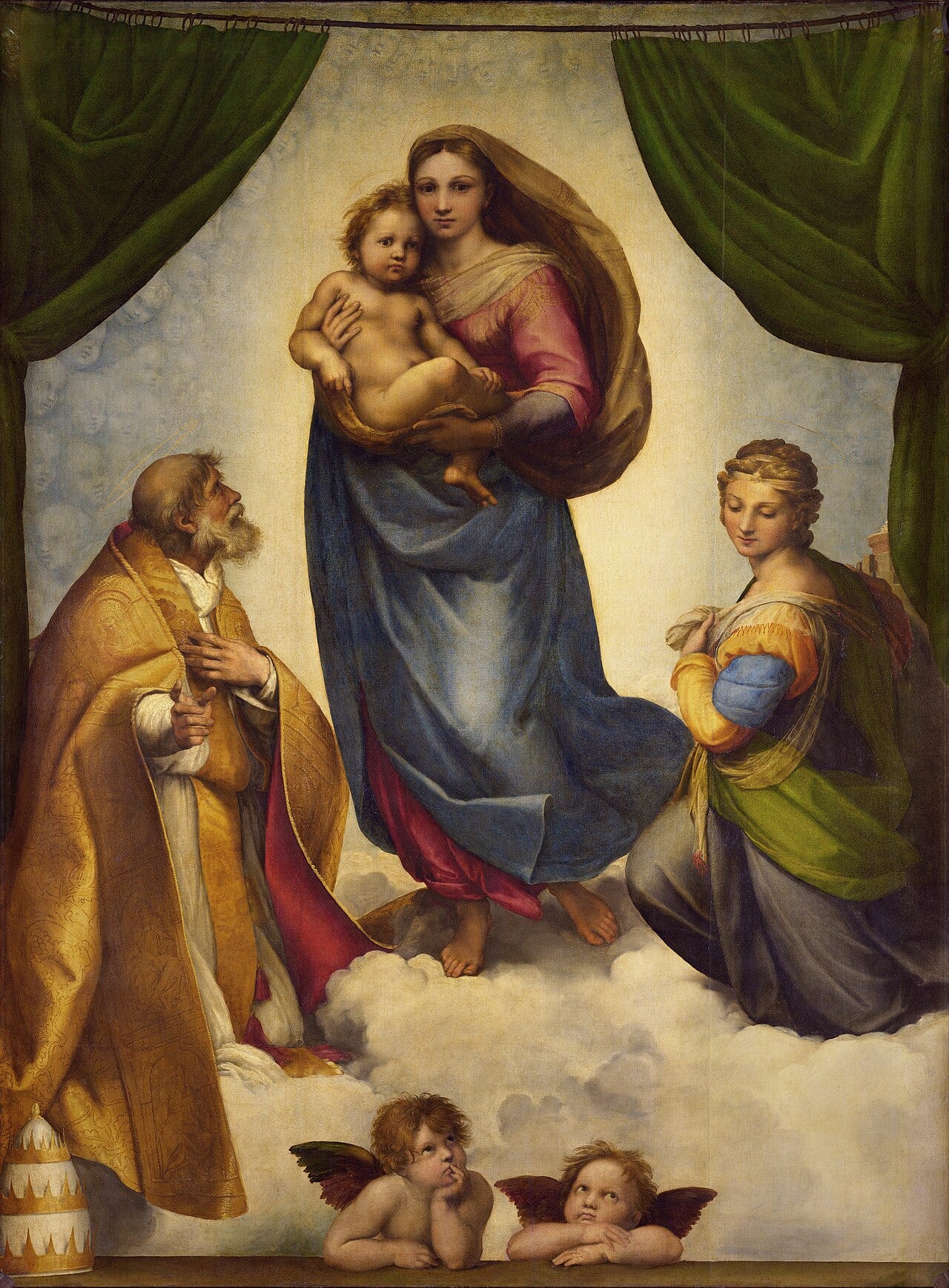
Raphael, The Cherubs of the Sistine Madonna
Raphael painted the Sistine Madonna around 1512, and at the very bottom two winged child angels lean on a ledge, gazing up with dreamy, half bored faces. These two cherubs have become the most famous angels in the world.
They were a small detail in a huge altarpiece, but in the 1800s people fell in love with the pair and copied them onto everything, from postcards to biscuit tins. Legend says Raphael based them on children watching him work.
The painting hangs at the Gemaldegalerie in Dresden. Almost nobody remembers the whole altarpiece, but everybody knows those two little angels.
Fra Angelico, The Annunciation
Fra Angelico, a Dominican friar, painted the Annunciation many times around 1435, the angel Gabriel bowing before the Virgin Mary in a delicate arched loggia, telling her she will bear Christ. He painted with prayer as much as with fresco.
Gabriel’s rainbow wings and gentle bow made this the model for the moment for centuries. Fra Angelico was so devout he was later beatified, the closest art has to a saintly painter.
Versions hang at the Prado in Madrid and the convent of San Marco in Florence. His angels feel less painted than glimpsed through a window into heaven.
Leonardo da Vinci, The Annunciation
Leonardo da Vinci painted his Annunciation around 1472, when he was barely twenty, a kneeling angel with carefully studied wings greeting the Virgin in a garden before a hazy blue landscape.
Leonardo based the angel’s wings on real birds, wanting them to look as if they could actually fly. His soft sfumato haze in the distance already shows the genius to come.
It hangs at the Uffizi in Florence. It is one of the earliest surviving works by Leonardo, an angel painted by a young man who would change art forever.
Caravaggio, Rest on the Flight into Egypt
Caravaggio painted Rest on the Flight into Egypt around 1597, and at its centre a curly haired angel with white wings plays the violin for the exhausted holy family. It is one of his tenderest works, lit with his early naturalism.
Joseph holds up the music for the angel, who stands with his back half turned, wings drooping. The music is a real, identifiable hymn, and the whole scene is calm and human.
It hangs at the Doria Pamphilj gallery in Rome. Caravaggio, usually so dark and violent, here painted an angel as pure gentle rest.
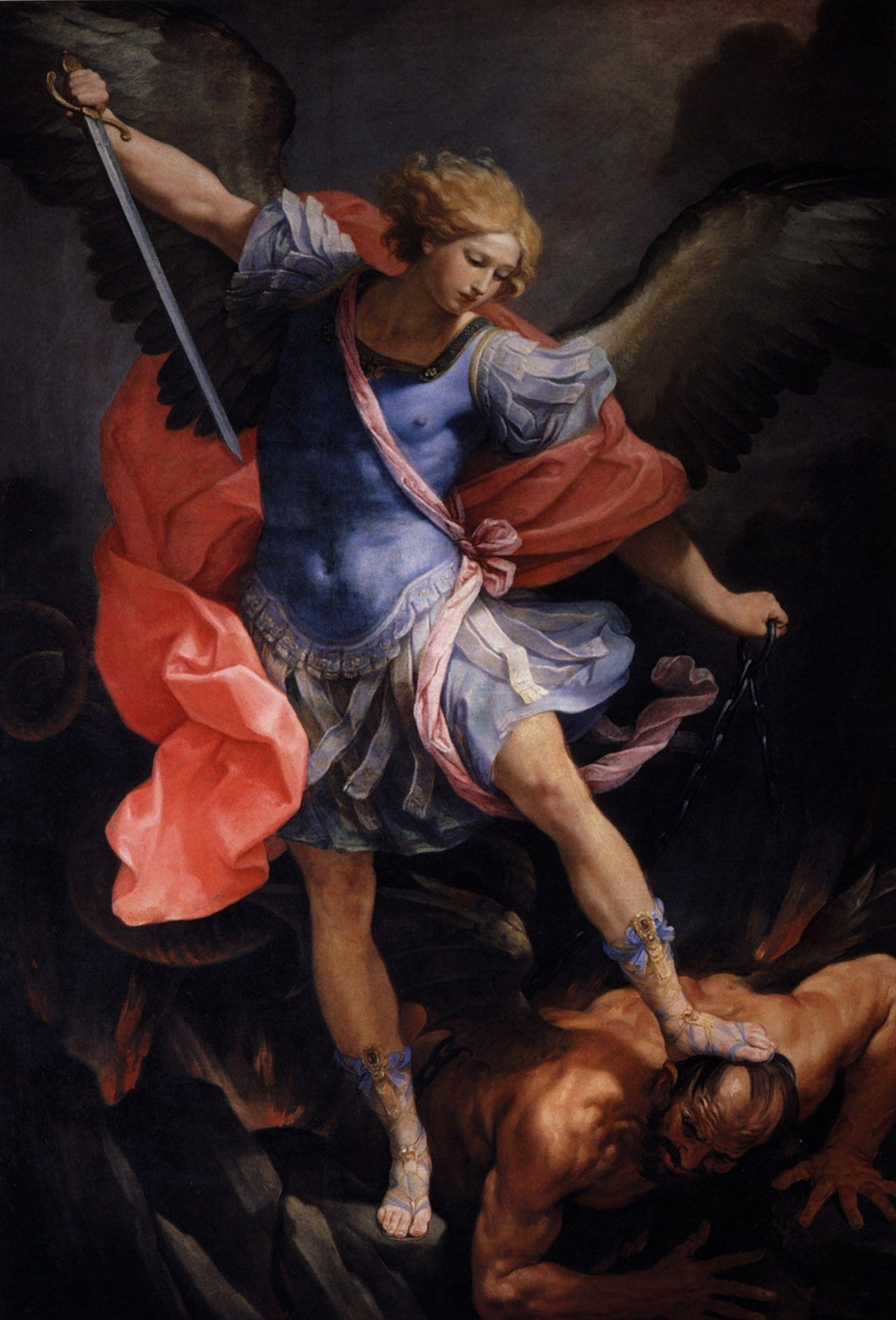
Guido Reni, Saint Michael the Archangel
Guido Reni painted Saint Michael the Archangel around 1636, a beautiful winged warrior in gleaming armour standing calmly over the defeated Devil, sword raised, foot on the monster’s head.
Reni made Michael impossibly serene, barely ruffled by the cosmic battle he has just won. The Devil beneath was rumoured to be a portrait of a cardinal the painter disliked.
It hangs in the church of Santa Maria della Concezione in Rome. It became the model for the beautiful, calm warrior angel copied ever since.
William Bouguereau, Song of the Angels
William Bouguereau painted Song of the Angels in 1881, three winged angels playing a lute and violins beside the sleeping Virgin and infant Christ in a quiet wood. It is soft, glowing and utterly sincere.
Bouguereau was the great academic star of his day, and this is angel painting at its sweetest and most polished. The moderns mocked him for exactly that, but the public adored it.
It hangs at the Getty in Los Angeles. Loved and derided in equal measure, it is one of the most reproduced religious images of the nineteenth century.
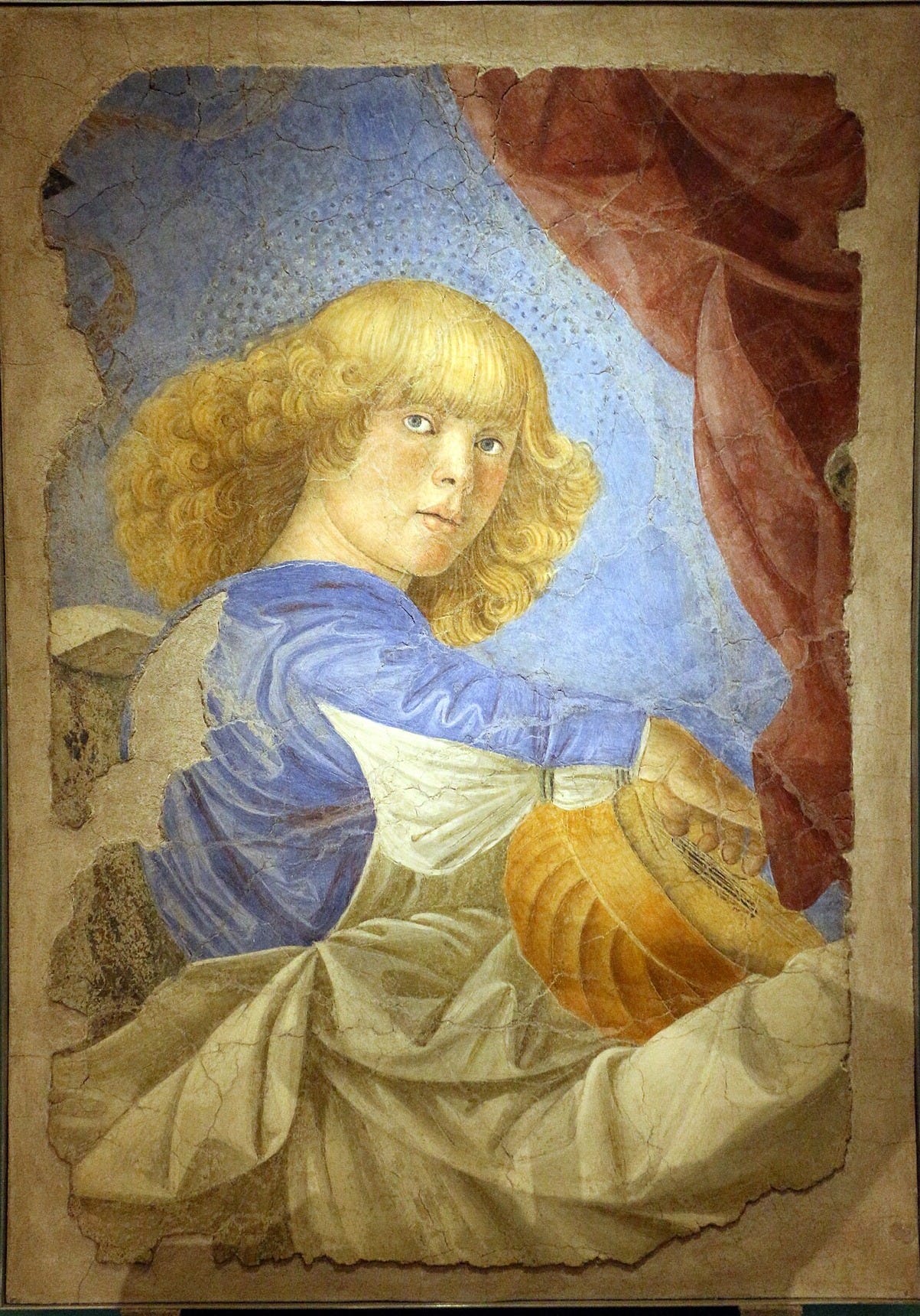
Melozzo da Forli, Music-Making Angel
Melozzo da Forli painted a series of music making angels around 1480 for a church dome in Rome, curly haired figures in rose and gold robes playing lutes and viols. They are among the most charming angels of the Renaissance.
When the old church was demolished, the frescoes were cut from the walls and saved. The single lute playing angel became so loved it now appears on cards, posters and stamps around the world.
The fragments hang in the Vatican Museums. Melozzo’s angels look like real young musicians, caught mid song.
Abbott Handerson Thayer, Angel
The American painter Abbott Handerson Thayer made Angel in 1887, a young girl with huge white feathered wings standing calmly, facing forward in soft light. He used his own daughter as the model.
Thayer painted these winged girls after the death of his first wife, and they read as images of innocence and consolation rather than religion. He was also a serious naturalist, so the wings are studied from real birds.
It hangs at the Smithsonian American Art Museum in Washington. His angel is less a heavenly being than a child made luminous by grief and love.
Rembrandt, The Angel Leaving Tobias
Rembrandt painted The Angel Leaving Tobias and his Family in 1637, the archangel Raphael rising suddenly into the air, his back to us, as the family kneels and shields their eyes below.
Rembrandt caught the exact instant the disguised angel reveals himself and departs, the family frozen between fear and wonder. We see mostly the soles of his feet and the rush of his wings.
It hangs at the Louvre in Paris. Rembrandt made a heavenly departure feel like a real, startling event in an ordinary room.
Peter Paul Rubens, The Fall of the Rebel Angels
Peter Paul Rubens painted The Fall of the Rebel Angels around 1620, a churning avalanche of muscular rebel angels hurled screaming out of heaven into the dark, driven down by Michael above. It is high Baroque at full force.
This is the terrifying side of angels. The rebels tumble and twist, their beauty warping into monstrous shapes as they fall, a whole war in heaven packed into one heaving mass of bodies.
It hangs at the Alte Pinakothek in Munich. Rubens shows that an angel could be as frightening as any demon, once it turned against God.
Gustave Dore, Paradise Lost
Gustave Dore illustrated John Milton’s Paradise Lost in 1866, filling it with radiant winged angels soaring in ranks through vast glowing heavens of light and cloud, and rebel angels plunging into the dark.
Dore was the most popular illustrator of his age, and his dramatic black and white angels shaped how millions pictured heaven and hell. His images fed straight into later book and film design.
His engravings are held in collections and countless editions worldwide. For generations, Dore’s soaring hosts were what an angel was supposed to look like.
Hugo Simberg, The Wounded Angel
The Finnish painter Hugo Simberg made The Wounded Angel in 1903, two solemn boys carrying a small angel on a stretcher through a bleak grey landscape. The angel is bandaged over the eyes and clutches a few snowdrops.
Simberg refused to explain it, and it has haunted viewers ever since. The angel is hurt and earthbound, carried by ordinary children, faith itself wounded and in need of help.
It hangs at the Ateneum in Helsinki, where Finns voted it their national painting. It is the strangest and most moving angel on this list, heaven brought low and needing rescue.
Questions people ask about angel paintings
What are the two famous cherubs at the bottom of a painting? They are from Raphael Sistine Madonna of around 1512. The two dreamy winged children became the most reproduced angels in the world.
Why do angels play instruments in paintings? Music making angels stood for the harmony of heaven. Caravaggio, Melozzo and Bouguereau all gave their angels lutes and violins.
What are the rebel angels? Angels who turned against God and were cast out of heaven. Rubens painted them tumbling and twisting into the dark in his Fall of the Rebel Angels.
Who painted the wounded angel? The Finnish artist Hugo Simberg, in 1903. His bandaged angel carried by two boys was voted Finland’s national painting.
Did Leonardo really base angel wings on birds? Yes. Leonardo studied real birds so his angel wings would look as if they could truly fly, part of his lifelong obsession with flight.
Where to see them
Gemaldegalerie, Dresden: Raphael Sistine Madonna, with its famous cherubs.
Uffizi, Florence: Leonardo The Annunciation.
Doria Pamphilj, Rome: Caravaggio Rest on the Flight into Egypt.
Alte Pinakothek, Munich: Rubens The Fall of the Rebel Angels.
Ateneum, Helsinki: Simberg The Wounded Angel.
Keep exploring
If the angels pulled you in, three more paths from here. Weigh up the painter of those famous cherubs in is Raphael the greatest of all, learn to read the hidden clues in famous canvases in seven secrets hidden in famous paintings, or start with the basics of iconography.
One last thing. An angel is the easiest thing in art to make sweet, and the hardest to make real. The greatest painters found the whole range in those wings, comfort, terror, music and grief. These twelve run from the nursery to the war in heaven.