Famous Art Nouveau Art: 12 Works That Defined It

Art Nouveau was the last great decorative style before the modern world, a wild burst of curling lines, flowers and dreaming women that swept across Europe around 1900.

Gustav Klimt, The Kiss, 1908

It ran from grand paintings to metro railings, but its purest images are the posters and canvases that turned everyday life into pattern. Here are twelve of the most famous Art Nouveau artworks, all now in the public domain.

I have gathered the ones that made the whole style, all whiplash curves and golden women, impossible to forget.


Learn art the fun way. Free stories every week, no boring lectures.


If you liked this one

If this is the kind of art history you want more of:


1. Gustav Klimt, The Kiss (1908)

Two lovers kneel at the edge of a golden cliff, wrapped in a single robe of gold and pattern, in the most famous embrace ever painted.

Klimt covered the canvas in real gold leaf, learned from the mosaics he had seen in Ravenna, until the couple almost dissolve into ornament.

The man's robe is all hard black and white rectangles, the woman's all soft colored circles, the two patterns locking together like the lovers themselves.

Nobody knows who the models were, though many guess Klimt and his lifelong companion Emilie Floge. Vienna bought it straight off the easel in 1908, and it has never left the country since.

I decode more hidden gold in seven secrets of famous paintings.

2. Alphonse Mucha, Gismonda (1894)

Alphonse Mucha, Gismonda, 1894

On New Year's Eve 1894 a Paris print shop needed a poster for the actress Sarah Bernhardt by morning, and only an unknown Czech was left in the office.

Mucha stayed up all night and produced a tall, narrow poster of Bernhardt as a Byzantine princess, crowned with orchids, calm as a saint. Paris had never seen anything like it, and by dawn the style that would carry his name was born.

Bernhardt was so pleased she signed him to a six year contract. Collectors began bribing bill stickers to peel the posters off the walls before the paste had dried.

3. Aubrey Beardsley, The Peacock Skirt (1893)

Aubrey Beardsley, The Peacock Skirt, 1893

Beardsley was only twenty when he drew this, a cruel and elegant black and white illustration for Oscar Wilde's banned play Salome. A woman in a vast trailing gown of peacock feathers looms over a shrinking man, all cold line and empty space.

He worked only in ink, borrowing the flat shapes and open gaps of Japanese prints, and left more of the page blank than filled. Wilde said the drawings were too much for his words.

Beardsley was dead of tuberculosis at twenty five, and his publisher had already censored several of the Salome drawings for indecency.

4. Henri de Toulouse Lautrec, Moulin Rouge La Goulue (1891)

Henri de Toulouse Lautrec, Moulin Rouge La Goulue, 1891

When Toulouse Lautrec plastered Paris with this poster in 1891, the Moulin Rouge dance hall became the most famous night spot in the world overnight.

The dancer La Goulue kicks up her petticoats in the glare, a row of black cutout spectators behind her, her partner a ghostly shape in the front.

Lautrec flattened everything into flat blocks of color and hard outline, learned from Japanese prints and cheap print shop tricks.

He signed it with the dance hall's name in tall letters, an advertisement that was also real art. Three thousand copies went up around the city, and people tore them down to keep.


Join 130,000 readers who get the secrets behind the paintings. Free.


5. Alphonse Mucha, The Seasons (1896)

Alphonse Mucha, The Seasons (Winter panel), 1896

Two years after Gismonda, Mucha turned the lithograph poster into pure decoration with a set of four panels, one woman for each season of the year.

Spring wears blossom in her hair, summer lounges by cool water, autumn gathers grapes, winter shelters a small bird from the snow.

They sold to hang on a wall rather than to advertise anything, some of the first art made for the ordinary home. Mucha drew each figure inside a soft circle of flowers and vines, a formula copied a million times since.

He came to hate being famous for pretty women, and spent his last twenty years on a giant cycle about the history of the Slavs.

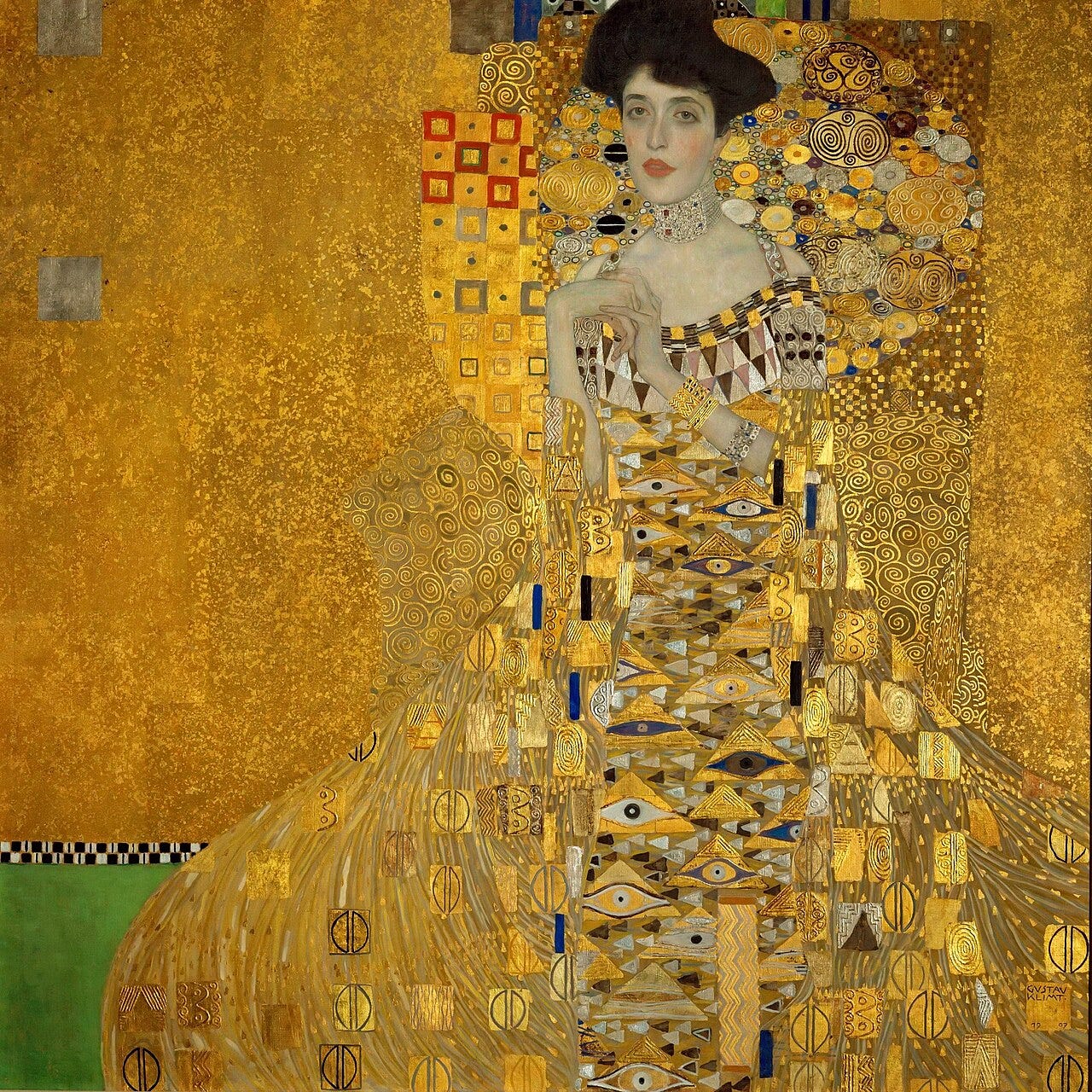
6. Gustav Klimt, Portrait of Adele Bloch Bauer I (1907)

Gustav Klimt, Portrait of Adele Bloch Bauer I, 1907

A Vienna society hostess sits swallowed in a storm of gold, her pale face and hands the only human things in a shower of spirals, eyes and Egyptian patterns.

Klimt spent three years and a fortune in gold leaf on the portrait of Adele Bloch Bauer, the only woman he painted twice. The Nazis seized it from her Jewish family, and it hung for decades in a Vienna museum simply as the Woman in Gold.

After a long court fight her niece won it back in 2006, and it sold that year for 135 million dollars, at the time the most anyone had ever paid for a painting.


130,000 people read this every week. Joining them costs nothing.


7. Jan Toorop, Delftsche Slaolie (1894)

Jan Toorop, Delftsche Slaolie, 1894

An advertisement for salad oil became one of the strangest posters of the age, so odd that a whole national style was nicknamed after it.

Toorop drew two women in flowing gowns among lines of hair and plant that curl like smoke, selling bottled oil as if it were a Symbolist vision.

The Dutch called the twisting manner the salad oil style for years afterward. Toorop had grown up in Java, and the shadow puppets and batik of the East Indies run all through his curling line.

The salad oil style name stuck in Dutch art writing for decades, long after the brand itself was forgotten.

8. Theophile Steinlen, Tournee du Chat Noir (1896)

Theophile Steinlen, Tournee du Chat Noir, 1896

A single black cat sits stiff and staring on a poster for a Montmartre cabaret, and it became the most reproduced image in the history of Paris nightlife.

Steinlen made it to advertise a touring show from the Chat Noir, the rowdy cabaret where artists and poets drank and performed. The cat is flat, gold rimmed and slightly sinister, halfway between a shop sign and an Egyptian god.

Steinlen loved cats and filled his Montmartre studio with dozens of them. That one poster still sells more prints today than almost any other image of old Paris.

9. Privat Livemont, Absinthe Robette (1896)

Privat Livemont, Absinthe Robette, 1896

Belgium had its own Mucha in Privat Livemont, and his most famous poster made a glass of absinthe look like a sacrament. A woman in a long pale gown lifts the green drink as if offering communion, wreathed in swirling steam and light.

The drink it sold was the notorious green fairy, blamed for madness and banned across Europe within twenty years. He built the whole image from thin gold outlines, a trick borrowed from stained glass.

The poster outlived the drink by a century, still hanging on student walls long after absinthe was outlawed.

10. Koloman Moser, Frommes Kalender (1899)

Koloman Moser, Frommes Kalender, 1899

Vienna's Art Nouveau had its own harder, more geometric edge, and Koloman Moser was its quiet engine. This calendar poster shows three women with streaming hair merging into a single flat pattern of curves, printed for a Vienna publisher in 1899.

Moser helped found the Vienna Secession with Klimt, then built furniture, stained glass, stamps and whole rooms in the same clean style.

He believed everyday objects deserved as much care as any painting, the creed of the Vienna workshop he helped launch.

Within a few years his straight lines and squares would push Art Nouveau toward the modern design that replaced it.


Two new stories a week, 130+ secrets unlocked. Start free.


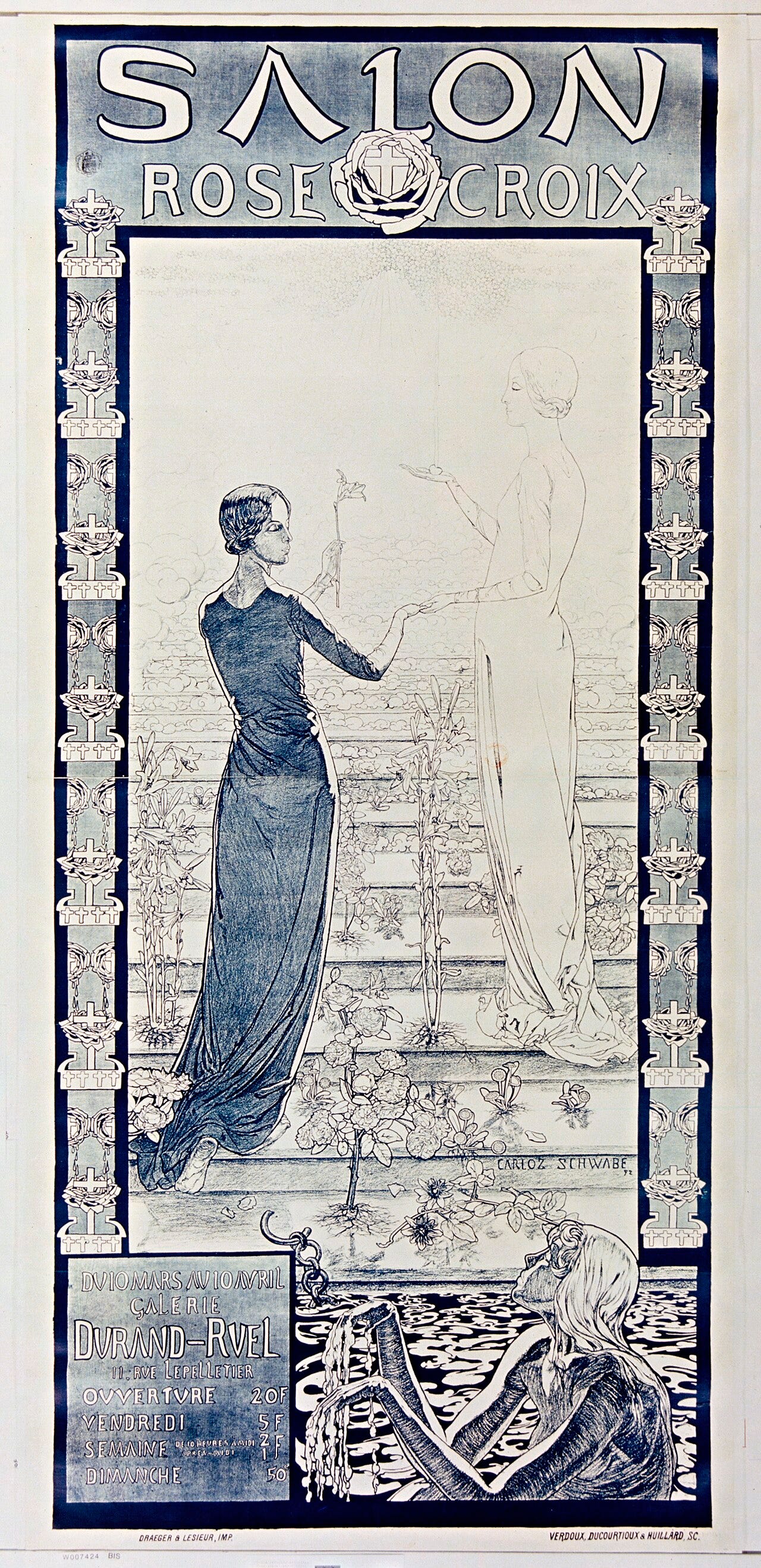
11. Carlos Schwabe, Salon de la Rose et Croix (1892)

Carlos Schwabe, Salon de la Rose et Croix, 1892

Not every Art Nouveau image sold soap; this one advertised a secret society devoted to mystical art. Schwabe drew three women climbing a stair out of a swamp of filth toward a shining light, souls escaping the material world.

It was the poster for the first Rosicrucian art salon in Paris, a strange fusion of Symbolism and the occult. Every lily, chain and ray of light carries a coded meaning.

The salons lasted just six years, from 1892 to 1897, before their founder lost interest and closed them, but their dreamy look had already fed straight into the wider Art Nouveau.

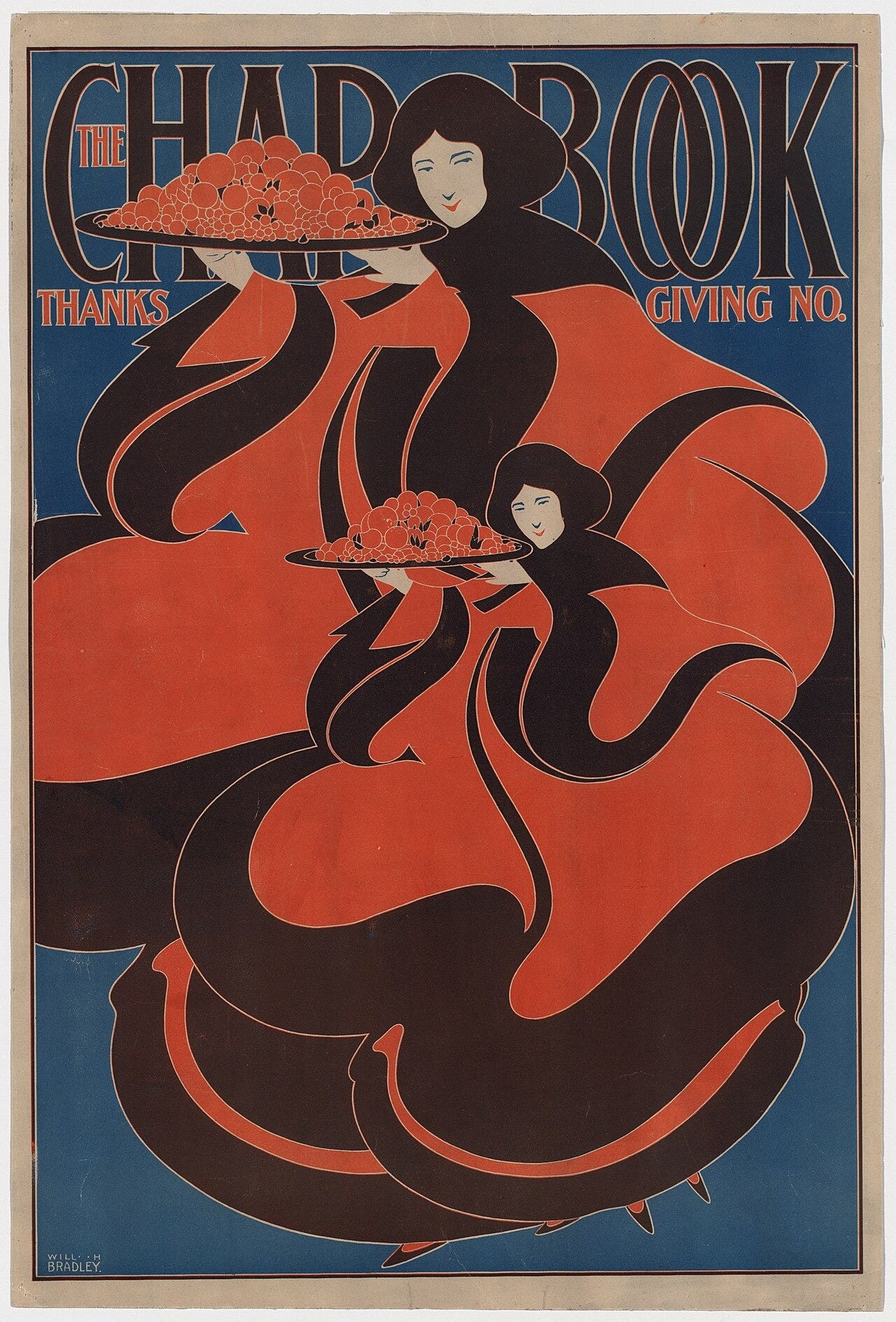
12. Will Bradley, The Chap Book (1895)

Will Bradley, The Chap Book, 1895

Art Nouveau crossed the Atlantic, and its American champion was a self taught printer from Boston named Will Bradley. His posters for a little magazine called The Chap Book turned Beardsley's black and white line into something brighter and more playful.

Two women in flat patterned dresses gossip among giant flowers, all curve and silhouette. Bradley was so tied to the style that critics called him the American Beardsley, a name he never shook.

He went on to design magazines and even founded his own film company, carrying the curling line deep into the new century.


Art Nouveau, quick questions

  • What is Art Nouveau? A decorative style from about 1890 to 1910, known for curling lines, flowers and idealized women, that ran across art, design and architecture.

  • Who is the most famous Art Nouveau artist? Alphonse Mucha for posters and Gustav Klimt for painting are the two biggest names.

  • What does Art Nouveau mean? French for new art, taken from the name of a Paris shop that sold the style.

  • How is it different from Art Deco? Art Nouveau curves and flows with nature; Art Deco, which came later, is sharp, geometric and machine age.

  • Why did Art Nouveau end? It was swept away around the First World War by cleaner, straighter modern design.


If these curling images pulled you in, you will love these too:


The curl that conquered the world

Art Nouveau burned bright for barely twenty years, then the war and the machine age swept its flowers away as fussy and old fashioned. For a while it survived only on dusty theatre posters and grandmothers' jewelry.

Yet the curling line never really died. It came roaring back in the psychedelic posters of the 1960s, and today Mucha's calm women and Klimt's gold sell more prints than ever.

Few dead styles have proved so hard to kill.