
Four hundred years after Artemisia Gentileschi worked in Rome, Florence, Venice, Naples and London, her catalogue is still growing. Pictures long credited to her father or to nameless painters keep coming back to her, and one was identified only after an explosion had torn it open. Each of them also tells where she was living, and for whom she painted.
Cool Stories About Art is a newsletter to learn art the fun way.
Join 200,000+ readers and get:
10 new art stories / month
The entire archive of content (140+ articles)
Comment, ask questions, and chat with other readers
Heroines, Patrons and Cities
Artemisia Gentileschi learned to paint in her father's studio in Rome. From there she followed the commissions: to Florence and its grand duke, back to Rome, then to Venice, to Naples under a Spanish viceroy and, for two years, to the court in London.
Her favorite subjects were women from the Bible and from ancient history, and she returned to several of them, sometimes decades apart. Her work now hangs in Florence, Naples, London, Madrid and Budapest, and in several American museums.
They climb toward her best-known canvas, and together they cover her whole working life, from a canvas she dated at seventeen to the crowded compositions of her Naples years. Several were found, or given back to her, only recently.
12. Hercules and Omphale (about 1635 to 1637)
Hercules is holding a spindle, the stick that women used to spin wool. Beside him, Queen Omphale wears his lion skin and carries his club, and a small Cupid watches from the floor at his feet. In 2020 an explosion tore through Hercules and Omphale, a canvas some 2.5 meters across, and only then did most people learn who had painted it.
The subject is Greek. To atone for killing a man named Iphitos, Hercules was sold as a slave to Omphale, queen of Lydia, and set to do women's work. Artemisia painted it in Naples, where she had settled in 1630. She was in her early forties, and large canvases crowded with figures had become her ambition.
For decades the picture hung in the Sursock Palace, a nineteenth-century house in Beirut, in front of a window. On August 4, 2020, a double explosion in the city's port killed more than 200 people and wrecked part of the palace roof. The blast drove the window through the canvas, which was left riddled with holes, with a wide L-shaped tear across the hero's knee.
That damage is what brought her name back. A few months later, the Lebanese art historian Gregory Buchakjian published in Apollo Magazine the attribution he had been researching since the early 1990s. The canvas matches the measurements of one recorded in a Naples collection in 1699, and specialists accepted it, which raised her known paintings to about sixty.
In 2022 the canvas traveled to the Getty Museum in Los Angeles, where the conservator Ulrich Birkmaier spent three years on it and called it some of the worst damage he had ever seen. He had even gathered the debris from behind the canvas to recover flakes of her paint.
His X-rays showed something more. Under the hero's face lies a first head, which Artemisia painted and then replaced. Some scars will always show, Birkmaier has said, but the blast also gave a glimpse of a painter at work in Naples, changing her mind about Hercules.
At a Glance
Artist: Artemisia Gentileschi (1593 to 1654 or later)
Painted: About 1635 to 1637
Medium: Oil on canvas
Size: 200 × 250 cm (78.7 × 98.4 in)
Where to see it: Sursock Palace Collections, Beirut (on long-term loan to the J. Paul Getty Museum, Los Angeles)
11. Danaë (about 1612)
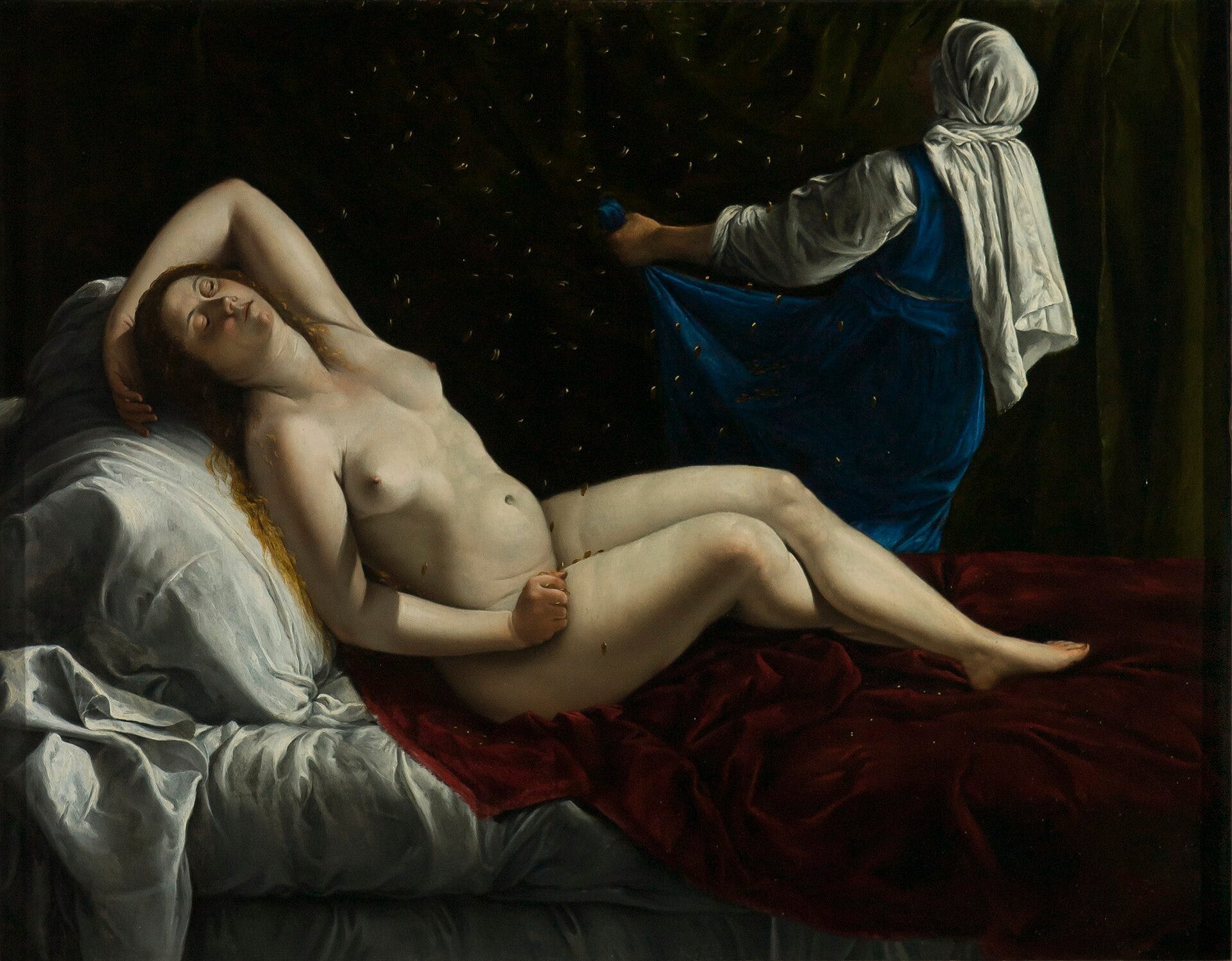
Gold coins are falling onto the bare skin of a young woman lying on a bed, and behind her a maid catches them in her skirt. Danaë is a small painting on copper, and when Sotheby's offered it in Monte Carlo in 1986, the catalogue gave it to the wrong Gentileschi.