
Painters of the seventeenth century worked for a Church that wanted images to move people at once, and for patrons who wanted to be seen. The pictures they left carry stories to match, from a death sentence handed down in Rome to a meat chopper smuggled into a London gallery.
Cool Stories About Art is a newsletter to learn art the fun way.
Join 200,000+ readers and get:
10 new art stories / month
The entire archive of content (1,000+ articles)
Comment, ask questions, and chat with other readers
How These Were Chosen
Baroque is the name given to European art of the seventeenth century, and it grew out of a quarrel over images. In 1563, at the Council of Trent, the Catholic Church ruled that paintings must stir the faithful. In 1566, Protestants in the Low Countries smashed altarpieces.
Painters in Rome answered with theater: hard light against deep shadow, bodies pushed to the edge of the frame, a story caught at the second it turns. In the Protestant north, the same drama moved indoors, onto smaller canvases made for homes.
Drama was the rule for this list. Some paintings freeze one precise second of a story, others carry a true story of violence or scandal, and a few keep the event offstage. Most stop just before the climax or just after it.
13. Nicolas Poussin, Et in Arcadia Ego (about 1637 to 1638)
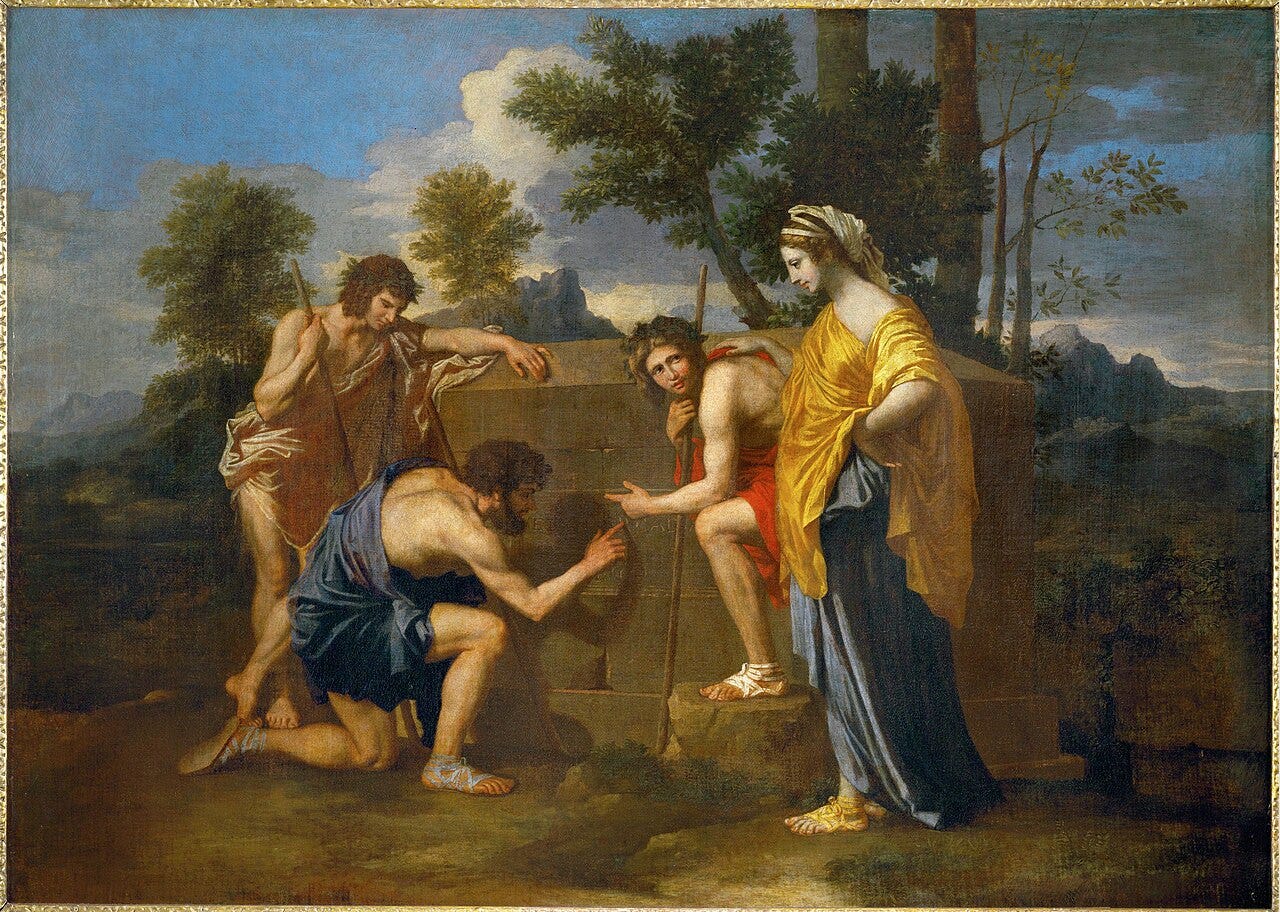
With one finger, a kneeling shepherd traces four Latin words carved on a stone tomb in Et in Arcadia Ego, ET IN ARCADIA EGO, while two companions and a woman lean in to follow. Nicolas Poussin, a Frenchman who spent most of his working life in Rome, made the canvas there around 1637 to 1638.
The tomb is out of place. Arcadia was the shepherds' paradise of ancient pastoral poetry, and this block of stone is the one thing in Poussin's landscape that does not belong there. Yet the picture shows no body and no mourner. It does not even show a skull.
That missing skull matters, because the inscription had already appeared in painting with one. Around 1618 to 1622, Guercino, a painter from Cento near Bologna, showed two shepherds staring at a skull set on a stone block that carries the same words, with a mouse and a blowfly beside it. His message was blunt. Death is speaking, and Death lives in Arcadia too.
Poussin followed that model at first. In an earlier version of his own, now at Chatsworth House in England, a skull still sits on top of the tomb. For the Louvre canvas he took it away and kept only the stone and the four words.
That single removal changed how the words were heard, as the German art historian Erwin Panofsky showed in a famous essay. Read correctly, the Latin means "Even in Arcady there am I," and the speaker is Death. Many later readers heard instead the voice of a dead shepherd saying that he too had once lived in Arcadia, and Panofsky argued that the Louvre picture itself leads toward that second reading.
So Poussin never touched the inscription. By changing what surrounds it, he let his shepherds meet a dead man rather than Death, and the threat of Guercino's picture turned into a quiet grief, held in a finger resting on the letters as if they had to be touched to be made out.
At a Glance
Artist: Nicolas Poussin (1594 to 1665)
Painted: About 1637 to 1638
Medium: Oil on canvas
Size: 85 × 121 cm (33 1/2 × 47 5/8 in)
Where to see it: Musée du Louvre, Paris, Richelieu wing, room 825
12. Guido Reni, Aurora (1614)
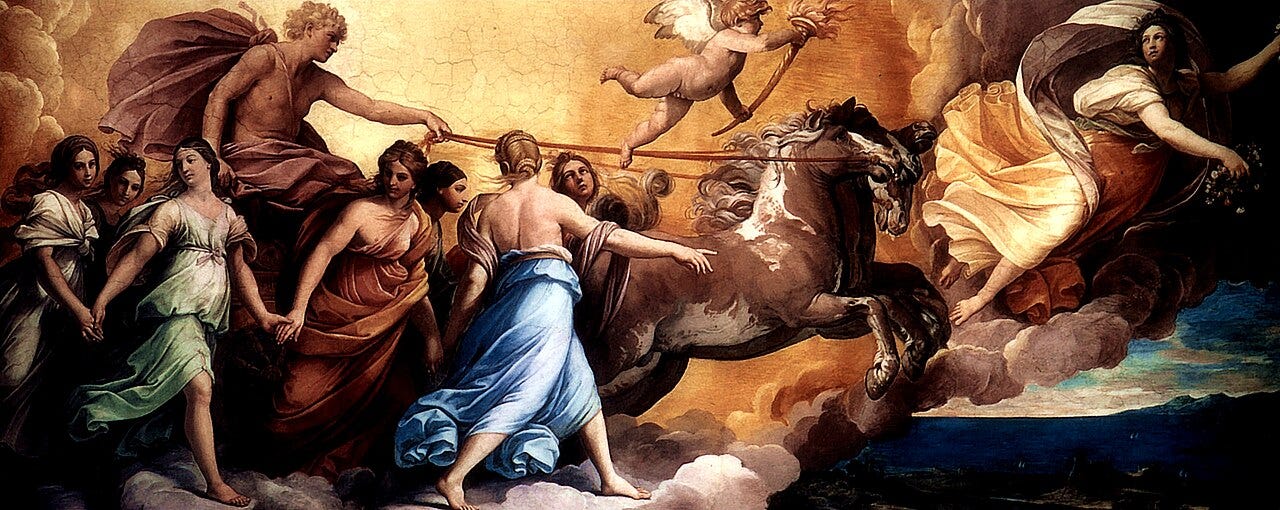
On a ceiling in Rome, a woman flies ahead of a chariot and scatters flowers in its path. She is Aurora, the goddess of dawn, and behind her Apollo drives the chariot of the sun, ringed by dancing young women, the Hours.
Guido Reni painted the fresco in 1614 in a garden pavilion on the Quirinal Hill. He chose neither the theme nor the model for those dancing women. Both came from the man paying for the ceiling, and the model he handed over was not a painting.