
The most famous battle paintings were mostly made by men who never saw combat. Uccello painted a battle as a geometry lesson, David turned a mule ride into a charge, and Goya painted the one that refuses to be heroic at all. Twelve battles and what each one is really arguing, a pattern America's own famous Civil War paintings mostly break, since their painters had actually been there.
Learn art the fun way
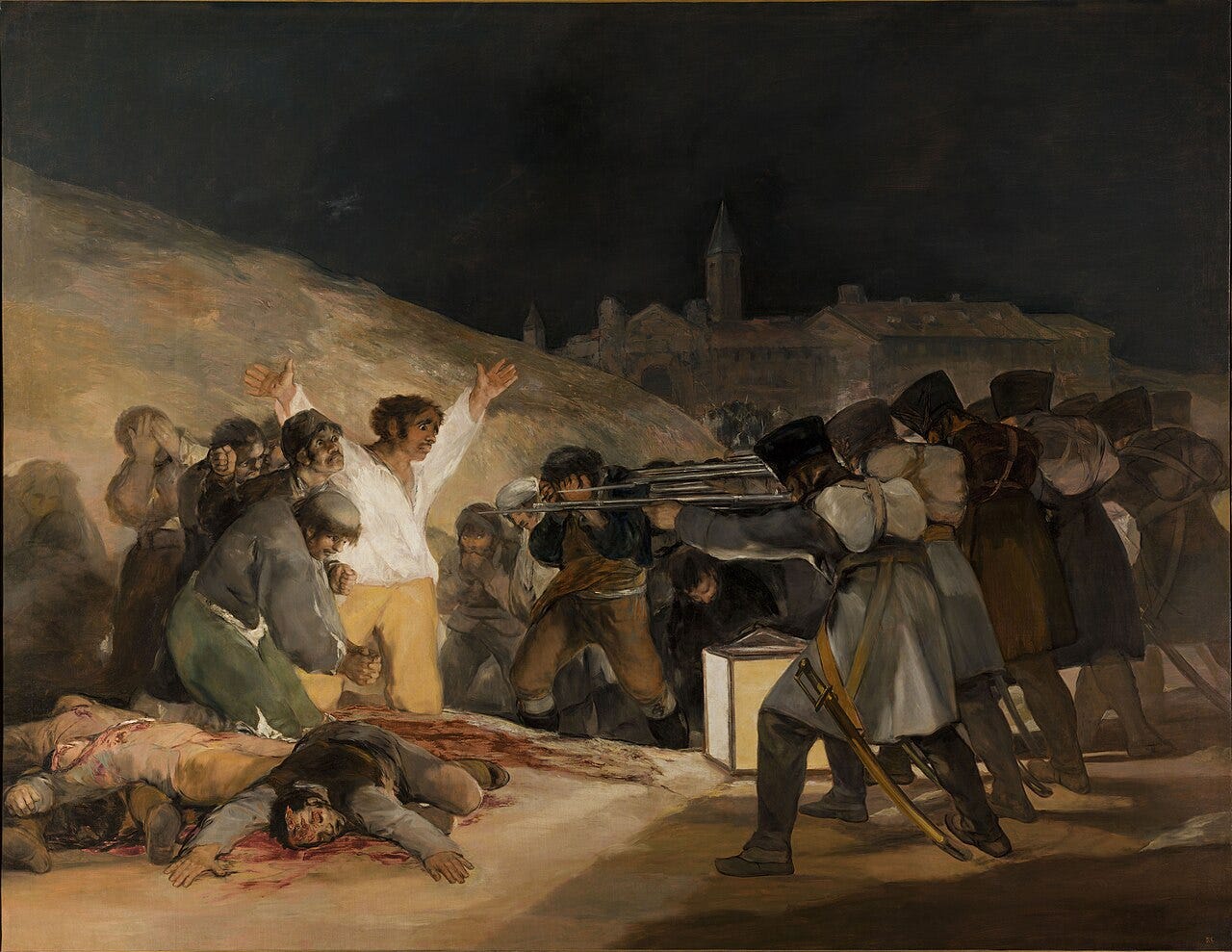
1 | The Third of May 1808, Francisco Goya (1814)
A man in a white shirt throws his arms wide before a firing squad whose faces we never see. A lantern on the ground does all the lighting.
Goya invented modern war painting here: the victim at the center, the killers anonymous. I go into his whole story in Francisco Goya.
2 | The Battle of San Romano, Paolo Uccello (about 1440)
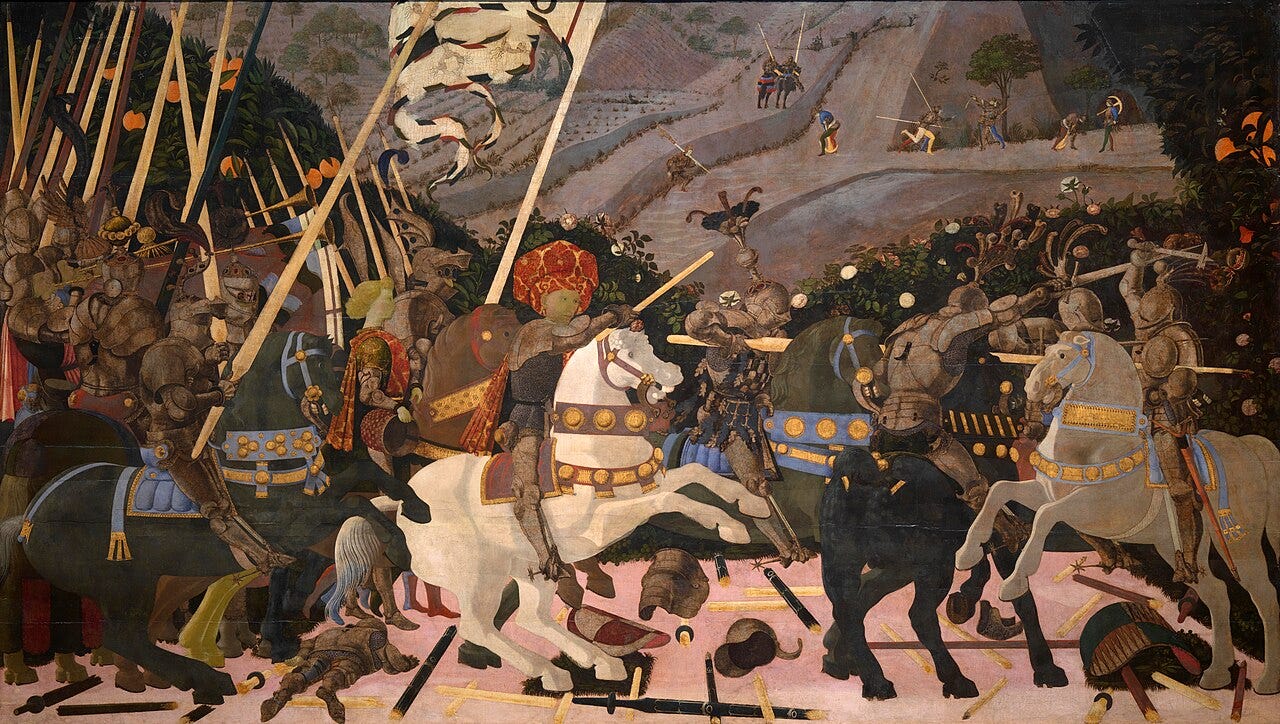
Broken lances lie on the ground in a perfect perspective grid, and a fallen soldier is foreshortened like a textbook exercise. The battle is an excuse.
The three panels are now split between London, Florence and Paris. More on him in Paolo Uccello.
The three panels were painted around 1438 to 1440 for the Bartolini Salimbeni family and later seized by Lorenzo de Medici for the Palazzo Medici. They are now split between London, Florence and Paris.
3 | The Battle of Anghiari, Leonardo da Vinci (1505, lost)
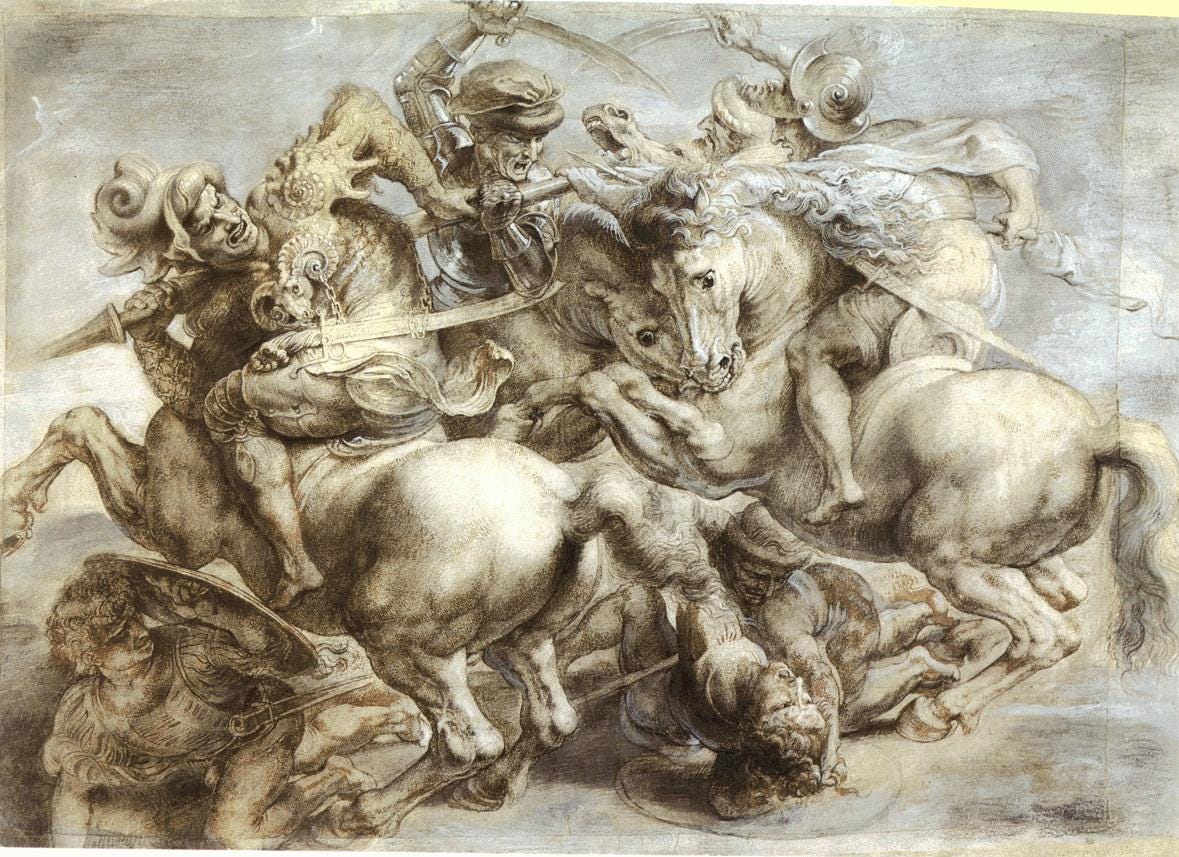
Leonardo painted a knot of horsemen fighting for a standard, then watched his experimental wall technique run down the surface.
It survives only in copies, including one by Rubens. The whole feud around it is in Leonardo vs Michelangelo.
Leonardo began the mural in 1505 and abandoned it when the wax based medium ran. What survives is copies, the best being a drawing by Rubens made about a century later from an earlier copy.
4 | The Surrender of Breda, Diego Velazquez (1635)
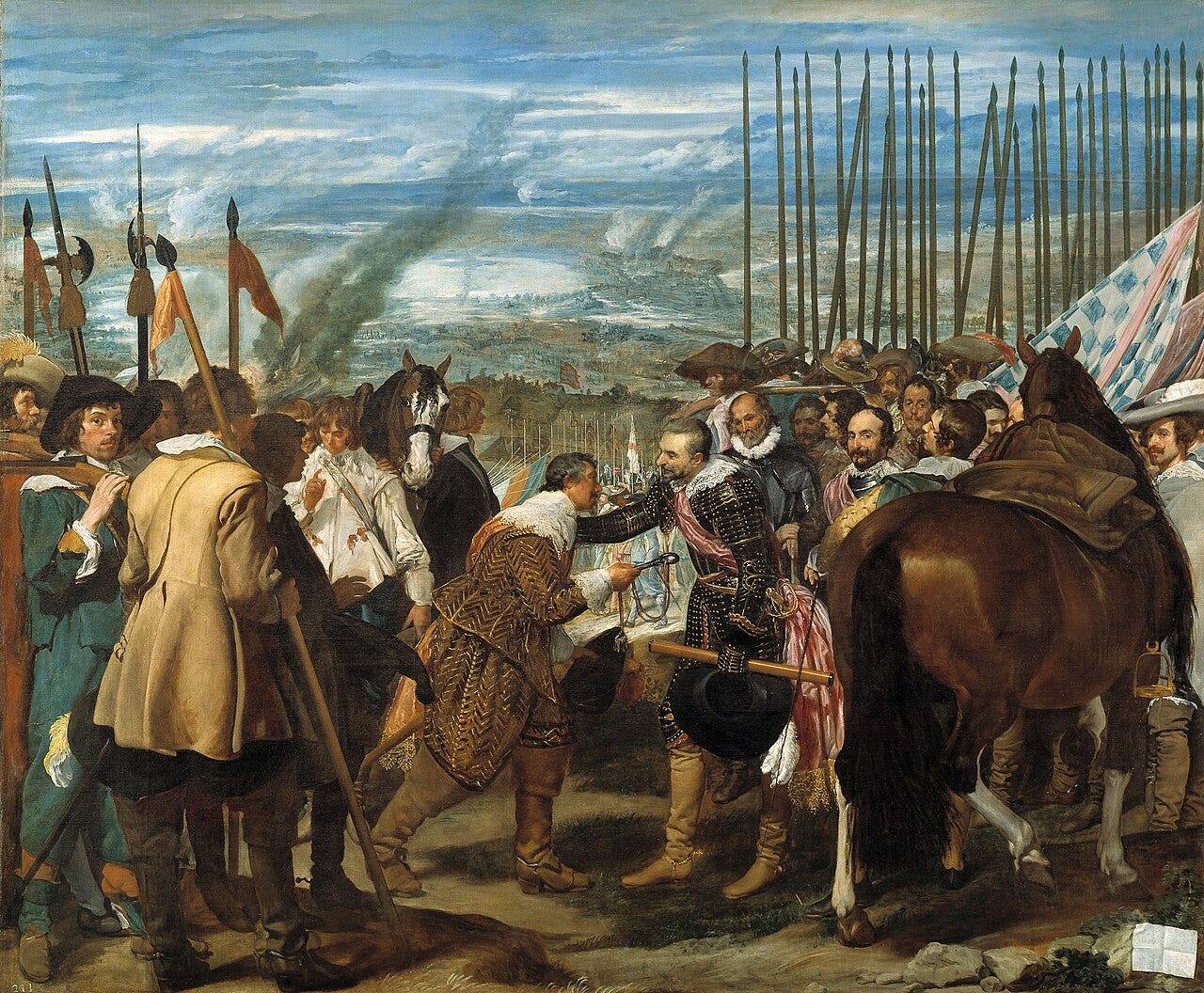
The Dutch commander hands over a key and the Spanish general stops him from kneeling, a hand on his shoulder. Behind them, a forest of lances.
A painting about how to win without humiliating. The rest of his life is in Diego Velazquez.
Velazquez painted it around 1635 for the Hall of Realms, and the courtesy of the gesture is the point: the Dutch commander is not made to kneel. Spain lost Breda again eleven years later.
5 | The mule that became a warhorse, Jacques Louis David (1801)
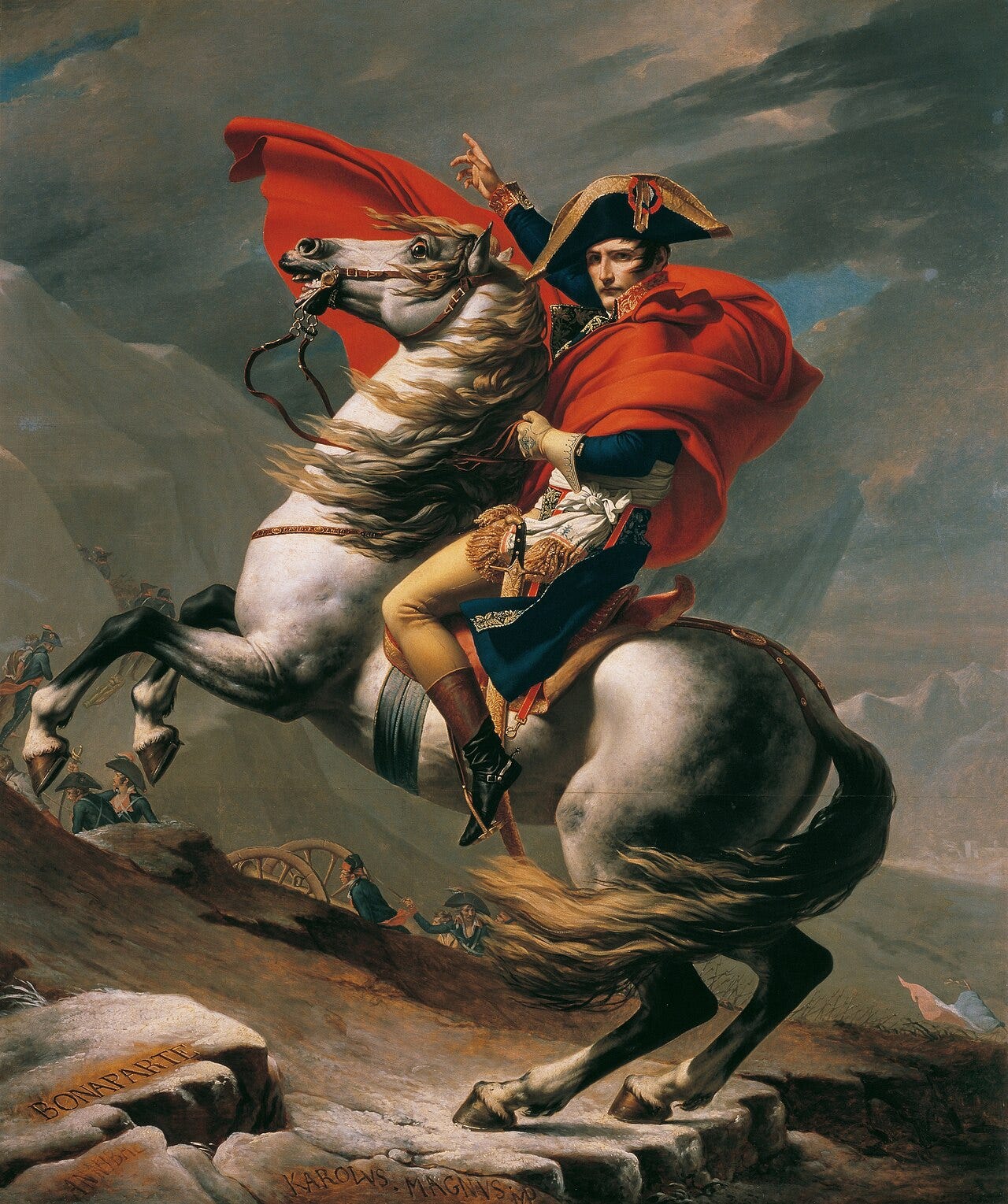
The rearing horse and pointing arm are pure invention: Napoleon crossed on a mule, in good weather, behind a guide.
He ordered the lie himself. More royal staging is in famous paintings of kings and queens.
David painted five versions of Napoleon Crossing the Alps between 1801 and 1805. Napoleon actually made the crossing on a mule led by a guide, and asked to be shown calm on a fiery horse.
6 | The Battle of Alexander at Issus, Albrecht Altdorfer (1529)
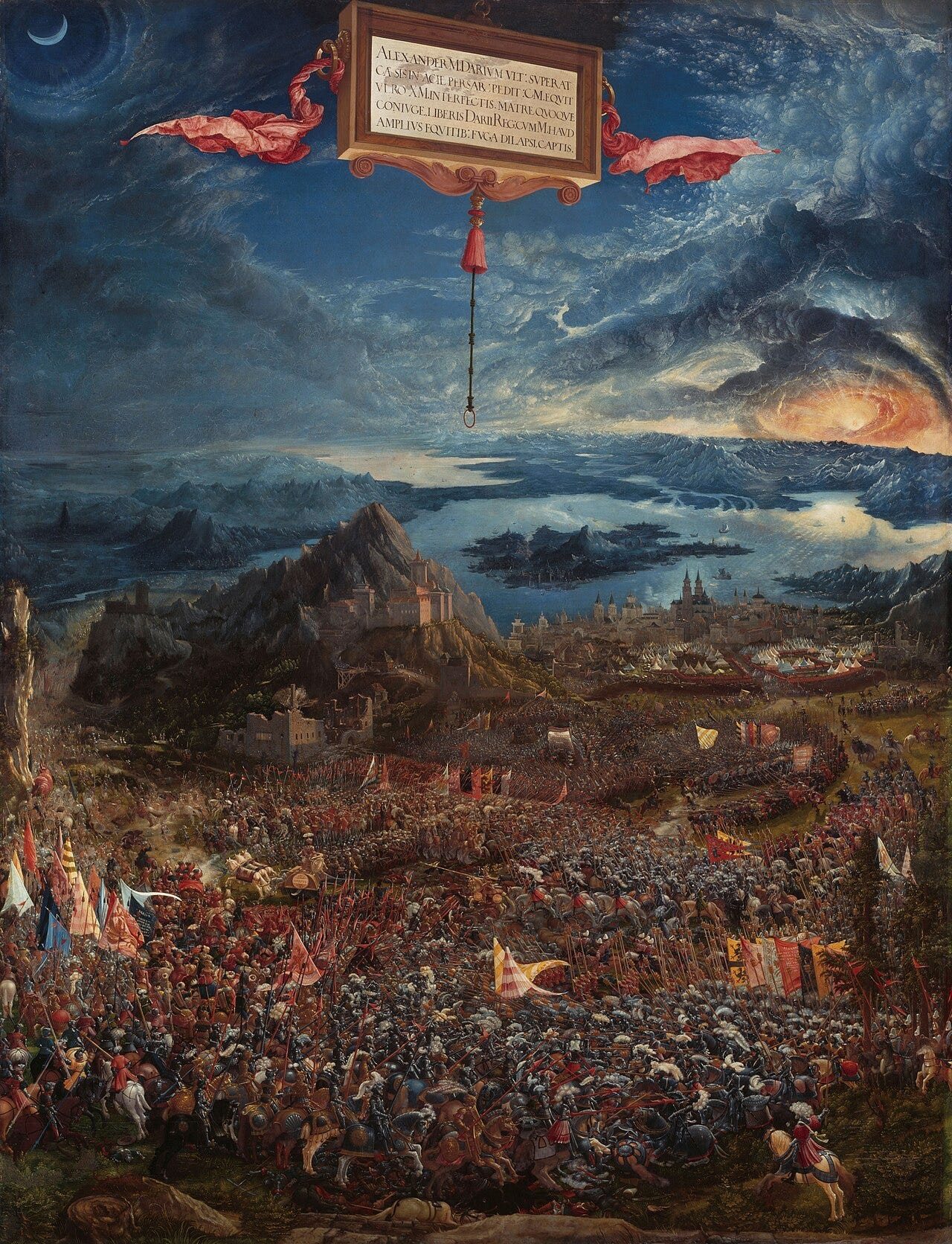
Thousands of tiny soldiers swirl below a cosmic sunset, with a hanging tablet naming the battle. The sky is bigger than the war.
Napoleon took it for his bathroom at Saint Cloud. It hangs in Munich now.
Altdorfer painted it in 1529 for Duke William IV of Bavaria, with a sky that takes up half the panel and an inscription counting the Persian dead. Napoleon took it and hung it in his bathroom at Saint Cloud.
7 | The Death of General Wolfe, Benjamin West (1770)
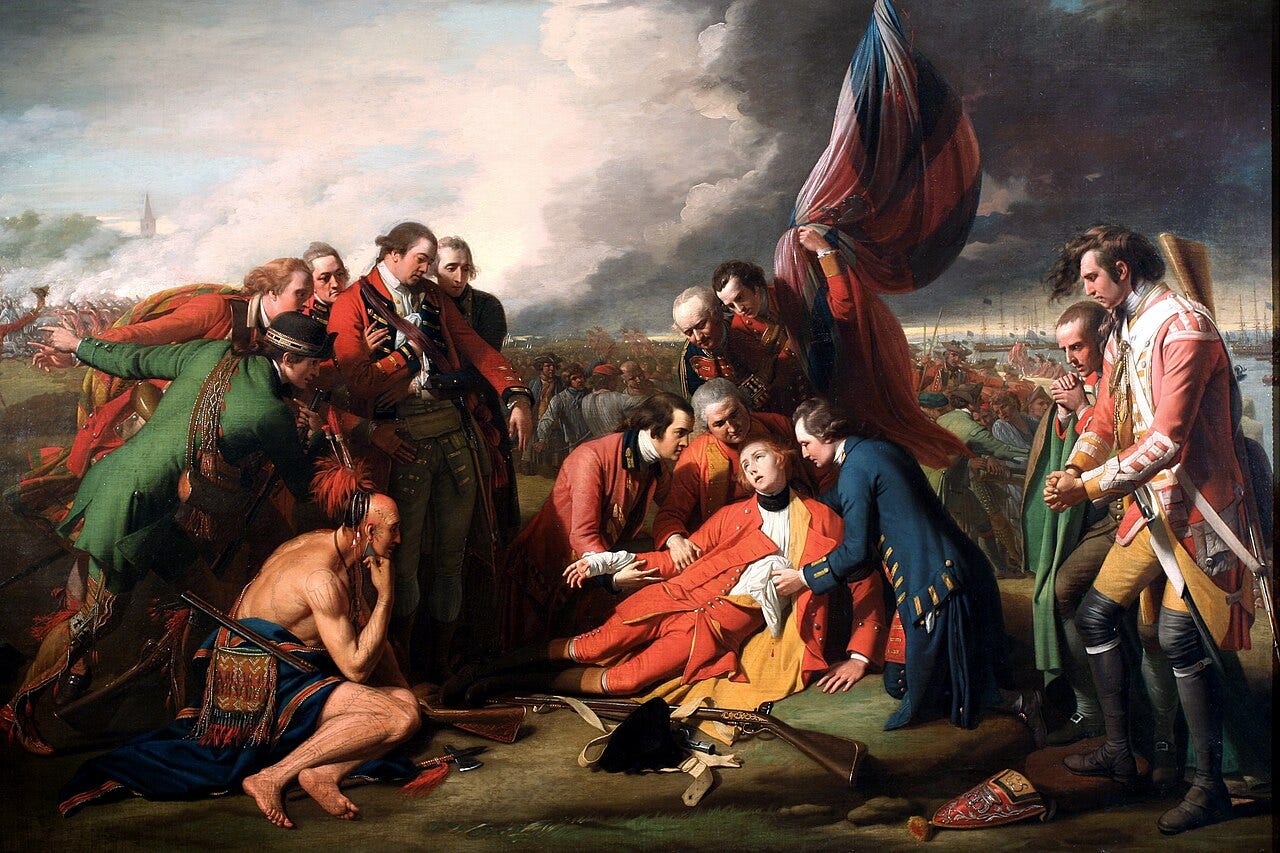
West painted a contemporary death in modern uniforms rather than Roman togas, and the art establishment was scandalized until the public loved it.
Almost nobody in the group was actually present at Wolfe’s death. It is a cast list, not a record.
West showed it in 1770 in modern uniform rather than classical dress, which George III disliked and the public loved. Several of the officers gathered round the dying general were not present at Quebec.
8 | The Raft of the Medusa, Theodore Gericault (1819)
Not a battle but its aftermath: a naval scandal painted at the scale of history, with survivors interviewed and a model raft built in the studio.
The government did not enjoy it. The story is in Theodore Gericault.
9 | The Panorama of the Battle of Borodino and the giant canvases
The 19th century built circular buildings for battle panoramas over 100 meters long, ancestors of cinema, with real sand and props in front of the canvas.
The Raclawice Panorama in Wroclaw and the Borodino Panorama in Moscow still work exactly as designed.
10 | The Battle of Grunwald, Jan Matejko (1878)
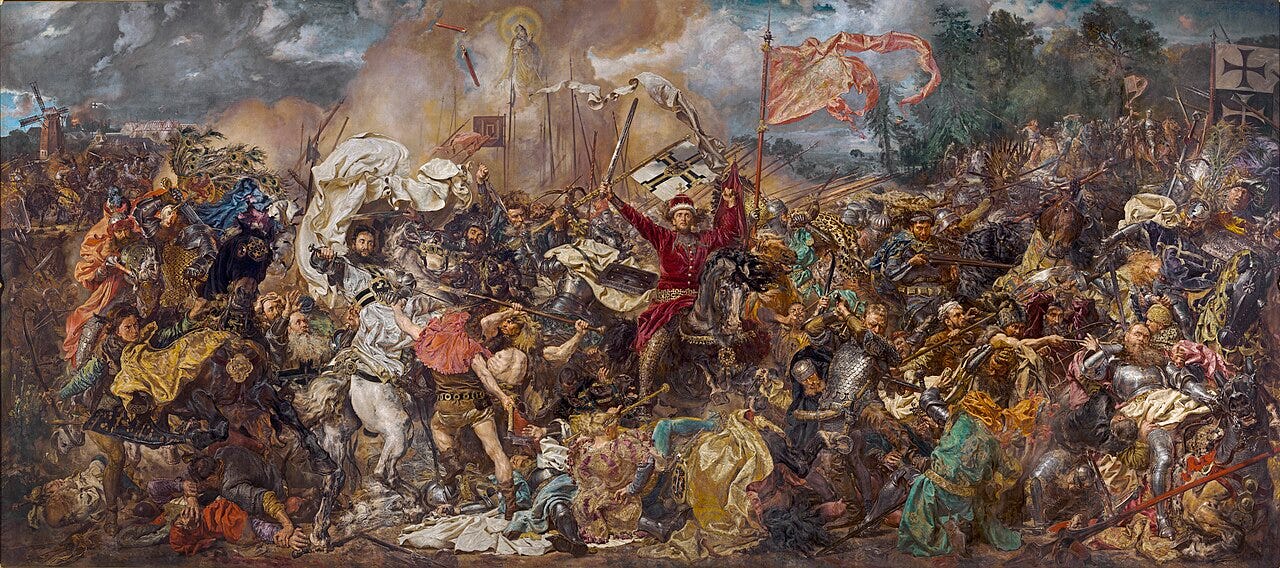
Ten square meters of Polish and Lithuanian knights destroying the Teutonic Order in 1410, painted while Poland did not exist on the map.
The Nazis hunted for it specifically in 1939; it was buried and survived. I cover him properly in Jan Matejko.
11 | Gassed, John Singer Sargent (1919)
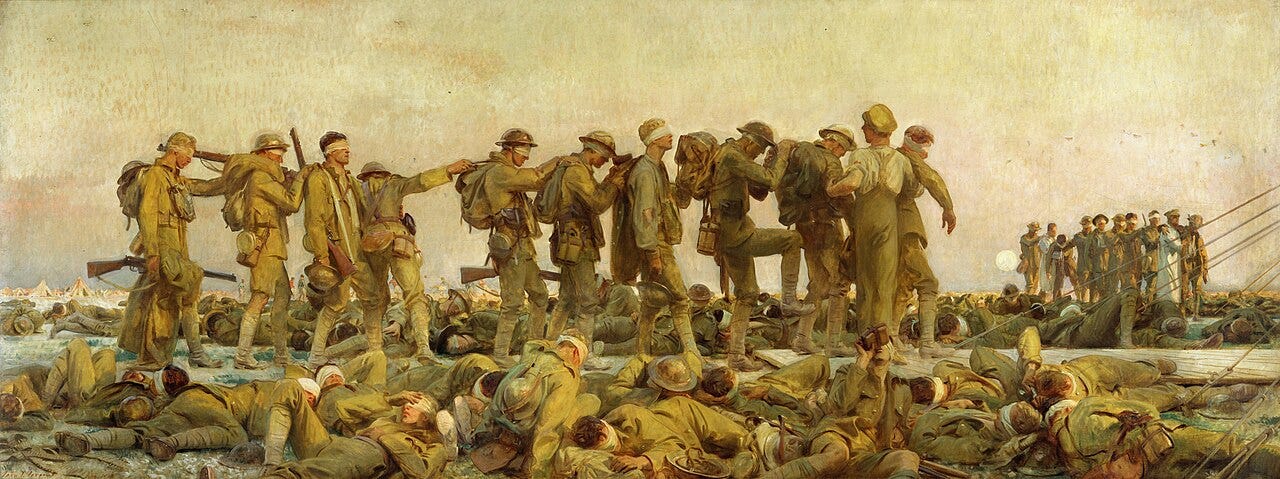
A line of blinded soldiers walks with hands on shoulders toward a dressing station, stepping over bodies, while a football match continues in the distance.
The society portraitist was sent to the front and came back with this. His full story sits in John Singer Sargent.
12 | Guernica, Pablo Picasso (1937)
No soldiers, no planes, no uniforms. A bull, a horse, a lamp, a screaming mother, all in grey, painted in five weeks after the bombing of a Basque town.
It toured the world instead of going to Spain, arriving in Madrid only in 1981. I go into his whole story in Pablo Picasso.
The Met and the Rijksmuseum publish the commission records behind several of these, which is where the propaganda becomes obvious.
What readers ask about these battles
If you only look at one, which? Goya’s Third of May 1808 and Picasso’s Guernica, both of which refuse to celebrate anything.
Why is Uccello’s battle so strange? He used it to demonstrate perspective. The lances fall on a grid and the dead lie at textbook angles.
Did Napoleon really cross the Alps like that? No. He rode a mule in fine weather and specifically asked to be painted calm on a fiery horse.
Which battle painting is lost? Leonardo’s Battle of Anghiari, ruined by his own technique and known only through copies.
Where is The Third of May 1808 today? The Prado for Goya and Velazquez, the Reina Sofia for Guernica, London and Florence for Uccello, Warsaw for Matejko.
And a closing figure: Picasso refused to let Guernica return to Spain while Franco lived. It arrived in Madrid in 1981, six years after the dictator’s death and eight years after the painter’s.
Battles are only half of it. The wider record of war on canvas, from glory to the trenches, is in famous war paintings.
Reading San Romano purely as a geometry exercise undersells why the Bartolini Salimbeni family commissioned it. Florence had just beaten Siena, and turning that victory into a lesson in perspective does not erase the fact that it was still war propaganda dressed up as an art lesson.
The mule anecdote about Napoleon has been repeated so often that it now works as its own kind of myth, the tidy debunking readers expect before they trust the rest of the caption. That does not make David's five overpainted versions less staged, it just means the corrective story deserves the same scrutiny as the original one.
Picasso kept Guernica in New York for decades on the condition that it return only once Spain had a republic again, and the arrangement suited him too. A painting that hangs at the Museum of Modern Art for over forty years builds a different kind of authority than a story about political principle fully explains.
West's Death of General Wolfe is the more dishonest painting of the two, precisely because it borrows the vocabulary of documentary truth. Contemporary uniforms replaced Roman togas to signal accuracy, yet several of the officers arranged around the dying general were never at Quebec. Goya's firing squad makes no such claim: the killers stay faceless because the painting never pretends to record who exactly stood there.
Velazquez's single gesture, a hand stopping the Dutch commander from kneeling, does more work than Altdorfer's entire cosmic sky. Reducing the Battle of Alexander at Issus to a sunset that dwarfs both armies flattens winner and loser into the same tiny brushstrokes, which is a comfortable way to avoid saying anything about the actual outcome. The Surrender of Breda commits to a specific claim about how Spain wanted to be seen winning, and that specificity is the reason the painting still reads as diplomacy rather than propaganda.
This subject is one thread in a wider theme. See how it fits into War and Power in Art.