Bird Paintings: 12 Famous Works to Know

The most famous bird paintings hold something wild very still. Fabritius chained a goldfinch to its perch and made it immortal, Audubon shot and wired thousands of birds to draw them life size, and a Dutch swan spread its wings so fiercely it became a national symbol. Here are twelve to know, and where to see them.

Birds are almost impossible to paint from life, because they never stop moving. So painters have watched, sketched, stuffed and even shot them to catch the flash of a wing. The twelve below run from a tiny chained finch to a whole concert of squabbling birds.

Use this as a quick tour:

  • The single portraits: Fabritius and Durer, one bird studied with total care.

  • The naturalists: Audubon and Liljefors, birds as science and wildness.

  • The eastern masters: Hiroshige, Hokusai and Koson, the bird and flower print.

  • Where to see them: a museum list at the end, grouped by city.


New here? Learn art the fun way. Free stories every week, no boring lectures.


Carel Fabritius, The Goldfinch

A small goldfinch perched on its feeder box, chained by one leg, against a pale wall
Carel Fabritius, The Goldfinch, 1654

Carel Fabritius painted The Goldfinch in 1654, a small bird perched on top of its little feeder box, fixed by a fine chain around one leg, against a plain pale wall. It is tiny, barely bigger than a sheet of paper.

Fabritius, a pupil of Rembrandt, died that same year when a gunpowder store blew up and destroyed much of his work. This little bird is one of the few paintings that survived, which makes it almost unbearably precious.

It hangs at the Mauritshuis in The Hague. A best selling novel took its name from it, and the chained little finch has become one of the most loved birds in art.

John James Audubon, The Birds of America

A large wading bird bends its whole body to fit a life size plate, feathers precisely drawn
John James Audubon, plate from The Birds of America, around 1835

John James Audubon spent years across America drawing every bird he could find at life size for his huge book The Birds of America, made around 1830. Big birds like the flamingo bend and twist to fit the giant page.

To draw them so accurately, Audubon shot fresh birds and wired them into lifelike poses. It sounds brutal, but it produced the most ambitious and beautiful record of birds ever attempted.

Complete copies are among the most valuable books in the world, and prints hang in the Metropolitan Museum and beyond. Audubon turned science into art on an epic scale.

Jan Asselijn, The Threatened Swan

A white swan spreads its wings and hisses fiercely to defend its nest against a dog
Jan Asselijn, The Threatened Swan, around 1650

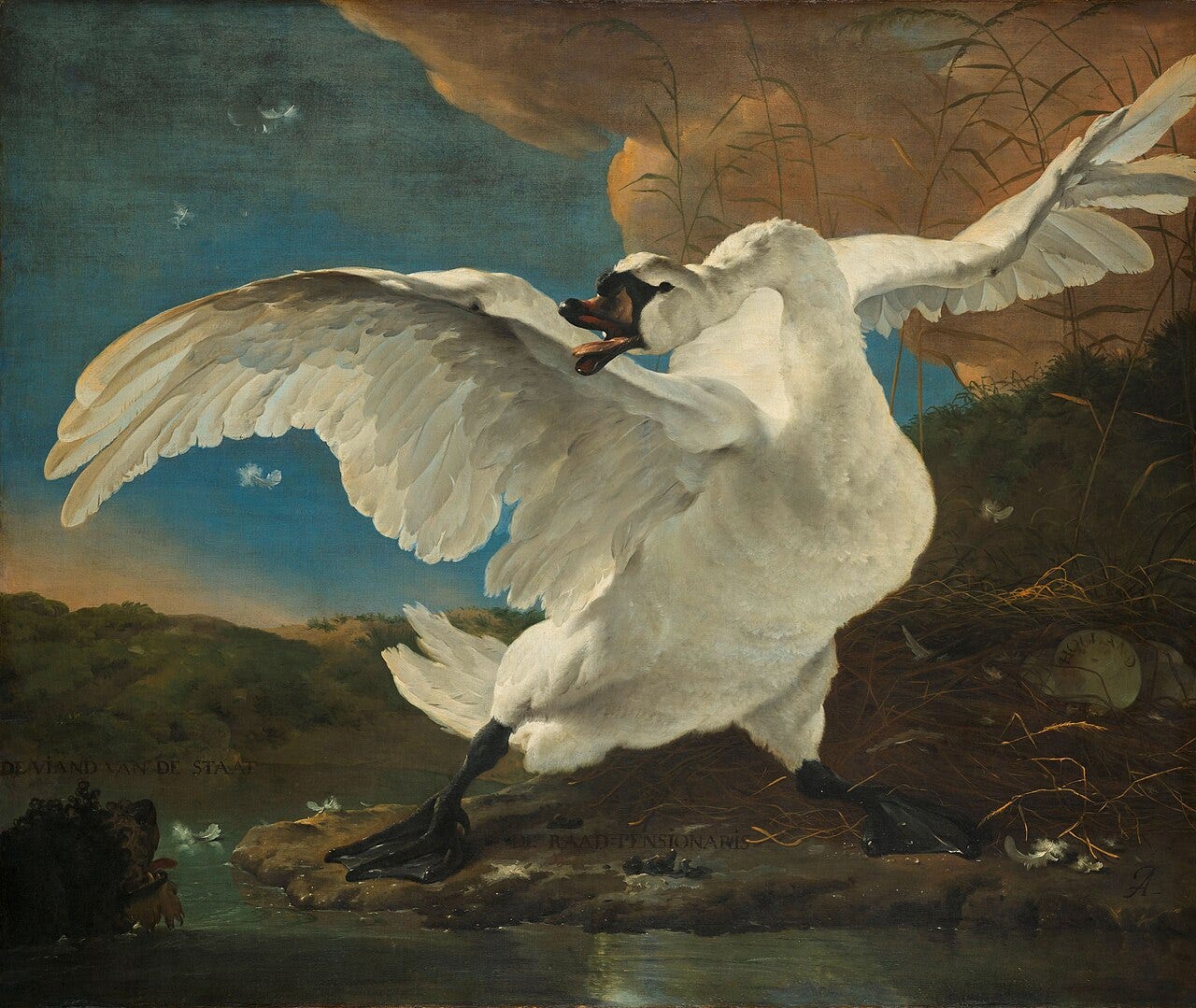
Jan Asselijn painted The Threatened Swan around 1650, a great white swan spreading its wings and hissing furiously to defend its nest and eggs against a small dog in the water below.

It is pure drama, feathers flying, the swan reared up in rage. Later viewers read the brave swan as a symbol of a Dutch leader defending the nation, and words were even added to the picture to say so.

It hangs at the Rijksmuseum in Amsterdam, where it was the very first painting the museum ever acquired. A single furious bird became a national emblem.

Ohara Koson, Bird Print

A single bird perched on a flowering branch against a plain pale ground in a Japanese print
Ohara Koson, a bird on a branch, around 1910

Ohara Koson made hundreds of bird and flower prints around 1910, a single bird perched on a flowering branch against a plain pale ground, quiet and exact. He is the great modern master of the form.

Koson simplified each scene to one bird and one branch, catching the exact tilt of a head or lift of a wing. His prints sold widely in the West and shaped how many people picture Japanese art.

His work hangs in museums worldwide. In a single bird on a branch, Koson could hold a whole season and a whole mood.

Utagawa Hiroshige, Bird and Flower

A small bird among camellia or plum blossom, cropped close in a tall narrow print
Utagawa Hiroshige, a bird and flower print, around 1835

Utagawa Hiroshige made elegant bird and flower prints around 1835, a small sparrow or bush warbler among plum or camellia blossom, cropped close in a tall narrow format. These are the classic kacho-e, or woodblock bird pictures.

Hiroshige reduced each scene to a few perfect shapes, a bird, a branch, a spray of blossom, with a line of poetry alongside. Nothing is wasted.

Impressions hang in the Metropolitan Museum and beyond. These prints helped spark Japonisme, teaching Western painters the beauty of empty space.

Katsushika Hokusai, Cranes

Elegant long necked cranes stand and preen, drawn with sharp confident lines
Katsushika Hokusai, cranes, around 1830

Katsushika Hokusai, best known for his Great Wave, also drew birds with astonishing skill around 1830, especially cranes, their long necks and legs folded into elegant confident lines.

The crane was a symbol of long life and good fortune in Japan, and Hokusai drew it again and again, catching the exact poise of the standing bird. His birds feel alive on the page.

His bird prints and drawings hang in the Metropolitan Museum and beyond. Even in a few lines, Hokusai could give a bird its whole character.

Melchior d’Hondecoeter, The Floating Feather

Exotic waterfowl including a pelican and flamingo gather at a pond, a single feather floating on the water
Melchior d’Hondecoeter, The Floating Feather, around 1680

Melchior d’Hondecoeter painted The Floating Feather around 1680, a gathering of exotic waterfowl, a pelican, a flamingo and ducks, at the edge of a pond, with a single white feather drifting on the still water.

Hondecoeter was the great Dutch specialist in birds, painting the rare species kept in royal menageries. That one perfectly painted floating feather is a quiet display of pure skill.

It hangs at the Rijksmuseum in Amsterdam. His grand bird pieces turned the menagerie into theatre.

Melchior d’Hondecoeter, Birds in a Park

Peacocks, hens and songbirds gather among trees and classical ruins in a grand scene
Melchior d’Hondecoeter, birds in a park, around 1686

Melchior d’Hondecoeter also painted grand park scenes crowded with birds, peacocks fanning their tails, hens, ducks and songbirds gathered among trees and classical ruins.

He gave each bird its own pose and personality, arranging whole flocks into lively, almost human dramas. Wealthy Dutch families hung these big canvases as displays of exotic wealth.

His bird pieces hang across European museums. Hondecoeter made the ordinary farmyard and the royal aviary equally grand.

Frans Snyders, Concert of Birds

A crowd of different birds gathers on branches around an owl holding a sheet of music
Frans Snyders, Concert of Birds, around 1630

Frans Snyders painted the Concert of Birds around 1630, a noisy crowd of different birds gathered on branches around an owl that seems to conduct them from a sheet of music. It is a Flemish Baroque comedy.

The theme came from an old fable, and every bird is painted true to life while the whole scene turns into a joke about a squabbling choir. Snyders worked with Rubens and shared his energy.

Versions hang at the Prado in Madrid and beyond. It is one of the liveliest, funniest bird paintings ever made.

Jean-Baptiste Oudry, Birds

Game birds and songbirds arranged with rich feathers against a dark ground
Jean-Baptiste Oudry, a still life with birds, around 1740

Jean-Baptiste Oudry painted birds in the early 1700s for the French court, both living birds and game, their feathers rendered with dazzling precision against dark grounds.

Oudry was famous for painting white on white, a white bird against a white cloth, a near impossible test of skill he passed with ease. He ran the royal tapestry works and studied animals endlessly.

His work hangs in the Louvre and museums worldwide. Oudry could paint a feather so well you feel you could lift it off the canvas.

Bruno Liljefors, Birds in the Wild

Wild birds fly low over a marsh or shoreline in cold northern light
Bruno Liljefors, wild birds in a northern landscape, around 1900

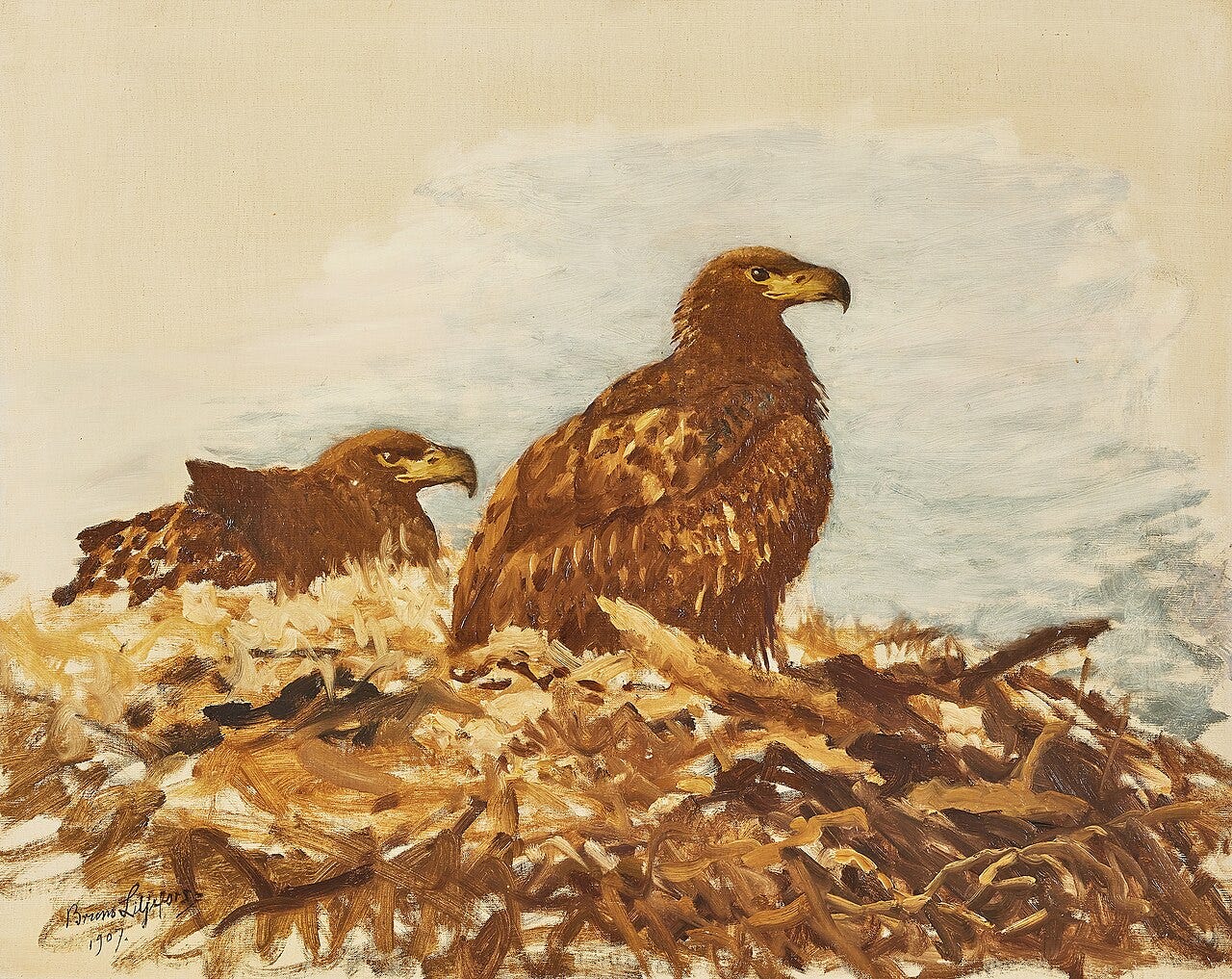
The Swedish painter Bruno Liljefors painted wild birds in their real landscapes around 1900, eagles, ducks and gulls seen low over marsh and shore in cold northern light, often mid hunt.

Liljefors watched birds for hours in the field and painted them as part of nature, predator and prey together, not as neat specimens. He is often called the greatest wildlife painter of all.

His work hangs in Scandinavian museums and beyond. He put the bird back into the wild, wary, moving and free.

Albrecht Durer, Wing of a Roller

A single bird wing rendered in exact watercolour, every feather and colour precise
Albrecht Durer, Wing of a European Roller, around 1512

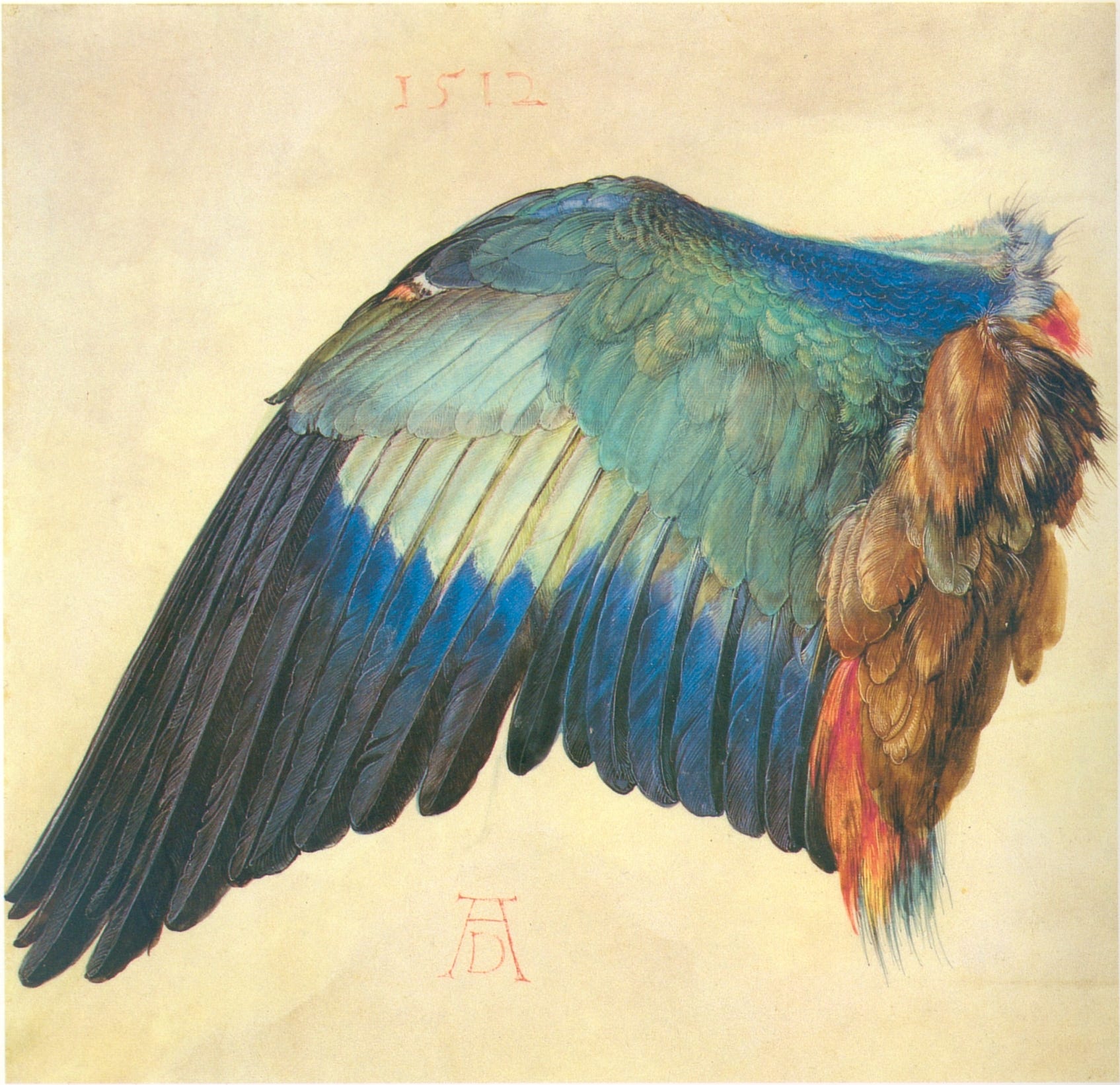
Albrecht Durer painted a single bird’s wing in watercolour around 1512, the severed wing of a blue and brown roller, every feather and shifting colour recorded with total precision.

Durer, the great German master, studied the natural world like a scientist. This one wing, painted for its own sake, is as careful as any of his self portraits.

It is held at the Albertina in Vienna. Five centuries on, it remains one of the most exact and beautiful studies of a bird ever made.


Join 130,000 readers who get the secrets behind the paintings. Free.


Questions people ask about bird paintings

  • What is the most famous bird painting? Carel Fabritius The Goldfinch of 1654 is probably the most famous single bird, along with Audubon life size Birds of America.

  • Why is the goldfinch chained in the painting? Pet goldfinches were kept on a fine chain and even trained to draw water. Fabritius painted his exactly as it lived, tethered to its little feeder.

  • How did Audubon draw birds so accurately? He shot fresh birds and wired them into lifelike poses so he could draw every feather at full size. Brutal, but it produced the greatest bird book ever made.

  • What is a bird and flower print? Called kacho-e in Japan, it pairs a single bird with a branch of blossom. Hiroshige, Hokusai and Ohara Koson were its great masters.

  • Why did The Threatened Swan become famous? The furious swan defending its nest was later read as a Dutch hero defending the nation, and it was the first painting the Rijksmuseum ever bought.

Where to see them

  • Mauritshuis, The Hague: Fabritius The Goldfinch.

  • Rijksmuseum, Amsterdam: Asselijn The Threatened Swan and Hondecoeter The Floating Feather.

  • Metropolitan Museum, New York: Audubon and Hiroshige bird prints.

  • Albertina, Vienna: Durer Wing of a Roller.

  • Prado, Madrid: Snyders Concert of Birds.

Keep exploring

If the birds pulled you in, three more paths from here. Dive into the print that conquered the world in the true story behind Hokusai and the Great Wave, learn to read the hidden clues in famous canvases in seven secrets hidden in famous paintings, or start with the basics of still life painting.


Two new stories a week, 130+ secrets unlocked. Start free.


One last thing. A bird is the hardest of models, gone the instant you look up. To pin one to a canvas and keep it alive is a small miracle, whether it is a chained finch or a whole marsh of wild geese. These twelve still flutter.