Books in Art: 12 Famous Paintings and Their Stories
A book in a painting is never just a prop. It can mark a saint as a scholar, a woman as dangerously independent, or a whole household as pious or worldly. For centuries painters used the open page to say what a face could not.
A saint sits with his tame lion and a wall of little books, painted in Italy around 1475. Centuries later a girl in a lemon yellow dress disappears into a novel, and Van Gogh props his dead father Bible beside a worn French paperback.
The scholar room: saints and thinkers surrounded by books, the oldest use of the motif.
The dangerous reader: women lost in novels, a quiet act that once unsettled polite society.
The book as clue: a single title on a desk that tells you who the sitter really is.
Faith on the page: open Bibles and prayer books that carry the whole weight of a picture.
If you like the secrets hidden in paintings
Three that take a single picture apart, properly:
Seven secrets hidden in famous paintings, details sitting in plain sight.
The Last Supper, detail by detail, what Leonardo hid at that table.
Twelve famous portraits and the real people, the faces behind the paintings.
1. Rogier van der Weyden, The Magdalen Reading
A woman in a green dress sits on the floor, absorbed in a book, painted in Brussels around 1438.
She is Mary Magdalene, and the book marks her as devout, her body curled into a half circle around her reading. The panel is only a corner cut from a large lost altarpiece.
Two other fragments survive in Lisbon, and cleaning in the 20th century uncovered a background of figures that layers of overpaint had hidden.
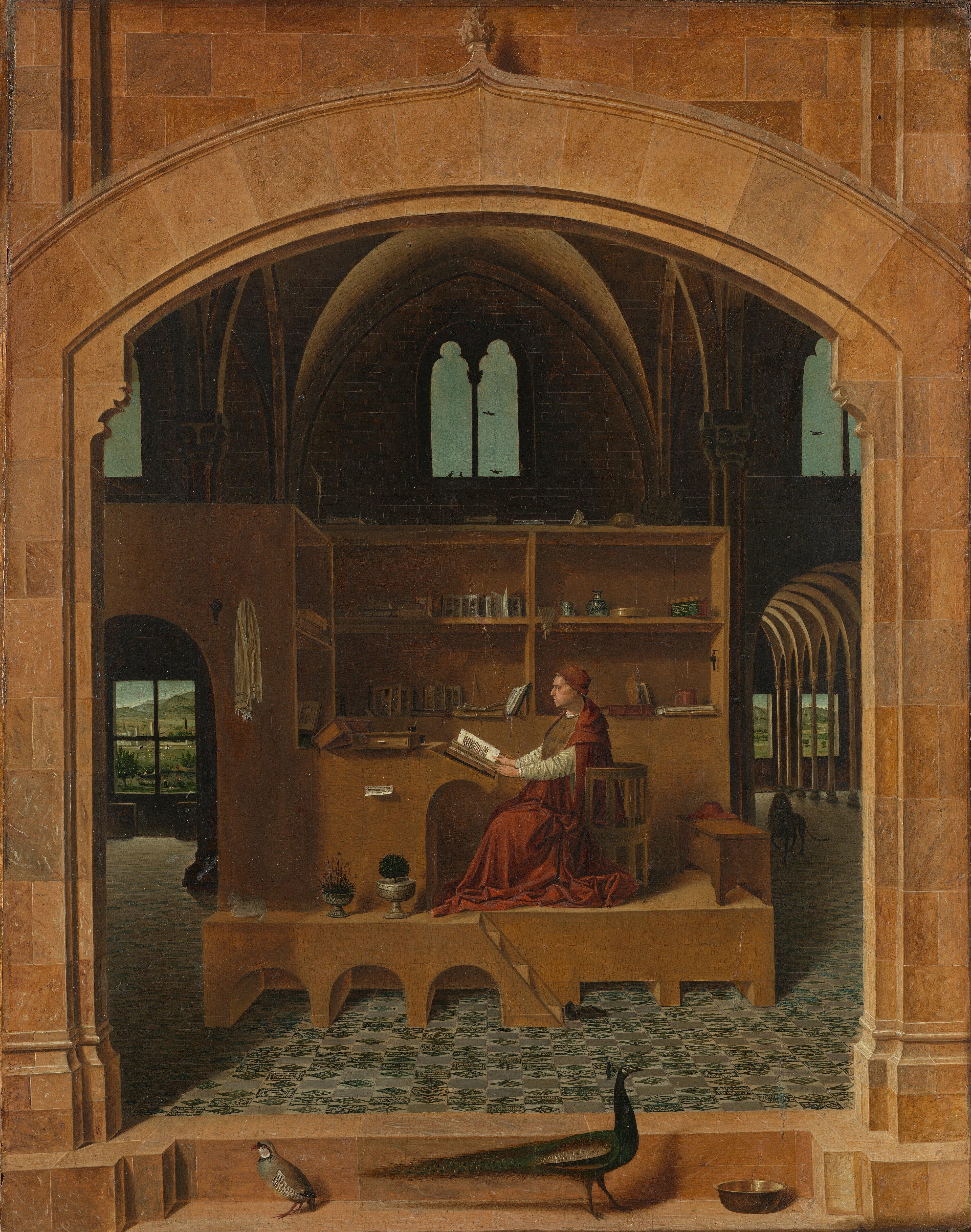
2. Antonello da Messina, Saint Jerome in His Study
Saint Jerome sits reading in a wooden study set inside a vast stone hall, painted around 1475.
Antonello lined the shelves with tiny books, jars and a dozing cat, showing off what oil paint could do with texture and light. A lion, Jerome usual companion, waits in the shadowed arcade to the right.
The picture is so small and so finely worked that early owners argued over whether a Flemish or an Italian hand had made it.
3. Sandro Botticelli, The Madonna of the Book
The Virgin and the Christ child lean over an open book by a window, painted in Florence around 1480.
The book is a Book of Hours, a personal prayer book, and its pages are painted so precisely you can read the script. Nails and a crown of thorns in the child hand quietly foretell his death.
It now hangs in the Poldi Pezzoli house museum in Milan, a small jewel of a collection.
4. Albrecht Durer, Saint Jerome in His Study
Durer engraved Saint Jerome writing at his desk in a sunlit room in 1514, a lion and a dog asleep on the floor.
Every object is a symbol, the skull for death, the hourglass for time, and the books for the saint translation of the Bible into Latin. Durer cut the whole scene into a copper plate the size of a postcard.
He treated it as one of three showpiece engravings, and pulled copies that carried his name across Europe.
5. Jean Honore Fragonard, A Young Girl Reading
A girl in a lemon yellow dress reads in profile, a small book held up in one hand, painted around 1770.
Fragonard worked fast and loose, and x rays show he first painted her looking out at us before turning her face down into the page. The change made her private, sealed inside her book.
The National Gallery of Art bought it in 1961, and it is now one of the most reproduced images of a reader in Western art.
6. Carl Spitzweg, The Bookworm
An old scholar perches on a library ladder around 1850, a book in each hand, one clamped under his arm and another between his knees.
Spitzweg, a trained chemist, gently mocked the bookish men of his day, so lost in print they ignore the world. The globe above the man head hints at everything he is missing outside.
He painted three versions, and the first now hangs in Schweinfurt in a museum built around German 19th century art.
7. Edouard Manet, Portrait of Emile Zola
The writer Emile Zola sits at a cluttered desk piled with books in 1868, a pamphlet open in his hand.
Manet painted it to thank Zola for defending him in print, and slipped his own scandalous Olympia into the pictures pinned on the wall behind, next to a Japanese print and a Velazquez etching.
The blue booklet on the desk is Zola own essay praising Manet, a thank you hidden in plain sight.
8. Vincent van Gogh, Still Life with Bible
Van Gogh painted a heavy open family Bible beside a small yellow paperback in Nuenen in October 1885.
The Bible was his father, a Protestant pastor who had died months earlier, and it lies open at Isaiah 53. The little book in front is Emile Zola novel The Joy of Life, the new world set against the old faith.
An unlit candle stands between them, a blunt sign that the father, and his religion, had gone out.
9. Pierre Auguste Renoir, The Reader
A young woman bends over a book, her face lit gold, painted around 1876.
Renoir cared less about the book than the light on her skin, and he let the whole background dissolve into loose warm strokes. The reading is an excuse to paint a face in soft daylight.
He made it around the same years as his crowded Moulin de la Galette, trading the dance hall for a single quiet face.
10. Vittore Carpaccio, Saint Augustine in His Study

Saint Augustine looks up from his writing desk in a study lined with books and instruments, painted in Venice around 1502.
He has just felt a vision, the moment he learns that Saint Jerome has died, and the light through the window is that vision arriving. A small white dog on the floor stares in the same direction.
The room is really a portrait of a Renaissance scholar study, down to the scattered sheet music and the astrolabe on the shelf.
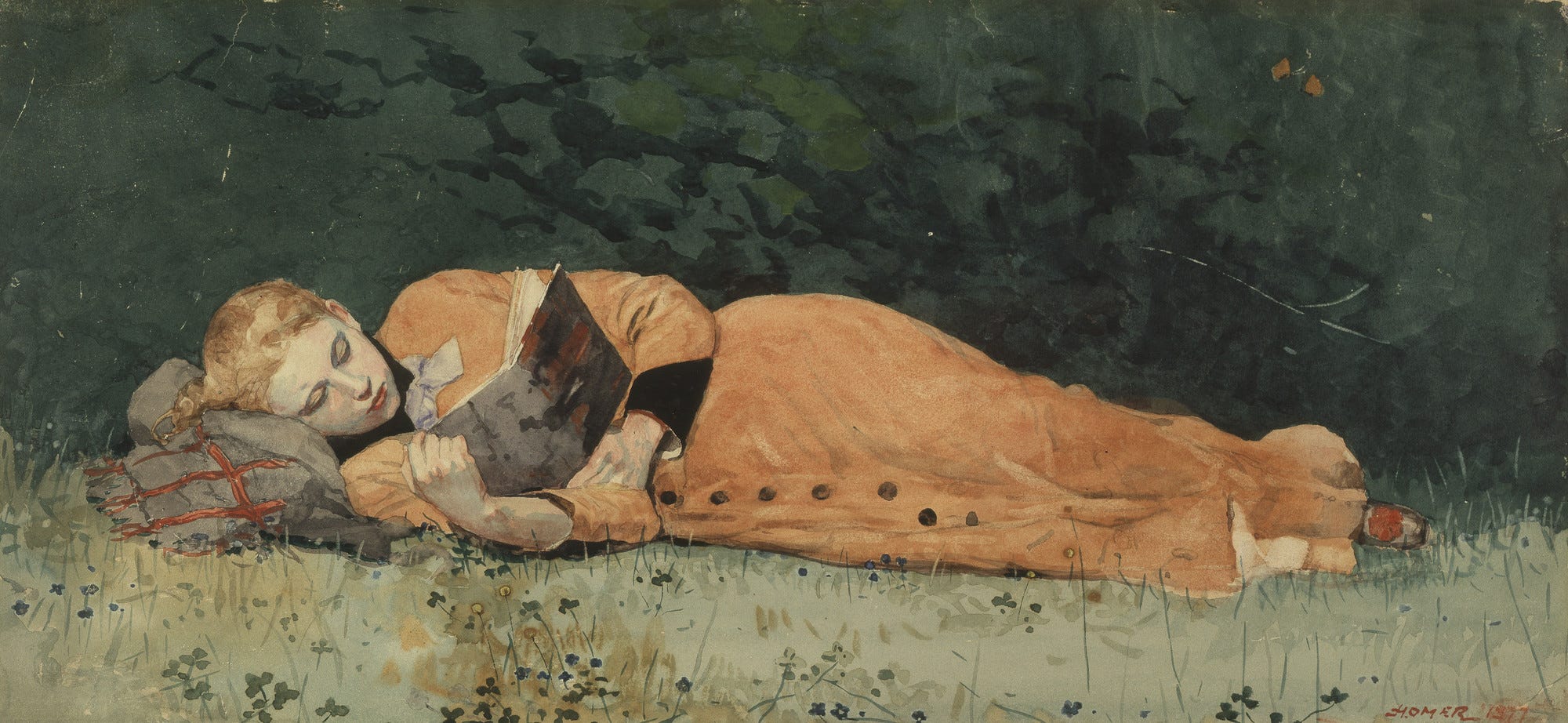
11. Winslow Homer, The New Novel
A young woman lies in the grass in a red dress, propped on one elbow, lost in a book, painted in watercolor in 1877.
Homer showed it at the American Watercolor Society and it marked the start of his fully formed style. A woman reading alone was still seen by some as idle or improper, which gives the quiet scene an edge.
It hangs today in Springfield, Massachusetts, one of the works that pushed American watercolor into serious art.
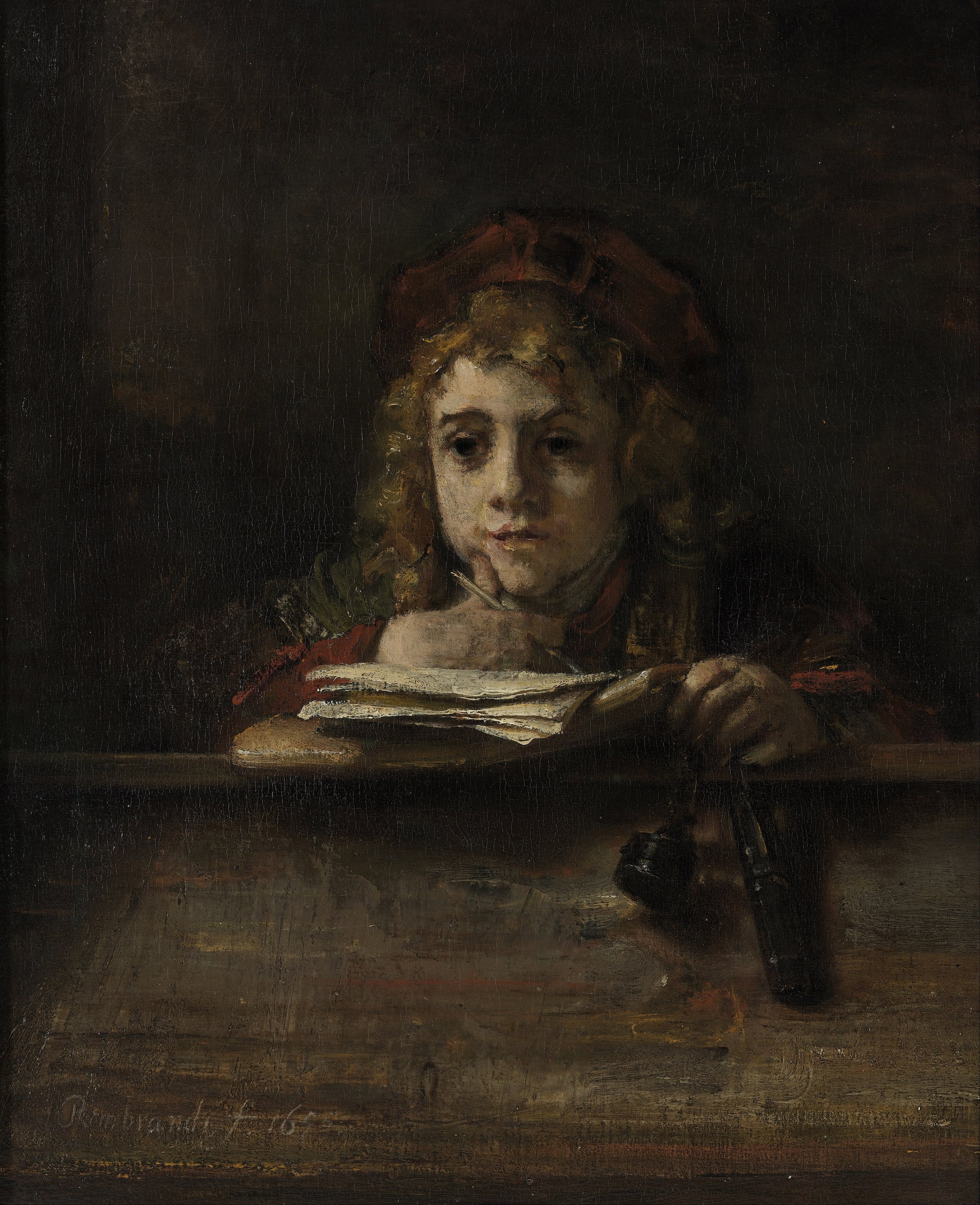
12. Rembrandt van Rijn, Titus at His Desk
Rembrandt painted his teenage son Titus daydreaming at a school desk in 1655, a pen case and inkwell hanging from it.
The boy is not reading, he is staring off, thumb pressed to his lip, caught in the middle of a thought. Rembrandt built the whole picture around that ordinary drift of a child attention.
Titus would die in 1668 at twenty six, a year before his father, one of the many losses that marked Rembrandt late life.
Where to see them
National Gallery, London: van der Weyden Magdalen Reading and Antonello da Messina Saint Jerome in His Study.
Musee d Orsay, Paris: Manet Portrait of Emile Zola and Renoir The Reader.
Van Gogh Museum, Amsterdam: Van Gogh Still Life with Bible.
Museo Poldi Pezzoli, Milan: Botticelli Madonna of the Book.
Museum Boijmans Van Beuningen, Rotterdam: Rembrandt Titus at His Desk.
Why the book is never just a book
Many of these are portrait paintings where a single book does the work of a whole biography, telling you the sitter is learned, devout, or quietly modern.
Others are still life paintings, where an open Bible or a worn novel carries the meaning that a face would in a portrait. Van Gogh built a family quarrel out of two books and a candle.
And the oldest ones show scholars painted in oil, the medium that let Antonello line a shelf with books so small and so exact that owners could not agree who had painted them.
Books in art, questions people ask
What does a book symbolize in a painting? Usually learning, faith or devotion. An open Bible signals piety, a saint books mark him as a scholar, and a novel can hint at independence.
Why are saints often shown reading? Because scripture and study were central to their lives. Saint Jerome, who translated the Bible into Latin, is almost always painted with books.
What book is in Van Gogh Still Life with Bible? His late father family Bible, open at Isaiah 53, set beside Emile Zola novel The Joy of Life.
What is the most famous painting of a woman reading? Fragonard A Young Girl Reading of around 1770, in Washington, is the best known image of a solitary reader in Western art.
Who is the boy in Rembrandt Titus at His Desk? Titus van Rijn, the painter son, shown around fourteen, daydreaming at his school desk in 1655.
What the page is really saying
Look at any of these books and you find a second story in plain sight. Van Gogh opened his father Bible to Isaiah 53, the chapter about a servant despised and rejected, then set a bright yellow Zola novel in front of it. He painted the whole quarrel between a pastor father and a restless son without a single word of his own.