
William-Adolphe Bouguereau painted some of the smoothest canvases of nineteenth-century France, and his name still stands for the art of the Paris Salon. The pictures themselves had rougher lives. A visitor in Nebraska once took a chair to one of his nudes, and a picture he painted in grief for his son later hung in the home of a Hollywood star.
Cool Stories About Art is a newsletter to learn art the fun way.
Join 200,000+ readers and get:
10 new art stories / month
The entire archive of content (140+ articles)
Comment, ask questions, and chat with other readers
A Salon Career in Twelve Canvases
Bouguereau built his career at the Salon, the enormous annual exhibition in Paris where a painter could win public fame. The Salon wanted large, finished pictures of myths, saints and nudes, and he gave it surfaces so smooth that the brush leaves no trace.
Alongside those, he painted barefoot peasant children for private buyers, and many of his canvases crossed the Atlantic while he was alive. That is why so many of them hang in American museums today, and in Paris his chief works are not in the Louvre but in the Musée d'Orsay.
The twelve go from a canvas he painted as a student to a myth he showed at nearly seventy, and they pass through mourning, Hell and a nude attacked in America.
12. The Return of Spring (1886)
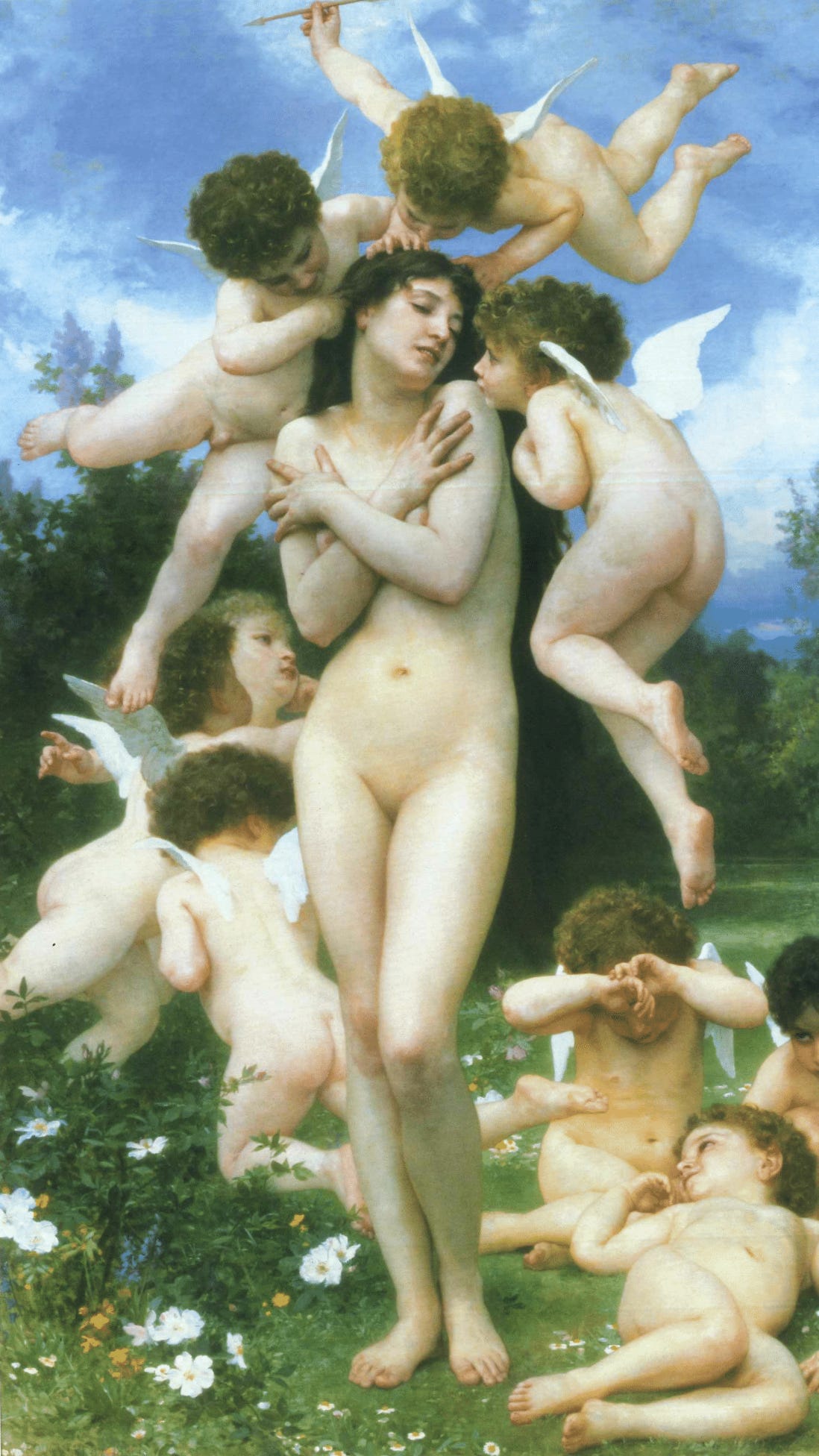
A swarm of small winged cupids clings to a young woman and climbs toward her face. She stands naked on a rock above a pool, half turning away with her arms raised. Bouguereau titled the canvas The Return of Spring, and Salon visitors in Paris saw it in 1886.
Four years later the picture had crossed the Atlantic. In 1890 it was on show in Omaha, Nebraska, at the opening show of a newly founded local art association, and in December a young man named Carey Judson Warbington picked up a chair and began to smash it.
He made no secret of his reason. It was, he declared, "worth while to sacrifice one man's life to rid the world of so corrupting a sight as that picture!" The Omaha Daily Bee printed the story with the headline "With an Assassin's Hand."
The canvas was repaired, by Bouguereau himself according to one account. In 1976 another shocked visitor attacked it, and the Omaha World-Herald reported that a man was facing a charge of damaging art.
Twice, eighty-six years apart, someone in Omaha found this picture worth attacking. I find it less simple than they did. The woman does not welcome the cupids. She turns half away with her arms raised, and the little winged bodies keep climbing all the same.
At a Glance
Artist: William-Adolphe Bouguereau (1825 to 1905)
Painted: 1886
Medium: Oil on canvas
Size: 214.6 × 127 cm (84.5 × 50 in)
Where to see it: Joslyn Art Museum, Omaha, Nebraska
11. Equality Before Death (1848)
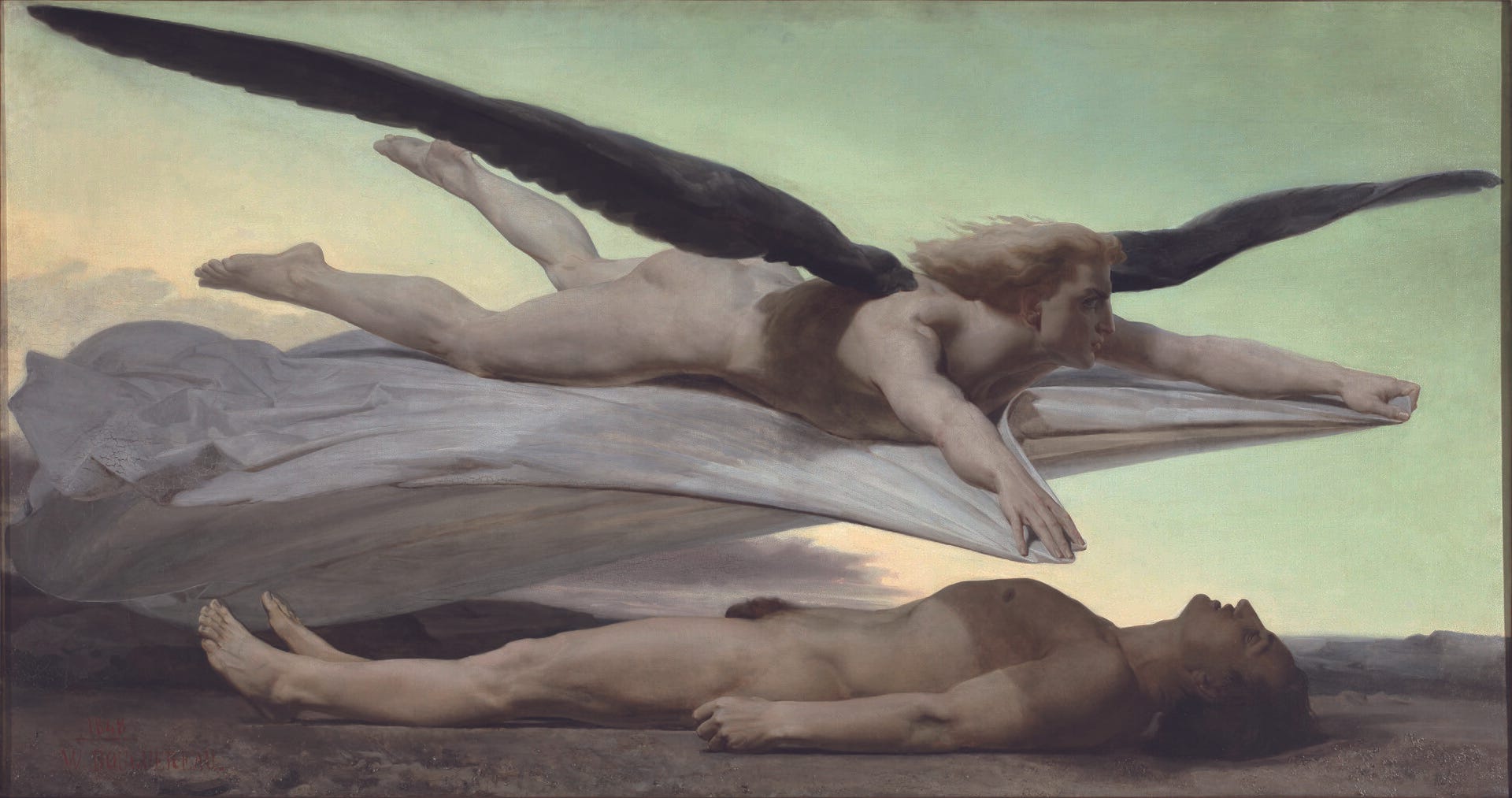
On a bare rock, under an empty sky, a young man lies dead. An angel with dark wings floats above him and draws a black shroud over his pale body. The student who painted it was in a hurry, and in 2010 the canvas entered the French national collections without the state buying it.