
Twelve bridges, from a Venetian waterfront that never existed to a footbridge built in a garden so that it could be painted. Along the way come a railway bridge that experts said would never stand, a night view of the Thames that was taken into a courtroom, and a Japanese print that Van Gogh copied in oil.
Cool Stories About Art is a newsletter to learn art the fun way.
Join 200,000+ readers and get:
10 new art stories / month
The entire archive of content (140+ articles)
Comment, ask questions, and chat with other readers
How These Were Chosen
Painters love bridges, first, because of what a bridge does to a composition. In a landscape, nearly everything stands upright: trees, steeples, houses, people. A bridge lies across the view and gives the painter one long line to set high or low. Seen straight on, it cuts the picture in two.
Seen from the bank, it pulls the eye into the distance. On calm water, its arch meets its own reflection. A bridge also gives a scale, through the two or three figures crossing it, and a period, through its material: wood rots, stone lasts, and iron arrived only in the late 1700s.
Every painting on this list meets at least one of three conditions. The bridge is real, and you can see what it is made of. People or traffic on it give its scale. Or it holds the whole composition together, as a line, a curve or a shape doubled in the water. Pictures where the bridge was only part of the scenery were left out.
Once the twelve were together, a thread ran through them: Japanese prints. Hokusai and Hiroshige made the bridge the very subject of their pictures, and Whistler, Van Gogh and Monet, who all collected those prints, learned from them a new way to frame it.
12. Francesco Guardi, Capriccio with a Ruined Late Gothic Arch, with Fishermen on a Bridge
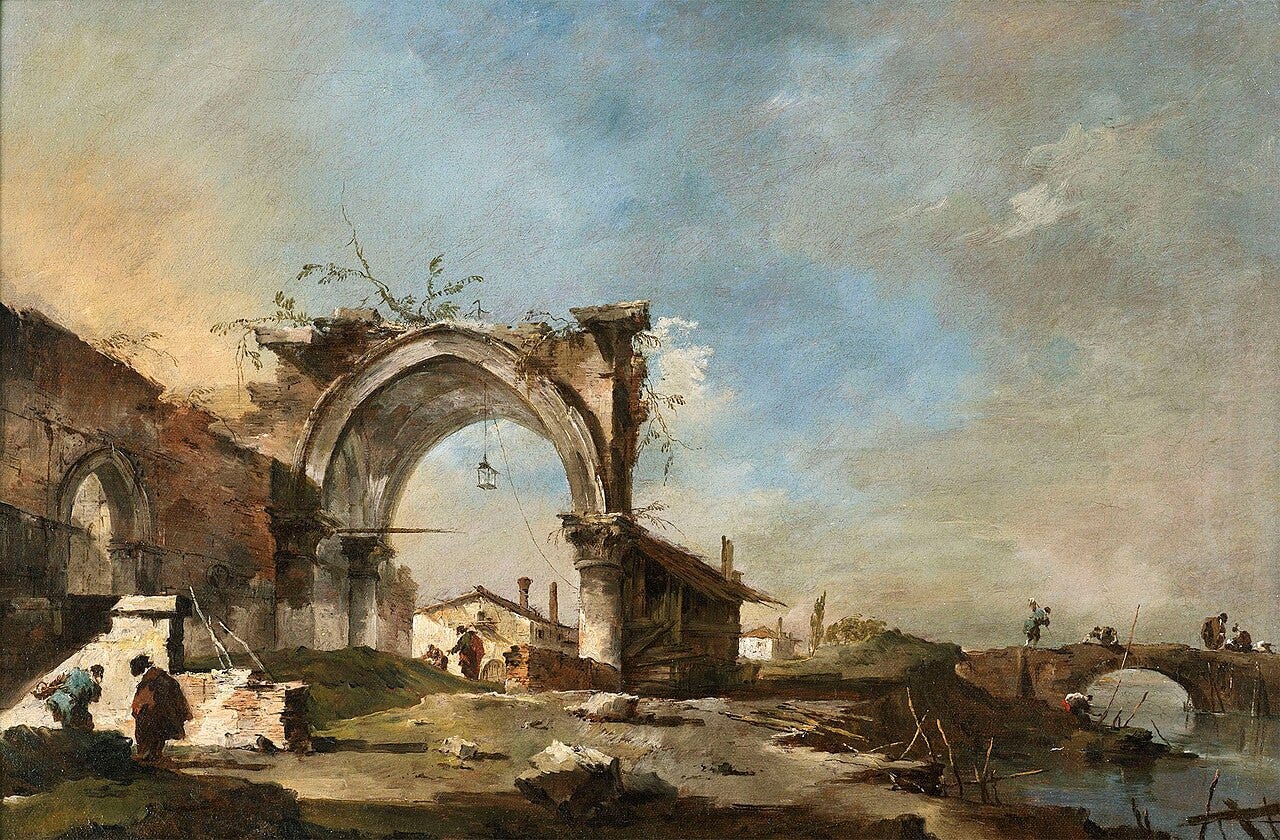
A broken Gothic arch fills the left side of the canvas, with plants growing along its top and a lantern hanging from a line at its center. Under the arch stands a low house with pale walls, and a wooden shack leans against the right pier. Farther right, a small stone bridge crosses the water on a single arch. A few fishermen stand on it, one of them upright with a pole in his hand.
This corner of Venice never existed. The picture is a capriccio, Italian for a caprice: an imaginary architectural view that mixes real buildings with invented ones. Francesco Guardi was, with Canaletto, one of the great painters of Venetian views in the eighteenth century, and his workshop turned out capriccios in large numbers in the 1770s and 1780s.
His buyers were travelers on the Grand Tour, the long journey through Italy that finished the education of wealthy young Europeans. They took home a souvenir of Venice, even when the souvenir mixed the true with the false.
Comparing this canvas with another version of the same motif, now in the National Gallery in London, shows how Guardi built these views. The London picture has the same arch, the same lantern, the same house and the same shack. The arch itself comes from a real building: it is the arcade of the Doge's Palace, enlarged and turned into a ruin. But the London version, smaller and upright, has no bridge.
For this canvas, Guardi widened the view and added the bridge on the right, the way a stage designer adds a piece of scenery. The bridge is the most invented part of an already imaginary place. Without it, the canvas would be almost the London picture, with a little more sky.
At a Glance
Artist: Francesco Guardi (1712 to 1793)
Painted: Date unknown
Medium: Oil on canvas
Size: 48.5 × 73.7 cm (19 × 29 in)
Where to see it: Private collection
About This Painting
What are the most famous capriccios?
Besides Guardi's own, there is Canaletto's capriccio showing the Rialto Bridge that Palladio designed (see number 6), Giovanni Paolo Panini's imaginary picture galleries crowded with views of ancient Rome, and Hubert Robert's Imaginary View of the Grande Galerie of the Louvre in Ruins, at the Louvre.
What is Francesco Guardi known for?
For his views of Venice and its lagoon, painted with a quick, flickering touch, very different from Canaletto's precision. He spent years in the family workshop with his brother Giovanni Antonio, painting altarpieces and figure scenes, before views of Venice became his specialty.
11. Katsushika Hokusai, The Arched Bridge at Kameido Tenjin Shrine (about 1830)
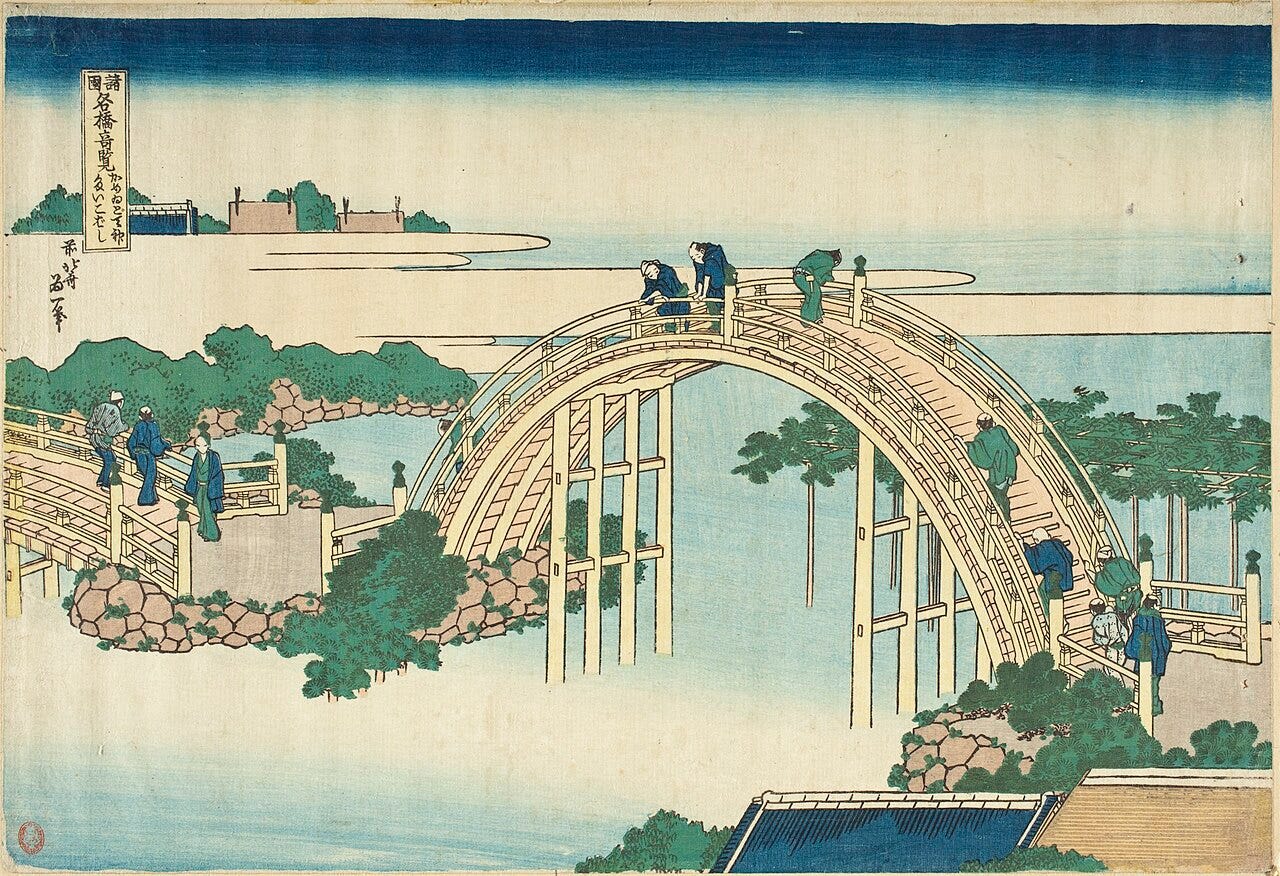
The next bridge looks as unlikely as Guardi's, and yet it is real. A wooden footbridge rises over pale blue water in an arch so steep that its supports look like stilts. At the very top, three small figures lean over the rail.