Famous British Paintings: 12 Works You Should Know

British painting gave the world satires sold by subscription, a warship turned national symbol, and a swimming pool with no swimmer in it. The twelve works below span nearly three centuries, from Hogarth's London to Hockney's California. This guide covers 12 famous British paintings, from Hogarth's Marriage A-la-Mode and Turner's The Fighting Temeraire to Millais's Ophelia and Hockney's A Bigger Splash, with the facts, records, and museum locations behind each one.

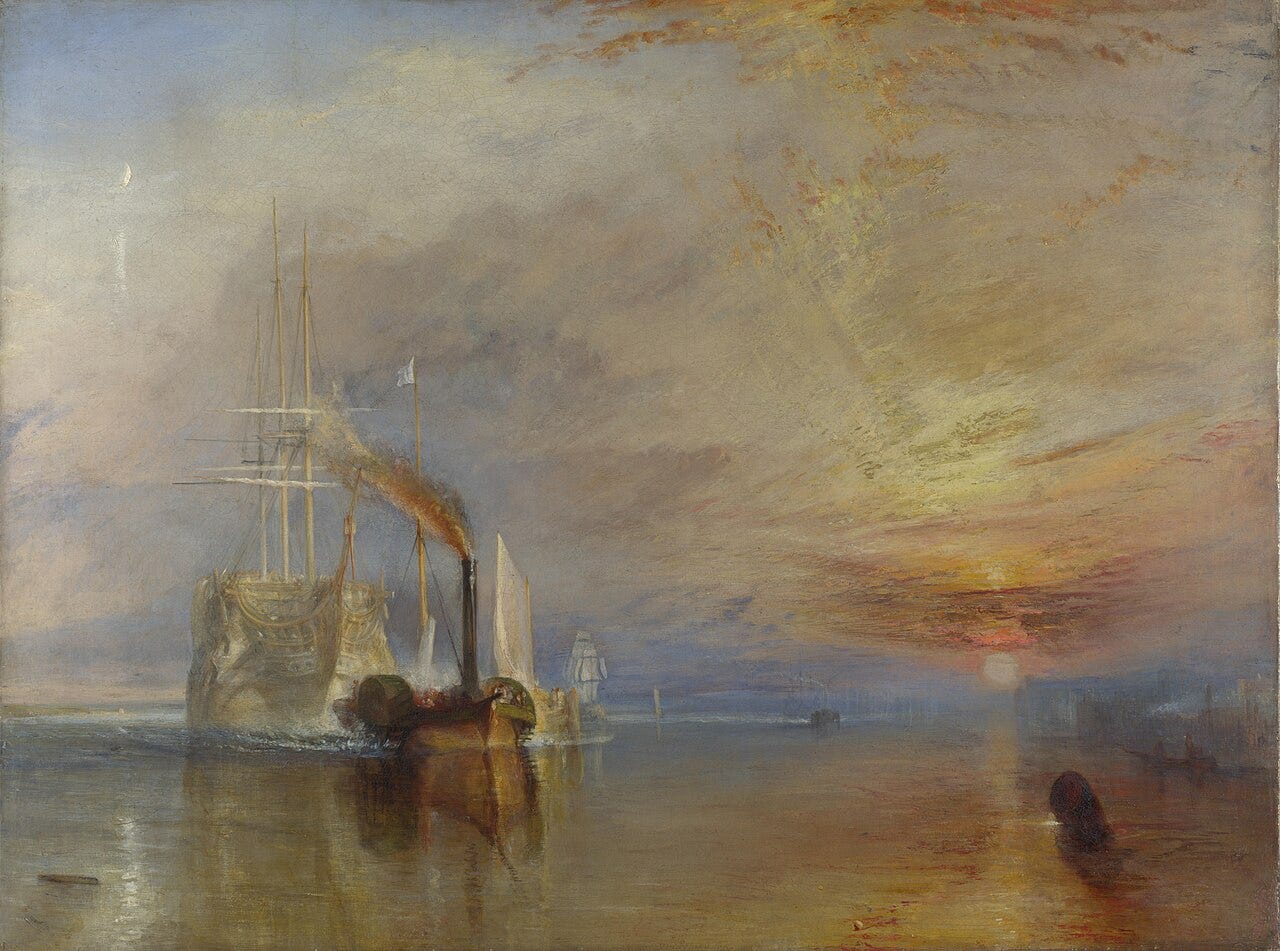
Turner's warship the Fighting Temeraire towed up the Thames to be broken up for scrap
J.M.W. Turner, The Fighting Temeraire, 1839, oil on canvas, National Gallery, London

British painting in 30 seconds

  • Turner's The Fighting Temeraire was voted the greatest painting in any British collection in a 2005 BBC Radio 4 public poll.

  • In 2023, Britain's National Portrait Gallery paid 50 million pounds for Reynolds's Portrait of Mai, a record price for a British portrait.

  • Francis Bacon's Three Studies of Lucian Freud sold for 142.4 million dollars in 2013, an auction record for any work of art at the time.

  • Lucian Freud's Benefits Supervisor Sleeping sold for 33.6 million dollars in 2008, then a record for a living artist.

  • Elizabeth Siddal appears twice on this list: as the model for Millais's Ophelia and as the woman memorialized in Rossetti's Beata Beatrix.

  • Waterhouse's The Lady of Shalott was part of Henry Tate's 1894 gift to the nation, the donation that created the Tate gallery.

1. William Hogarth, Marriage A-la-Mode (about 1743 to 1745)

Hogarth's satirical series on an arranged marriage that ends in ruin and death
William Hogarth, Marriage A-la-Mode, about 1743 to 1745, National Gallery, London

Six canvases, one arranged marriage, and a slow slide into catastrophe. Hogarth painted the series as a satire: a spendthrift nobleman's son weds a wealthy merchant's daughter, and by the sixth painting the whole arrangement has ended in ruin and death.

The paintings hang together at the National Gallery in London, but Hogarth made his money another way. He sold engravings of the series to subscribers in 1745, a business model he pioneered.

New here? Learn art the fun way. Free stories every week, no boring lectures.

2. Thomas Gainsborough, Mr and Mrs Andrews (about 1750)

Gainsborough's double portrait of a newly married couple before their own farmland
Thomas Gainsborough, Mr and Mrs Andrews, about 1750, National Gallery, London

A newly married couple poses in front of their own farmland near Sudbury, Suffolk. Half the picture is the pair themselves, the other half is the land they own, which is very much the point.

The double portrait is considered the finest work of Gainsborough's early career and now hangs in the National Gallery in London.

3. Joshua Reynolds, Portrait of Mai (Omai) (1776)

In 2023, this painting cost Britain's National Portrait Gallery 50 million pounds, about 58.4 million dollars, a record price for a British portrait. The man in it earned that fame in person first.

Mai was a young Tahitian who arrived in England with Captain Cook's second Pacific voyage and became a celebrity in London society. Reynolds painted him at the height of that fame.

4. JMW Turner, The Fighting Temeraire (1839)

The HMS Temeraire fought at Trafalgar. Turner shows the veteran warship at the end of that life, towed up the Thames by a small steam tug to be broken up for scrap. He exhibited it at the Royal Academy in 1839, and it now hangs in the National Gallery in London.

In a 2005 BBC Radio 4 public poll, the British voted it the greatest painting in any British collection, ahead of Constable's Hay Wain. In 2020 it went on the new British 20 pound note alongside Turner's 1799 self portrait.

5. John Constable, The Hay Wain (1821)

Constable's horse drawn wagon crossing a river in the Suffolk countryside
John Constable, The Hay Wain, 1821, National Gallery, London

A horse drawn wagon crosses a river by a cottage in the Stour valley, on the border of Suffolk and Essex. If one image stands for the English countryside, it is probably this one.

It came second to Turner's Fighting Temeraire in that same 2005 BBC poll, which tells you how close the race for Britain's favorite painting really was. The painting is at the National Gallery in London.

6. John Everett Millais, Ophelia (1851 to 1852)

The model nearly drowned for real. To paint Ophelia from Shakespeare's Hamlet dying in the water, Millais had Elizabeth Siddal pose fully clothed in a bathtub, kept warm by oil lamps underneath, in the middle of winter.

The lamps went out without Millais noticing. Siddal caught a severe cold from the freezing water, her father threatened Millais with a damages claim over her medical bills, and the painting now hangs at Tate Britain in London.

7. Dante Gabriel Rossetti, Beata Beatrix (about 1864 to 1870)

Rossetti's memorial portrait of Elizabeth Siddal as Dante's Beatrice at the moment of death
Dante Gabriel Rossetti, Beata Beatrix, about 1864 to 1870, Tate Britain, London

The same Elizabeth Siddal who froze in Millais's bathtub became Rossetti's wife and favorite model. She died in 1862, and Rossetti painted this as her memorial.

On the surface it depicts Beatrice from Dante Alighieri's La Vita Nuova at the moment of her death, but Beatrice here is a stand in for Siddal. The painting is at Tate Britain.

8. John William Waterhouse, The Lady of Shalott (1888)

Waterhouse's Lady of Shalott adrift in a boat at the end of Tennyson's poem
John William Waterhouse, The Lady of Shalott, 1888, Tate Britain, London

Waterhouse illustrates the end of Tennyson's 1832 poem of the same name. It has become one of the most loved paintings at Tate Britain.

It was there from the very beginning. The painting was among the founding works gifted to the nation by the sugar magnate Sir Henry Tate in 1894, the donation that created the Tate gallery itself.

9. James McNeill Whistler, Arrangement in Grey and Black No. 1 (1871)

Yes, an American made this list. Whistler was born in the United States but spent most of his career in London, where he became a central figure of British art in his era.

You know the painting as Whistler's Mother, which is exactly the problem. We tell that whole story in the real title behind Whistler's Mother.

10. Francis Bacon, Three Studies of Lucian Freud (1969)

Bacon's triptych of his friend and rival Lucian Freud, painted three times over
Francis Bacon, Three Studies of Lucian Freud, 1969, private collection

For a few years, this was the most expensive artwork ever sold at auction. The triptych went for 142.4 million dollars at Christie's New York in November 2013, a record at the time for any work of art.

The buyer was casino owner Elaine Wynn. The subject was Bacon's friend and rival Lucian Freud, painted three times over.

11. Lucian Freud, Benefits Supervisor Sleeping (1995)

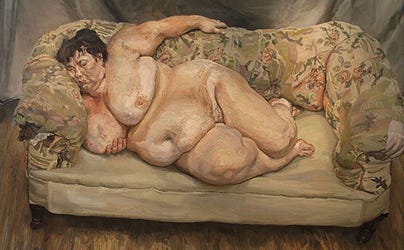
Lucian Freud's portrait of Sue Tilley asleep on a worn sofa
Lucian Freud, Benefits Supervisor Sleeping, 1995, private collection

Sue Tilley worked as a supervisor in a London jobcentre. Freud painted her asleep, and in May 2008 the portrait sold at Christie's New York for 33.6 million dollars to Roman Abramovich, a record at the time for a living artist.

So the sitter of Bacon's record breaking triptych set an auction record of his own. The two were close friends and rivals in London's postwar art world.

12. David Hockney, A Bigger Splash (1967)
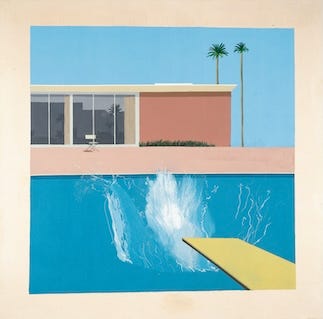
Hockney's swimming pool painting showing only the splash, no diver
David Hockney, A Bigger Splash, 1967, Tate Britain, London

No diver, just the splash. Hockney painted it in acrylic in California between April and June 1967, while teaching at Berkeley, working from a photograph he found in a book about building swimming pools.

Tate bought it in 1981 and it is on display at Tate Britain in London.

FAQ: British painting

What is the most famous British painting? By public vote, Turner's The Fighting Temeraire. A 2005 BBC Radio 4 poll named it the greatest painting in any British collection, with Constable's Hay Wain as runner up.

What is the most expensive British painting ever sold? Francis Bacon's Three Studies of Lucian Freud sold for 142.4 million dollars in 2013, an auction record at the time for any work of art. For portraits, Reynolds's Portrait of Mai set a British record when the National Portrait Gallery bought it for 50 million pounds in 2023.

Where can I see the paintings on this list? Most are in London. The Hogarth, Gainsborough, Turner, and Constable works are at the National Gallery, while the Millais, Rossetti, Waterhouse, and Hockney paintings are at Tate Britain.

Was Whistler really British? He was born in the United States, so strictly no. He spent most of his career in London and became a central figure of British art in his era, which is why he earns a place here.

Who was Elizabeth Siddal? The model who posed in a freezing bathtub for Millais's Ophelia and later married Rossetti. After her death in 1862, Rossetti painted Beata Beatrix as her memorial.

This list is one branch of our bigger ranking of the greatest painters of all time. And the money trail from Bacon and Freud continues in the most expensive paintings ever sold, where both of their records still rank.

Enjoyed this? Join the readers who learn art the fun way, free every week.

One last fact to carry with you. Since 2020, The Fighting Temeraire has appeared on the British 20 pound note, printed alongside Turner's 1799 self portrait.

Related reading