
Pieter Bruegel the Elder left about forty paintings, made in roughly ten years, and many of them hold hundreds of tiny figures. In recent decades, X-rays and infrared cameras have looked beneath the paint of several. They found two corpses covered over by a later hand, and a man who was painted in on top of a tree trunk.
Cool Stories About Art is a newsletter to learn art the fun way.
Join 200,000+ readers and get:
10 new art stories / month
The entire archive of content (140+ articles)
Comment, ask questions, and chat with other readers
Forty Panels in Ten Years
Bruegel worked from the late 1550s until he died in 1569, first in Antwerp and then in Brussels, where he moved in 1563. Twelve of his surviving paintings are in Vienna. Most of his pictures are oak panels nearly four feet high, crowded with villagers, beggars and soldiers.
What held his attention was ordinary life on a large scale: work in the fields, village feasts, crowds on the road, and Bible stories moved among the Flemish people of his own day. He gave each small figure something to do, so that a single panel can hold the eye for a long time.
The twelve chosen are the pictures most often shown as his greatest, together with three that rarely appear in such lists. For several of them, what laboratories found under the paint has changed the way they are read, and those findings carry many of the stories that follow.
12. The Procession to Calvary (1564)
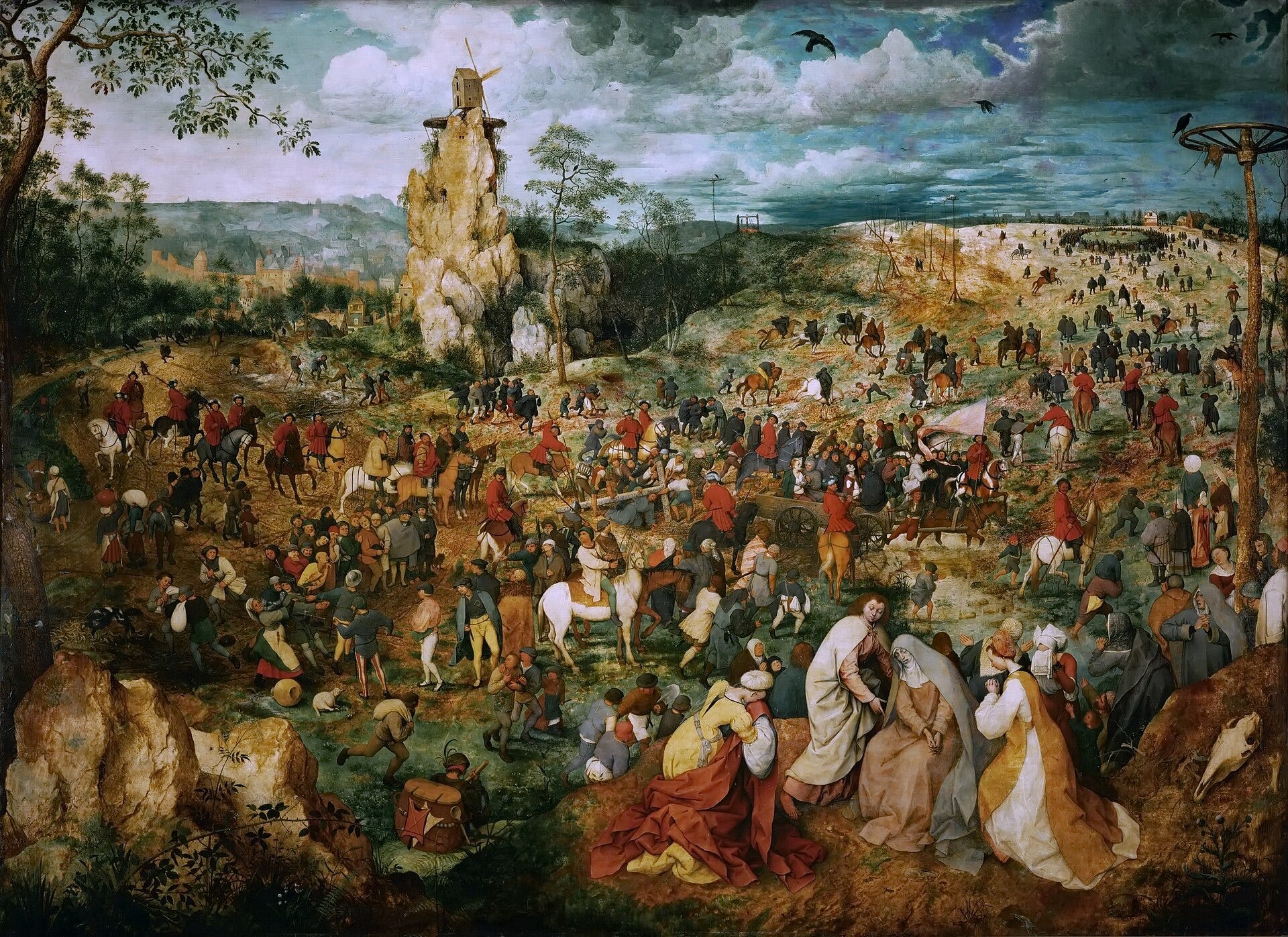
Near the center of a crowded panel, a man in gray has fallen under a heavy wooden cross. He is tiny, and the eye usually finds him last. Around him, some five hundred people stream out of a walled city toward the hill of the execution, and on a tall pillar of rock in the middle distance stands a windmill.
The fallen man is Christ, and the painting is The Procession to Calvary, also known as Christ Carrying the Cross. Bruegel signed it and dated it 1564, the year after his move to Brussels. It is his largest surviving panel, more than four feet high and five and a half feet wide, and the only one of the twelve Bruegels in Vienna that has never been cut down.
On that wide panel, Bruegel set the Gospel story in a Flemish countryside of his own day. Most of the crowd watches the condemned man from a safe distance. Only a small group of women in the right foreground, apart from the others, mourns.
Nearly 450 years later, that crowd became a film. In 2011 the Polish director Lech Majewski based The Mill and the Cross on a book by the critic Michael Francis Gibson and set the whole story inside the painting. Rutger Hauer played Bruegel, Michael York played Nicolaes Jonghelinck, the Antwerp collector who owned sixteen of his pictures, and Charlotte Rampling played the Virgin Mary.
To put his actors into the picture, Majewski mixed live action and blue screen with 2D and 3D images built from the panel itself. The actors walk the road of 1564, past the rock with its mill, toward the hill where the cross will be raised.
At a Glance
Artist: Pieter Bruegel the Elder (about 1525 to 1569)
Painted: 1564
Medium: Oil on oak panel
Size: 124.2 × 170.7 cm (48.9 × 67.2 in)
Where to see it: Kunsthistorisches Museum, Vienna
11. Dulle Griet (1563)
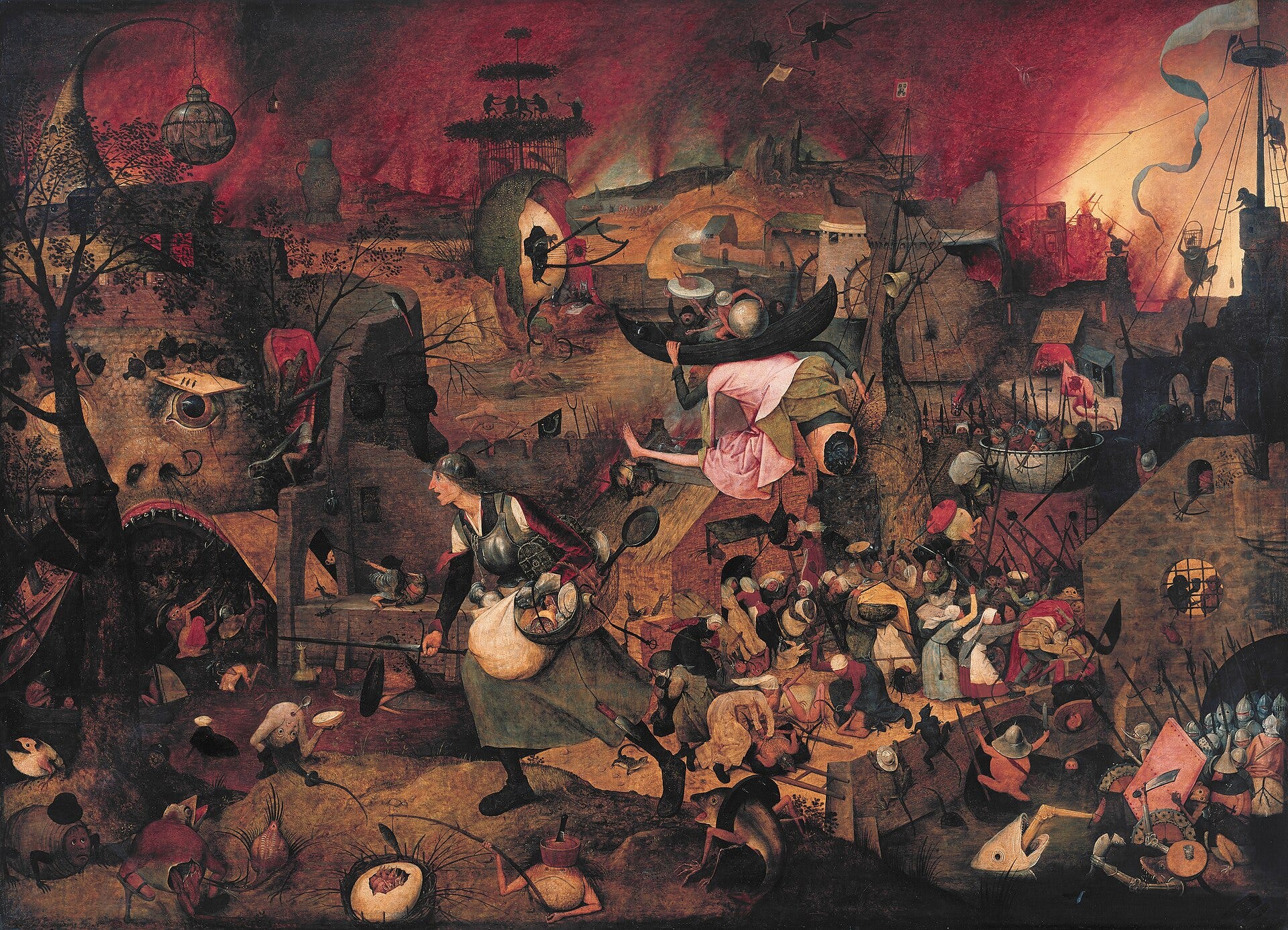
A giant woman in a breastplate and a helmet marches through a burning country, sword raised, her other arm full of loot. She heads for a huge open mouth on the left, the gate of hell, while smaller women fight off strange creatures around her. Close to her, a few letters in the paint were long read as the name of the picture.