Butterfly Paintings: 12 Famous Works to Know
The most famous butterfly paintings hide a heavy idea inside a light subject. To old masters a butterfly meant the soul and the shortness of life, Merian used them to rewrite science, and Van Gogh painted moths from an asylum garden. Here are twelve to know, and where to see them.
For centuries a butterfly in a painting was never just pretty. It stood for the soul, for resurrection, and for how fast beauty fades. Dutch still life painters tucked one onto a flower as a quiet reminder of death. Later artists set it free. The twelve below run from a scientist in Surinam to a moth in a French asylum.
Use this as a quick tour:
The moderns: Van Gogh and Redon, who painted butterflies as feeling.
The scientist: Maria Sibylla Merian, who changed how we understand them.
The Dutch masters: van der Ast, Bosschaert, Ruysch and more, who hid meaning in flowers.
Where to see them: a museum list at the end, grouped by city.
Vincent van Gogh, Butterflies and Poppies
Vincent van Gogh painted Butterflies and Poppies in 1890, in the last months of his life. White butterflies drift over red poppies, the paint laid on thick and quick.
Van Gogh painted several butterfly and grass studies while in and near the asylum at Saint Remy, looking closely at small living things when the wider world felt overwhelming.
It hangs at the Van Gogh Museum in Amsterdam. Knowing how little time he had left, it is hard not to read these fragile insects as a note on how briefly beauty lasts.
Vincent van Gogh, Great Peacock Moth
In 1889 Van Gogh found a huge moth in the garden of the asylum at Saint Remy and painted it at once, resting among green leaves. He wrongly called it a death head moth in a letter.
He was thrilled by its size and colour and wished he could have kept it alive to paint again. The eye spots on its wings stare back at the viewer.
It is at the Van Gogh Museum in Amsterdam. Even confined and unwell, Van Gogh kept turning to the small wonders in front of him, painting a single moth as if it mattered enormously.
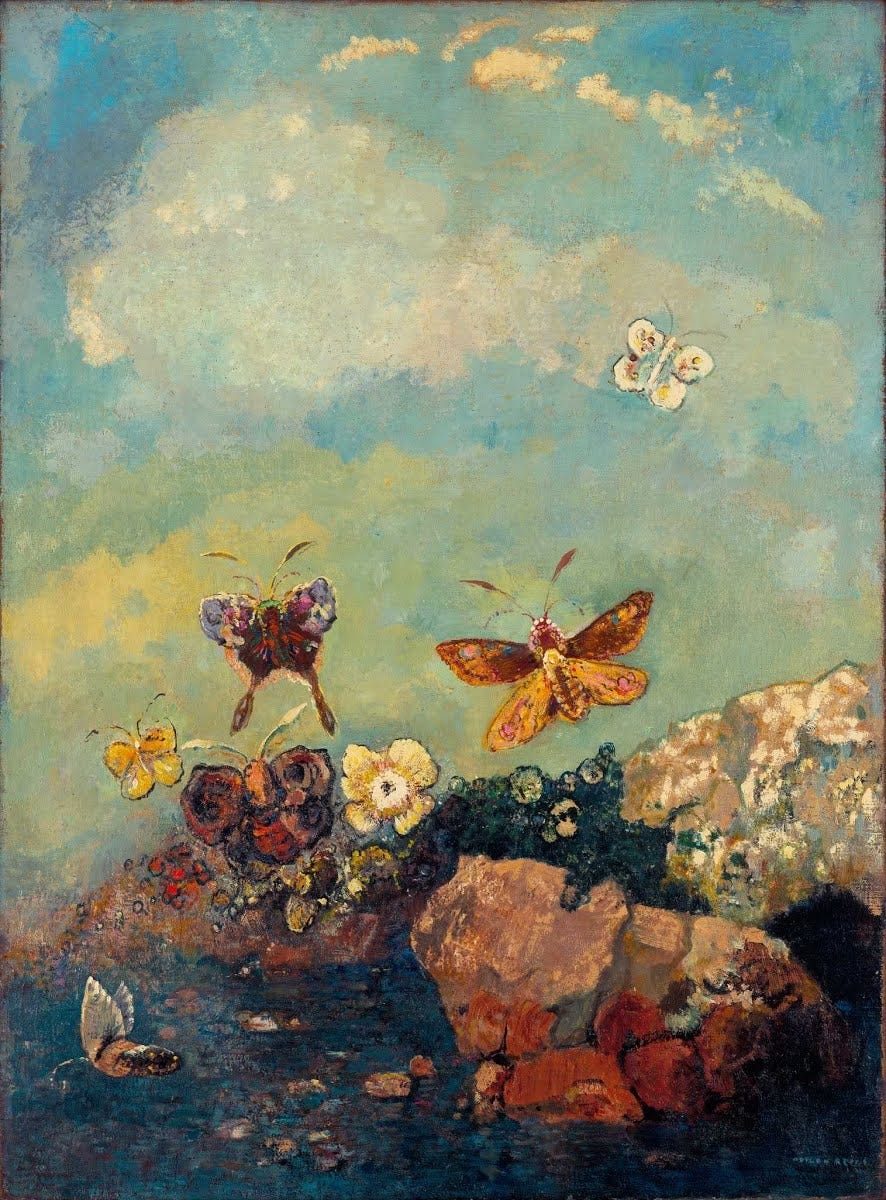
Odilon Redon, Butterflies
Odilon Redon painted swarms of butterflies around 1910, dozens of glowing coloured wings scattered across a soft dreamlike ground. There is no story, only colour and drift.
Redon spent his early career in dark charcoal fantasies, then late in life exploded into colour. These butterflies belong to his Symbolist world, closer to a vision than a nature study.
A famous version is at the Museum of Modern Art in New York. For Redon the butterfly was pure imagination set loose, beauty freed from any lesson.
Maria Sibylla Merian, Metamorphosis of the Butterflies
Maria Sibylla Merian published her great book on the insects of Surinam in 1705, based on a daring expedition she made to South America in her fifties. Each plate shows a butterfly with its caterpillar, chrysalis and the plant it feeds on.
At the time most people still believed insects were born from mud. Merian proved otherwise by raising them herself and drawing the full life cycle, changing science through art.
Her plates are held in major collections including the Rijksmuseum. She was one of the first women who reshaped art history, an artist and a naturalist at once.
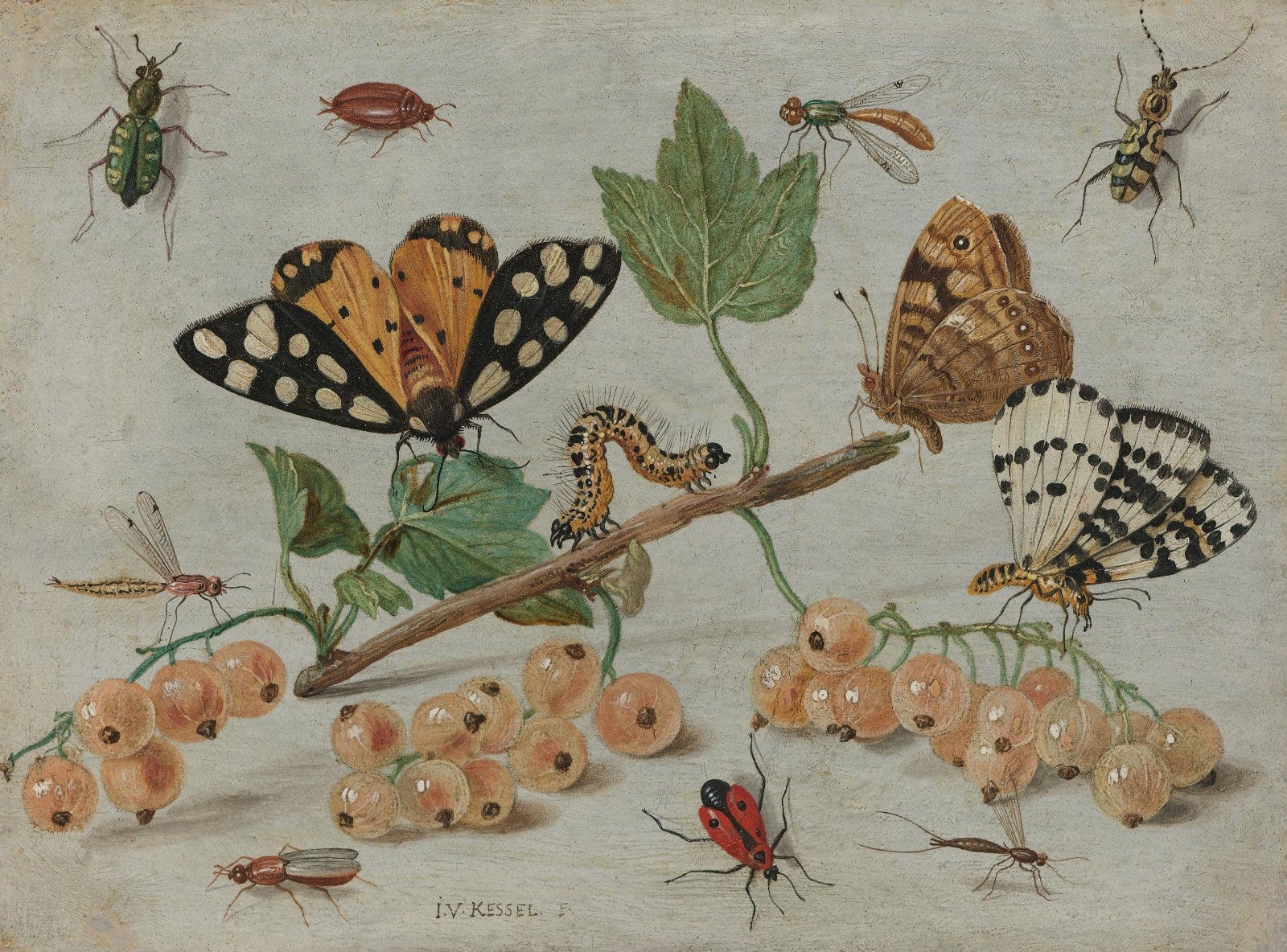
Jan van Kessel the Elder, Insects and Butterflies
Jan van Kessel the Elder made tiny cabinet panels in the mid 1600s, scattering precisely painted butterflies, moths and beetles across a dark ground like specimens pinned to a board.
Van Kessel came from a famous Antwerp painting family and worked almost like a scientist, arranging insects for collectors who loved the new craze for natural curiosities.
His little panels are spread across European museums. They sit right on the line between art and science, a butterfly painted with the care of a jeweller.
Balthasar van der Ast, Still Life with a Butterfly
Balthasar van der Ast painted flower still lifes in the early 1600s where a butterfly almost always appears, resting among tulips, shells and a few flaws in the petals.
In these paintings the butterfly is a coded message. Set beside wilting blooms and a fly, it points to the soul and to how quickly everything beautiful decays, the idea behind every vanitas.
His work hangs in museums across the Netherlands and beyond. The butterfly looks like decoration, but to a viewer of the time it was a small sermon on death and the soul.
Ambrosius Bosschaert, Bouquet with a Butterfly
Ambrosius Bosschaert the Elder was one of the first great Dutch flower painters, and around 1620 he set precise, jewel like bouquets in glass vases, a butterfly perched on a leaf.
Bosschaert combined flowers that bloom in different seasons, so his bouquets never really existed. They were ideal images, and the butterfly added the touch of fragile living beauty.
His paintings are held in the Mauritshuis in The Hague and elsewhere. The single butterfly is the one moving, breathing thing in a perfect, impossible bouquet.
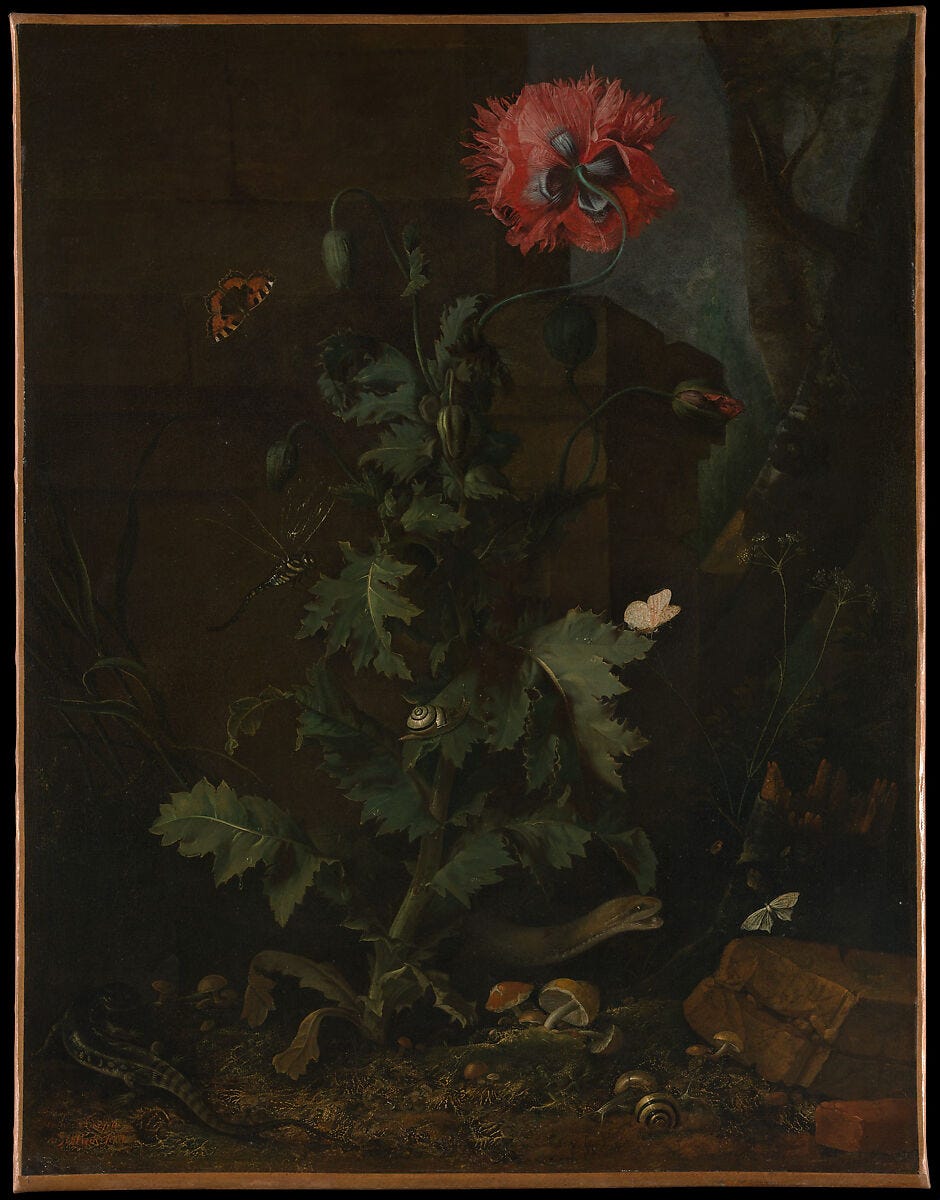
Otto Marseus van Schrieck, Forest Floor with Butterflies
Otto Marseus van Schrieck invented a strange kind of still life in the mid 1600s, the forest floor seen up close and at night, crawling with butterflies, snakes, frogs and toadstools.
He kept a garden full of live insects and reptiles to study, and his shadowy tangles turned the still life into something wild and slightly menacing.
His paintings are held in major European collections. Here the butterfly is not on a neat table but deep in the undergrowth, part of a whole hidden living world.
Rachel Ruysch, Flowers with Insects
Rachel Ruysch was one of the most successful painters of her age, and around 1700 she filled dark dramatic bouquets with butterflies, beetles and lizards hidden among the flowers.
Ruysch worked into her eighties and sold her flower pieces for more than Rembrandt got for many paintings. Her insects are painted with a naturalist eye, each one exact.
Her work hangs in the Rijksmuseum and across Europe. She was one of the great women artists of the Dutch age, and her butterflies are among the finest ever painted.
Jan van Huysum, Flowers with a Butterfly
Jan van Huysum was the most admired flower painter of the early 1700s, and his lavish overflowing bouquets almost always include a butterfly, a bird nest and beads of dew.
Van Huysum was famously secretive, hiding his techniques and refusing pupils. His flowers glow against light backgrounds, a shift away from the dark still lifes before him.
His paintings hang in the Rijksmuseum and the National Gallery in London. The butterfly is the final flourish on bouquets so rich they almost spill out of the frame.
William Bouguereau, Psyche
William Bouguereau painted Psyche in 1892 with the delicate wings of a butterfly, because in Greek myth Psyche is the human soul, and the Greek word for soul also means butterfly.
This is the old symbolism made literal. The butterfly wings turn a young woman into an image of the soul itself, light enough to fly and easy to harm.
Bouguereau was the great academic star of his day, later mocked by the moderns. His Psyche shows exactly why a butterfly haunted painters for so long, it was always about the soul.
Jan Davidsz de Heem, Flowers with a Butterfly
Jan Davidsz de Heem was the grand master of the Baroque still life, and his rich bouquets and fruit pieces of the mid 1600s always carry a butterfly somewhere in the shadows.
De Heem loaded his tables with flowers, fruit, glass and insects, then hid a butterfly as the sign of the soul among all that abundance, a full still life argument about wealth and death.
His work hangs in the Rijksmuseum, the Louvre and beyond. The butterfly is small, but in a de Heem it is often the whole point, the soul among the riches.
Questions people ask about butterfly paintings
What does a butterfly mean in a painting? Traditionally the soul, resurrection and the shortness of life. In Dutch still lifes a butterfly beside wilting flowers is a quiet reminder of death.
Who painted butterflies most famously? Maria Sibylla Merian for science, Van Gogh and Redon among the moderns, and the Dutch still life masters like Rachel Ruysch and Jan van Huysum.
Why did Van Gogh paint moths and butterflies? He painted small living things from the garden of the asylum at Saint Remy, looking closely at nature when the wider world felt too much.
Why is Psyche painted with butterfly wings? In Greek the word for soul also means butterfly, so Psyche, the human soul, is shown with a butterfly’s wings.
Who was Maria Sibylla Merian? A naturalist and artist who travelled to Surinam and proved, through her butterfly paintings, that insects grow from caterpillars rather than mud.
Where to see them
Van Gogh Museum, Amsterdam: Van Gogh Butterflies and Poppies and Great Peacock Moth.
Rijksmuseum, Amsterdam: Ruysch, van Huysum and Merian works.
Museum of Modern Art, New York: Redon Butterflies.
Mauritshuis, The Hague: Bosschaert flower pieces with butterflies.
Keep exploring
If the butterflies pulled you in, three more paths from here. Meet the forgotten women who shaped art in the old masters were women too, learn to read the hidden clues in famous canvases in seven secrets hidden in famous paintings, or start with the basics of still life painting.
One last thing. A butterfly lives a few weeks, yet painters gave it the biggest job in the room, standing in for the soul. Set one beside a dying flower and the whole picture becomes a question about how long any of us gets. Twelve painters, one small, fragile answer.