Candlelight Paintings: 12 Glowing Scenes to Know
Candlelight paintings use one small flame as the only light source. A candle, an ember, or a lantern carves faces out of the dark. The technique runs from Geertgen around 1490 to Petrus van Schendel in the 1800s.
A candle changes everything in a picture. It picks out a cheek, a hand, a page, and drops the rest into shadow. Painters used it to guide your eye and to slow you down. Here are twelve scenes lit by a single flame.
One light source: the flame is usually the only lamp in the room, so the painter controls exactly what you see.
Warm color: candlelight pushes everything toward orange and gold, which is why these scenes feel close and quiet.
Hidden flame: artists often block the candle with a hand or a book, so you get the glow without the glare.
A test of skill: rendering light passing through fingers or smoke was seen as the hardest thing a painter could attempt.
If these draw you in, you will also love 7 secrets hidden in famous paintings, the mafia and the missing Caravaggio, and what a vanitas painting really means.
1. Georges de La Tour, The Magdalen with the Smoking Flame

Mary Magdalene sits alone at night. One hand rests on a skull. A candle burns beside her and its flame smokes in a thin trail.
La Tour was almost erased from history. His name vanished for over two centuries until the scholar Hermann Voss reconstructed his work in 1915. Many pictures once labeled by other artists came back to him.
The smoke here is the point. It marks time passing in real seconds, a quiet clock made of soot.
2. Georges de La Tour, Saint Joseph the Carpenter
Joseph bends over a wooden beam with a drill. A boy, the young Jesus, holds a candle up to light the work. The flame glows through his fingers.
The glowing hand was the hardest test a painter could set. La Tour renders the fingers as translucent red, lit from behind by the flame they shield.
The tools scattered on the floor form a shape. Some readers see the outline of a cross, laid out years before it would matter.
3. Georges de La Tour, The Newborn
A woman holds a tightly wrapped baby. Another woman shields a candle with her hand. The light falls on the infant face and nothing else.
People often call this a Nativity. There are no halos and no saints. It may simply be a mother and her newborn, which is why it feels so plain and true.
The wrapped child looks almost like a loaf of bread. That flat, swaddled form makes the small face above it hit harder.
4. Gerrit van Honthorst, Christ before the High Priest
Christ stands at night before the priest Caiaphas. A single candle sits on the table between them. It lights both faces and leaves the crowd in gloom.
In Rome the Dutch painter was nicknamed Gherardo delle Notti, Gerard of the night. He built a whole career on candlelit scenes for wealthy Italian patrons.
The candle sits dead center, the only calm point in the picture. It puts the accuser and the accused in the same small pool of light.
5. Peter Paul Rubens, Old Woman and Boy with Candles
An old woman holds a lit candle. A boy leans in to light his own from her flame. The two lights flare at the moment they touch.
Rubens was not a night painter, and this small panel is a study, not a commission. He is testing one idea, how fire passes from one wick to another.
The picture shows a candle being lit, not just a candle burning. That single act of sharing a flame is the whole subject.
6. Joseph Wright of Derby, A Philosopher Lecturing on the Orrery

A lecturer explains a model of the solar system to a small group. A lamp sits at the center of the machine, hidden behind a boy head, and lights every face.
The lamp stands in for the sun. Wright placed a source of light inside the orrery so that the model of the heavens is lit exactly the way the real sky is.
There is no god and no altar here, only a lamp and a machine. Wright gave a science lesson the awe of a religious scene.
7. Gerrit Dou, Astronomer by Candlelight
An astronomer works deep into the night. He holds a candle to a celestial globe and measures a distance across it. An hourglass stands nearby.
The panel is barely eight inches wide. Dou worked with a magnifying glass to paint the globe, the book, and the flame at that scale.
The candle lights a globe of the stars, a book, and an hourglass in one small pool. Knowledge and time sit in the same circle of light.
8. Godfried Schalcken, Young Girl with a Candle

A young woman shields a candle with one hand and looks out toward us. The flame lights her face and the curve of her fingers.
The Dutch called these small pictures kaarslichtjes, little candlelights. Schalcken built a European reputation on them and later painted for the court in England.
The hand cupped around the flame does two jobs. It stops the glare and it turns the fingers into a soft red screen.
9. Petrus van Schendel, A Market by Candlelight
A crowded night market spreads out under the dark. Dozens of candles light the stalls, the goods, and the faces of the sellers. A church tower rises behind.
Van Schendel was known across Europe as Monsieur Chandelle, Mister Candlelight. He studied the physics of light and split his studio into a bright half where he painted and a dark half where his models posed.
He is the last great link in this chain. Two hundred years after the Dutch night painters, he was still selling the same trick of one flame in the dark.
10. Caravaggio, The Taking of Christ
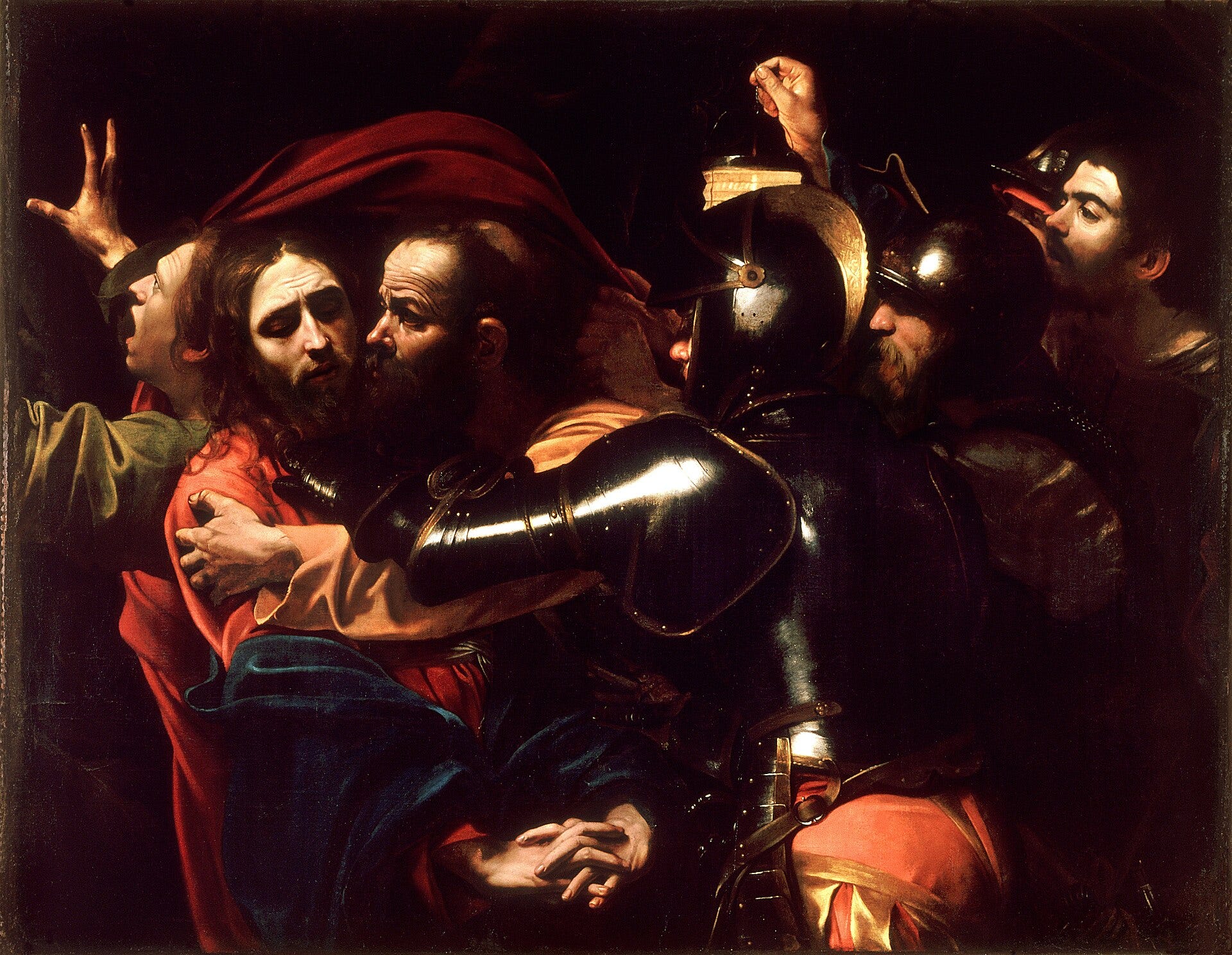
Soldiers seize Christ in the garden at night. On the right, a man lifts a lantern to see the scene. Its light rakes across armor and faces.
That lantern bearer is Caravaggio himself, a self portrait pushed to the edge. The painting was lost for centuries and rediscovered in 1990, hanging unrecognized in a Jesuit house in Dublin.
Caravaggio rarely painted a real flame. He is the reason the whole tradition exists, the man who taught Europe to build a picture out of one light in the dark.
11. El Greco, A Boy Blowing on an Ember to Light a Candle

A boy leans close to a glowing coal and blows on it. The ember flares orange and lights his cheeks and lips from below.
This is a rare everyday subject from El Greco, painted during his years in Italy before he left for Spain. There is no saint and no story, just a boy and a spark.
The light here is not a candle but an ember about to become one. El Greco caught the exact second before a flame is born.
12. Geertgen tot Sint Jans, The Nativity at Night
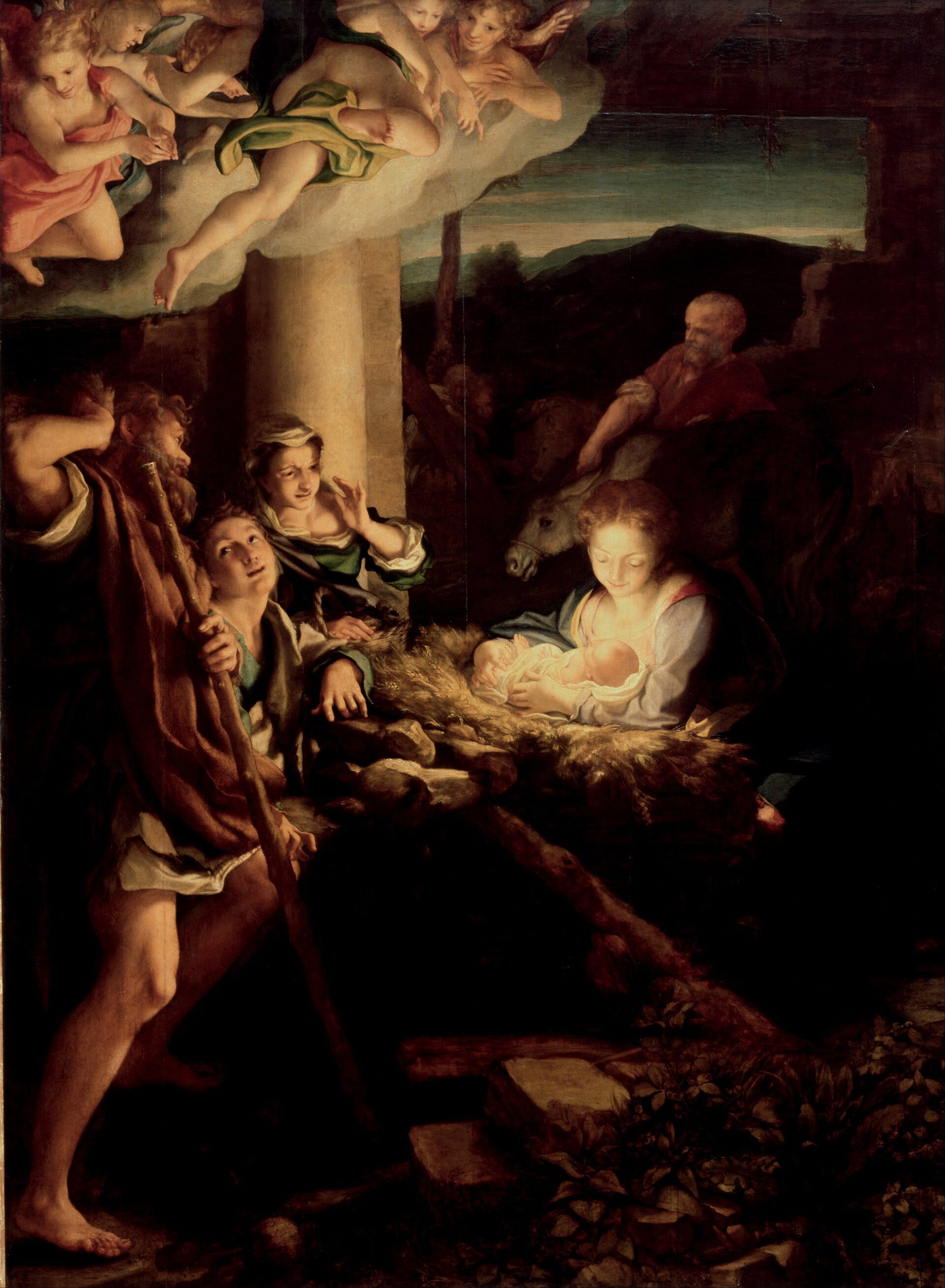
Mary kneels over the newborn Christ in a dark stable. The baby himself glows and lights the faces bent over him. A fire and an angel add smaller lights.
This is one of the earliest night scenes in European painting. The idea of a picture lit from within came from two lost night Nativities by Hugo van der Goes.
Here the light source is a baby, not a candle. Every candlelit painting that followed, for the next four centuries, grew from this small oak panel.
Where to see them
The National Gallery, London: Gerrit van Honthorst Christ before the High Priest and Geertgen tot Sint Jans The Nativity at Night.
Musee du Louvre, Paris: Georges de La Tour Saint Joseph the Carpenter.
Mauritshuis, The Hague: Peter Paul Rubens Old Woman and Boy with Candles.
J. Paul Getty Museum, Los Angeles: Gerrit Dou Astronomer by Candlelight.
National Gallery of Ireland, Dublin: Caravaggio The Taking of Christ.
Why one flame does so much
Almost all of these lean on chiaroscuro, the play of light and shadow, and its deepest form, tenebrism, where a single light glows out of near total dark.
Others are quiet genre scenes of ordinary night, and a few carry a vanitas warning through a skull or a burning candle that time is running out.
Candlelight in art, questions people ask
Who was the greatest candlelight painter? Georges de La Tour is the most admired today, though he was forgotten for over two hundred years and only recovered in 1915.
Why did artists paint by candlelight? One flame let them control exactly what the viewer sees. It also made a picture feel close, quiet, and private.
Did Caravaggio paint candlelight? Rarely, but his dark backgrounds and single light sources made the whole tradition possible. He is its true starting point.
What was Honthorst nickname? In Rome he was called Gherardo delle Notti, Gerard of the night, for his candlelit scenes.
What is the oldest candlelight painting? Geertgen tot Sint Jans painted The Nativity at Night around 1490, one of the first pictures lit from within.
The flame that outlived four centuries
When Petrus van Schendel painted his night markets in the 1800s, he was repeating a trick invented before 1490. From Geertgen glowing infant to Caravaggio lantern to van Schendel crowded stalls, one small flame did the same job for over four hundred years. It told your eye where to look, and it made you stand a little closer.