
Most painters leave a legend. Caravaggio left paperwork: contracts, court files, a police report, a letter from an agent worried about wet varnish. So many of his pictures can be tied to an exact day, a patron or a reason to run. These twelve follow him from his first Roman canvases to one finished while he was still wanted for murder, and one of them carries his signature in blood.
Cool Stories About Art is a newsletter to learn art the fun way.
Join 200,000+ readers and get:
10 new art stories / month
The entire archive of content (1,000+ articles)
Comment, ask questions, and chat with other readers
A Short Career With a Hinge
Caravaggio painted sacred scenes with ordinary faces under a hard, directed light, and his career splits in two. Until 1606 he worked in Rome. That year he killed a man there, and he spent the next four years on the run through Naples, Malta and Sicily.
That break is what lets twelve pictures carry a whole life. Each canvas below is tied to a moment that can be dated: a contract signed, another painter's altarpiece to face, a city that took him in or drove him out. Where he stood explains more about a picture than a catalogue of styles.
The choice follows the route, with the Roman years on one side of the break and the flight on the other. Each entry sets the painter in his place, then follows what he tried and what became of the canvas.
12. The Martyrdom of Saint Ursula (1610)
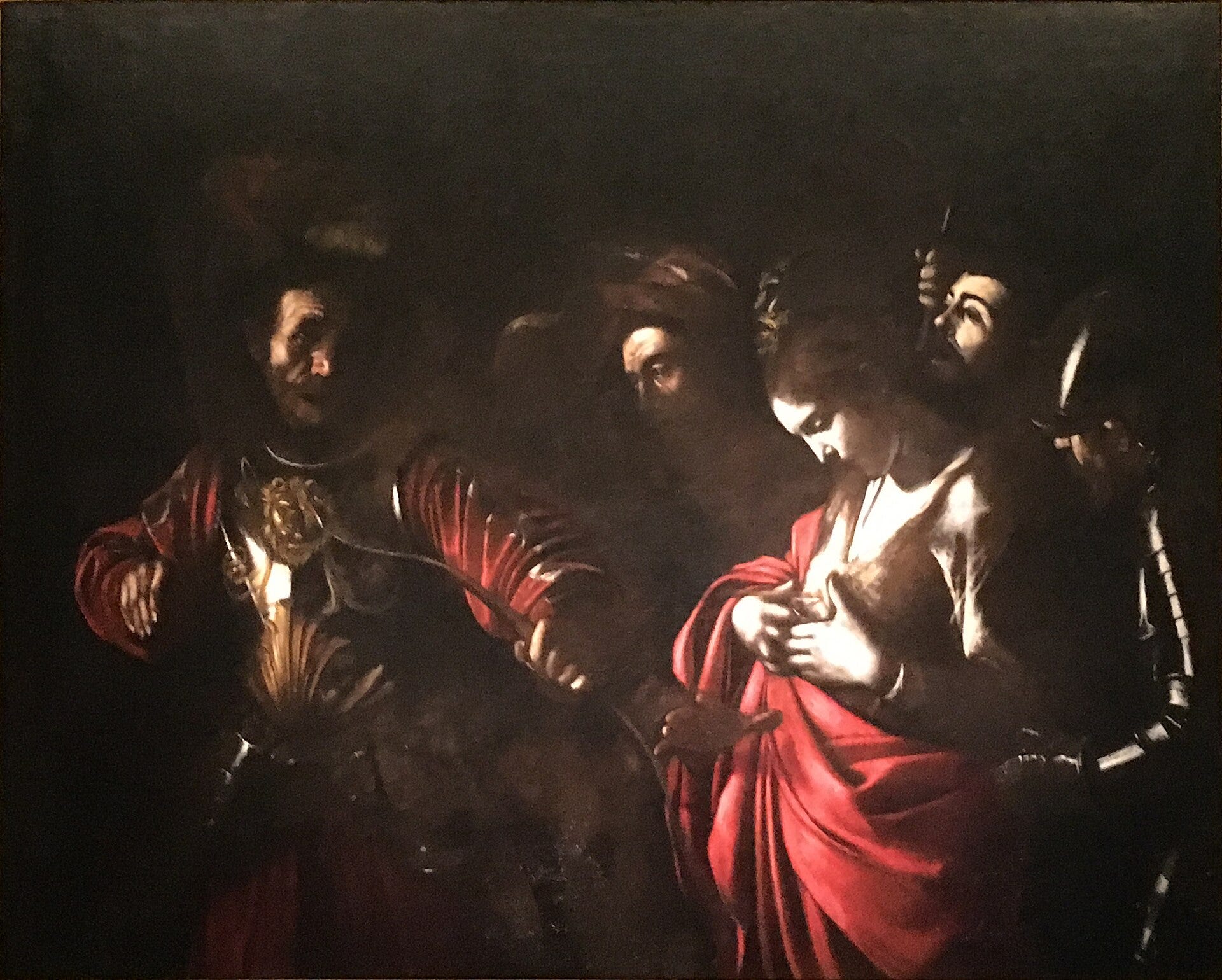
A young woman in a red robe looks down at the arrow that has just entered her chest, and the man who shot it stands close enough to touch her. In The Martyrdom of Saint Ursula, Caravaggio painted the moment from her legend when the king of the Huns, refused in marriage, shoots her at point-blank range.
Behind her shoulder, a pale face with an open mouth looks on, and many read it as the painter's own. I find that face harder to forget than the arrow.
The date was May 1610, and the place was Naples. Caravaggio, thirty-eight, was still under the sentence passed in Rome for a killing four years earlier. Lanfranco Massa, agent of the Genoese patron Marcantonio Doria, wrote that the picture would go that week.
The trouble was the varnish. It was thick and not yet dry, so the canvas had been put in the sun, and the heat softened it. Massa would have to ask Caravaggio how to save it.
The canvas left Naples on 27 May and reached Genoa on 18 June. Until 1980 it passed for a work by Bartolomeo Manfredi or Mattia Preti. Then the historian Vincenzo Pacelli found Massa's letter, and the Ursula went back to Caravaggio.
At a Glance
Artist: Michelangelo Merisi da Caravaggio (1571 to 1610)
Painted: 1610, Naples
Medium: Oil on canvas
Size: 143 × 180 cm (56.3 × 70.9 in)
Where to see it: Gallerie d'Italia, Palazzo Zevallos Stigliano, Naples
11. The Burial of Saint Lucy (1608)
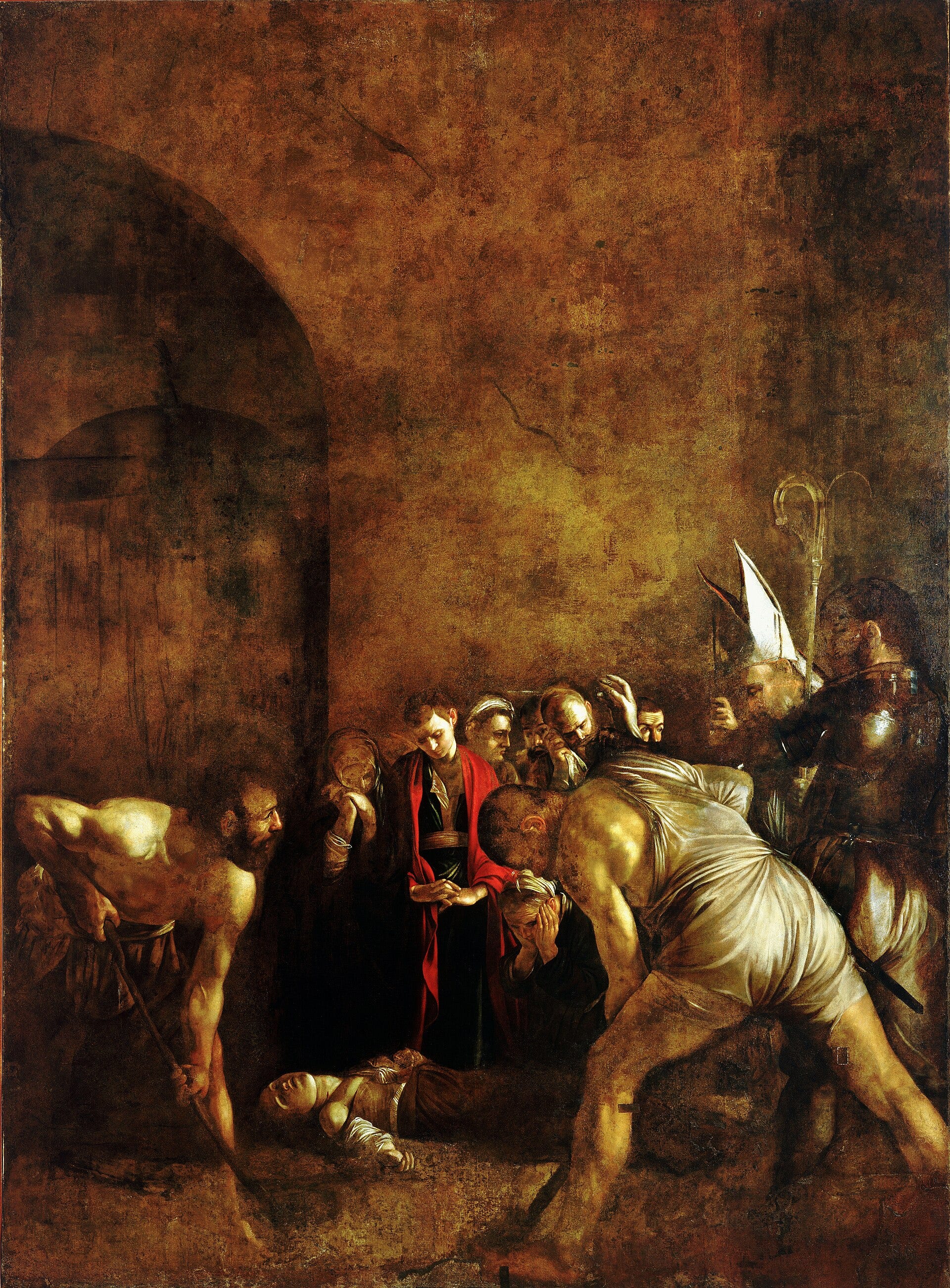
Half of this altarpiece is a bare wall. It climbs nearly to the upper edge, pierced by one dark arch, and under it two gravediggers, huge beside the mourners, bend over a dead woman. A city had just handed its patron saint to a runaway from Malta.