
Many of the summits, shores and ruins that Caspar David Friedrich painted were put together indoors, in a studio in Dresden, from pencil drawings that could be years old. A rock he sketched in the Harz in June 1811 reappeared more than a decade later at the foot of an Alpine peak he had never seen.
Cool Stories About Art is a newsletter to learn art the fun way.
Join 200,000+ readers and get:
10 new art stories / month
The entire archive of content (140+ articles)
Comment, ask questions, and chat with other readers
How Friedrich Built a Landscape
Friedrich came to oil painting late. After settling in Dresden in 1798, he spent about ten years making his name with pencil drawings and sepia, a brown ink brushed on in washes.
Even in oil, his method stayed the same. He drew outdoors, in the Harz and on the islands and coast of the Baltic near Greifswald, where he was born, and painted indoors, often combining sketches made in different places and years.
My guess is that the studio gave him what a single view could not: the freedom to leave things out. The twelve works chosen here follow him from a sepia drawing of 1805 to a night shore finished after a stroke had left him partly paralyzed.
12. The Watzmann (1824 to 1825)
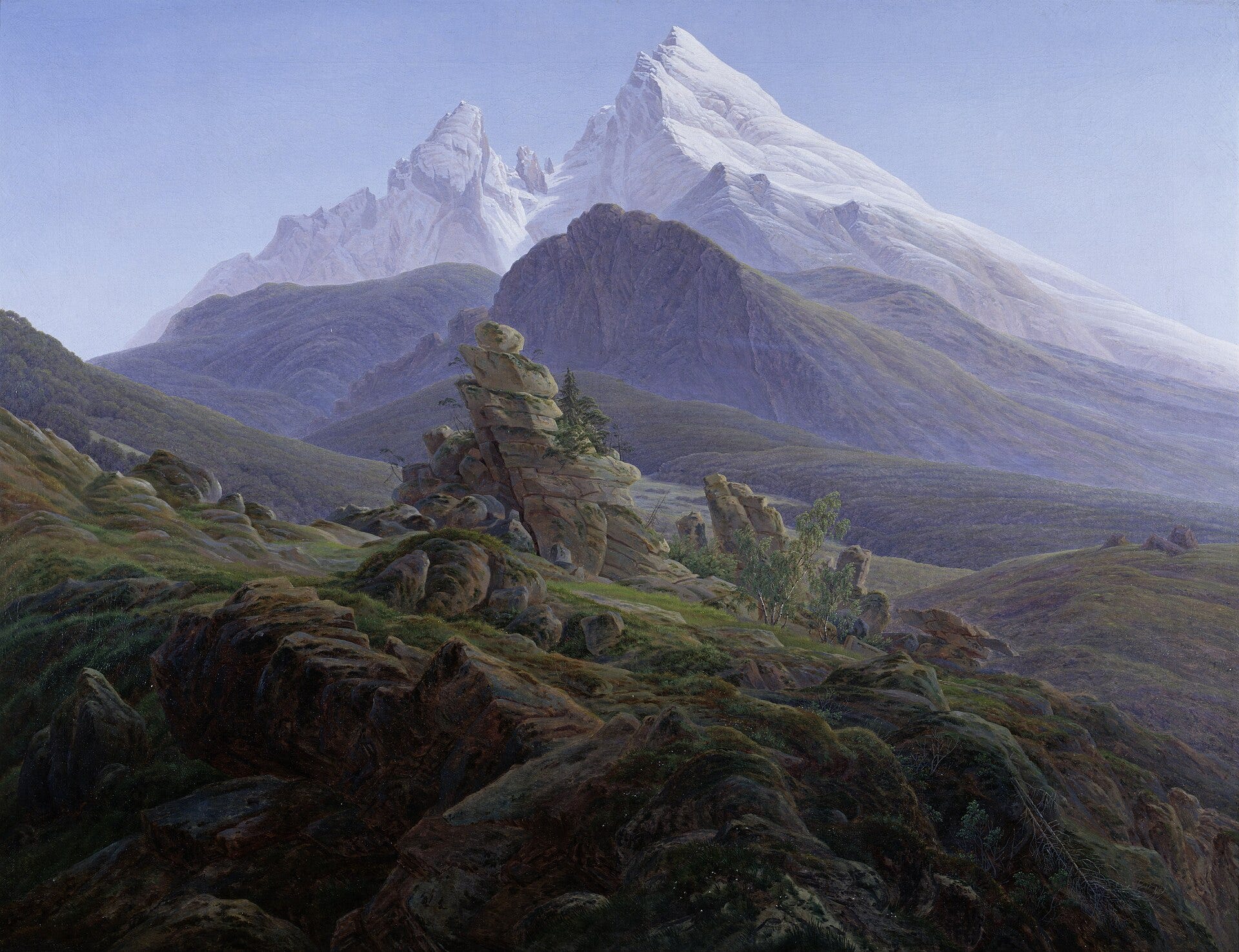
Snow covers the double summit of The Watzmann high above ridge after ridge of gray and brown rock. Lower down, grass and a few small trees grow on a rocky outcrop. Nowhere on the canvas is there a path or a figure.
Friedrich had never been to the Alps. In 1824, the year he was made a professor at the Dresden Academy, Alpine views filled the city's exhibitions. One of them was a Watzmann by Ludwig Richter, a younger painter.
So Friedrich built his mountain out of another man's travels and his own walks. The peak comes from a watercolor by his pupil August Heinrich. The ridges come from his sketches of the Harz and of the Riesengebirge, the Giant Mountains. The rocks below come from a drawing he made on June 28, 1811, on the Trudenstein, near the Brocken.
The bareness of his own picture was probably also an answer to Richter, whose picturesque, storytelling manner Friedrich disliked. In his writings on art, Friedrich complained that landscape painters piled objects in front of, behind and on top of one another.
Shown in Dresden in 1825, the picture unsettled at least one visitor. The reviewer of a literary journal, the Literarisches Conversationsblatt, found something frightening in the complete solitude. One longed to see at least an eagle or a chamois, he wrote, in vain: no life dwelt there but that of air and light.
At a Glance
Artist: Caspar David Friedrich (1774 to 1840)
Painted: 1824 to 1825
Medium: Oil on canvas
Size: 135 × 170 cm (53.1 × 66.9 in)
Where to see it: Alte Nationalgalerie, Berlin
11. Monastery Graveyard in the Snow (1817 to 1819)
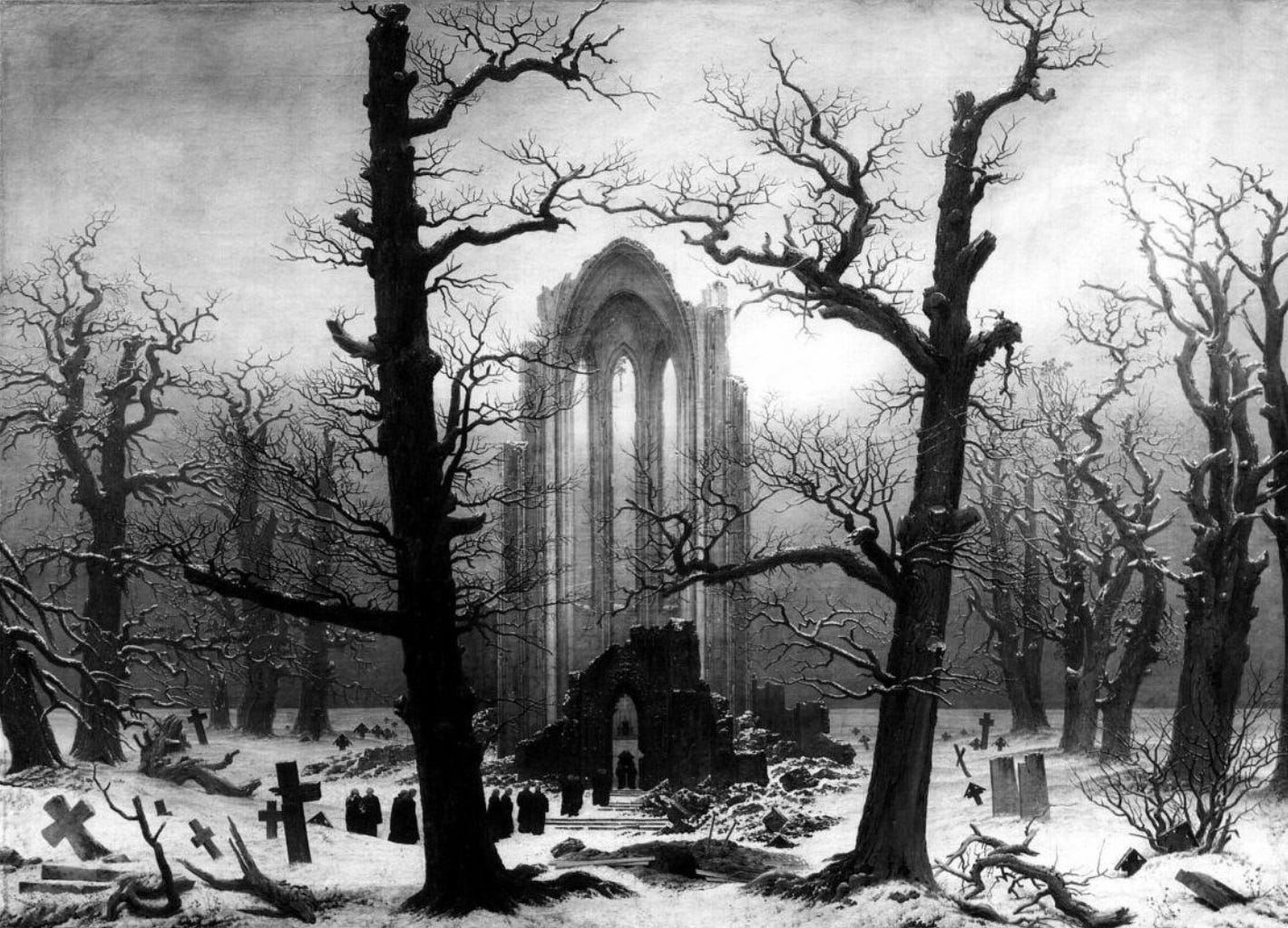
The painting in this black and white photograph no longer exists. Behind bare, twisted oaks rises the tall pointed choir of a ruined Gothic church, and a short line of monks walks between snowy graves toward its open door. The full-size canvas that survives today was painted by someone else.