Cat Paintings: 12 Famous Works to Know

The most famous cat paintings are never just cute. Manet slipped a black cat into a scandal to hint at everything polite society would not say, a Paris cabaret turned a cat into the most famous poster in the world, and a Japanese master built whole alphabets out of cats. Here are twelve to know, and where to see them.

For centuries the cat was a problem for painters, linked to witches, sin and sly independence, the opposite of the loyal dog. Then artists learned to love exactly that mystery. The twelve below run from a Dutch witch’s familiar to a beloved cabaret mascot.

Use this as a quick tour:

  • The provocateurs: Manet, whose black cat carried a hidden meaning.

  • The poster and print masters: Steinlen and Kuniyoshi, who made cats famous.

  • The companions: Renoir, Bonnard and Valadon, cats at home.

  • Where to see them: a museum list at the end, grouped by city.


New here? Learn art the fun way. Free stories every week, no boring lectures.


Edouard Manet, Olympia

A reclining nude stares out boldly while a black cat arches its back at the foot of the bed
Edouard Manet, Olympia, 1863

Edouard Manet painted Olympia in 1863, a reclining nude who stares straight out at the viewer, unashamed. At the foot of the bed, a black cat arches its back, tail up.

The cat is no accident. Where old paintings put a sleeping dog for loyalty, Manet put a bristling black cat, long linked to sex and the night, sharpening the scandal that made Paris gasp.

It hangs at the Musee d’Orsay in Paris. The little cat says everything the polite title will not, and the crowds who saw it in 1865 understood exactly.

Theophile Steinlen, Le Chat Noir

A tall black cat with green eyes and a golden halo sits above the words Le Chat Noir
Theophile Steinlen, Tournee du Chat Noir, 1896

Theophile Steinlen designed this poster in 1896 for the famous Chat Noir cabaret in Montmartre, a tall black cat with fiery green eyes and a golden halo. It became one of the most famous poster images ever made.

The Chat Noir was the wild heart of bohemian Paris, and its cat mascot came to stand for the whole world of artists, poets and night life. The poster still sells by the million.

Original prints hang in museums worldwide. Steinlen, who loved cats and filled his home with them, turned one into an immortal symbol of Paris itself.

Utagawa Kuniyoshi, Cats

A print crowded with expressive cats acting out human scenes in playful poses
Utagawa Kuniyoshi, cats posed as the stations of the Tokaido road, around 1848

Utagawa Kuniyoshi filled his prints with cats around 1848, posing them as actors, arranging them into written characters, even acting out the fifty three stations of a famous road. He is the great cat artist of Japanese woodblock art.

Kuniyoshi kept many cats in his studio and reportedly worked with kittens tucked into his robe. His cats are full of personality, sly, funny and completely alive.

His prints hang in the Metropolitan Museum and beyond. No artist has ever loved drawing cats more, or made them funnier.

Pierre-Auguste Renoir, Woman with a Cat

A young woman cradles a sleeping tabby cat against her in soft warm light
Pierre-Auguste Renoir, Woman with a Cat, around 1875

Pierre-Auguste Renoir painted several women cradling cats in the 1870s, a young woman holding a sleeping tabby against her chest in soft warm light. Cat and sitter blur into one gentle mass.

Renoir loved soft, comfortable pleasure, and a purring cat was the perfect subject, all warmth and contentment. He treated the cat as fondly as the woman holding it.

His cat paintings hang in the National Gallery of Art in Washington and beyond. For Renoir the cat was simply happiness, curled up and warm.

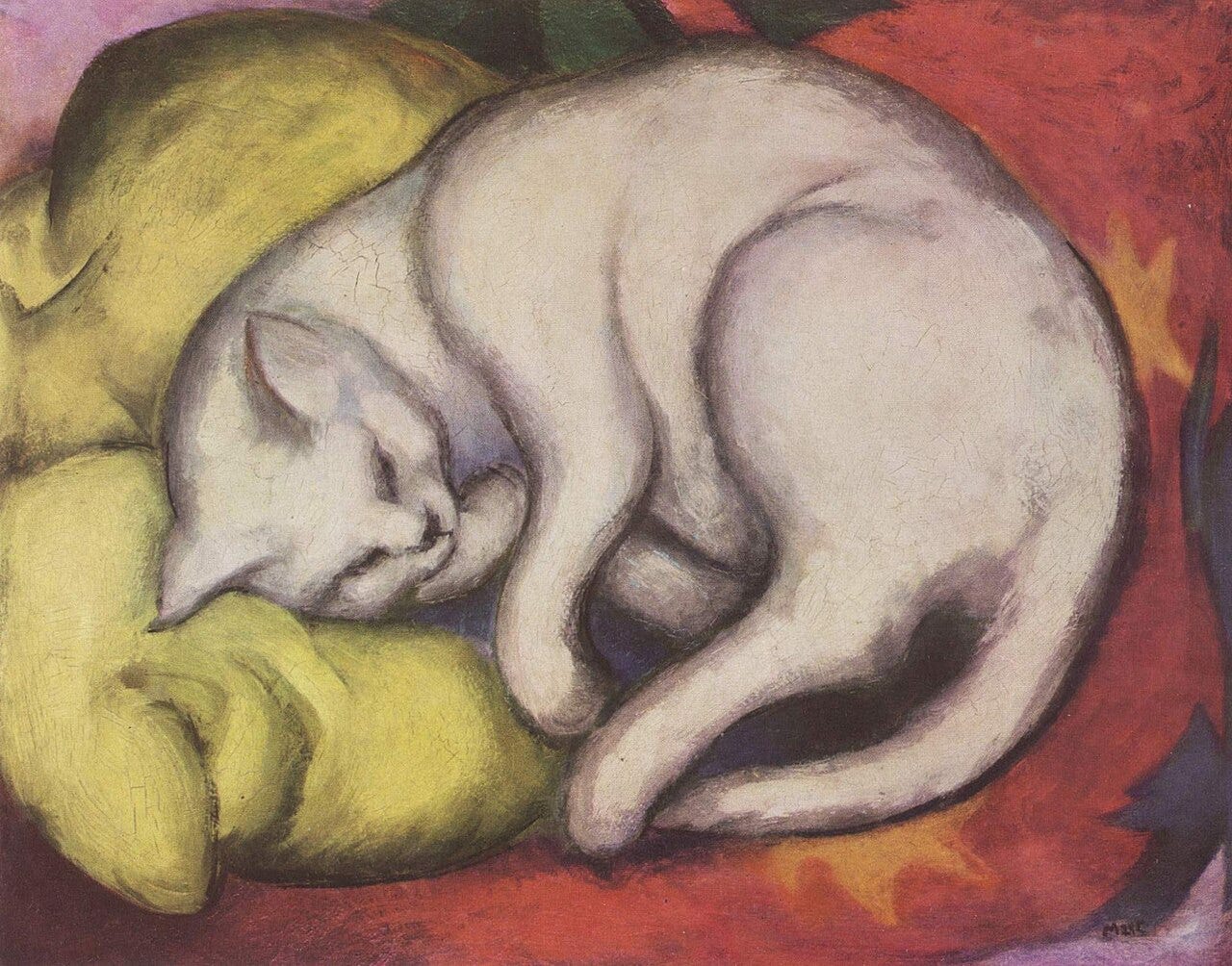
Franz Marc, Cats

Rounded cats in red, yellow and blue curl and stretch across an abstract patterned ground
Franz Marc, Cats, around 1912

Franz Marc painted cats around 1912 in red, yellow and blue, rounded shapes curling and stretching across a patterned ground. This is Expressionism, colour used for feeling, not fact.

Marc believed animals were purer than people and gave each colour a meaning. His cats fold into the coloured world around them, at one with it, gentle and instinctive.

His work hangs in museums across Europe and America. Marc was killed in the First World War a few years later, and his tender animals became an emblem of a lost, kinder world.

Marguerite Gerard, The Cat’s Lunch

An elegant woman in a shining satin dress feeds a small cat in a rich interior
Marguerite Gerard, The Cat’s Lunch, around 1800

Marguerite Gerard painted charming domestic scenes around 1800, including an elegant woman in a gleaming satin dress feeding a small cat in a richly furnished room.

Gerard, trained by her brother in law Fragonard, was a rare successful woman painter of her day. She specialised in these intimate moments where a pampered pet is part of a life of comfort.

Her work hangs in the Hermitage and other collections. The well fed cat is a sign of the whole soft, wealthy world she painted so well.

Theophile Steinlen, Cat in Summer

A sleek cat sits on a sunlit stone balustrade among flowers, tail curled
Theophile Steinlen, a cat on a balustrade, around 1909

Theophile Steinlen returns with one of his many affectionate cat studies, a sleek cat sitting on a sunlit balustrade among flowers, tail neatly curled. He drew the cats of his own home endlessly.

Beyond the famous poster, Steinlen was simply the great everyday painter of the cat, catching every stretch, blink and pounce. His Montmartre studio was full of them.

His cat images hang in collections worldwide. Nobody observed the ordinary house cat with more patience or love.

Pierre Bonnard, The White Cat

A white cat arches with comically long stretched legs against a warm background
Pierre Bonnard, The White Cat, 1894

Pierre Bonnard painted The White Cat in 1894, a white cat arching its back with absurdly, impossibly long stretched legs, eyes shut in a giant yawn. It is almost a cartoon.

Bonnard, a member of the Nabis and a great cat lover, exaggerated the stretch into something funny and strange. He was influenced by the flat, playful design of Japanese prints.

It hangs at the Musee d’Orsay in Paris. Odd and delightful, it catches the exact silly shape a cat makes mid stretch.

Gottfried Mind, Cats

A mother cat with several kittens rendered in soft, lifelike watercolour
Gottfried Mind, a cat with kittens, around 1810

Gottfried Mind, a Swiss artist of the early 1800s, painted cats so well and so often that he was nicknamed the Raphael of Cats. Here a mother cat rests with a litter of kittens.

Mind, who was deaf and had a developmental disability, found in cats a subject he could study endlessly and render with real tenderness. His watercolours of them were treasured across Europe.

His work is held in Swiss and European collections. He may be the first artist to build a whole reputation almost entirely on painting cats.

Edouard Manet, The Cats’ Rendezvous

A black cat and a white cat meet on a moonlit rooftop in a stark print
Edouard Manet, The Cats’ Rendezvous, 1868

Edouard Manet returns with The Cats’ Rendezvous, a print from 1868 showing a black cat and a white cat meeting on a moonlit rooftop. He made it as a poster to advertise a book about cats. It is a stark lithograph.

Reduced to pure black and white shapes, the two cats face off on the tiles, tails high. It is strong, flat and modern, closer to a graphic design than a painting.

Impressions hang in major print collections. Manet, who put a cat at the foot of Olympia, clearly could not leave them alone.

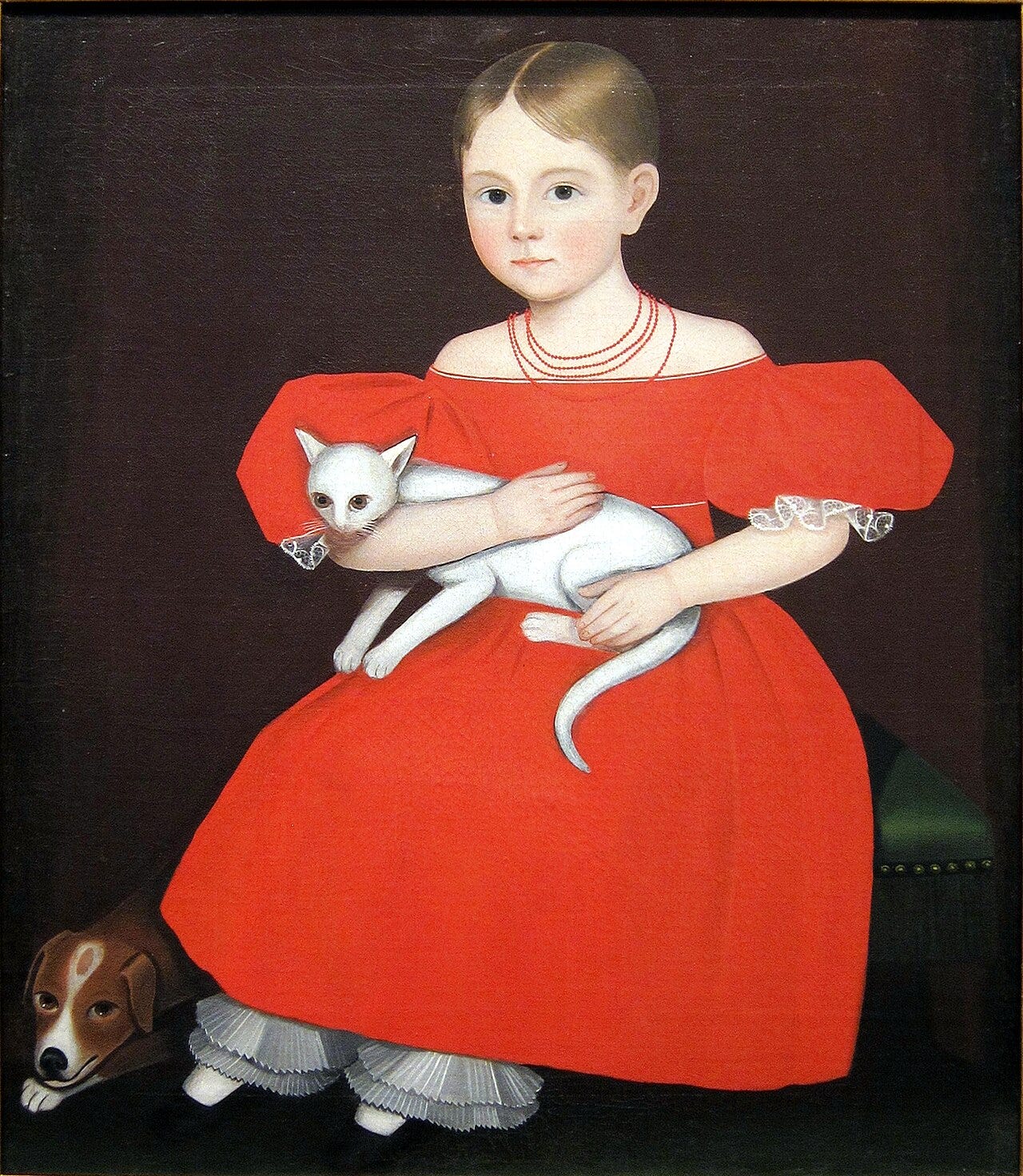
Ammi Phillips, Girl in Red Dress with Cat and Dog

A solemn child in a bright red dress holds a white cat while a small dog sits below
Ammi Phillips, Girl in a Red Dress with a Cat and Dog, around 1835

Ammi Phillips, a travelling American folk painter, made Girl in a Red Dress with a Cat and Dog around 1835, a solemn little girl in a glowing red dress holding a white cat, a small dog at her feet.

Phillips had no formal training and painted flat, simple, unforgettable portraits across rural New York and New England. The white cat in the child’s arms is the warm heart of the picture.

It hangs at the American Folk Art Museum in New York. It has become one of the most loved American folk paintings, and the cat is a big reason why.

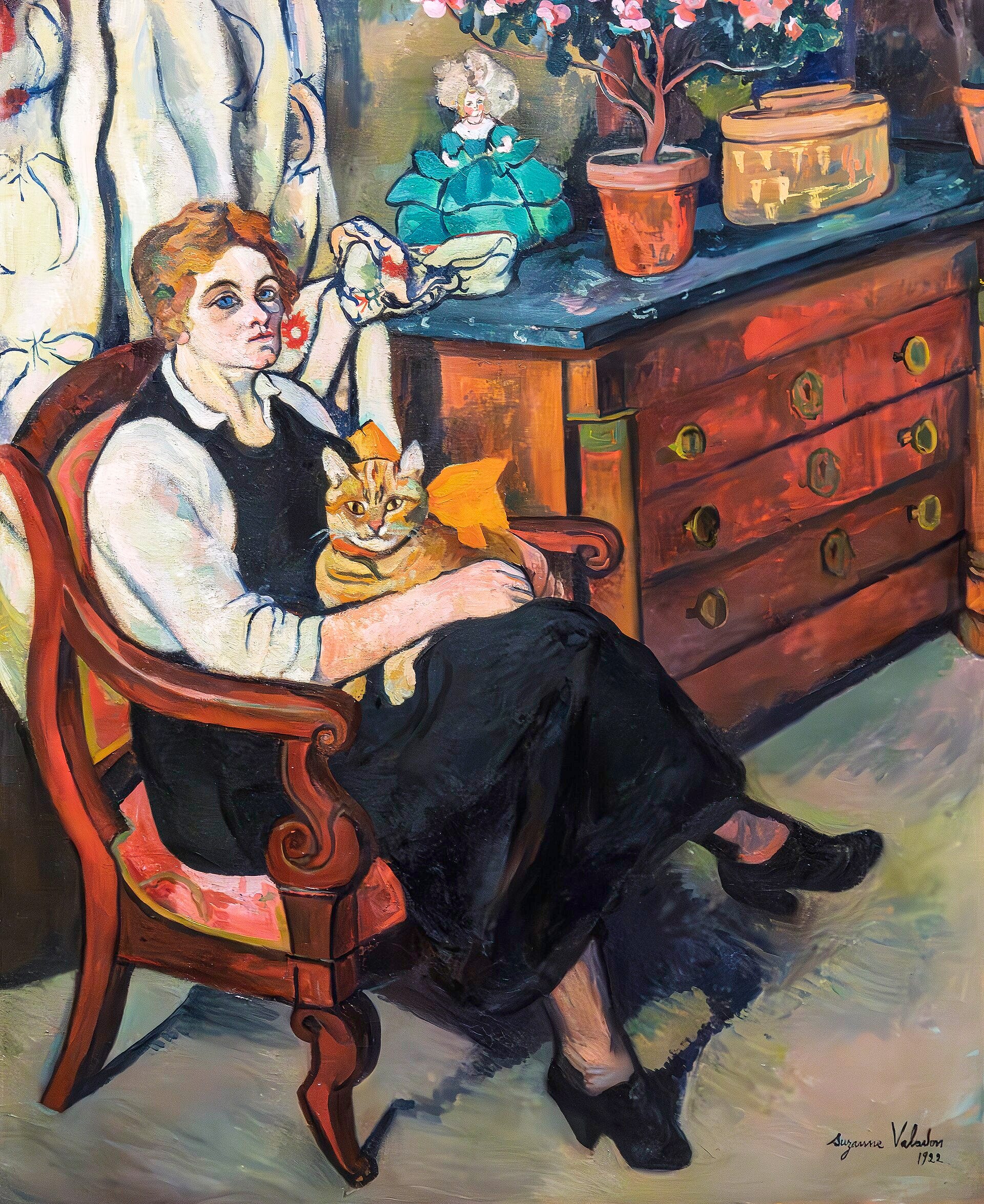
Suzanne Valadon, Woman with a Cat

A woman sits with a cat in her lap, painted in strong outlines and warm colour
Suzanne Valadon, a woman with a cat, around 1920

Suzanne Valadon painted women and their cats in the early 1900s, here a woman with a cat settled in her lap, drawn in strong outlines and warm colour. Valadon herself lived surrounded by cats.

A former circus performer and artist’s model who became a painter, Valadon filled her Montmartre home with strays and even served them caviar on feast days. Her cats are proud, solid and at ease.

Her work hangs in the Centre Pompidou and other French collections. For Valadon, one of the great women painters of Montmartre, the cat was family.


Join 130,000 readers who get the secrets behind the paintings. Free.


Questions people ask about cat paintings

  • Why is there a cat in Manet Olympia? The black cat replaced the sleeping dog of older nudes. Long linked to sex and the night, it sharpened the scandal of a nude who stares straight back at you.

  • What is the Le Chat Noir poster? Steinlen 1896 design for a famous Montmartre cabaret, a black cat with a golden halo. It became one of the most reproduced posters in the world.

  • Who painted the most cats? The Japanese master Utagawa Kuniyoshi and the Paris artist Theophile Steinlen both filled their work with cats, and both kept many at home.

  • Why were cats seen as sinister in old art? They were linked to witches, the night and sly independence, the opposite of the loyal dog, so a cat often hinted at something secret or improper.

  • Who was called the Raphael of Cats? Gottfried Mind, a Swiss artist of the early 1800s who painted cats so well he built his whole fame on them.

Where to see them

  • Musee d’Orsay, Paris: Manet Olympia and Bonnard The White Cat.

  • Metropolitan Museum, New York: Kuniyoshi cat prints.

  • National Gallery of Art, Washington: Renoir Woman with a Cat.

  • American Folk Art Museum, New York: Ammi Phillips Girl in a Red Dress with a Cat and Dog.

Keep exploring

If the cats pulled you in, three more paths from here. Meet the painters who could not work without their cats in 21 famous painters and their cats, learn to read the hidden clues in famous canvases in seven secrets hidden in famous paintings, or start with the basics of portrait painting.


Two new stories a week, 130+ secrets unlocked. Start free.


One last thing. A dog in a painting means loyalty, plain and simple. A cat means something you have to work out, secrecy, sex, wit, independence. That is exactly why painters keep slipping one into the corner. Watch the cat, and the picture gets more interesting.