
Few painters were laughed at in Paris for as long as this one. Salon juries refused him year after year, a critic dismissed him as a madman, and the French state hesitated to accept his pictures even as a gift. Then, a year after his death, a retrospective in Paris sent younger painters home to rethink their own work.
Cool Stories About Art is a newsletter to learn art the fun way.
Join 200,000+ readers and get:
10 new art stories / month
The entire archive of content (140+ articles)
Comment, ask questions, and chat with other readers
Forty Years Spent Looking Hard
For forty years he painted a small world: his family, his wife, a few friends, the fruit on his table and the hills around Aix. He never went looking for new subjects. What he wanted from these familiar ones was their weight, and the way each thing holds its place in space.
That search explains why his pictures can look odd at first. Tables tilt, outlines break, and patches of color do the work that soft shading had done before him. The Cubists would later build a whole method on those very oddities.
The twelve here follow his entire working life, from a portrait made in his late twenties to the huge figure paintings of his final years, and each one is set in the moment of his life that produced it.
12. The Artist's Father, Reading "L'Événement" (1866)
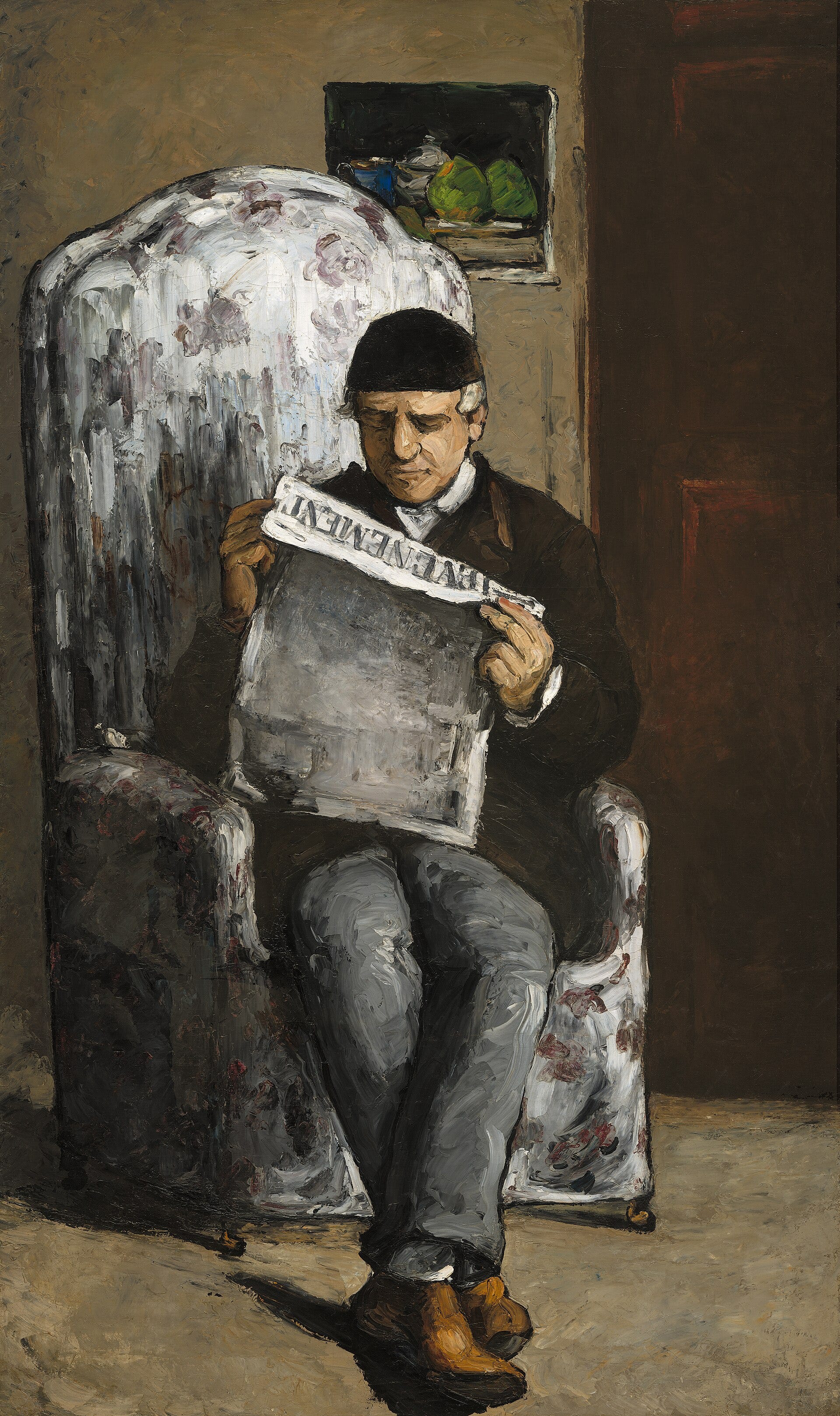
A newspaper hides most of the old man in the tall armchair. Only his head, his hands and his legs show around its edges, and on the wall above him hangs a small still life of green fruit and a blue cup. The Artist's Father, Reading "L'Événement" shows a rich banker painted by the son who refused to become one.
In 1866 Paul Cézanne was twenty-seven, and for five years he had been trying to make a name as a painter in Paris. That spring the Salon, the yearly exhibition whose jury decided which painters Paris would get to see, rejected both canvases he submitted. He went back to Aix, and there he painted his father.
The newspaper in the old man's hands is hard to read as an accident. That same spring, the Paris daily L'Événement was running the Salon reviews of Émile Zola, Cézanne's closest friend since their schooldays in Aix. Zola attacked the jury for shutting out every painter who worked in a new way, and when he gathered the seven articles into a booklet, Mon Salon, he dedicated it "To my friend Paul Cézanne."
The way the picture is painted carries the same defiance. Cézanne laid the paint on thick, in the heavy manner of Gustave Courbet, the leader of the Realists, and the still life on the wall is one of his own works. The canvas stands almost two meters tall, the size of an official portrait, and he spent it on an old man reading at home.
Sixteen years later, this canvas opened a door that stayed shut to all his others. In 1882 it hung at the Salon under a discreet title, Portrait of M. L. A., probably the only time his work was ever shown there. He kept it rolled up until his death, a souvenir of the single welcome the official art world gave him.
At a Glance
Artist: Paul Cézanne (1839 to 1906)
Painted: 1866, Aix-en-Provence
Medium: Oil on canvas
Size: 198.5 × 119.3 cm (78.1 × 46.9 in)
Where to see it: National Gallery of Art, Washington
11. Bathers at Rest (1876 to 1877)
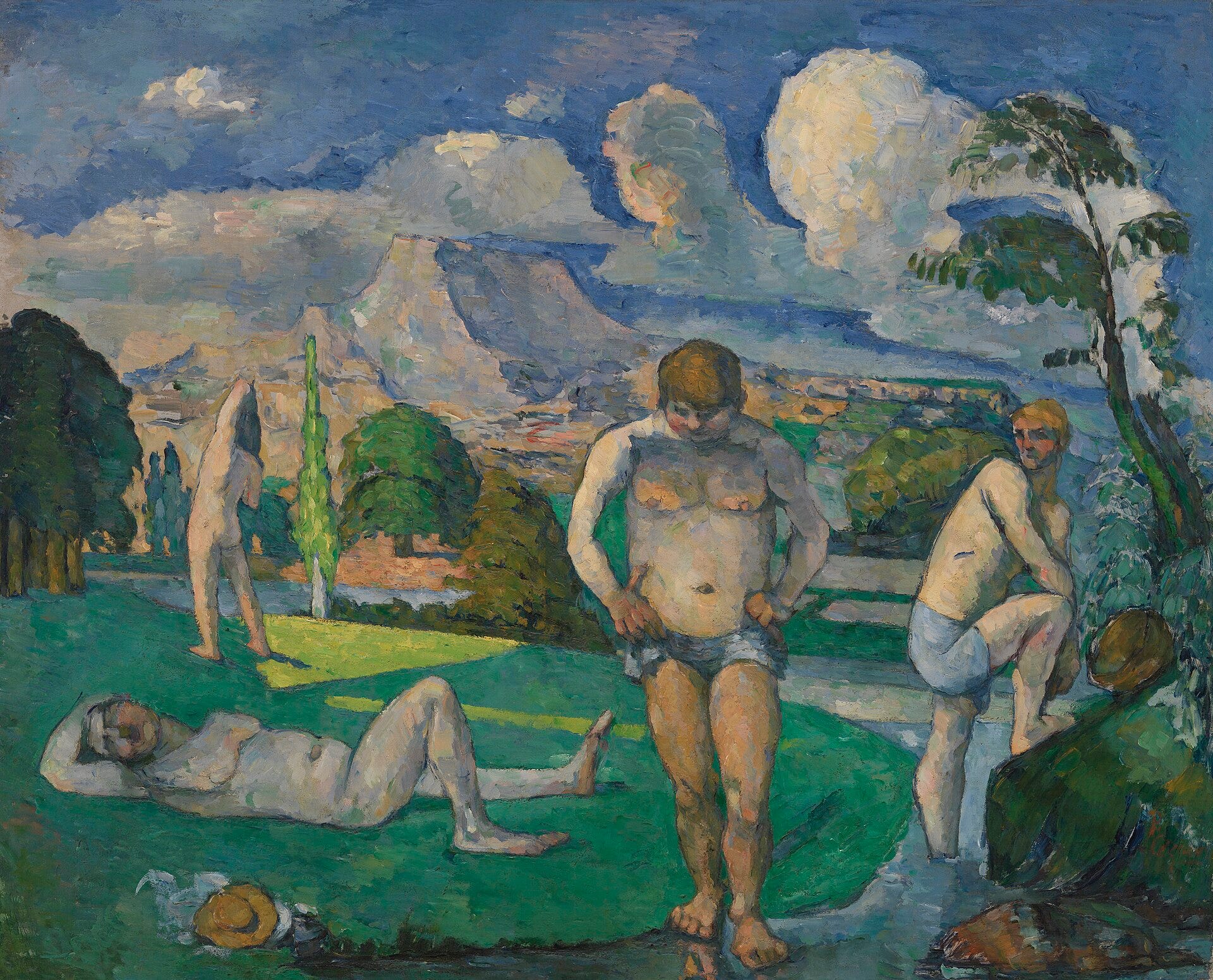
Four naked men sit and stand on a riverbank under heavy clouds, painted in thick strokes of blue and green. Bathers at Rest could have stayed in France. The French state had two chances to keep it, almost forty years apart, and as far as anyone can tell, it let the picture go both times.