Children in Art: 12 Famous Paintings to Know

The most famous paintings of children are rarely as innocent as they look. Velazquez turned a little princess into the heart of the most puzzled over picture in art, a soap bubble stood for how fast life passes, and one dreamy boy blowing bubbles ended up selling soap for a century. Here are twelve to know, and where to see them.

For most of history, children in art were tiny adults, stiff heirs to a throne or symbols of innocence and death. Then painters learned to catch the real thing: the fidget, the daydream, the game. The twelve below run from a Spanish court to a summer garden at dusk.

Use this as a quick tour:

  • The royal heirs: Velazquez and van Dyck, children as future kings.

  • The symbols: Chardin and Millais, childhood as a lesson about time.

  • The real children: Renoir, Sargent and Cassatt, caught at play.

  • Where to see them: a museum list at the end, grouped by city.


New here? Learn art the fun way. Free stories every week, no boring lectures.


Diego Velazquez, Las Meninas

The young Infanta Margarita stands among her maids as the painter works at a huge canvas
Diego Velazquez, Las Meninas, 1656

Diego Velazquez painted Las Meninas in 1656, and its centre is a five year old, the blonde Infanta Margarita, surrounded by her maids, a dog and two dwarfs, in the painter’s own studio.

The little princess holds the whole picture together while the king and queen appear only as a reflection in a distant mirror. It is often called the greatest portrait ever painted, and a child is its heart.

It hangs at the Prado in Madrid. Scholars have argued for centuries about what is really happening, but everyone remembers the small, solemn girl in the middle.

Bartolome Esteban Murillo, Boys Eating Grapes and Melon

Two ragged street boys grin as they eat fruit in a sunlit corner
Bartolome Esteban Murillo, Boys Eating Grapes and Melon, around 1650

Bartolome Murillo painted ragged street children around 1650, here two grinning boys tucking into grapes and melon in a sunny corner of Seville. This is genre painting, everyday life rather than saints or kings.

Murillo, famous for his tender Virgins, also loved the poor children of his city, painting them with warmth and dignity rather than pity. Their grins are completely real.

It hangs at the Alte Pinakothek in Munich. These cheerful, hungry boys were something new, ordinary children painted as worth a great artist’s attention.

Joshua Reynolds, The Age of Innocence

A young girl in a white dress sits in a landscape with her hands folded, gazing softly out
Joshua Reynolds, The Age of Innocence, around 1788

Joshua Reynolds painted The Age of Innocence around 1788, a small girl in a simple white dress seated in a landscape, hands folded, gazing softly out. The title alone tells you how to feel.

Reynolds, the grand portraitist and first head of the Royal Academy, helped invent this new idea of childhood as a state of natural innocence, freshly fashionable in his day.

It hangs at the Tate in London. Endlessly copied and printed, it became the very image of the innocent child for generations.

Thomas Gainsborough, The Blue Boy

A boy in a shining blue satin costume stands confidently in a dark landscape
Thomas Gainsborough, The Blue Boy, around 1770

Thomas Gainsborough painted The Blue Boy around 1770, a boy standing confidently in a gleaming blue satin costume from a century earlier, against a stormy landscape. He is probably a merchant’s son dressed up as a young aristocrat.

Gainsborough painted the gleaming blue silk to prove a point about colour to his rival Reynolds, and the oil handling is extraordinary. The boy became one of the most famous images in British art.

It hangs at the Huntington in California. Reproduced on everything from chocolate boxes to films, the confident boy in blue is instantly recognised worldwide.

Jean-Simeon Chardin, Soap Bubbles

A boy leans out of a window blowing a large fragile soap bubble as a small child watches
Jean-Simeon Chardin, Soap Bubbles, around 1734

Jean-Simeon Chardin painted Soap Bubbles around 1734, an older boy leaning out of a window to blow a single large, trembling bubble while a small child peeps over the sill to watch.

The bubble is the whole point. Beautiful and about to burst, it was a centuries old symbol of how short and fragile life is. Chardin wraps that heavy idea in a perfect quiet moment.

Versions hang at the Metropolitan Museum and the National Gallery of Art in Washington. A child at play becomes a gentle sermon on time.

John Everett Millais, Bubbles

A golden haired boy in green gazes up at a soap bubble he has just blown
John Everett Millais, Bubbles, 1886

John Everett Millais painted Bubbles in 1886, a golden haired boy gazing up at a soap bubble he has just blown, a broken pipe and a fallen pot beside him. It echoes Chardin’s old theme in a late Pre-Raphaelite style.

The model was Millais’s own grandson. To his fury, the painting was bought and used to advertise Pears soap, one of the first times fine art was turned into a brand campaign.

It hangs at the Lady Lever Art Gallery near Liverpool. The delicate meditation on fleeting life became, forever, a soap advert.

Pierre-Auguste Renoir, A Girl with a Watering Can

A small girl in a blue dress stands in a flowery garden holding a watering can
Pierre-Auguste Renoir, A Girl with a Watering Can, 1876

Pierre-Auguste Renoir painted A Girl with a Watering Can in 1876, a small girl in a lace trimmed blue dress standing in a sunlit flowery garden, holding a little watering can. It is pure Impressionist happiness.

Renoir dissolved the child, flowers and grass into one warm shimmer of colour and light. There is no lesson here, only the simple pleasure of a child in a garden.

It hangs at the National Gallery of Art in Washington. Renoir made childhood look exactly as sweet and sunlit as we wish it were.

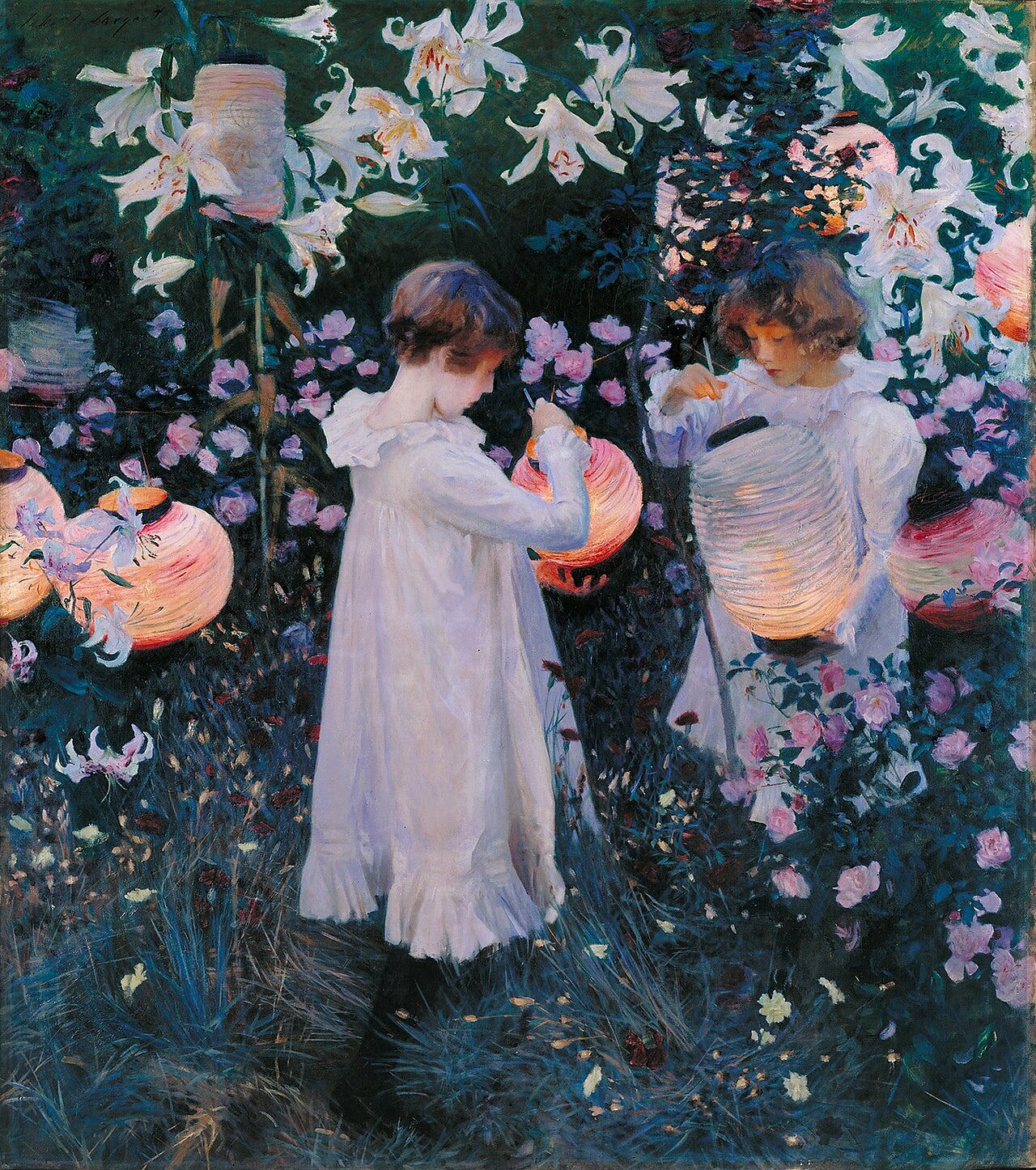
John Singer Sargent, Carnation, Lily, Lily, Rose

Two small girls in white light paper lanterns among tall flowers at dusk
John Singer Sargent, Carnation, Lily, Lily, Rose, 1886

John Singer Sargent painted Carnation, Lily, Lily, Rose in 1886, two small girls in white dresses lighting paper lanterns among tall lilies and roses in the blue glow of dusk.

Sargent could only paint for a few minutes each evening, in the exact fading light, so it took two whole summers. He even replanted the garden to keep the flowers blooming for the picture.

It hangs at Tate Britain in London. The two absorbed children in the twilight garden make one of the most magical images of childhood ever painted.

Diego Velazquez, Prince Balthasar Charles on Horseback

A small royal boy in a sash rides a rearing pony against a mountain landscape
Diego Velazquez, Prince Balthasar Charles on Horseback, around 1635

Diego Velazquez painted the little heir to Spain, Prince Balthasar Charles, on horseback around 1635, a small boy in a general’s sash riding a plump rearing pony against a mountain landscape.

The child is dressed and posed exactly like his warrior father, a future king in miniature. Sadly the prince died at just sixteen, so the grand image outlived its subject.

It hangs at the Prado in Madrid. It shows the old idea of a royal child, not really a child at all, but a kingdom’s hope in small form.

Anthony van Dyck, The Five Eldest Children of Charles I

Five royal children pose together with a huge mastiff dog in a grand setting
Anthony van Dyck, The Five Eldest Children of Charles I, 1637

Anthony van Dyck painted the five eldest children of King Charles I of England in 1637, standing solemnly together with a huge mastiff, the future king Charles II resting his hand on the dog.

Van Dyck gave the royal children real presence and softness, but also the weight of their future. Within a few years their world would collapse and their father would be executed.

It hangs in the Royal Collection at Windsor. Painted in calm splendour, it is shadowed by everything we know was about to happen to them.

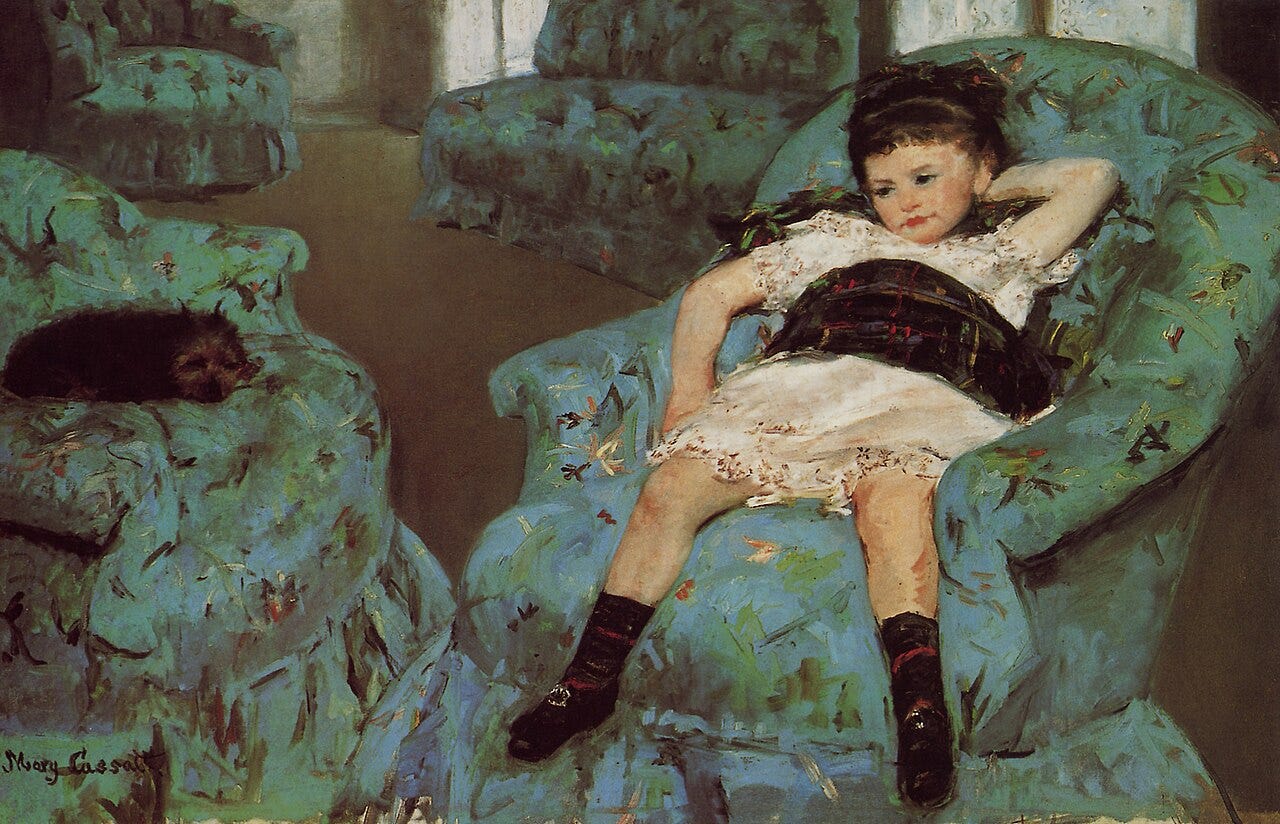
Mary Cassatt, Little Girl in a Blue Armchair

A small girl sprawls sideways in a large blue armchair, bored and restless, a dog nearby
Mary Cassatt, Little Girl in a Blue Armchair, 1878

Mary Cassatt painted Little Girl in a Blue Armchair in 1878, a small girl flung sideways across a huge blue armchair, bored, restless and slumped, a little dog dozing on another chair. It is childhood caught honestly. It is a fresh Impressionist view.

Cassatt refused to make the child sweet or posed. Her friend Degas even helped with the background. She was one of the great women artists of the age, and she painted real children, not dolls.

It hangs at the National Gallery of Art in Washington. That bored, sprawling girl feels more alive than any perfectly behaved little princess.

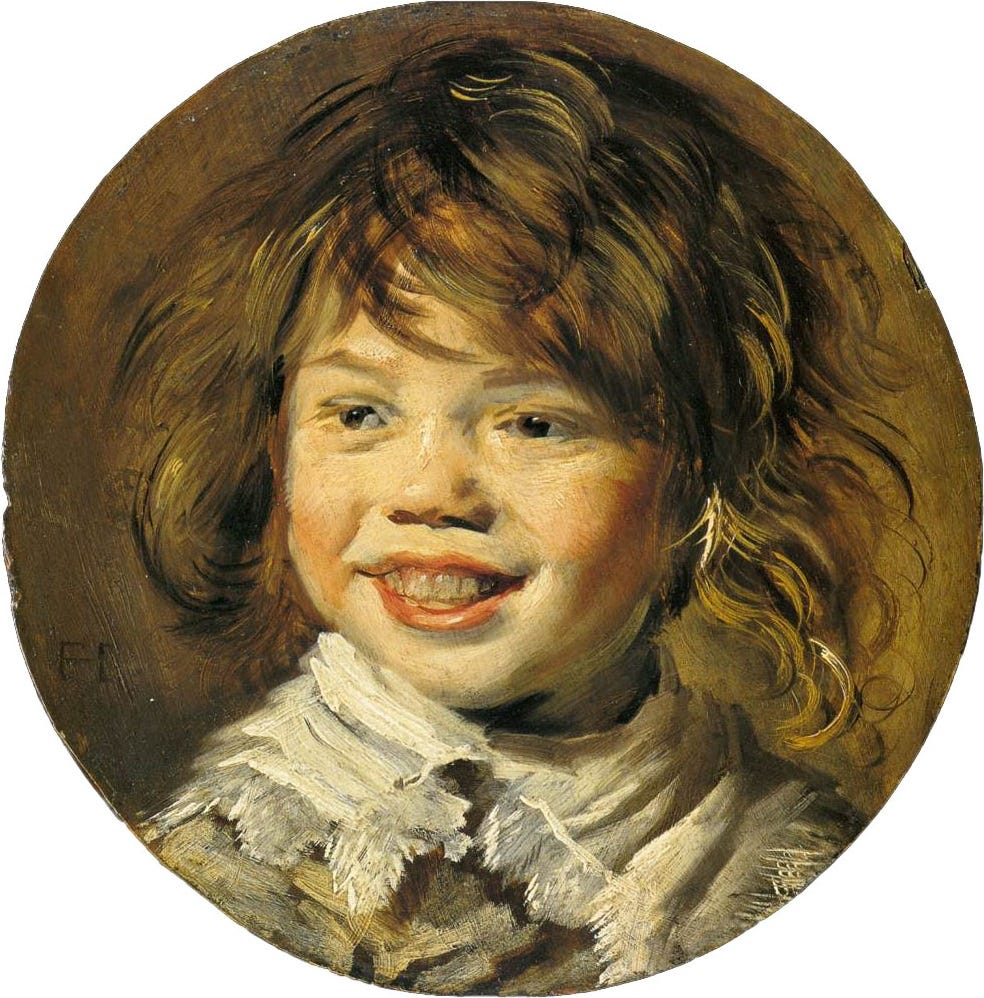
Frans Hals, Laughing Child

A small child laughs openly, painted with quick, lively brushstrokes
Frans Hals, a laughing child, around 1620

Frans Hals painted laughing children in the early 1600s, catching a small child mid laugh with a few quick, lively strokes. Nobody before him had caught a child’s face so alive.

Hals worked fast and loose, and that speed is exactly what lets him seize a fleeting giggle. Where others painted stiff little adults, Hals painted a real laughing child.

His laughing children hang in museums across Europe. They are among the first paintings to catch a child simply being joyful, in a single passing instant.


Join 130,000 readers who get the secrets behind the paintings. Free.


Questions people ask about children in art

  • Who is the child in Las Meninas? The five year old Infanta Margarita, daughter of the king of Spain. Velazquez placed her at the centre of what many call the greatest painting ever made.

  • Why do children blow bubbles in paintings? A soap bubble is beautiful and bursts in a second, an old symbol of how short and fragile life is. Chardin and Millais both used it.

  • Why was The Blue Boy so famous? Gainsborough painted the gleaming blue satin to win a colour argument with his rival Reynolds, and the confident boy became a British icon.

  • How long did Sargent Carnation, Lily, Lily, Rose take? Two whole summers, because he could only paint for a few minutes each evening in the exact fading light.

  • Why does the girl in Cassatt armchair look bored? Cassatt refused to make children sweet or posed, so she caught a real restless child slumped in a huge chair, honest rather than pretty.

Where to see them

  • Prado, Madrid: Velazquez Las Meninas and Prince Balthasar Charles on Horseback.

  • Tate Britain, London: Reynolds The Age of Innocence and Sargent Carnation, Lily, Lily, Rose.

  • National Gallery of Art, Washington: Renoir A Girl with a Watering Can and Cassatt Little Girl in a Blue Armchair.

  • The Huntington, California: Gainsborough The Blue Boy.

  • Royal Collection, Windsor: van Dyck The Five Eldest Children of Charles I.

Keep exploring

If the children pulled you in, three more paths from here. Meet the forgotten women who painted them in the old masters were women too, learn to read the hidden clues in famous canvases in seven secrets hidden in famous paintings, or start with the basics of portrait painting.


Two new stories a week, 130+ secrets unlocked. Start free.


One last thing. A child in a painting is never only a child. It is an heir, a symbol, a memory, a warning about how fast it all goes. The greatest painters caught both at once, the real fidgeting kid and the whole weight of what childhood means. These twelve still do.