Famous Chinese Paintings: 12 Masterworks
Chinese painting is one of the oldest living art traditions on earth, and it plays by rules of its own. It prizes ink over color, the brush over the likeness, and above all the landscape, painted not to copy a view but to hold the living breath, the qi, of mountains and water.
Here are twelve of the most famous Chinese paintings, most of them guarded as national treasures and almost never shown. A warning before you scroll: several are handscrolls, meant to be opened an arm's length at a time, not hung on a wall like a Western picture.
Where this gets properly interesting
Three that changed how I look at a picture:
Was Monet really the first Impressionist, the painting that may have got there first
The secret behind Monet Magpie, one bird in the snow, and why it matters
Six women, one monster, what Picasso did to the women who loved him
1. Zhang Zeduan, Along the River During the Qingming Festival, around 1120

If China has one painting everyone knows, it is this. Zhang Zeduan painted a five meter handscroll of the Song capital on a spring festival day, teeming with life, and it lives in the Palace Museum in Beijing.
Count the crowd and you find more than eight hundred people, dozens of boats, animals, shops and bridges, all in exact detail. It is a documentary of a lost city, closer to a street view than a landscape.
The scroll has been copied and reimagined for nine centuries, and it may be the most influential single work in all of Chinese art.
2. Fan Kuan, Travelers Among Mountains and Streams, around 1000
This is the mountain that all later Chinese landscapes look up to. Fan Kuan painted a single vast cliff filling most of the silk, with a thin waterfall and, far below, a tiny mule train you almost miss.
The point of Chinese landscape painting is right here. Man is small, nature is immense, and the aim is not a real place but a feeling of standing before something eternal.
For a thousand years it was known only from records. Fan Kuan's tiny signature was found hidden in the leaves only in 1958, proving it was really his.
3. Wang Ximeng, A Thousand Li of Rivers and Mountains, 1113
The most astonishing fact about this glowing blue and green panorama, nearly twelve meters long, is the age of the painter. Wang Ximeng made it as a teenager, taught personally by the art loving emperor Huizong.
He ground precious minerals, azurite and malachite, into the pigments, so the mountains still shine after nine hundred years.
Wang Ximeng died in his early twenties. This single scroll is almost the only thing he left, and it is one of the treasures China most rarely puts on show.
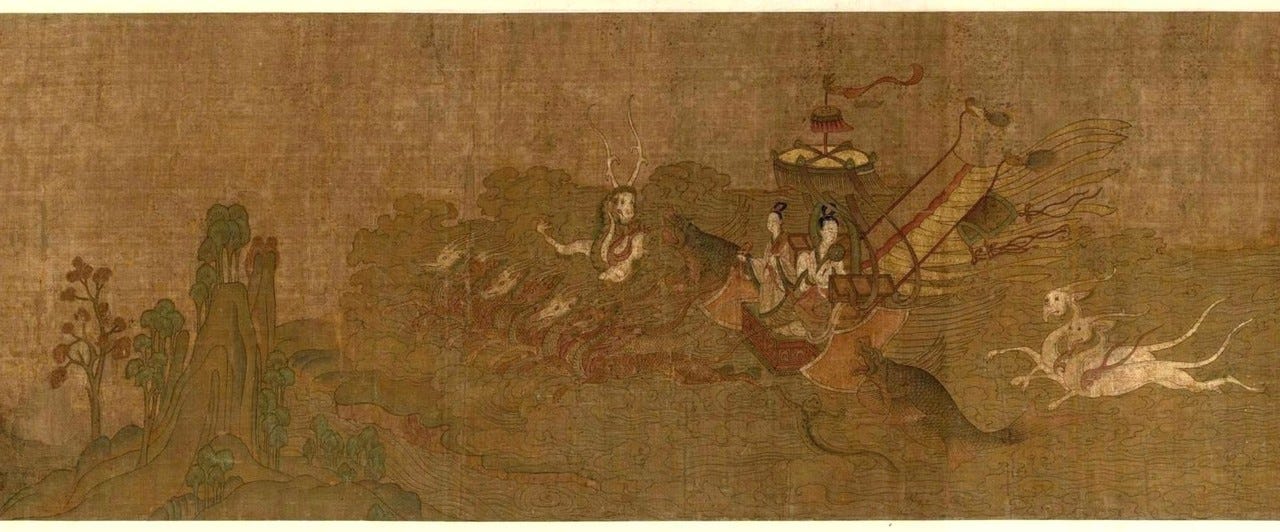
4. Gu Kaizhi, The Nymph of the Luo River, later copy
This dreamlike scroll tells a poem of doomed love between a poet and a river goddess, who drift toward each other and are kept apart. It survives in later copies of a lost work by Gu Kaizhi from around the fourth century.
The figures float slightly above the ground, and the landscape is deliberately childlike and small, an early stage of Chinese art before space was mastered.
It is one of the earliest story paintings anywhere, a picture that unrolls scene by scene like a strip of film.
5. Huang Gongwang, Dwelling in the Fuchun Mountains, 1350
The most revered landscape of them all is also the one that nearly burned. Huang Gongwang, a Yuan dynasty scholar, spent years on this long, spare ink scroll of hills and water along the Fuchun River.
In 1650 a devoted collector tried to burn it on his deathbed so it could follow him to the grave. His nephew snatched it from the fire, but it was left in two pieces.
The two halves now sit in two different museums, one in Zhejiang and one in Taipei. They were reunited for a single exhibition in 2011, the first time in over three hundred years.
6. Han Huang, Five Oxen, Tang dynasty
Five oxen stand in a row, each a different color and a different mood, one turning to scratch its head on a post. It is one of the oldest Chinese paintings on paper to survive, from around the eighth century.
Han Huang was a chief minister, and painting animals so plainly was a scholar's quiet statement about honest, humble labor.
The scroll vanished for decades in the twentieth century and was tracked down in Hong Kong in the 1950s and brought back to Beijing.
7. Gu Hongzhong, The Night Revels of Han Xizai, later copy
This one began as an act of spying. A tenth century emperor suspected his minister Han Xizai of wild private parties, so he sent the court painter Gu Hongzhong to memorize the scene and report back in pictures.
The result is an intimate record of a night of music, dancing and drinking, painted from memory. The hidden purpose buried inside a beautiful picture is the kind of secret I love, and I dig into more of them in seven secrets hidden in famous paintings, our paid deep dive.
Han Xizai, the story goes, played the fool on purpose to avoid a dangerous promotion. The painting meant to trap him became his monument.
8. Zhou Fang, Court Ladies Wearing Flowered Headdresses, Tang dynasty
Tang China loved its palace women full and graceful, and Zhou Fang painted them better than anyone, drifting through a garden in gauze silk with huge flowers pinned in their hair.
Look closely and you see tiny lapdogs, a crane and a butterfly. The ladies look almost bored, wrapped in luxury and quiet.
It is a rare window onto the fashion and beauty ideals of the Tang court, when a fuller figure was the height of elegance.
9. Yan Liben, Emperor Taizong Receiving the Tibetan Envoy, Tang dynasty
Here painting does the work of history. Yan Liben recorded the moment a Tibetan envoy arrived to arrange a royal marriage, with the great emperor Taizong carried in on a litter by palace women.
The emperor is painted larger than everyone else, a simple way of showing rank that Chinese artists used for centuries.
It commemorates a real alliance of the year 641, when a Chinese princess was sent to marry the king of Tibet, and it is treasured as much as a document as a picture.
10. Qiu Ying, Spring Morning in the Han Palace, Ming dynasty
A thousand years after the Tang, the Ming master Qiu Ying painted an imagined morning inside an ancient palace, a long, jewel bright scroll of women reading, playing music, dancing and painting.
Qiu Ying was rare among the great masters. He came from a poor family and trained as a craftsman, not a gentleman scholar, yet he outshone them all in sheer skill.
The scroll is a catalogue of palace life and, tucked inside it, a portrait of a painter at work, art quietly showing itself off.
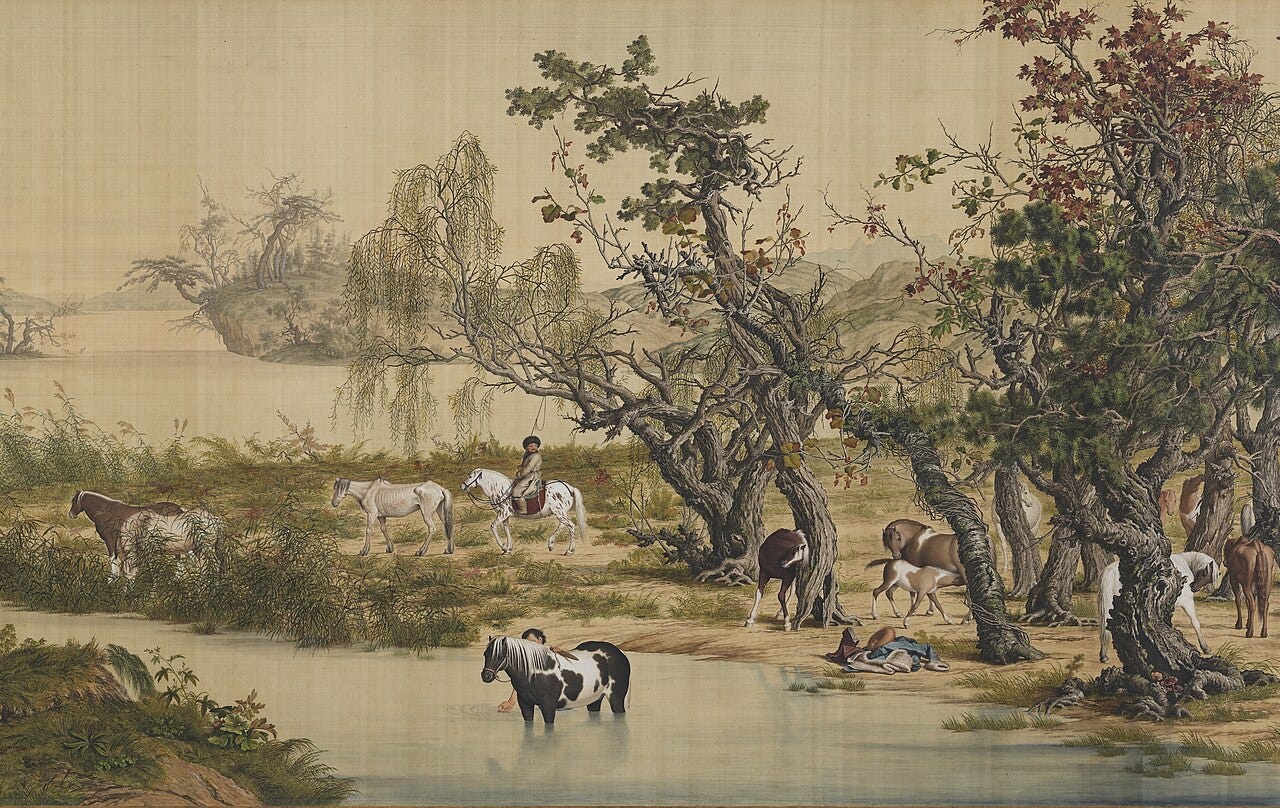
11. Giuseppe Castiglione, One Hundred Horses, 1728
The strangest name on this list belongs to a European. Giuseppe Castiglione was a Jesuit missionary from Milan who came to China, took the name Lang Shining, and spent fifty years as a painter at the Qing court.
His huge scroll of a hundred horses fuses Western shading and perspective with Chinese silk and brush. The animals have real weight and roundness, something classical Chinese painting never chased.
Castiglione served three emperors and helped design their gardens and palaces. He is the great bridge between European and Chinese art.
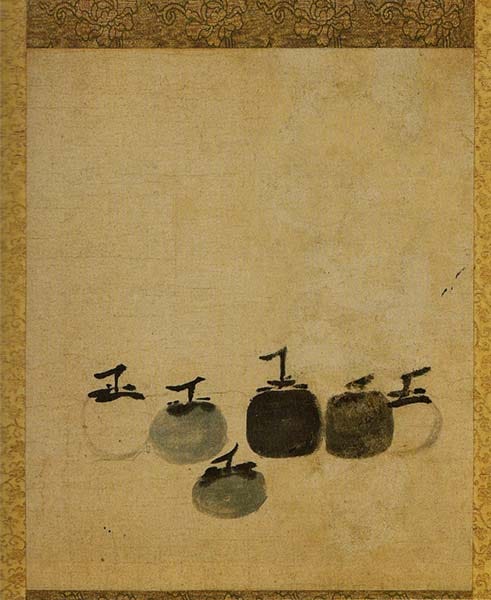
12. Muqi, Six Persimmons, 13th century
We end with almost nothing. Six persimmons sit in a row on empty paper, some dark, some pale, painted by the Chan Buddhist monk Muqi with a few loaded strokes of ink.
It looks effortless and is anything but. The spacing, the shades of black and the bare emptiness around the fruit are a lesson in Zen, where what is left out matters as much as what is put in.
Chinese collectors long undervalued Muqi, so his greatest works, this one included, were carried off to Japan, where they are revered as national treasures to this day.
Where these treasures live
Zhang Zeduan, Along the River During the Qingming Festival: Palace Museum, Beijing.
Fan Kuan, Travelers Among Mountains and Streams: National Palace Museum, Taipei.
Huang Gongwang, Dwelling in the Fuchun Mountains: split between museums in Zhejiang and Taipei.
Castiglione, One Hundred Horses: National Palace Museum, Taipei.
Muqi, Six Persimmons: Daitokuji temple, Kyoto, Japan.
If this tradition draws you in, here are two more ways to keep looking:
The darker truth about Gauguin, the part of the Tahiti story that never makes the wall label
Inside Monet house at Giverny, room by room, including his own bedroom
Luncheon of the Boating Party, detail by detail, who everybody at that table actually was
Chinese painting, common questions
What is the most famous Chinese painting? Along the River During the Qingming Festival by Zhang Zeduan, from around 1120, in the Palace Museum in Beijing, is the best known of all.
Why is landscape so important in Chinese art? Because mountains and water were seen as the living body of nature. A landscape was a whole world to enter and wander in the mind, far more than a pretty view.
What is a handscroll? A long painting on silk or paper, rolled up and opened a section at a time in the hands, so the scene moves past you like a journey.
Why are these paintings rarely on display? Many are fragile national treasures. China and Taiwan limit how often the oldest silk scrolls can be unrolled and lit, to protect them.
Who was Giuseppe Castiglione? A Jesuit from Milan, known in China as Lang Shining, who served the Qing emperors for fifty years and blended Western and Chinese painting.
The art of the empty space
Western painting spent centuries filling every inch of the canvas. Chinese painting did the opposite, treating the bare silk or paper as part of the picture, a mist, a lake, a sky, a silence.
That is why a scroll of six persimmons can feel as full as a crowded festival street. When the collector Wu Hongyu tried to burn the Fuchun Mountains scroll to take it into death with him in 1650, he was not destroying a picture of a place.
He was trying to keep a whole world, mountains, water and empty air, for himself alone.