Famous Cityscape Paintings: 12 Views of the City

Long before the postcard or the photograph, painters were the ones who showed people what a city looked like, its skyline, its light, its crowds and its weather.

Johannes Vermeer, View of Delft, about 1660

A great cityscape is more than a record, it catches the mood of a place, from the calm of old Delft to the rush of modern Paris in the rain. Here are twelve of the most famous cityscape paintings, all now in the public domain.

I have gathered the works that turned brick, water and sky into unforgettable portraits of a city.


Learn art the fun way. Free stories every week, no boring lectures.


If you want the detail

Three that changed how I look at a picture:


1. Johannes Vermeer, View of Delft (about 1660)

Vermeer painted his own small Dutch town from across the harbor on a fresh morning after rain, and made the most beloved cityscape in the world.

The clouds still hang heavy, but sunlight is breaking through onto the far rooftops, catching the tower of the New Church in gold.

He built the whole scene from tiny beads of thick paint that glitter like grains of light on the water and walls. It now hangs in the Mauritshuis in The Hague, this small townscape caught forever in one changing moment.

Marcel Proust called it the most beautiful painting in the world, and had a character in his novel collapse and die while gazing at one small patch of yellow wall in it.

2. El Greco, View of Toledo (about 1600)

El Greco, View of Toledo, about 1600

A storm rolls in over the Spanish city of Toledo, the sky an eerie dark green, the hills unnaturally lit, the whole town seeming to shudder under the coming weather.

El Greco painted almost no pure landscapes, and this strange, electric view is unlike anything else of its age. It feels less like a real place than a vision or a dream of one, centuries ahead of its time.

He even shifted the cathedral to the wrong side of the town to make a better picture. He was one of the first artists to bend a real place entirely to his own vision.

The picture now hangs in the Metropolitan Museum in New York, one of the earliest and strangest cityscapes in all of Western art.

3. Canaletto, The Stonemason's Yard (about 1725)

Canaletto, The Stonemason's Yard, about 1725

Canaletto is famous for his glittering, postcard perfect views of Venice, yet this early one shows the city off duty, a rough working square strewn with stone blocks and building rubble.

Washing hangs from the windows, a woman leans out, a child has fallen over and cries, all under a soft, real Venetian light. It is warmer and truer than his later tourist views, painted before he learned to please rich foreign buyers.

The great dome of a church rises behind the mess of ordinary life. It hangs in the National Gallery in London, and unlike his later views it was never shipped off to a tourist, staying a picture of Venice as the Venetians actually lived it.

4. Bernardo Bellotto, View of Dresden (about 1750)

Bernardo Bellotto, View of Dresden, about 1750

Canaletto's nephew Bellotto painted the German city of Dresden so precisely that his views were later used to help rebuild it after the Second World War.

He worked with the same crisp, sunlit clarity as his uncle, whose name he even borrowed, showing the river, the bridges and the great domed church in perfect detail.

Every window, boat and figure is set down with almost photographic care. When Allied bombs destroyed old Dresden in 1945, planners turned to these two hundred year old paintings as a record of what had been lost.

His pictures became, by accident, a blueprint for a vanished city.


Join 130,000 readers who get the secrets behind the paintings. Free.


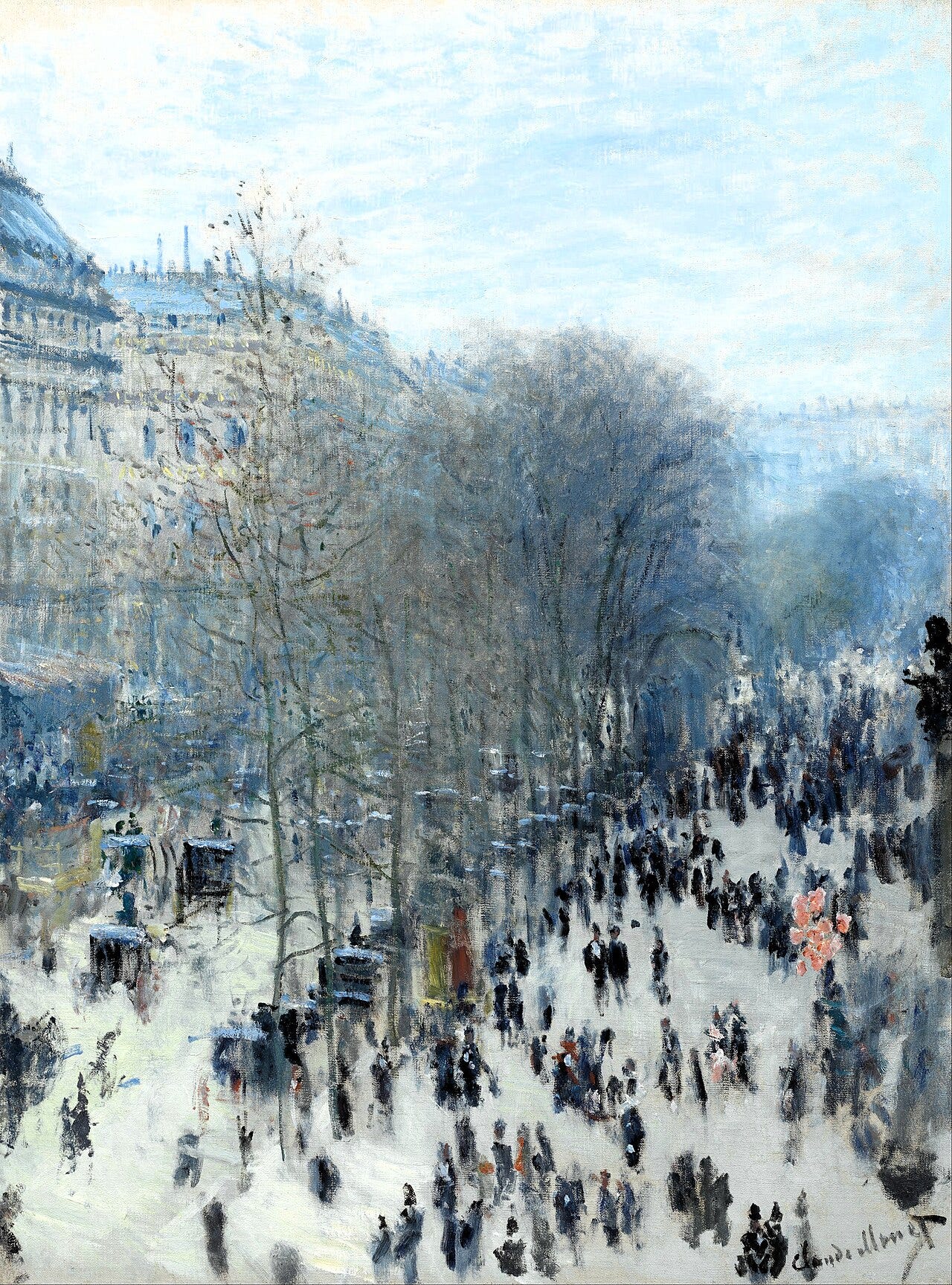
5. Claude Monet, Boulevard des Capucines (1873)

Claude Monet, Boulevard des Capucines, 1873

Monet leaned out of an upstairs window and painted the crowd on a grand Paris boulevard as a blur of tiny flecks, people reduced to little dabs and commas of paint.

When it was shown at the very first Impressionist exhibition in 1874, a furious critic mocked those dabs as mere tongue lickings of paint.

Monet did not care to draw every top hat and carriage, only to catch the glitter and movement of a modern street.

Bare winter trees frame the scene, and two men watch from a balcony at the very edge. It was one of the pictures that gave Impressionism both its name and its first great scandal.

6. Camille Pissarro, Boulevard Montmartre at Night (1897)

Camille Pissarro, Boulevard Montmartre at Night, 1897

Pissarro, old and ill, took a hotel room above a busy Paris boulevard and painted the same view over and over, in every light and season.

This one shows the street at night, the wet road black and glossy, the gas lamps and shop windows smeared into long streaks of gold.

It is one of the earliest paintings to catch the electric glow of the modern nighttime city. He was too frail to walk the streets he loved, so he painted them from his window instead.

He painted more than a dozen views of this one stretch of boulevard, and this night scene is the only one in which the lamps come on.


Learn art the fun way. Free stories every week, no boring lectures.


7. Gustave Caillebotte, Paris Street, Rainy Day (1877)

Gustave Caillebotte, Paris Street, Rainy Day, 1877

Well dressed Parisians cross a wide new boulevard under umbrellas on a cold wet day, the cobbles shining, a couple walking straight toward us in sharp, photographic detail.

Caillebotte painted the brand new Paris of grand avenues and tall stone buildings, cool, modern and a little lonely. The huge canvas uses a strange, wide angle perspective, a lamppost in the center splitting the scene in two.

Nobody quite looks at anybody else, each figure sealed in the anonymity of the big city. It now anchors the Art Institute of Chicago, a canvas almost seven feet wide given over entirely to strangers sharing a wet street.

8. Childe Hassam, Allies Day, May 1917 (1917)

Childe Hassam, Allies Day, May 1917, 1917

Fifth Avenue in New York erupts in a storm of flags, American, British and French banners rippling down the whole length of the street, painted from high above in bright, broken Impressionist color.

Hassam made this during the First World War, just after America joined the Allies, and the city hung out flags to celebrate. He painted dozens of these flag pictures, the most joyful and patriotic cityscapes of his career.

The buildings dissolve into a haze of red, white and blue. It hangs now in Washington, and more than one president has borrowed it to hang in the White House.

9. Maurice Utrillo, The Lapin Agile, Montmartre (about 1930)

Maurice Utrillo, The Lapin Agile, Montmartre, about 1930

Utrillo painted the crooked streets of old Montmartre with peeling white walls and empty pavements, streets he knew because he rarely left them.

A troubled man who began painting as a kind of therapy, he built his walls from thick, chalky paint, sometimes mixing in real plaster to get the crumbling texture right.

His Montmartre is quiet, faded and a little sad, almost always empty of people. He often worked from cheap postcards as much as from life, painting the same corners again and again.

Today his hometown views sell for far more than he ever earned in his difficult life.

10. Jan van der Heyden, View of a Dutch Town (about 1670)

Jan van der Heyden, View of a Dutch Town, about 1670

Long before photography, one Dutchman painted city streets so sharply that you can count the individual bricks in every wall. Van der Heyden was obsessed with buildings, and painted sunlit Dutch and imaginary towns with a jeweler's patience, every leaf, tile and reflection in place.

He was also a real inventor, who redesigned the fire hose and the street lamp for the city of Amsterdam. His paintings feel almost like blueprints touched by warm afternoon light.

He grew as famous in his lifetime for his firefighting manual as for his jewel like views of the streets he helped protect.

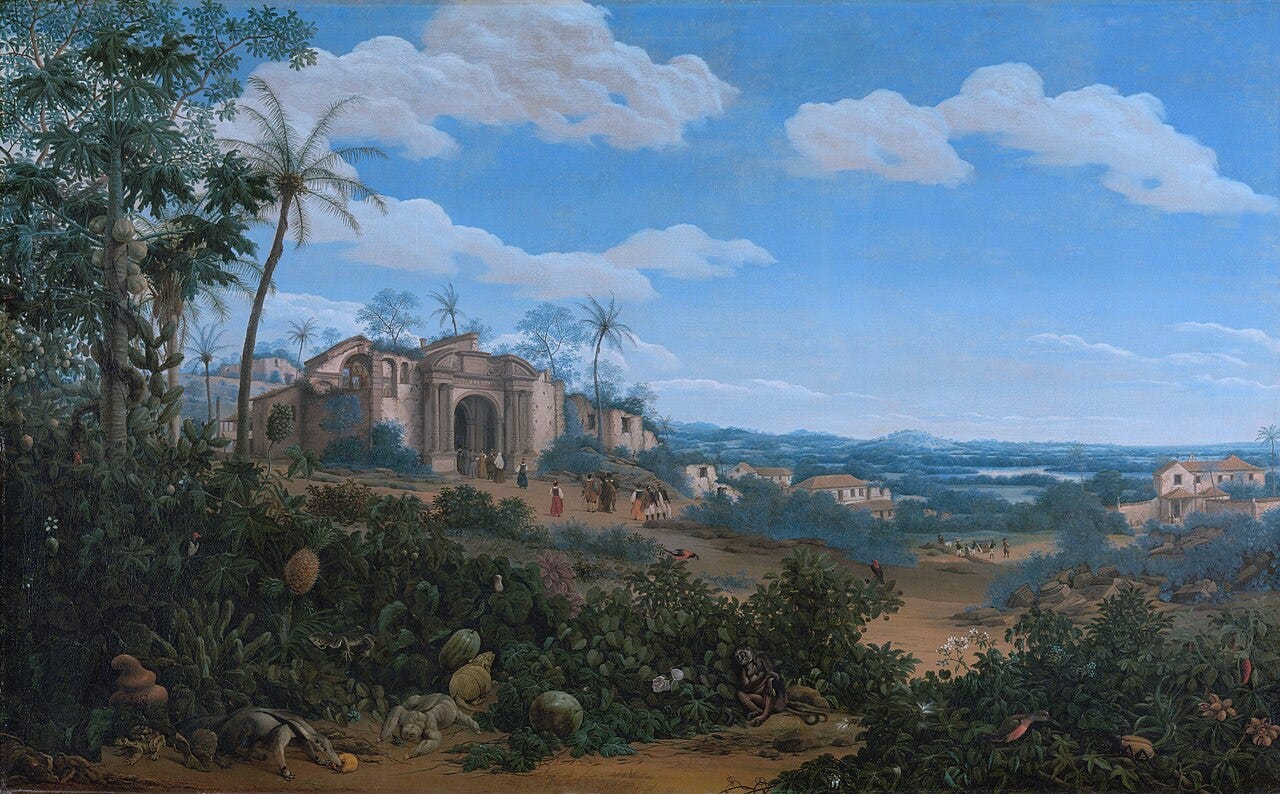
11. Frans Post, View of Olinda, Brazil (about 1662)

Frans Post, View of Olinda, Brazil, about 1662

A European painter shows a ruined colonial town in Brazil, its broken churches overgrown with tropical plants, an armadillo and strange birds in the foreground.

Frans Post was the first trained European artist to paint the Americas from life, sent across the Atlantic with a Dutch expedition in the 1630s. He recorded the light, the palms and the animals of a world Europe had barely seen.

Back home he kept painting Brazil from memory for the rest of his life, adding ever more exotic creatures. His pictures were Europe's first real glimpse of a New World city.


Two new stories a week, 130+ secrets unlocked. Start free.


12. Pieter Bruegel the Elder, The Tower of Babel (1563)
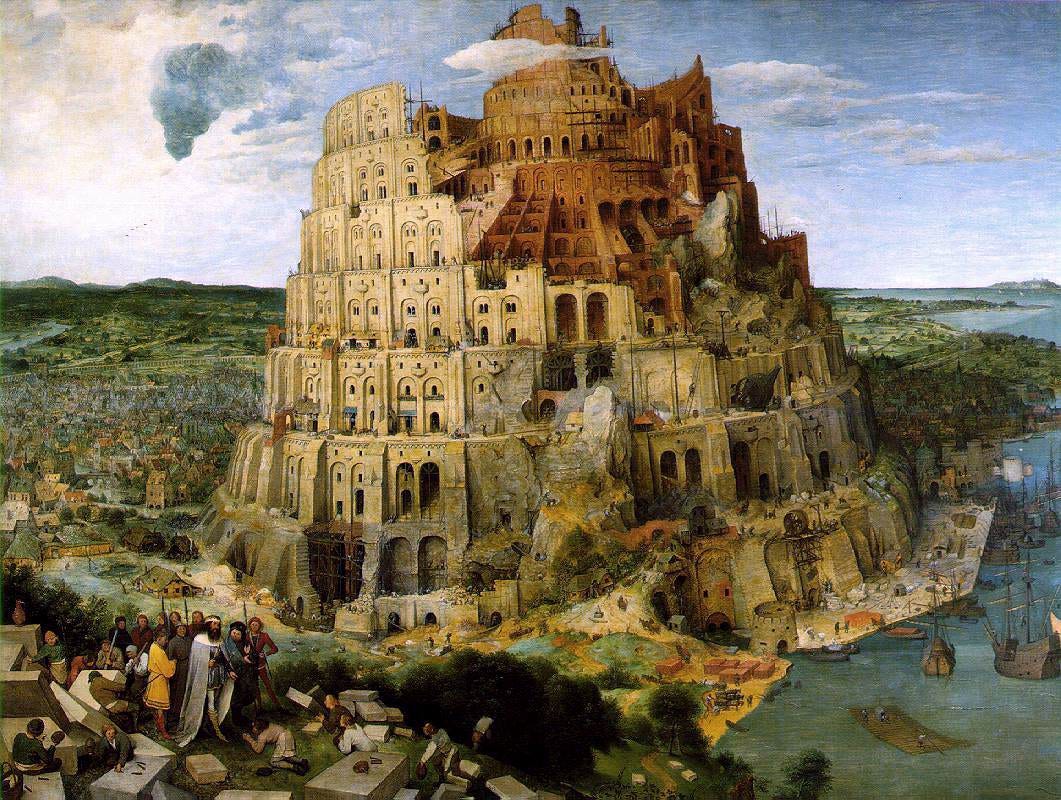
Pieter Bruegel the Elder, The Tower of Babel, 1563

A vast spiral tower, half built and already crumbling, rises out of a busy sixteenth century city toward the clouds, swarming with tiny workers, cranes and scaffolding.

Bruegel painted the Bible story of Babel as a warning about human pride, the tower doomed to fall before it was ever finished. Yet the real subject is the city below, a living port of ships, houses and thousands of laboring people.

He modeled the doomed tower on the ruined Colosseum in Rome, which he had seen crumbling on his travels. The larger of his two versions of Babel now hangs in Vienna, still the most famous imaginary building in all of art.


What people ask about cityscape paintings

  • What is a cityscape painting? A painting whose main subject is a city or town, its buildings, streets and skyline, rather than people or the countryside.

  • What is a veduta? An Italian word for a detailed, mostly accurate view of a city, made famous by Venetian painters like Canaletto for Grand Tour tourists.

  • What is the most famous cityscape? Vermeer's View of Delft is the most celebrated, along with El Greco's stormy View of Toledo.

  • Who painted the most cityscapes? The Venetian view painters Canaletto and his nephew Bellotto, and later the Impressionists who painted modern Paris.

  • Why did artists start painting cities? As cities grew rich and proud, people wanted images of them, first as records for travelers, later to catch the energy of modern life.


If these city views pulled you in, you will love these too:


The city that stays still

A city never stops changing. Buildings rise and fall, streets are widened, whole quarters vanish, and the light is different every hour.

These paintings caught one version of a place and held it, so that we can still stand on a Venetian quay or a rainy Paris corner that changed or disappeared long ago.

Some of the cities in them, like old Dresden, were later destroyed and rebuilt from the pictures themselves. In the end, the painting outlasts the city it shows.