Famous Civil War Paintings: 12 Works and Their Stories
The most famous Civil War paintings turned four years of American bloodshed into pictures the country still carries, from Winslow Homer's lonely camps to the crashing battle lines of Gettysburg. Most were made by men who had actually seen the war.
Artists went to the front as reporters, soldiers and grieving witnesses, and what they brought home was rarely simple glory. I have gathered twelve, all now in the public domain, that show the war as Americans first pictured it.
What these painters saw:
The camp. Long stretches of boredom, homesickness and waiting, not only battle.
The cause. Freedom, slavery and the meaning of the war, argued in paint.
The myth. Images built after the guns fell silent, shaping how each side remembered.
The cost. Empty fields, fresh graves and the faces of men who came home changed.
Three stories that go deeper
Three that take a single painting apart, properly:
The Arnolfini Portrait, detail by detail, the mirror, the dog, and the question everyone asks
The darker truth about Gauguin, the part of the Tahiti story that never makes the wall label
Vermeer, Woman Holding a Balance, what is actually on those scales
1. Winslow Homer, Home, Sweet Home (about 1863)
Two soldiers stand apart in a quiet camp, heads low, while a band plays somewhere out of sight. The tune is the sentimental favorite that gave Homer his title, and every man in the North knew its words about longing for home.
There is no fighting here, only the ache of being far from it.
Homer had gone to the front for Harper's Weekly, sketching the Union army, and this early oil turned those sketches into something deeper. Shown around 1863, it made critics notice a young illustrator who could paint silence.
It sold quickly and hangs today at the National Gallery of Art, a picture of a war that was mostly waiting, mud and memory.
2. Eastman Johnson, A Ride for Liberty, The Fugitive Slaves (1862)
A family gallops through the dawn on a single horse, the father leaning low, the mother clutching a child, all of them racing north.
Eastman Johnson claimed he watched this exact scene near Manassas on the morning of March 2, 1862, and wrote the date straight into the title.
Freedom here is a matter of a few hundred yards and a fast horse.
Instead of a grand allegory, he gave the escape the grain of something witnessed, hooves in real mud, faces turned toward the danger behind. He left several versions, unsure whether the family made it, keeping the ending open.
It is one of the few Civil War images to put an enslaved family's own courage at the center.
3. Frederic Edwin Church, Our Banner in the Sky (1861)
Look closely at this glowing sunset and the clouds resolve into the Stars and Stripes, a torn flag stretched across the heavens. The little oil sketch dates to the raw weeks after Fort Sumter fell in April 1861, when the Union flag had just been hauled down in surrender.
Church turned patriotic fury into a sky that seems to take sides.
A bare tree stands in for the flagpole, and a scatter of real stars fills the corner where the flag's blue field should be. Sold cheaply as a color print, the image became Northern propaganda for a cause dressed up as nature itself.
It was among the first shots in the war of pictures.
4. Conrad Wise Chapman, The Flag of Fort Sumter (about 1864)
A lone Confederate sentry stands on the battered ramparts of Fort Sumter, the flag snapping above a fortress pounded half to rubble. The painter, Conrad Wise Chapman, was a young Southern soldier who recorded what he saw while posted at Charleston.
He filled dozens of small canvases with the guns, flags and defenses of a city under siege.
Working from sketches made under fire, he finished the oils later, leaving a rare view from inside the Confederacy. Most Civil War art came out of Northern studios, so a soldier's eye on the Southern side is unusual.
His Charleston series now hangs at the American Civil War Museum in Richmond.
5. Sanford Robinson Gifford, A Coming Storm (1863)
On its surface this is pure landscape, a dark squall gathering over a still lake, one small figure set against the weather. Yet the picture carried an omen no one could have planned.
Its owner was Edwin Booth, the celebrated actor whose brother would murder Abraham Lincoln.
When the storm scene was hung in New York in 1865, days after the assassination, the poet Herman Melville saw prophecy in it and wrote a poem naming Booth.
Gifford had served in the Union army himself, guarding Washington. He later bought the painting back and reworked it, as if he could not quite leave the omen alone.
6. Albert Bierstadt, Guerrilla Warfare, Picket Duty in Virginia (1862)
A sunlit Virginia forest opens like a stage, and only slowly do you spot the Union pickets crouched among the trees, rifles ready. Bierstadt, famous for his enormous views of the American West, turned that same golden light onto a nervous patrol.
The grand calm makes the ambush hidden inside it all the worse.
He based the scene on a visit to his brother's regiment near Washington in 1861, sketching soldiers on picket duty. The title admits the ugly truth that this war had no clean front, only skirmishes in the woods.
I trace his whole career in my guide to Albert Bierstadt.
7. William D. Washington, The Burial of Latane (1864)
No soldiers, no smoke, just a group of women and enslaved workers lowering a young officer into a Virginia grave. The dead man was Captain William Latane, the only Confederate killed in Stuart's celebrated ride around McClellan's army in 1862, buried with no minister to hand.
Washington turned a minor casualty into a sacred scene.
Copied as an engraving and hung in countless Southern parlors, the picture became a cornerstone of the Lost Cause, the myth that recast a war fought over slavery as noble sacrifice.
It quietly sets loyal slaves at the graveside, a comforting fiction the real war never bore out. Few paintings did more to shape how the South chose to remember.
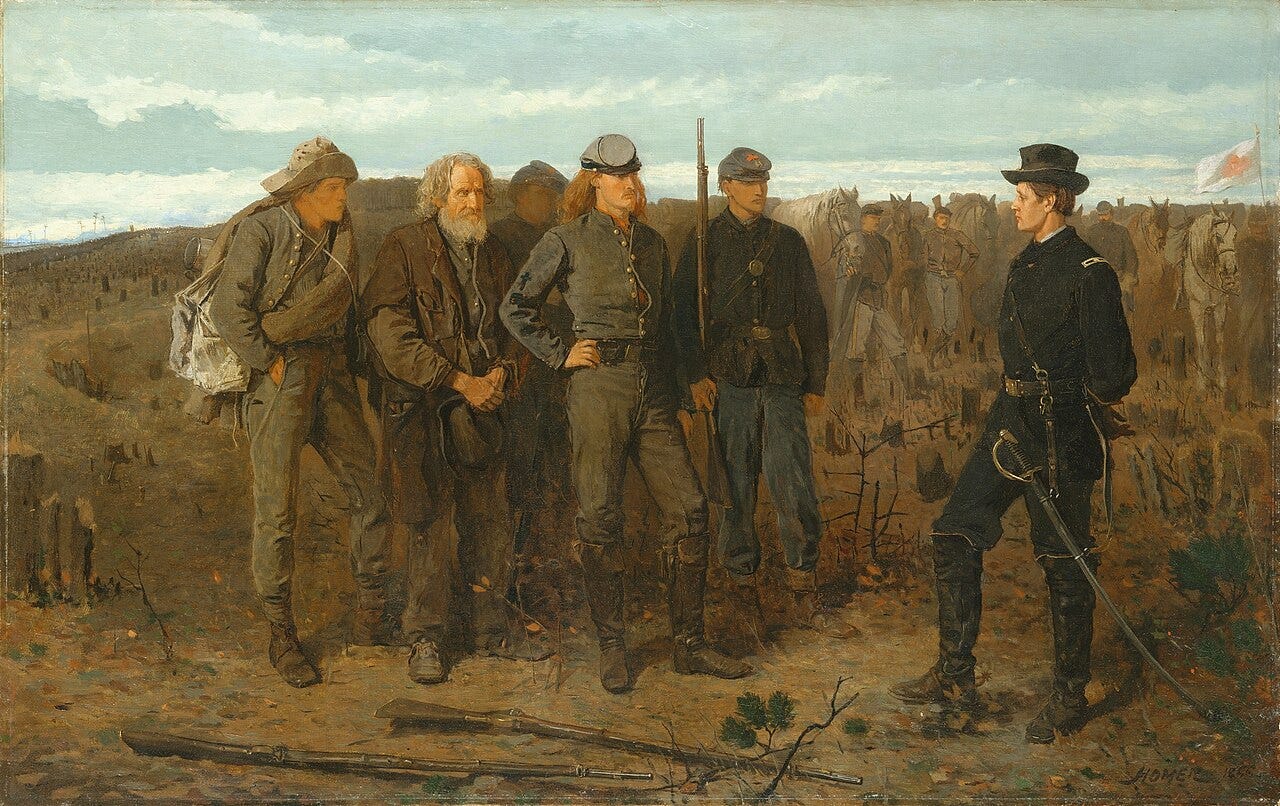
8. Winslow Homer, Prisoners from the Front (1866)
A trim Union general faces three captured Confederates across a torn field, and the whole war seems pressed into that stare. This is the canvas that made Homer's name when crowds first saw it, a year after the fighting stopped.
Each ragged prisoner stands for a different Southern type, from defiant youth to broken old man.
The officer is drawn from the real General Francis Barlow, cool and buttoned against the men he has beaten. Homer refuses easy triumph, letting the defeated keep their dignity.
Sent to the Paris Exposition in 1867, it announced that America had a serious painter of its own, a story I tell in full in Winslow Homer.
9. Thure de Thulstrup, Battle of Gettysburg (1887)
Union and Confederate lines crash together at a stone wall, smoke and banners everywhere, in the image many Americans still picture when they hear the word Gettysburg.
Thulstrup, a Swedish trained illustrator, made it for the printer Louis Prang more than twenty years after the battle. Turned out as a mass color print, it hung in schools and parlors for generations.
The scene shows the climax of Pickett's Charge on July 3, 1863, the Confederate assault that failed and broke the war open. Accuracy came second to drama, with uniforms and positions tidied for effect.
It shaped popular memory more than any eyewitness sketch ever could.
10. Peter F. Rothermel, The Battle of Gettysburg, Pickett's Charge (1870)
Sixteen feet tall and thirty two feet wide, this is a wall of war you could almost step into, bodies and flags piling toward you. Pennsylvania paid Rothermel a small fortune to paint its great victory, and he spent years on studies and interviews.
The result is one of the largest framed paintings in the United States.
He questioned veterans and walked the field, cramming the canvas with named officers and exact regiments. Critics grumbled that the carnage was too honest and the Union heroes hard to find in the chaos.
It still fills a room at the State Museum of Pennsylvania in Harrisburg.
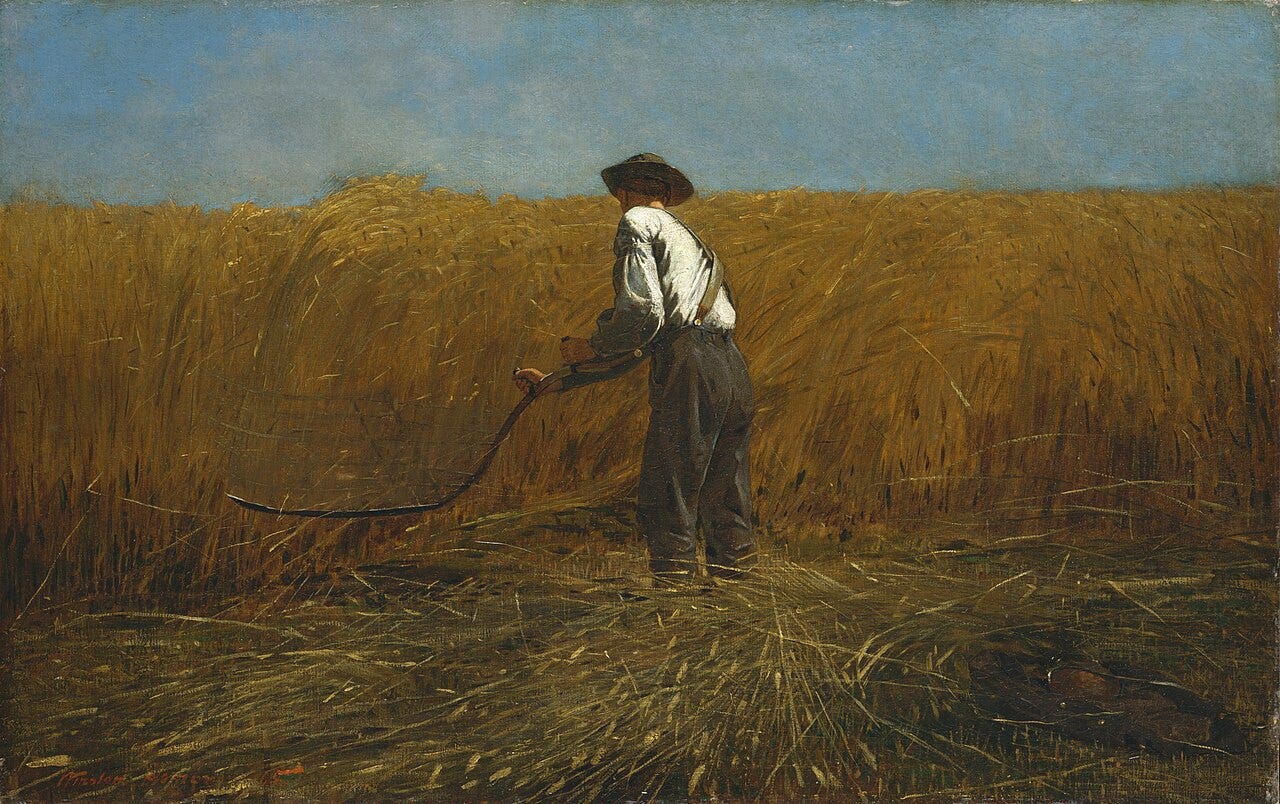
11. Winslow Homer, The Veteran in a New Field (1865)
A discharged soldier has thrown down his jacket and taken up a scythe, his back to us, cutting through a vast field of wheat. Homer finished it in the autumn of 1865, months after the surrender and the murder of Lincoln, with the whole country counting its dead.
The single long blade turns a peaceful harvest into a picture of the reaper himself.
An X ray shows Homer first gave the man a modern cradled scythe, then swapped it for an old single blade to summon death straight from the Bible. The wheat stands for the fallen, cut down in their season.
The Metropolitan Museum has held the picture since 1967, one of the starkest images the whole war produced.
12. Eastman Johnson, The Girl I Left Behind Me (about 1872)
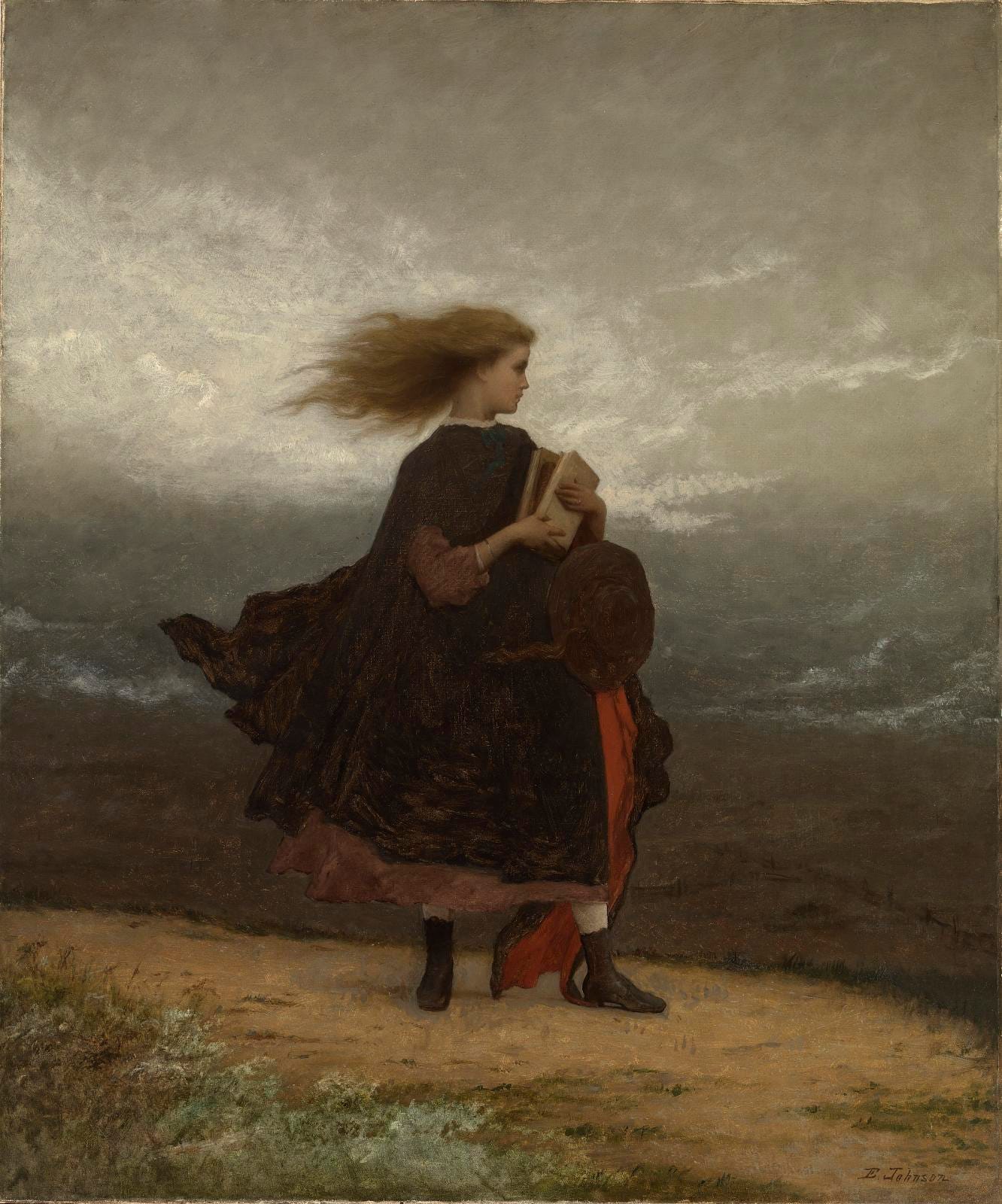
Eastman Johnson turned from the battlefield to the home front for this one, a young woman standing alone on a windswept hill, her coat whipping, her eyes fixed on a horizon that will not give her what she wants.
The title lifts the marching song soldiers sang as they left home, so the whole picture aches with a man who may never return. He painted the waiting rather than the fighting.
Her schoolbooks and slate suggest a teacher, holding a life together while the men are gone. Made a few years after the war, it distills all that separation into one figure against the sky.
It hangs now at the Smithsonian American Art Museum, the whole war measured in one woman's wait.
Where these war pictures are kept
Winslow Homer, Prisoners from the Front and The Veteran in a New Field: the Metropolitan Museum, New York.
Eastman Johnson, A Ride for Liberty: the Brooklyn Museum.
Conrad Wise Chapman, the Charleston series: the American Civil War Museum, Richmond.
Peter Rothermel, Pickett's Charge: the State Museum of Pennsylvania, Harrisburg.
Eastman Johnson, The Girl I Left Behind Me: the Smithsonian American Art Museum, Washington.
If these scenes pulled you in, keep going:
The Ambassadors, detail by detail, the object at the bottom that only works from one side
Luncheon of the Boating Party, detail by detail, who everybody at that table actually was
Ten women artists you need to know, the names the textbooks skipped
Civil War paintings, a few quick questions
Who is the most famous Civil War painter? Winslow Homer, who covered the war for Harper's Weekly and turned his field sketches into oils like Prisoners from the Front.
Were these painted during the war? Some were, like Homer's camp scenes and Chapman's Charleston views. The huge Gettysburg panoramas came years later, built from research and memory.
What is the Lost Cause in art? A wave of Southern images, such as The Burial of Latane, that recast a war fought over slavery as noble and tragic sacrifice.
Did any of these artists fight? Yes. Conrad Wise Chapman served in the Confederate army and Sanford Gifford in the Union, and both painted what they saw.
Where can I see Civil War paintings? The Metropolitan Museum, the Smithsonian American Art Museum and the American Civil War Museum in Richmond hold many of the best known works.
The war America chose to picture
Put these side by side and a pattern shows. The paintings made during the war are quiet, camps, escapes, empty fields, the small human weather of a catastrophe.
The loud ones, crashing battle lines and marble heroes, came afterward, once each side was busy deciding what the whole thing had meant. Winslow Homer, who had seen the real thing up close, spent the rest of his life painting the sea instead.
He had looked hard at the war, and once was enough.