
Christmas gives composers a deadline that never moves. Whatever is ready by the night of December 24 is what the church, the theater or the television studio will hear, finished or not. Some of the best-loved music of the season was written in a matter of days, and at least one piece first reached its audience under the name of a man who never lived.
Cool Stories About Art is a newsletter to learn art the fun way.
Join 200,000+ readers and get:
10 new art stories / month
The entire archive of content (140+ articles)
Comment, ask questions, and chat with other readers
What Christmas Asked of Composers
For centuries, Christmas was one of the busiest seasons in a church musician's year. Midnight Mass and every feast up to Epiphany, on January 6, needed music, and courts and theaters wanted December evenings of their own. The Nativity story handed composers its scenes ready-made: shepherds, angels, kings, a cradle.
Classical Christmas music, in that sense, is music written by trained composers for a church, a court, a concert hall, a stage or a studio, about the feast or its story. Every work chosen meets that definition and is still performed each December, and behind each one sits a story that few concertgoers know.
Most of them lean on something older as well: carols sung in the street, medieval poems, a folk tale, a painting, or music the composer had first written for another occasion.
12. Hector Berlioz, L'Enfance du Christ (1850 to 1854)
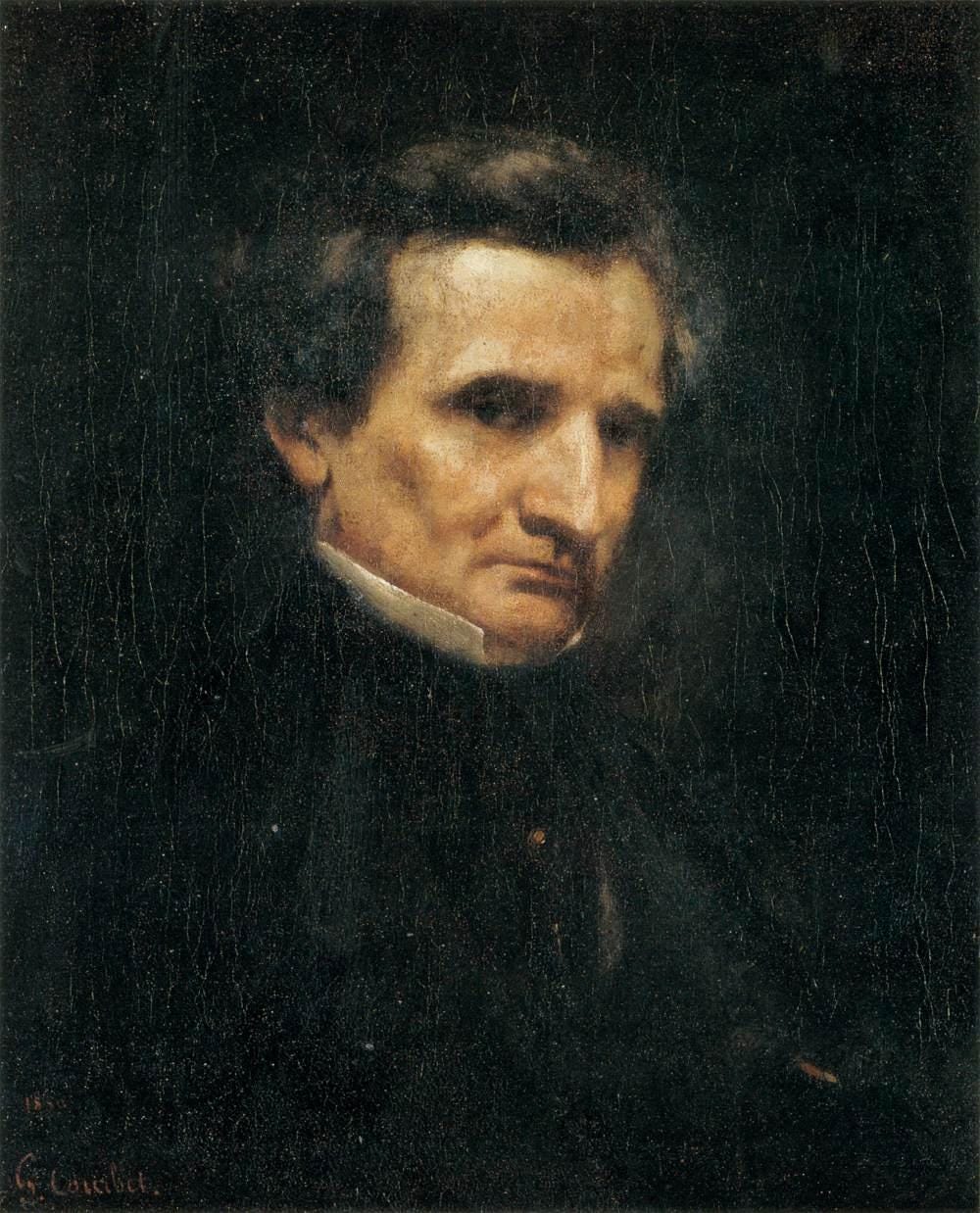
Shepherds say goodbye to Mary, Joseph and the child, who are about to leave for Egypt, in a short, plain chorus first heard in Paris in 1850. It was billed as the work of Pierre Ducré, master of music in 1679 at the Sainte-Chapelle, the Gothic royal chapel in the heart of Paris. His manuscript, the story went, had turned up on an old parchment while the chapel was being restored.
Pierre Ducré never existed. The chorus was by Hector Berlioz, who had written it that year as a small piece for his friend the architect Joseph-Louis Duc, then invented the old master, the parchment and the discovery to go with it. The farewell would become the heart of an oratorio that did not exist yet, L'Enfance du Christ, The Childhood of Christ.
The hoax worked. A critic who disliked Berlioz's music wrote that Berlioz would never manage a melody as simple and charming as old Ducré's. It was after that review that Berlioz admitted the old master was himself.
Having confessed, he did not drop the joke. Around the farewell chorus he built a middle part, The Flight into Egypt, then added the family's arrival at Saïs, an ancient city of Egypt, and an opening on the dream of King Herod, written in 1854. The complete trilogy was first performed in Paris on December 10, 1854.
Writing to his sister Adèle, Berlioz called the finished work a "petite sainteté," a small piece of piety, in the manner of the old illuminated missals, the hand-painted mass books of earlier centuries.
At a Glance
Composer: Hector Berlioz (1803 to 1869)
Written: 1850 to 1854, Paris
Form: Oratorio (sacred trilogy), Op. 25
Length: About 1 hour 35 minutes
About This Piece
Who wrote the Shepherd's Farewell lyrics?
Berlioz wrote them himself, as he did for the whole of L'Enfance du Christ, in a deliberately old-fashioned French that matched the music he had passed off as a work of the 17th century.
11. Gian Carlo Menotti, Amahl and the Night Visitors (1951)
In November 1951, Gian Carlo Menotti owed NBC an opera. The network had commissioned it the year before for the Christmas season, and the date was fixed: a live broadcast on Christmas Eve. "I just didn't have an idea in my head," Menotti said later. With only weeks to go, he still did not know what his opera would be about.