Famous Dada Artworks: 12 That Refused to Be Art

The most famous Dada artworks are objects that argued art should not exist: a urinal signed with a fake name, a plumbing trap called God, a head built from a wig dummy and a ruler. Between 1916 and 1923 a scattered group of exiles and deserters made about a dozen things that art has been answering ever since.

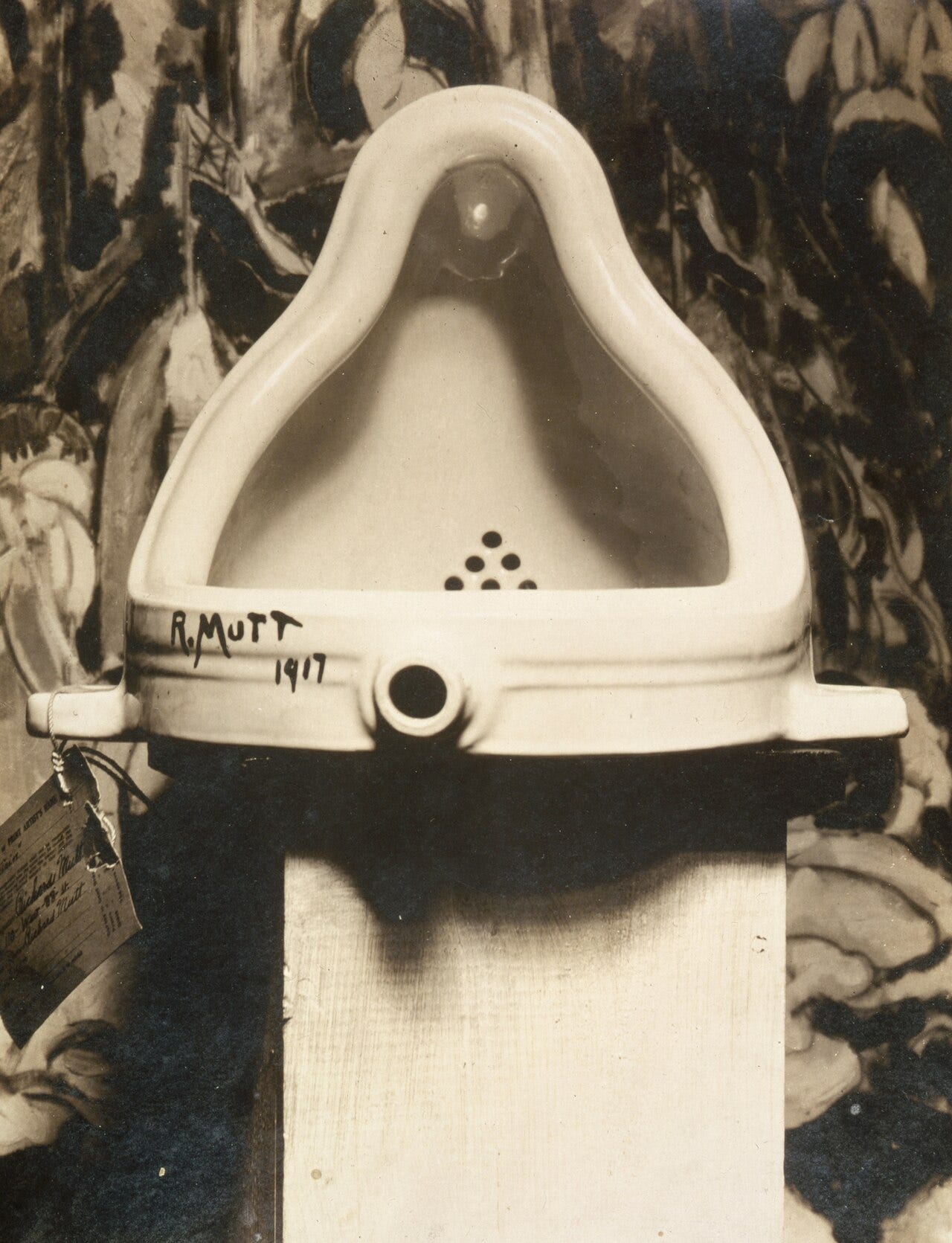
Marcel Duchamp, Fountain, 1917, photographed by Alfred Stieglitz

I have picked twelve, in order, from a poem of invented sounds shouted in a Zurich nightclub to a house in Hannover that a man slowly filled with his own sculpture until it pushed through the ceiling.

In 30 seconds:

  • 12 Dada works, from Hugo Ball's Karawane (1916) to Kurt Schwitters's Merzbau (begun around 1923).

  • Duchamp appears twice, with Fountain and L.H.O.O.Q. Schwitters appears twice, with his first Merz picture and his house.

  • Three of the twelve are not paintings or sculptures at all: a stage performance, a plumbing fitting and a set of rooms.

  • The original Fountain no longer exists. Every version in a museum is a replica Duchamp approved in 1964.

  • Sophie Taeuber Arp, who carved the Dada Head of 1920, is the only artist here whose face has been printed on money.

Four questions that unlock almost any Dada object:

  • Who chose it. Dada often replaced making with choosing, and the signature did the rest.

  • What it was before. A urinal, a flatiron, a tram ticket, a magazine page. The old life of the object carries half the meaning.

  • Who it was aimed at. Generals, priests, critics, the Mona Lisa, the war.

  • Whether chance did the work. Torn paper dropped on a floor, words shaken in a bag, cracks left exactly where they fell.


Learn art the fun way. Free stories every week, no boring lectures.


Two guides to read alongside this list

If you want the history before the objects, start with what Dada was and why it began. Marcel Duchamp turns up twice below, and his full story is here: Marcel Duchamp.

For what came next, Surrealism grew directly out of the Paris Dada group after 1924, while abstract art was pulling in the opposite direction at the same time.

1. Hugo Ball, Karawane (1916)

Hugo Ball in a cardboard costume performing Karawane at the Cabaret Voltaire, 1916
Hugo Ball performing at the Cabaret Voltaire, Zurich, 1916

Ball could not walk in the costume, so two men carried him onto the stage and set him down like furniture.

His legs were sealed in blue cardboard tubes, his arms in a cardboard cape that flapped when he lifted them, and his head sat under a tall blue and white hat. Then he read Karawane, a poem built entirely from words that mean nothing in any language.

He performed it in June 1916 at the Cabaret Voltaire, the Zurich club he had opened four months earlier. Ball wrote afterwards that his voice had slid into the cadence of a church lament, which was not what he had planned.

2. Marcel Duchamp, Fountain (1917)

The Richard Mutt Case, page from The Blind Man number 2, New York, 1917
The Richard Mutt Case, The Blind Man, number 2, New York, 1917

A porcelain urinal, laid on its back, signed R. Mutt and dated 1917.

It was entered in the first exhibition of the Society of Independent Artists in New York, whose founding rule was that anyone who paid the fee would be hung. The committee refused it anyway. Duchamp sat on that committee and resigned over it.

A small magazine called The Blind Man then ran an unsigned defence, the page above, arguing that whether Mr Mutt made the fountain with his own hands had no importance, because he chose it.

There is an open question about who sent it in. On April 11, 1917, two days after the rejection, Duchamp wrote to his sister Suzanne that one of his female friends had submitted a porcelain urinal under a masculine pseudonym. Some historians read that as the poet Elsa von Freytag Loringhoven. Others read the sentence differently. The letter exists, the answer does not.

3. Elsa von Freytag Loringhoven and Morton Schamberg, God (around 1917)

God, a cast iron plumbing trap mounted on a wooden miter box, around 1917
Baroness Elsa von Freytag Loringhoven and Morton Schamberg, God, around 1917

A cast iron plumbing trap, stood upright on a wooden miter box, and titled God.

For decades museums credited it to the American painter Morton Schamberg alone. It is now catalogued as a joint work, with the Baroness credited for finding and choosing the pipe and Schamberg for the mounting and the photographs.

She was a German poet living in New York who wore tin cans as jewellery, shaved her head and painted it, and was arrested more than once over what she wore in the street. She is the reason the Fountain question above refuses to close.

4. Marcel Duchamp, L.H.O.O.Q. (1919)

Marcel Duchamp, L.H.O.O.Q., Mona Lisa with a moustache, as printed in the journal 391 in 1920
Marcel Duchamp, L.H.O.O.Q., as reproduced in Francis Picabia's journal 391, March 1920

Duchamp bought a cheap postcard of the Mona Lisa in Paris, drew a moustache and a goatee on her in pencil, and wrote five letters underneath.

Said out loud in French, L.H.O.O.Q. sounds like elle a chaud au cul, which is coarse slang for a woman who is sexually restless. Duchamp once gave the polite translation as there is fire down below.

The version above is the one Francis Picabia printed in his journal 391 in March 1920. Duchamp had already sailed for New York, so Picabia redrew the face himself and forgot the goatee. In 1942 Duchamp added it by hand to two copies and wrote on them: moustache by Picabia and beard by Duchamp.

5. Hannah Hoch, Cut with the Kitchen Knife (1919)

Hannah Hoch, Cut with the Kitchen Knife, 1919, photomontage
Hannah Hoch, Cut with the Kitchen Knife Dada Through the Last Weimar Beer Belly Cultural Epoch in Germany, 1919

Hundreds of fragments cut from German illustrated magazines: ball bearings, crowds, dancers, the heads of generals dropped onto the bodies of dancers, and a map of Europe marking the countries where women could vote.

Hoch worked at the Ullstein publishing house designing patterns for embroidery and lace magazines, which is where the raw material came from. She cut with the same precision she used on a pattern sheet.

The full title runs Cut with the Kitchen Knife Dada Through the Last Weimar Beer Belly Cultural Epoch in Germany. It is a photomontage, a method she and Raoul Hausmann claimed to have invented in the summer of 1918 after seeing a soldier's souvenir photograph on a wall on the Baltic coast, a printed scene with a real face pasted into it.


No lectures, no jargon. Just the stories, free every week.


6. Kurt Schwitters, Merzbild 1A, The Psychiatrist (1919)

Kurt Schwitters, Merzbild 1A, The Psychiatrist, 1919, assemblage
Kurt Schwitters, Merzbild 1A, The Psychiatrist, 1919

Oil paint, a wooden wheel, torn board, a scrap of net and a face in profile, all glued and screwed onto one canvas.

The inscription on the stretcher dates it to February 13, 1919 and numbers it 1A, which makes it the first picture Schwitters called Merz.

The word came out of an accident. He had pasted a fragment of an advertisement for the Kommerz und Privatbank into a collage, and the surviving syllable read MERZ. He kept it, used it for everything he made afterwards, and it hangs today in the Thyssen Bornemisza in Madrid.

7. Raoul Hausmann, Mechanical Head, The Spirit of Our Time (around 1920)

Raoul Hausmann, Mechanical Head, The Spirit of Our Time, around 1920

A wooden hairdresser's dummy head with a collapsing drinking cup screwed to the crown, a pocket watch movement at the temple, a strip of tape measure, a ruler, a camera part and a small leather case.

Hausmann's argument was that the ordinary citizen of 1920 had no more inner life than a shop fitting, so an honest portrait would be a head full of measuring instruments and nothing else.

He assembled it from objects that were already lying around, which is why the dating stays loose at around 1920. It is at the Centre Pompidou in Paris.

8. Sophie Taeuber Arp, Dada Head (1920)

Sophie Taeuber Arp, Dada Head, 1920, painted wood
Sophie Taeuber Arp, Dada Head, 1920, Centre Pompidou

A turned wooden head on a stand, painted with flat curves, bands and dots, with no eyes worth the name and no expression at all.

Taeuber Arp trained in applied arts and held a teaching post in textile design at the Zurich School of Applied Arts. She danced at the Cabaret Voltaire behind a mask, which also kept her name away from a job a public scandal could have cost her.

Of everyone in this list she is the only one whose face has been printed on money. Switzerland put her on the fifty franc note issued from 1995 until it was withdrawn in 2016.

9. Johannes Baargeld, Typical Vertical Mess as Depiction of the Dada Baargeld (1920)

Johannes Theodor Baargeld, Typical Vertical Mess as Depiction of the Dada Baargeld, 1920

The artist's own head, cut from a photograph, sitting on the torso of the Venus de Milo, with a fish and a scatter of odd fragments around it.

Baargeld was born Alfred Grunwald, son of a wealthy Cologne insurance director. He picked a pseudonym that means cash in German and used his father's money to fund Cologne Dada with Max Ernst.

The two of them staged a show in April 1920 in a brewery courtyard that could only be reached through the public men's toilet, where a girl in a communion dress recited obscene verse and an axe was left out for visitors who wanted to destroy one of Ernst's sculptures. Baargeld died in an avalanche in the French Alps in 1927, at thirty four.


Join 170,000 readers who get the secrets behind the paintings. Free.


10. Man Ray, Cadeau (1921)

Man Ray, Cadeau, 1921, a flatiron with a row of brass tacks glued to its face
Man Ray, Cadeau, 1921

A household flatiron with fourteen brass tacks glued in a row down the face that is supposed to press cloth flat.

Man Ray made it on the day his first Paris solo show opened, in December 1921. By his own account he bought the iron, the tacks and the glue from a shop near the gallery, assembled the thing in a few minutes and slipped it into the exhibition.

It was stolen before the evening ended and never recovered. He shrugged and made more, and the signed later versions now sit in museums in New York, Philadelphia and Cleveland.

11. Francis Picabia, L'Oeil cacodylate (1921)

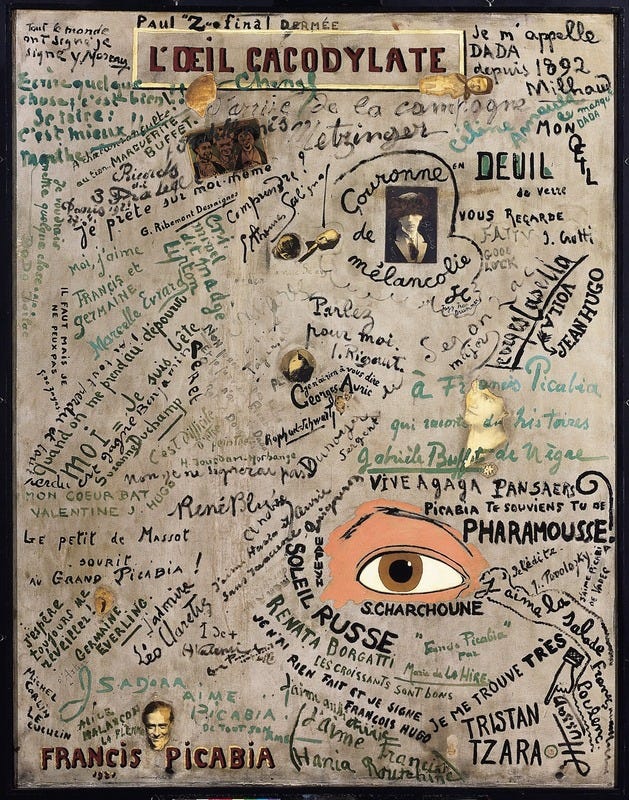
Francis Picabia, L'Oeil cacodylate, 1921, canvas covered in signatures around a single painted eye
Francis Picabia, L'Oeil cacodylate, 1921, Centre Pompidou

One large eye painted on a canvas, and around it roughly fifty signatures, scrawled jokes and pasted photographs left there by other people.

Picabia had an eye infection in 1921 and was treated with sodium cacodylate, which is where the title comes from. While he recovered he propped the canvas in his room and asked every visitor to write something on it.

Man Ray signed it. So did Jean Cocteau, who added a line about a crown of melancholy. Picabia painted the eye, the title and his own name, and left almost the entire surface to his friends. It went to the Centre Pompidou in 1968.

12. Kurt Schwitters, Merzbau (from around 1923)

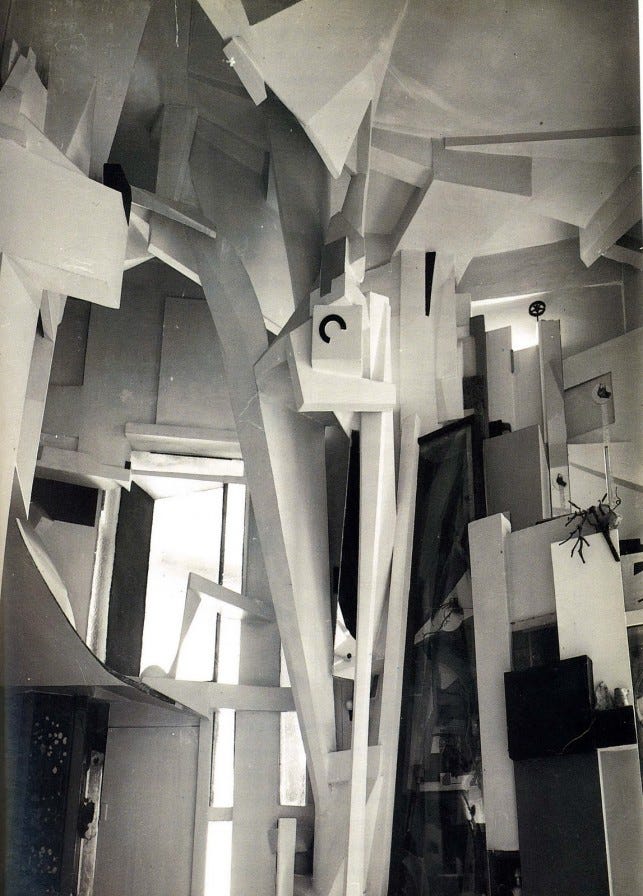
Kurt Schwitters, the Merzbau in his house in Hannover, photographed in 1933
Kurt Schwitters, Merzbau, Hannover, photographed in 1933

Schwitters started building inside his own house at Waldhausenstrasse 5 in Hannover around 1923, and never really stopped.

White angled columns grew out of the walls and the floor. Inside them he hid small grottoes holding objects taken or begged from people he knew, including things belonging to Hannah Hoch, Raoul Hausmann and Sophie Taeuber Arp. By 1937 it had spread through several rooms, the balcony and part of the attic.

He fled to Norway in 1937 and never saw it again. On the night of October 8, 1943, a British air raid on Hannover destroyed the house, and Schwitters only learned of it around eighteen months later. A full size reconstruction now stands in the Sprengel Museum in Hannover.


Two new stories a week, 130 secrets unlocked. Start free.


Where these Dada works live now

  • Fountain: no original survives. Replicas approved by Duchamp are at the Philadelphia Museum of Art, Tate Modern in London and the Centre Pompidou in Paris.

  • God: the sculpture is at the Philadelphia Museum of Art. Schamberg's photographs of it are at the Metropolitan Museum in New York.

  • Cut with the Kitchen Knife: the Nationalgalerie, Berlin.

  • Merzbild 1A: the Museo Thyssen Bornemisza, Madrid.

  • Mechanical Head, Dada Head and L'Oeil cacodylate: all three at the Centre Pompidou, Paris.

  • Cadeau: signed later versions at MoMA in New York, the Philadelphia Museum of Art and the Cleveland Museum of Art.

  • Merzbau: destroyed in 1943. The reconstruction is at the Sprengel Museum, Hannover.

Quick answers on Dada works

  • What is the most famous Dada artwork? Marcel Duchamp's Fountain of 1917, a porcelain urinal signed R. Mutt.

  • Can you still see the original Fountain? No. It vanished within weeks of being rejected in 1917. Every Fountain in a museum is a replica Duchamp approved in 1964.

  • Who were the women of Dada? Hannah Hoch in Berlin, Sophie Taeuber Arp in Zurich and Elsa von Freytag Loringhoven in New York. All three were treated as marginal in their own time and all three are now central to the story.

  • What is photomontage? Photographs cut out of print and reassembled into a scene that never happened. Hoch and Hausmann said they came up with it in 1918.

  • What is a readymade? A manufactured object presented as art with no change beyond the artist's choice, title and signature.

  • Is Dada the same thing as Surrealism? No. Dada came first and refused to build anything. Surrealism grew out of the Paris Dada group after 1924 and went looking for meaning in dreams instead.

  • Why is so much Dada work lost? A lot of it was made from junk, meant to last a night, or destroyed on purpose. War took the rest, including the Merzbau in 1943.

The work that almost did not get in

Hannah Hoch nearly missed the Dada Fair of 1920 altogether.

By her own account, George Grosz and John Heartfield argued against including her at all, and Raoul Hausmann had to insist. She was hung anyway, in a good spot.

Cut with the Kitchen Knife turned out to be one of the works people remembered from the whole show, and it has belonged to the Nationalgalerie in Berlin ever since. The men who wanted her left out are now a footnote to her picture.