Famous Dali Paintings: His 12 Greatest Works
Salvador Dali turned his own wild dreams into the most recognizable Surrealist paintings ever made, from melting clocks to floating tigers and burning giraffes.
A shameless showman with a waxed mustache curled up like antennae, he called himself a genius and painted his nightmares with the crisp precision of an old master.
These are twelve of his most famous paintings, each a window into a strange and brilliant mind. For the whole story of the man, see the complete Dali guide; here, the paintings themselves.
I have chosen the twelve that everyone knows.
1. The Persistence of Memory (1931)
Soft watches melt and drape over a barren landscape like slices of wet cheese, in the single most famous image of Surrealism Dali said the limp clocks came to him while he stared at a runny Camembert on a hot day, time itself gone soft and meaningless.
A strange fleshy shape in the center is widely read as a distorted self portrait, asleep and dreaming the whole scene. Tiny and precise, the picture is barely bigger than a sheet of paper.
It is a huge part of why Dali is famous, and yet it is barely bigger than this page, given to the Museum of Modern Art by an anonymous donor just three years after he painted it.
2. The Elephants (1948)
Two towering elephants stride across a desert on impossibly long, spindly legs like stilts made of glass, each carrying a heavy stone obelisk on its back.
Dali loved this contrast of massive weight held up by fragile, breakable legs, a dream image of power that could snap at any moment.
The spider thin legs stretch the beasts up into a strange, weightless sky, half nightmare and half circus. He used the same stilt legged elephants again and again across his work, a private symbol all his own.
It is one of his most reproduced images, printed on posters in a million student bedrooms.
3. Swans Reflecting Elephants (1937)
Three white swans float on a still lake, and their mirror reflections in the water turn upside down into three ghostly elephants, one image hidden inside another.
This is Dali's paranoiac critical method at work, training the eye to see two things at once, the way a madman finds hidden pictures everywhere.
The bare trees behind the swans become the elephants' ears and trunks in the reflection, a visual trick done with cold skill. A small figure of Dali himself stands to one side, lost in the vision.
Once you have seen the elephants in the swans, you can never again see only swans.
4. The Temptation of St Anthony (1946)
A naked hermit saint kneels in the desert, holding up a small cross against a parade of nightmarish creatures marching toward him on those same spider legs.
A rearing horse and a train of elephants carry temptations on their backs, a golden cup, a naked woman, palaces of desire, all balanced on legs about to buckle.
Dali painted it for a Hollywood competition to design a film scene, though his version was not the one chosen. The saint is tiny against the towering monsters, faith facing down a whole sky of temptation.
It hangs in Brussels today, one of the last great pictures of his Surrealist years before he turned to religion.
5. Christ of St John of the Cross (1951)
Christ hangs on the cross seen from high above, floating in a dark sky over a quiet bay, his head bowed so we never see his face, with no nails, no blood and no crown of thorns.
Dali based the strange overhead view on a small drawing by a sixteenth century Spanish mystic, Saint John of the Cross. He wanted a Christ of pure beauty and geometry, a modern faith built on mathematics and dreams rather than gore.
In 1961 a visitor in Glasgow slashed it and threw a rock at it, and it was carefully repaired. It hangs there still, one of the most loved religious pictures of the whole century.
6. The Sacrament of the Last Supper (1955)
Inside a great glowing pentagon of glass, Christ sits at a table with his twelve apostles, a huge male torso floating above them with arms spread over the whole scene.
Dali painted it in his devout, science obsessed later years, full of sacred geometry, mathematics and a clean, dreamlike calm. The room is built on the golden ratio, and the whole picture glows with an unearthly light.
He wanted to fuse religion, science and Renaissance beauty into one modern altarpiece. It hangs in Washington and is one of the most visited paintings in the National Gallery there.
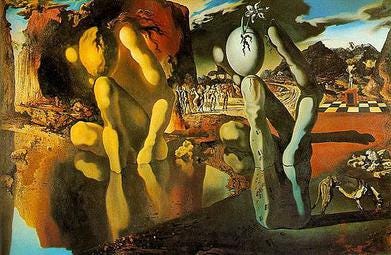
7. The Metamorphosis of Narcissus (1937)
On one side a young man kneels gazing at his reflection, and on the other a stone hand holds an egg from which a flower grows, the same shape twice, becoming a myth of change.
Dali painted the Greek story of Narcissus, who fell in love with his own reflection and turned into a flower, as a double image of before and after.
He showed it to Sigmund Freud, whose ideas about dreams shaped all of Surrealism, and the old doctor was fascinated. The kneeling figure and the stone hand are almost identical in shape, one melting into the other.
It hangs in the Tate in London, and Dali carried it to the city the next year to show the man behind his dreams in person.
8. Dream Caused by the Flight of a Bee (1944)
Gala sleeps naked, floating above a rock, while two tigers leap out of the mouth of a burst pomegranate, a bayonet about to prick her arm and wake her.
Dali painted his wife Gala's dream, the sting of the bayonet standing for the drone of a real bee that would jolt a sleeper awake.
Everything floats, weightless, in the half second before waking, the whole picture a snapshot of a dream at the moment it shatters.
An elephant on spider legs walks the far horizon, tiny and strange. Its full title runs to a dozen words, as playful and precise as the painting itself.
9. Soft Construction with Boiled Beans (1936)
A monstrous body tears itself apart, one giant hand crushing a breast while a twisted face screams, a nightmare of a nation ripping itself to pieces.
Dali claimed to have painted it months before the Spanish Civil War broke out, calling it a premonition of the horror to come in his homeland.
Scattered boiled beans lie around the writhing figure, an odd, homely touch amid the violence that even Dali could not fully explain.
It is his most powerful political picture, rage and prophecy in one clawing shape. It hangs in Philadelphia, and by his own telling he finished it just before Spain tore itself apart exactly as he had feared.
10. Galatea of the Spheres (1952)
The face of Dali's wife Gala floats out of a swirling cloud of hundreds of separate spheres, as if her portrait had been blown apart into atoms and put back together in mid air.
Painted in his atomic period, it turns Gala, his lifelong muse and manager, into something part angel and part science. Dali was obsessed with the new physics of the atom bomb, and built her face from floating particles held together by nothing but love.
Gala was the center of his whole world, and he signed many works with both their names. He once said he loved Gala more than his mother, more than money, more than Picasso, which for Dali was the highest praise of all.
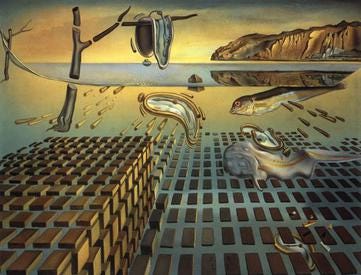
11. The Disintegration of the Persistence of Memory (1954)
Dali returned to his own famous melting clocks twenty years later and blew them apart, the whole scene breaking into floating blocks and rods hovering over a flooded landscape.
This is his atomic vision of the first picture, the solid world dissolving into the separate particles that physicists said everything was made of.
The soft watches are still there, now cut into drifting segments above the water, time itself coming undone. He loved to remake and comment on his own past, a showman revisiting his greatest hit It hangs in the Dali museum in Florida, beside his work on science and faith.
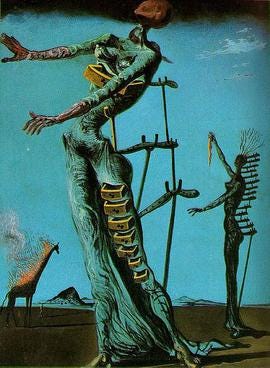
12. The Burning Giraffe (1937)
A woman with drawers pulled out of her own body walks forward, propped up by wooden crutches, while behind her a giraffe quietly burns against a blue evening sky.
Dali called the flaming giraffe the masculine cosmic apocalyptic monster, a sign of coming war, though he rarely explained his dream symbols plainly.
The little drawers, an idea borrowed from Freud, stand for the hidden secrets buried inside every person, opened for anyone to see.
The crutches, a favorite Dali prop, hold up bodies too weak or strange to stand on their own. It hangs in Basel, and Dali soon fled the coming war himself, sitting it out in America for eight years.
Dali's dream world, explained
What is Dali's most famous painting? The Persistence of Memory from 1931, the melting clocks, is his most famous by far.
What is Surrealism? An art movement that painted the strange logic of dreams and the unconscious mind, of which Dali was the most famous member.
Why did Dali paint melting clocks? He said they stood for the softness and unreality of time in dreams, sparked by watching a cheese melt in the sun.
Was Dali a good painter? Yes, he had the precise, old master technique of a Renaissance craftsman, which he used to paint impossible dream scenes.
Where can I see Dali's paintings? The Dali Theatre Museum in Figueres, Spain and the Dali Museum in Florida hold the largest collections.
If these paintings pulled you in, you will love these too:
The Ambassadors, detail by detail, the object at the bottom that only works from one side
Luncheon of the Boating Party, detail by detail, who everybody at that table actually was
Was Monet really the first Impressionist, the painting that may have got there first
The genius who played the fool
Dali worked hard to seem mad, cultivating the mustache, the wild eyes and the outrageous quotes, until people forgot how carefully he actually painted.
Behind the circus was a craftsman of astonishing skill, able to make a dream look more real than a photograph. These twelve pictures are the strange, precise records of a mind that turned its own nightmares into art.
He said the only difference between him and a madman was that he was not mad, and after looking at these, you almost believe him.