Dance Paintings: 12 Famous Works of Movement in Art

A dance painting freezes motion that was never meant to stop. From Botticelli floating goddesses to Degas exhausted ballerinas, artists used dance to study the body, catch a fleeting moment, and hint at desire, class, and time slipping away.

Dance is almost impossible to paint. The whole point of dance is that it moves, and paint does not. So artists cheated. They caught the split second before a leap, or the tired minute after, or turned the circle of dancers into a symbol of the seasons.

  • The frozen instant: great dance painting catches one split second, a raised foot or a turned head, and lets you feel the movement around it.

  • Dance as a code for desire: a couple turning together is one of the oldest ways to paint attraction without a word.

  • The class behind the ballet: behind the tutus, painters like Degas showed labor, sweat, and the hard business of the stage.

  • The circle as a symbol: a ring of dancers often stands for the seasons, the cycle of life, or time itself.

If these draw you in, you will also love 7 secrets hidden in famous paintings, who painted the first Impressionist, and Renoir Luncheon of the Boating Party in full.


Learn art the fun way. Free stories every week, no boring lectures.


1. Botticelli, Primavera

The Three Graces turning in a linked circle in a spring garden
Sandro Botticelli, Primavera, about 1480. Uffizi Gallery, Florence.

Painted around 1480 for the Medici, the picture reads left to right like a slow dance. The Three Graces turn in a linked circle while Venus presides and Spring scatters flowers.

For a painting of spring, it is packed with real plants. Botanists have counted around 190 identifiable species, many in bloom at once, which no real garden ever does.

For centuries it hung half forgotten in a Medici villa. Today it is one of the most visited works in Florence, a permanent crowd at the Uffizi.

2. Nicolas Poussin, A Dance to the Music of Time

Four figures dancing in a ring while a winged old man plays a lyre
Nicolas Poussin, A Dance to the Music of Time, about 1634 to 1636. Wallace Collection, London.

Painted around 1634 to 1636, four figures hold hands and turn in a ring while a winged old man plays a lyre and a baby blows bubbles.

This is a puzzle, not a party. The dancers are Poverty, Labor, Wealth and Pleasure, turning endlessly into one another, and the old man is Time itself keeping the beat.

The bubbles and the hourglass carried by Time are blunt reminders that it all ends. A novelist later borrowed the title for a twelve book series about English life.

3. Pieter Bruegel the Elder, The Peasant Dance

Villagers stamping and lurching at an open air feast
Pieter Bruegel the Elder, The Peasant Dance, about 1567. Kunsthistorisches Museum, Vienna.

Painted around 1567, villagers stamp and lurch at an open air feast, a bagpiper puffing away while couples rush in from the right.

This is not a simple folk celebration. The details, the drinking, the brawling in the background, the neglected church, read as a quiet sermon on gluttony and lust.

Bruegel dressed his peasants with real care and real weight. That respect for ordinary bodies in motion is exactly why later painters kept coming back to him.

4. Francisco Goya, The Meadow of San Isidro

Crowds picnicking and dancing on a riverbank with the Madrid skyline behind
Francisco Goya, The Meadow of San Isidro, 1788. Museo del Prado, Madrid.

Painted in 1788, crowds picnic and dance on the banks of the Manzanares during Madrid San Isidro festival, the whole city skyline glowing behind them.

This bright, airy scene is only an oil sketch. It was a study for a giant tapestry that Goya never finished, because the court fell into crisis soon after.

Within a few years Goya went deaf and his art turned dark. This sunlit crowd is one of the last purely happy things he ever painted.

5. Edgar Degas, The Dance Class

Young ballerinas waiting while an old ballet master watches
Edgar Degas, The Dance Class, about 1873 to 1876. Musee d Orsay, Paris.

Painted between 1873 and 1876, a room of young ballerinas waits while the aging ballet master Jules Perrot leans on his stick and watches.

Degas was not selling glamour. He shows the boredom and the aching feet, girls scratching their backs and adjusting ribbons while one dancer waits her turn.

Perrot was a real and famous dancer. Degas painted him from studies, then set him in a class he probably never actually taught.

6. Edgar Degas, Blue Dancers

Four dancers in blue adjusting their costumes in stage light
Edgar Degas, Blue Dancers, about 1897. Pushkin Museum, Moscow.

Around 1897, Degas painted four ballerinas in blue crowded close together, adjusting their straps and hair just before they go on. He worked it in thick, glowing pastel.

By this point Degas eyes were failing, so he built the scene from color and touch more than fine detail. The same few poses repeat across his late dance works, studied over and over.

This is Degas at his most abstract, four bodies dissolving into a single mass of blue. It hangs at the Pushkin Museum in Moscow.

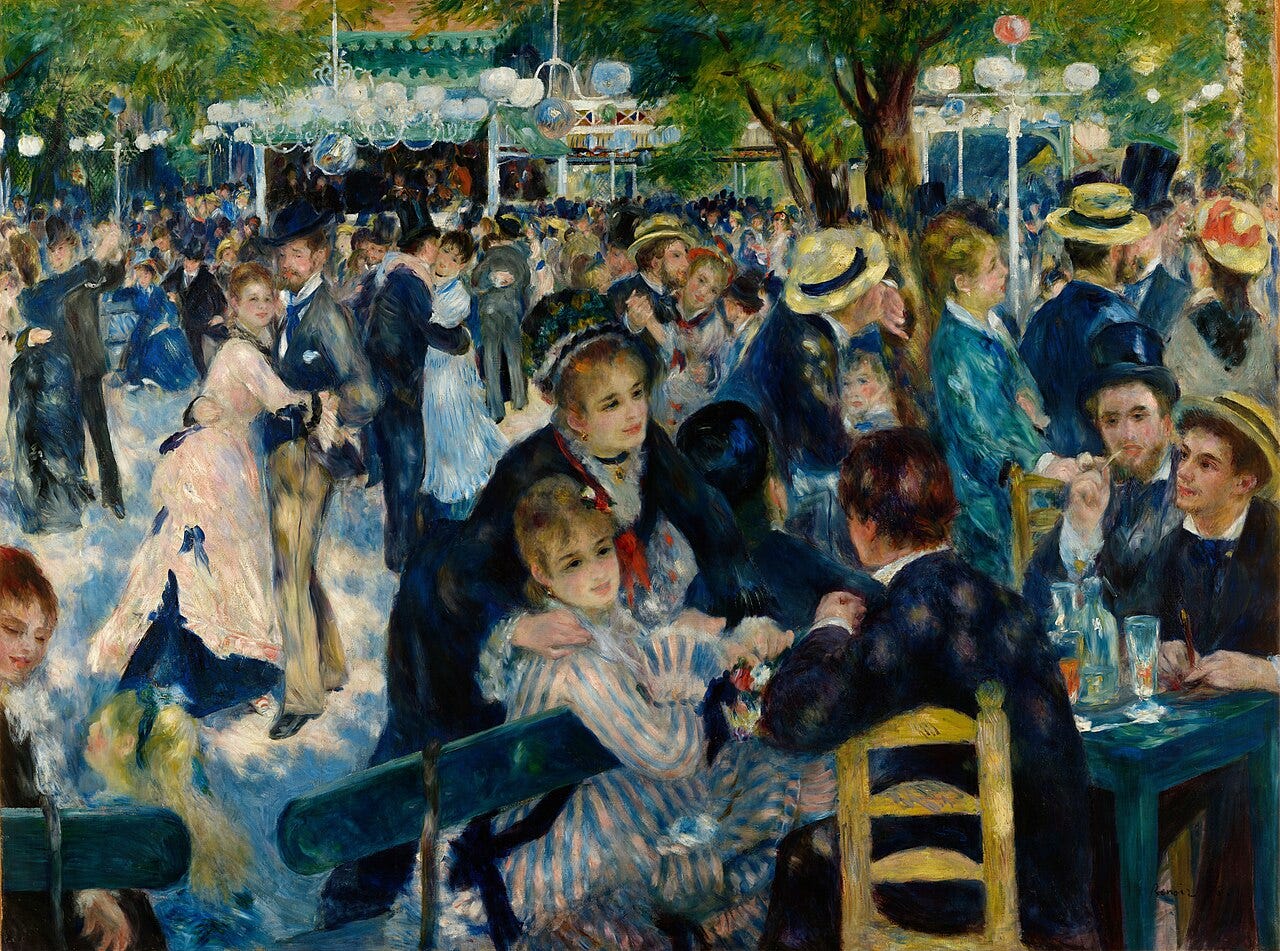
7. Renoir, Bal du moulin de la Galette

A Sunday crowd dancing under trees in dappled sunlight
Pierre Auguste Renoir, Bal du moulin de la Galette, 1876. Musee d Orsay, Paris.

Painted in 1876, a Sunday crowd dances and drinks under the trees at an open air hall in Montmartre, sunlight falling through the leaves in dappled spots.

Renoir claimed he painted it on the spot, outdoors, week after week. Many of the dancers are his actual friends, artists and models who posed for free.

In 1990 a smaller version of this scene sold for 78 million dollars, then one of the highest prices ever paid for any painting.

8. Renoir, Dance at Bougival

A couple turning together at a riverside dance hall
Pierre Auguste Renoir, Dance at Bougival, 1883. Museum of Fine Arts, Boston.

Painted in 1883, a couple turns together at a riverside dance hall, the woman in a white dress and red bonnet leaning into her partner arms.

The woman is Suzanne Valadon, then a teenage model. She studied the painters she posed for and became a respected artist in her own right.

Renoir made three near identical dance scenes that year. This is the warmest of them, and Boston has kept it as a visitor favorite ever since.


Join 130,000 readers who get the secrets behind the paintings. Free.


9. Toulouse Lautrec, At the Moulin Rouge: The Dance

A dancer kicking up her skirts while a contortionist coaches a new girl
Henri de Toulouse Lautrec, At the Moulin Rouge: The Dance, 1889 to 1890. Philadelphia Museum of Art.

Painted in 1889 to 1890, just after the Moulin Rouge opened, a dancer kicks up her skirts while the boneless contortionist Valentin coaches a new girl.

A note on the back, likely by the artist, says the scene shows Valentin training the new dancers. This was reportage, not fantasy. Lautrec drank there almost nightly.

The club owner hung it inside the Moulin Rouge itself from 1890. It later crossed the Atlantic and now anchors the collection in Philadelphia.

10. John Singer Sargent, El Jaleo

A Spanish dancer thrown back mid step in a dim tavern
John Singer Sargent, El Jaleo, 1882. Isabella Stewart Gardner Museum, Boston.

Painted in 1882, a Spanish dancer throws her head back mid step in a dim tavern, guitarists lined up along the wall behind her.

Sargent was 26 and had spent time in Spain absorbing flamenco. He froze the dance at its most off balance moment, the body leaning past where it should be able to hold.

Isabella Stewart Gardner built a special Spanish alcove for it, lit from below like a stage. It still sits there exactly as she planned.

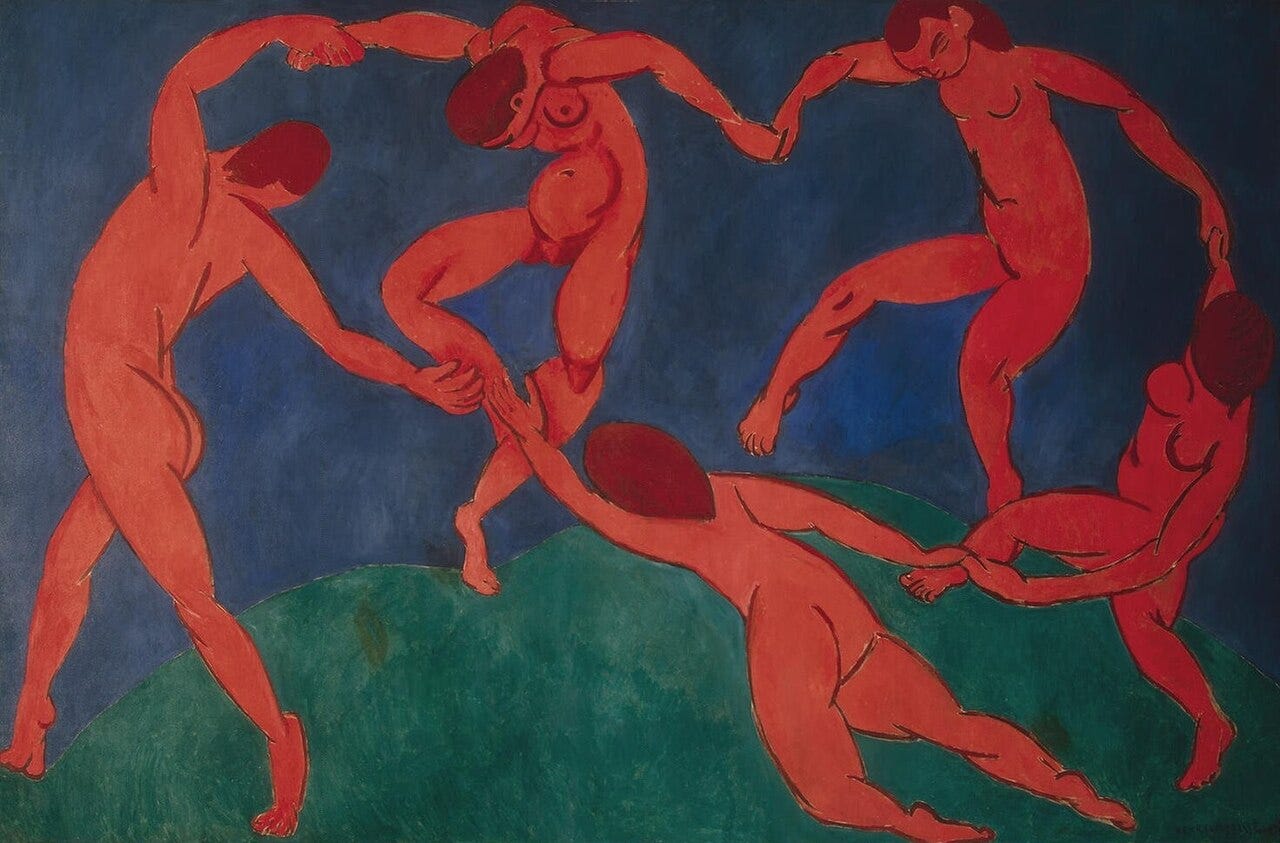
11. Henri Matisse, Dance

Five red figures whirling in a ring against blue and green
Henri Matisse, Dance, 1910. State Hermitage Museum, St Petersburg.

Painted in 1910 for the Russian collector Sergei Shchukin, five nude figures in flat red join hands and whirl in a ring against blue sky and green ground.

There is almost nothing in it. No setting, three colors, no detail on the bodies. Matisse reduced dance to pure line and energy, and shocked audiences by doing so.

An earlier, paler version from 1909 hangs at MoMA in New York. The Hermitage keeps the fiercer, redder final one.

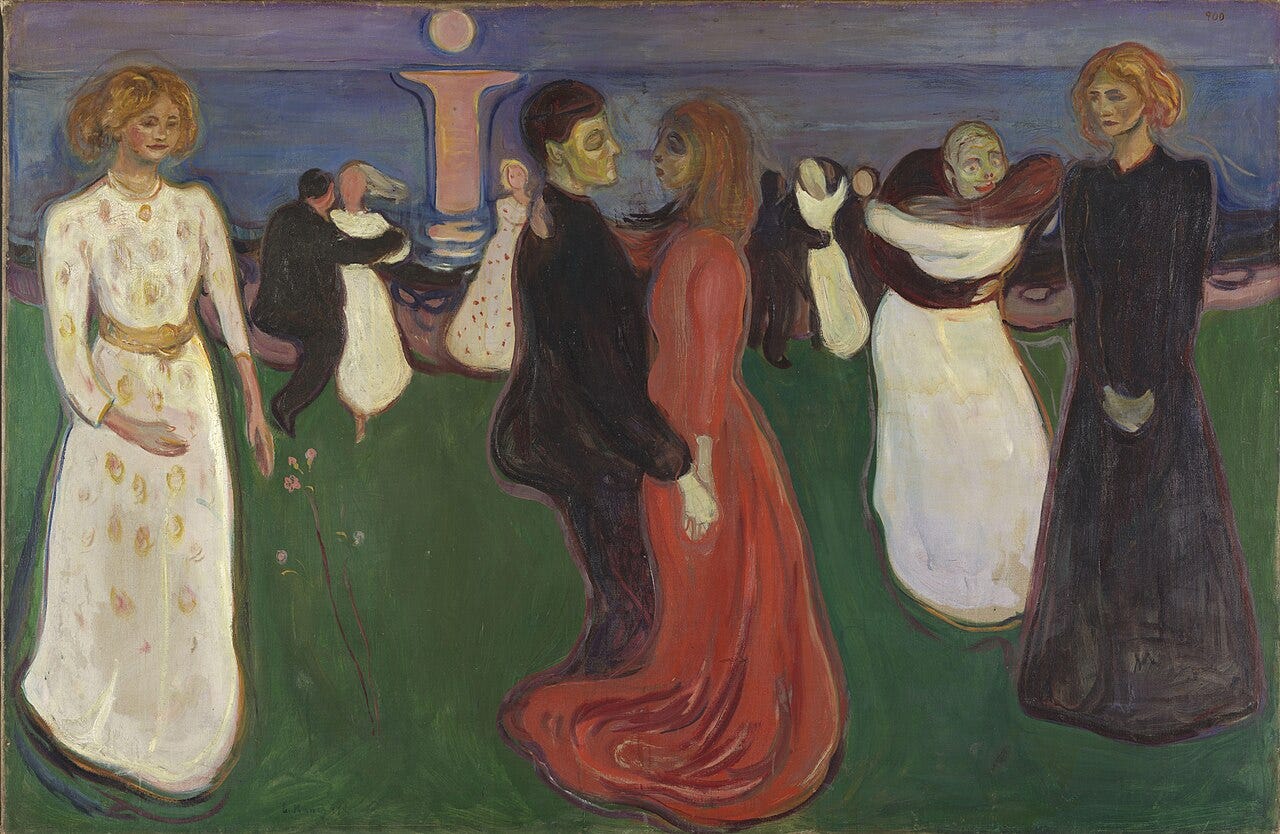
12. Edvard Munch, The Dance of Life

Couples turning on a summer night by the fjord under a pale moon
Edvard Munch, The Dance of Life, 1899 to 1900. National Museum, Oslo.

Painted in 1899 to 1900, couples turn on a summer night by the fjord under a pale moon, a central pair locked together in red and black.

The same woman appears three times, in white, in red, and in black. She is youth, passion and old age, the whole cycle of a life turning past in one dance.

The looming column of moonlight on the water is a Munch signature. He returned to this scene of love and loss for the rest of his career.

Where to see them

  • Musee d Orsay, Paris: Degas The Dance Class and Renoir Bal du moulin de la Galette.

  • Boston: Renoir Dance at Bougival (Museum of Fine Arts) and Sargent El Jaleo (Isabella Stewart Gardner Museum).

  • Philadelphia Museum of Art: Toulouse Lautrec At the Moulin Rouge: The Dance.

  • Vienna and Florence: Bruegel The Peasant Dance (Kunsthistorisches Museum) and Botticelli Primavera (Uffizi).

  • Farther afield: Poussin A Dance to the Music of Time (London), Goya The Meadow of San Isidro (Madrid), Matisse Dance (St Petersburg) and Munch The Dance of Life (Oslo).

What a painted dance is really about

Some of these are grand allegories, where a ring of dancers stands for the seasons or the cycle of a life.

Others are Impressionist scenes of real Paris nightlife, and Degas ballet works quietly show the labor and the men who preyed on young dancers.

Dance in art, questions people ask

  • Why is dance so hard to paint? Dance is movement and paint is still. Artists solve it by catching one exact instant, the moment just before or after the peak of a step.

  • Who is the most famous painter of dancers? Edgar Degas. Roughly half his work involves ballet, and he is the artist most tied to dance in Western painting.

  • Are Degas ballet paintings really about ballet? Partly. They also show labor, exhaustion, and the older men who preyed on young dancers backstage, often lurking in the wings.

  • Who is the woman in Renoir Dance at Bougival? Suzanne Valadon, a teenage model at the time, who went on to become a serious painter herself.

  • Where can I see the most dance paintings together? The Musee d Orsay in Paris holds Degas The Dance Class and Renoir Bal du moulin de la Galette.

The dancer who was also the painter

Look again at the woman in the white dress in Renoir Dance at Bougival. In 1883 she was a broke teenage model named Suzanne Valadon, hired to hold a pose. She watched every brushstroke, taught herself, and by the 1890s Degas was buying her drawings. She became the first woman admitted to the Societe Nationale des Beaux Arts as a painter. The girl posing inside one of these dance paintings ended up making her own.


Two new stories a week, 130 secrets unlocked. Start free.