The Devil in Art: 12 Famous Paintings of Satan
For seven centuries, European painters gave the Devil a face. He appears as a horned goat, a three faced giant, a hollow tree, a red dragon, and finally a beautiful fallen angel. These twelve famous paintings show how Satan changed shape from a medieval mosaic to 1890.
The Devil is the hardest figure in art to paint. He has no fixed body, so every age had to invent one. Medieval mosaics made him a beast that swallows sinners whole. By 1890 he had become quiet, brooding, almost human.
The medieval beast: a horned monster that eats the damned, as in the Florence Baptistery and Giotto Padua.
The Renaissance giant: Bosch hollow Tree Man and Botticelli frozen Satan at the bottom of hell.
The falling avalanche: Rubens and Signorelli hauled muscular bodies down into fire.
The tragic angel: by 1890 Vrubel and Stuck painted Lucifer as a beautiful, brooding figure.
If these draw you in, you will also love the painting that obsessed Hitler, 7 secrets hidden in famous paintings, and what a memento mori really means.
1. Coppo di Marcovaldo, Hell
In the later 1200s, mosaicists set a giant horned Satan into the golden ceiling of the Florence Baptistery. He sits on a throne of flame, cramming one sinner into his mouth while snakes burst from his ears and swallow others.
The design is credited to Coppo di Marcovaldo. This monster shaped the imagination of a Florentine child baptized beneath it, Dante Alighieri, who would later build his own Inferno.
Millions have looked up at it since. It is still overhead when you step into the Baptistery, across from the cathedral in Florence.
2. Giotto, The Last Judgment
Around 1305, Giotto covered the west wall of the Scrovegni Chapel in Padua with the Last Judgment. In the lower corner sits a blue, bloated Satan with three faces, chewing the damned in each mouth.
The chapel was paid for by Enrico Scrovegni to atone for his father sins as a moneylender. Giotto Satan, with three faces turned to evil, is a dark mirror of the Holy Trinity.
The frescoes came before Dante finished his poem. You can still stand below Giotto Satan in the small brick chapel in Padua.
3. Hans Memling, The Last Judgment
Between 1467 and 1471, Hans Memling painted a Last Judgment triptych in Bruges. On the right wing, black devils drag screaming souls into a burning pit while Saint Michael weighs the dead.
The triptych was made for a family chapel in Italy. In 1473 a privateer from Danzig, Paul Beneke, seized the ship carrying it and took the whole altarpiece as loot.
It never reached Italy. More than five centuries later it still hangs in Gdansk, at the National Museum, the city most valuable painting.
4. Sandro Botticelli, The Chart of Hell
In the 1480s to 1490s, Sandro Botticelli drew Dante entire Inferno as one great funnel of stone. At the very bottom, a huge Satan is frozen waist deep in ice, chewing three sinners at once.
Botticelli made more than ninety drawings for a deluxe edition of Dante. This one packs all nine circles into a single cone crawling with tiny tormented figures.
Most of the sheets are now in Berlin. The Chart of Hell is one of seven kept in the Vatican Library in Rome, rarely shown to the public.
5. Luca Signorelli, The Damned Cast into Hell
Between 1499 and 1502, Luca Signorelli filled a chapel wall in Orvieto Cathedral with muscular demons hauling the damned into hell. One winged devil carries off a screaming woman on his back.
Signorelli painted his devils in the colors of rotting flesh, gray, green and bruised purple. A young Michelangelo studied these bodies before he painted his own Last Judgment.
The frescoes fill the San Brizio Chapel inside the cathedral at Orvieto, in Umbria, and are still there today.
6. Hieronymus Bosch, The Garden of Earthly Delights

Around 1490 to 1500, Hieronymus Bosch painted a burning hell on the right wing of his great triptych. At its center stands the Tree Man, a hollow figure with a cracked eggshell body and legs like rotting trunks.
Devils torment gamblers, gluttons and musicians. One demon with a bird head swallows sinners whole. Some scholars think the Tree Man blank, backward turning face is a hidden self portrait of Bosch.
The triptych has been in Spain since the sixteenth century. It has hung in the Prado in Madrid since 1933.
7. Michelangelo, The Last Judgment
Between 1536 and 1541, Michelangelo painted the Last Judgment on the altar wall of the Sistine Chapel. At the bottom the demon Charon beats souls out of his boat, and Minos, wound in a serpent, judges hell.
A Vatican official, Biagio da Cesena, complained the nudes were shameful. Michelangelo painted Biagio face onto Minos, gave him donkey ears and a snake biting his groin.
When Biagio begged the Pope to have it removed, the Pope reportedly answered that his power did not reach into hell. The face is still there in the Sistine Chapel.
8. Peter Paul Rubens, The Fall of the Damned
Around 1620, Peter Paul Rubens painted a churning avalanche of bodies plunging out of the sky, hauled down by demons into fire. There is no ground, only falling flesh.
Rubens packs dozens of nude figures into a spiral with no top and no bottom. Serpents and bat winged devils bite and claw as the damned tumble headfirst into the dark.
The canvas stands more than three meters tall. It hangs at the Alte Pinakothek in Munich, where it survived an acid attack on the Rubens room in 1959 and was restored.
9. Francisco Goya, Witches Sabbath (The Great He Goat)
Between 1820 and 1823, Goya painted a huge black goat, the Devil, looming over a hunched crowd of witches in the dark. It was one of the Black Paintings he put straight onto the walls of his house.
Goya never meant anyone to see these. He painted them in silence in his old age, deaf and alone, on the plaster of the Quinta del Sordo. The Devil here is a shadow, faceless and vast.
The murals were later cut from the walls and transferred to canvas. The Great He Goat now hangs at the Prado in Madrid.
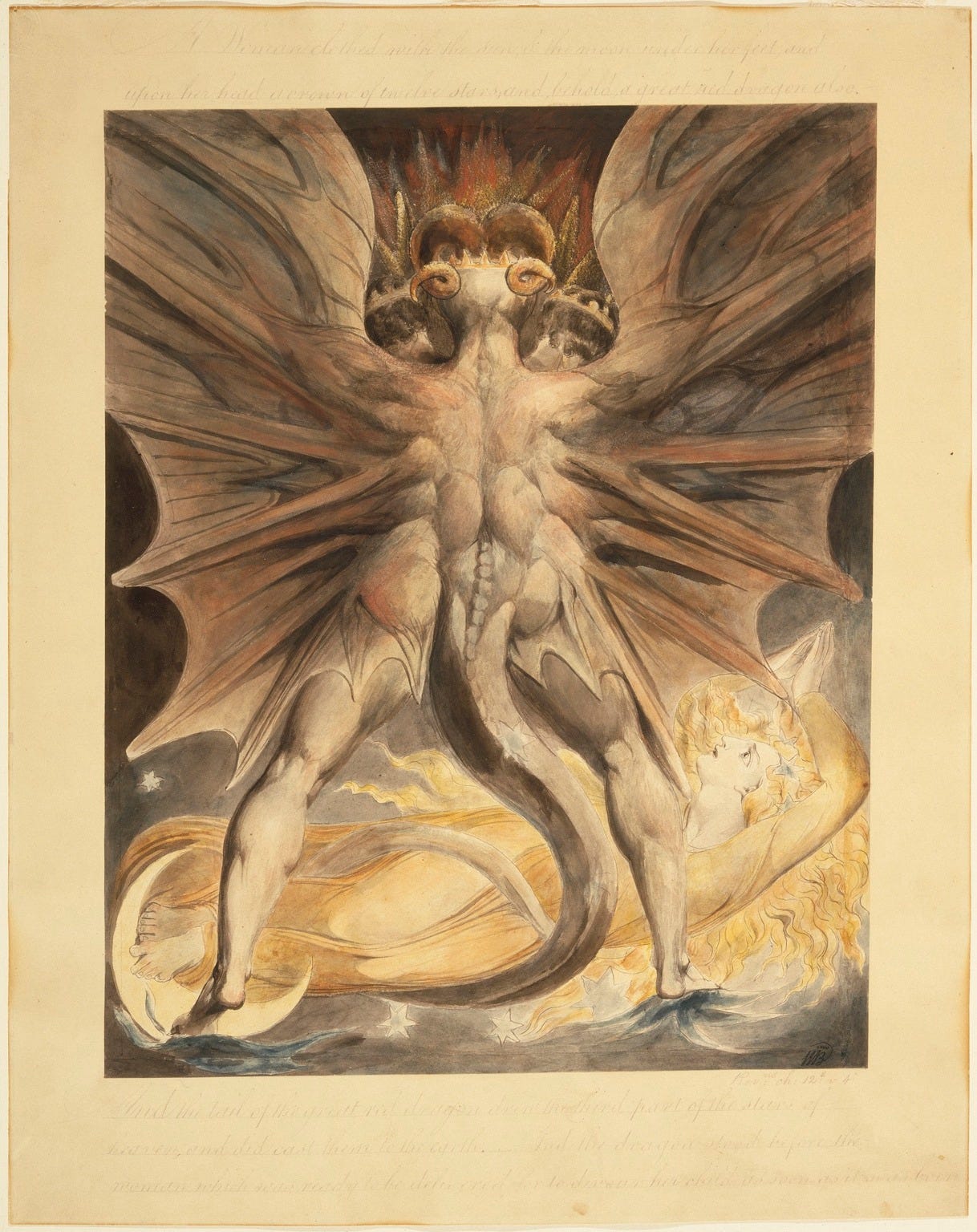
10. William Blake, The Great Red Dragon and the Woman Clothed with the Sun

Between 1803 and 1805, William Blake painted the dragon of Revelation with wings spread and back turned, towering over a woman crowned with stars. The dragon is Satan himself.
Blake made this for his patron Thomas Butts as part of a series of Bible watercolours. He gives the Devil a beautiful, muscled human back, more angel than beast.
The image later seeped into popular culture. Thomas Harris built his 1981 novel Red Dragon around it. The painting now belongs to the Brooklyn Museum in New York.
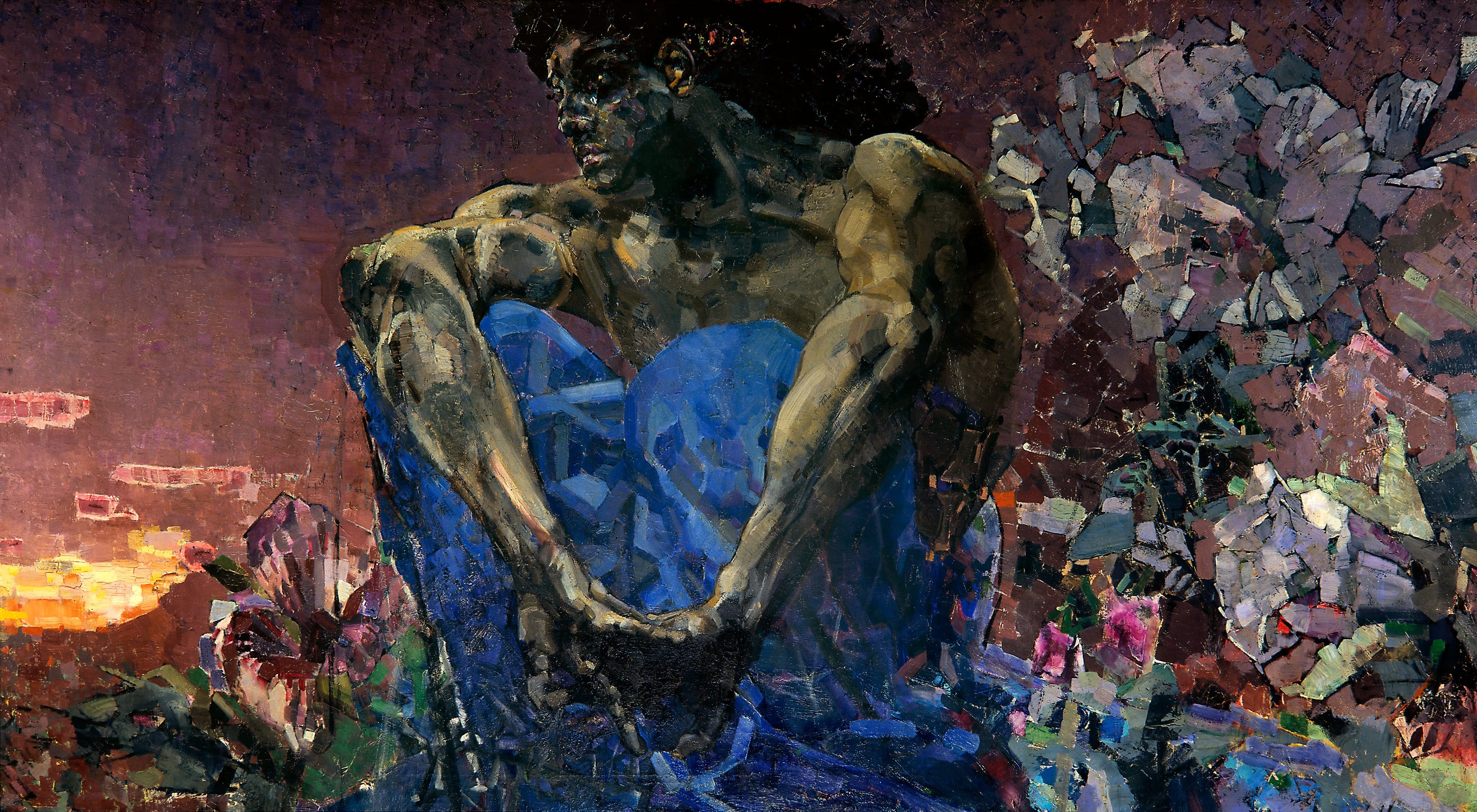
11. Mikhail Vrubel, The Demon Seated
In 1890, Mikhail Vrubel painted a young demon sitting alone against a red sunset, hands clasped, staring at nothing. His body seems pressed between the top and bottom of the frame.
This Devil is no monster. He comes from a poem by Lermontov about a fallen spirit who falls in love and cannot be saved. Vrubel built him from facets, like cracked crystal or stained glass.
Vrubel could not let the demon go. He painted him again and again until his own mind broke. The Demon Seated hangs at the Tretyakov Gallery in Moscow.
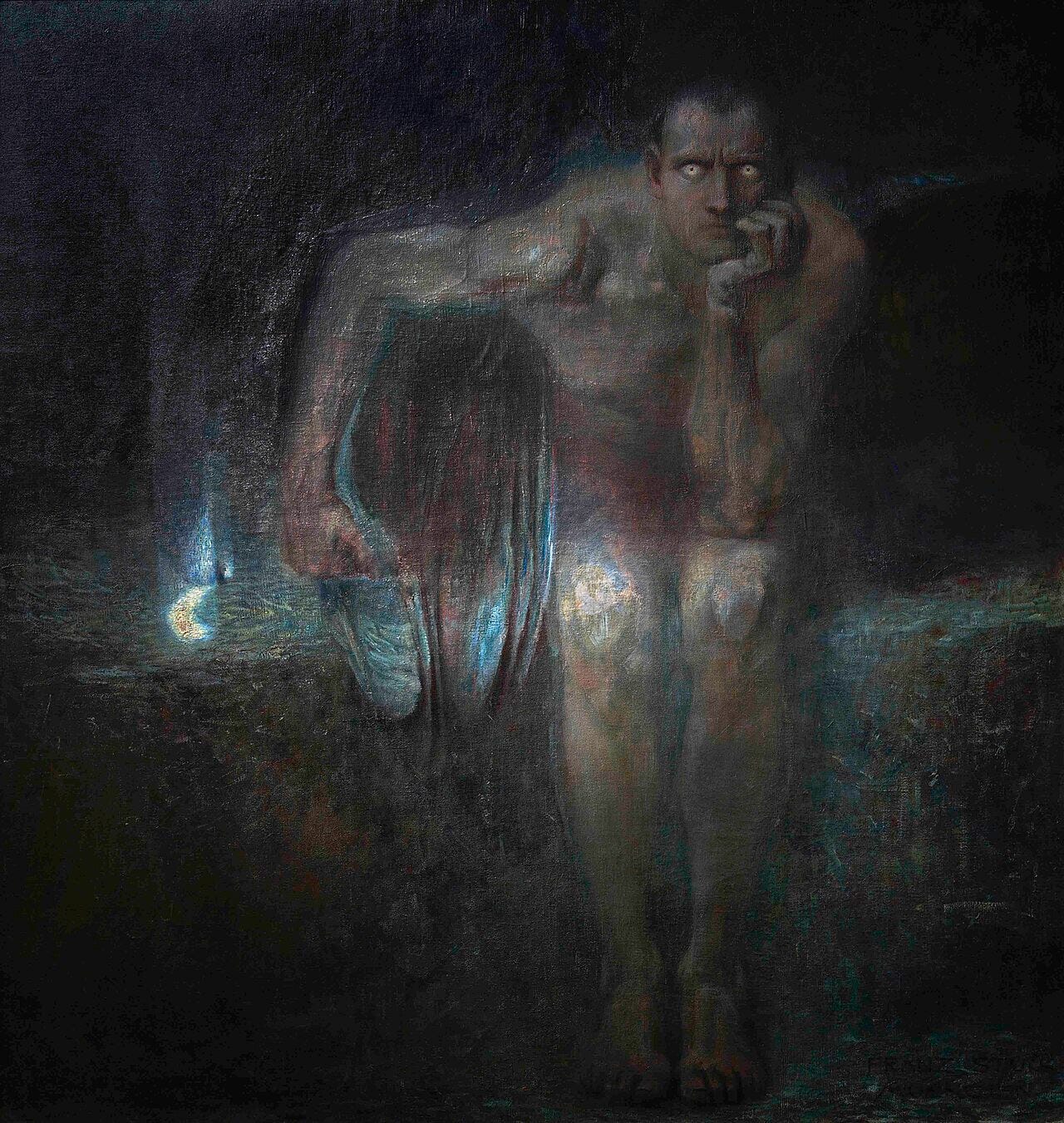
12. Franz von Stuck, Lucifer
Around 1890, Franz von Stuck painted Lucifer crouched in darkness, his body swallowed by shadow, only two pale eyes burning out at the viewer.
Stuck Devil does not roar or fall. He simply waits and stares. This is the fallen angel after the fall, fully aware of what defiance has cost him.
Prince Ferdinand of Bulgaria bought the painting for his royal collection in 1891. It hangs today at the National Gallery in Sofia.
Where to see them
Museo del Prado, Madrid: The Garden of Earthly Delights (Bosch) and Witches Sabbath (Goya).
Vatican City, Rome: the Sistine Chapel Last Judgment (Michelangelo) and the Chart of Hell (Botticelli).
Alte Pinakothek, Munich: The Fall of the Damned (Rubens).
Tretyakov Gallery, Moscow: The Demon Seated (Vrubel).
Scrovegni Chapel, Padua: The Last Judgment (Giotto).
How the Devil kept changing shape
The oldest are iconography of hell in mosaic and fresco, where every horn and flame carried a fixed meaning.
The later ones belong to Romanticism and Symbolism, where Lucifer became a tragic, beautiful figure rather than a beast.
The Devil in art, questions people ask
How was the Devil first shown in art? Early medieval art made Satan a horned, dark beast that eats sinners, as in the 1200s Florence Baptistery mosaic and Giotto blue three faced monster in Padua.
Why is the Devil sometimes handsome? By the 1800s, poets and painters saw Lucifer as a fallen angel rather than a beast. Vrubel and Franz von Stuck both painted him as a beautiful, tragic figure around 1890.
What is the Tree Man in Bosch hell? It is the hollow figure at the center of the Garden of Earthly Delights hell wing, with an eggshell body and tree trunk legs. Some believe its face is a hidden self portrait of Bosch.
Did Michelangelo hide an enemy in his Last Judgment? Yes. He painted the face of the critic Biagio da Cesena onto Minos, the judge of hell, complete with donkey ears and a serpent.
Where can I see the Devil in art? The Prado in Madrid holds Bosch and Goya, the Sistine Chapel holds Michelangelo, the Alte Pinakothek in Munich holds Rubens, and the Tretyakov in Moscow holds Vrubel.
The Devil his ministers feared
When Prince Ferdinand of Bulgaria hung Franz von Stuck Lucifer in Sofia, he told the painter that his own government ministers had crossed themselves at the sight of it. Seven centuries after Coppo di Marcovaldo set a snake spewing monster into a Florence ceiling, a pair of eyes in the dark could still send grown men reaching for the sign of the cross.