Dog Paintings: 12 Iconic Dogs in Art History
Dogs have sat in paintings for six hundred years, standing for loyalty, wealth, grief, and pure company. From the tiny dog in Van Eyck Arnolfini portrait to Goya drowning hound and a table of poker playing pups, twelve famous works put dogs center stage.
A dog in a painting is almost never just a dog. It promises fidelity in a marriage, shows off a family wealth, marks a hunt, or breaks your heart with grief. These twelve stretch from a Bruges bedroom in 1434 to a smoky American card table in 1903.
What the dog means: each dog does a job, from loyalty to mourning to plain company.
The lap dog of the rich: a pampered pet marks a family wealthy enough to keep one just for company.
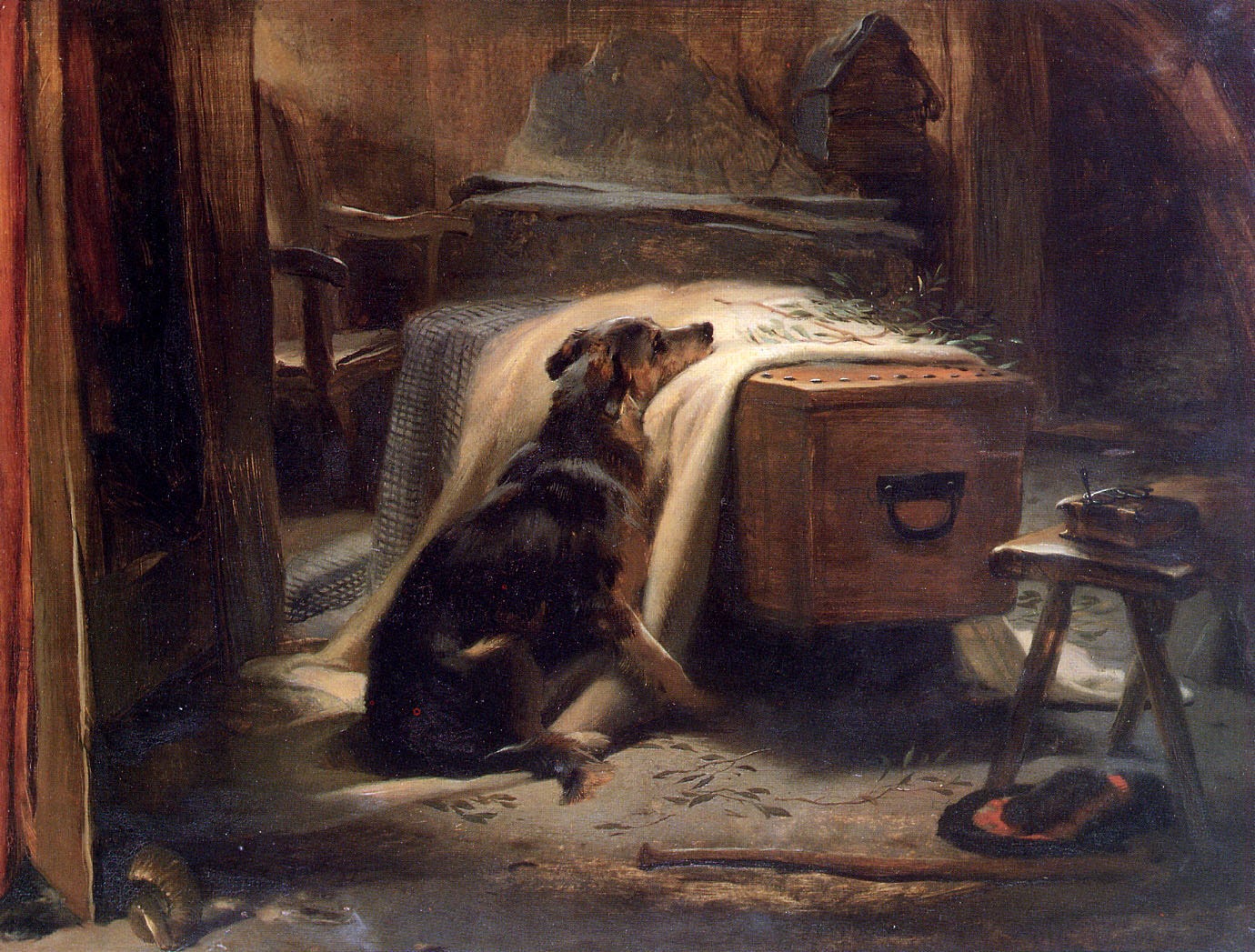
The mourner: Landseer left only a dog beside a coffin, the one who feels the death most.
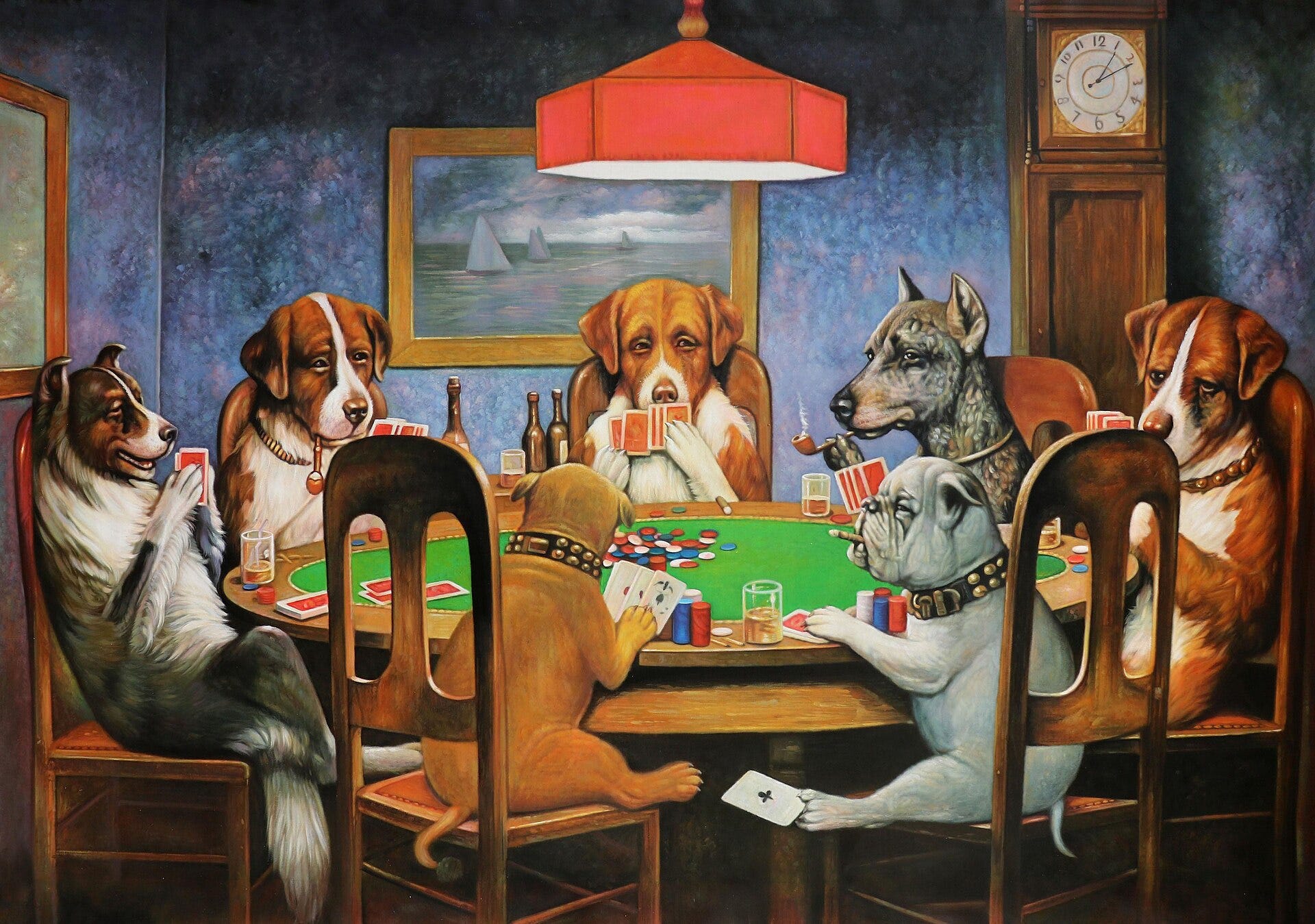
The joke: by 1903 dogs were sitting around a poker table, cheating each other.
If these draw you in, you will also love 7 secrets hidden in famous paintings, the secret detail in the Arnolfini Portrait, and 21 famous painters with their cats.
1. Jan van Eyck, The Arnolfini Portrait
In 1434 van Eyck painted a richly dressed couple in a Bruges bedroom. At their feet, painted hair by hair, stands a small bright eyed terrier.
The dog is a message. In a marriage scene it stands for fidelity, the loyalty each partner promises. It is also a status symbol, a pampered lap dog owned by people wealthy enough to keep one purely for company.
Van Eyck signed the wall above the mirror in curling Latin, Jan van Eyck was here 1434, rare confidence for a painter of his day.
2. Titian, Venus of Urbino
Titian finished this reclining nude around 1534. At the foot of the bed, curled asleep on the rumpled sheets, lies a small spaniel.
The sleeping dog is a clue about the room. A dog stands for fidelity in marriage, and because it sleeps rather than barks, it hints that the person looking at Venus is meant to be her husband, not an intruder.
Mark Twain later called it the foulest picture in the world, which only made crowds queue longer to see it.
3. Diego Velazquez, Las Meninas
In 1656 Velazquez painted the Spanish royal household in his studio. In the foreground a large, calm mastiff lies on the floor while a young court dwarf nudges it with a foot.
The dog anchors the whole scene. Amid mirrors, hidden viewers, and the painter own gaze, the sleepy hound is the one figure completely at ease, a note of ordinary life inside a puzzle of a picture.
The king and queen appear only as a blurred reflection in a mirror at the back, so we, the viewers, seem to stand exactly where they stood.
4. Pieter Bruegel the Elder, Hunters in the Snow
Bruegel painted this winter scene in 1565. Three hunters trudge home over a snowy ridge with a pack of tired dogs, having caught almost nothing.
The dogs tell the season story. Heads down, thin, and cold, they trail the hunters back toward a frozen village. This was one of a set of paintings tracking the months, and it shows the hard, hungry end of the year.
The panel is so tied to winter that it turns up again and again on Christmas cards, four and a half centuries on.
5. Francisco Goya, The Dog
Between 1819 and 1823 Goya painted a small dog head straight onto a wall of his house near Madrid. The animal peers upward, its body swallowed by a vast empty space.
This is one of the Black Paintings, made for no one, on his own walls, when Goya was old, deaf, and alone. The dog seems to be sinking or drowning, staring up at nothing.
Goya never meant these to be seen. They were cut from the walls and moved onto canvas about fifty years after he left the house.
6. George Stubbs, Water Spaniel

In 1778 Stubbs painted a single spaniel on a riverbank, standing among reeds and a weeping willow, the animal made almost heroic in its own small world.
Stubbs was the greatest animal painter of his century, famous for horses but just as sharp with dogs. He knew anatomy so well that even a family pet came out drawn with the care of a scientist.
Stubbs once spent around eighteen months dissecting horses for a book of engravings, work that made him the most trusted animal painter in Britain.
7. Thomas Gainsborough, Tristram and Fox
Sometime between 1775 and 1785 Gainsborough painted two dogs side by side, a dark spaniel and an alert tricolour, against a plain background.
These were the painter own dogs, Tristram and Fox. Gainsborough loved animals and grew tired of grand portrait commissions. Painting his own pets, with no patron to please, he worked loose and fast and clearly for pleasure.
The story goes that when Gainsborough quarreled with his wife, he would send an apology written in the voice of the dog Fox, signed with a paw.
8. Edwin Landseer, The Old Shepherd Chief Mourner
In 1837 Landseer painted a collie resting its head on the plain wooden coffin of its dead master, alone in a bare Highland cottage.
Everyone else has gone. Landseer leaves only the dog, the mourner to whom the death means the most. John Ruskin praised it as proof that a painter could show real feeling, and it became one of the most loved images of the Victorian age.
The picture helped spread the idea that animals feel grief, feeding some of the earliest campaigns for animal welfare in Britain.
9. Gustave Courbet, Self Portrait with a Black Dog
In 1842 the young Courbet painted himself as a confident traveller, sketchbook beside him, a black spaniel pressed against his side.
Courbet was building an image of himself as an artist before he was famous. The dog is a companion on the road, but also a prop, marking him as a free young man on his way to conquer Paris.
This was one of the first paintings Courbet ever got accepted into the Paris Salon, in 1844.
10. Pierre Auguste Renoir, Madame Charpentier and Her Children

In 1878 Renoir painted a wealthy Paris hostess with her two small children in a Japanese style sitting room. In the foreground the little daughter sits astride the family dog.
The dog is a large, patient Newfoundland named Porthos. Its size next to the tiny child shows just how gentle the breed is, and it grounds the whole glittering scene in warm family life.
Madame Charpentier used her social clout to get the painting hung well at the Salon, and it helped launch Renoir career.
11. Cassius Marcellus Coolidge, A Friend in Need
In 1903 the American painter Coolidge sat seven dogs around a late night poker table. One bulldog slips an ace to a friend under the table with its paw.
This is the famous one from the Dogs Playing Poker series. Coolidge painted sixteen of them, all commissioned by a printing firm to advertise cigars. They became some of the most reproduced images in American life.
For all the mockery, A Friend in Need sold for six hundred fifty eight thousand dollars at auction in 2015.
12. Briton Riviere, Sympathy
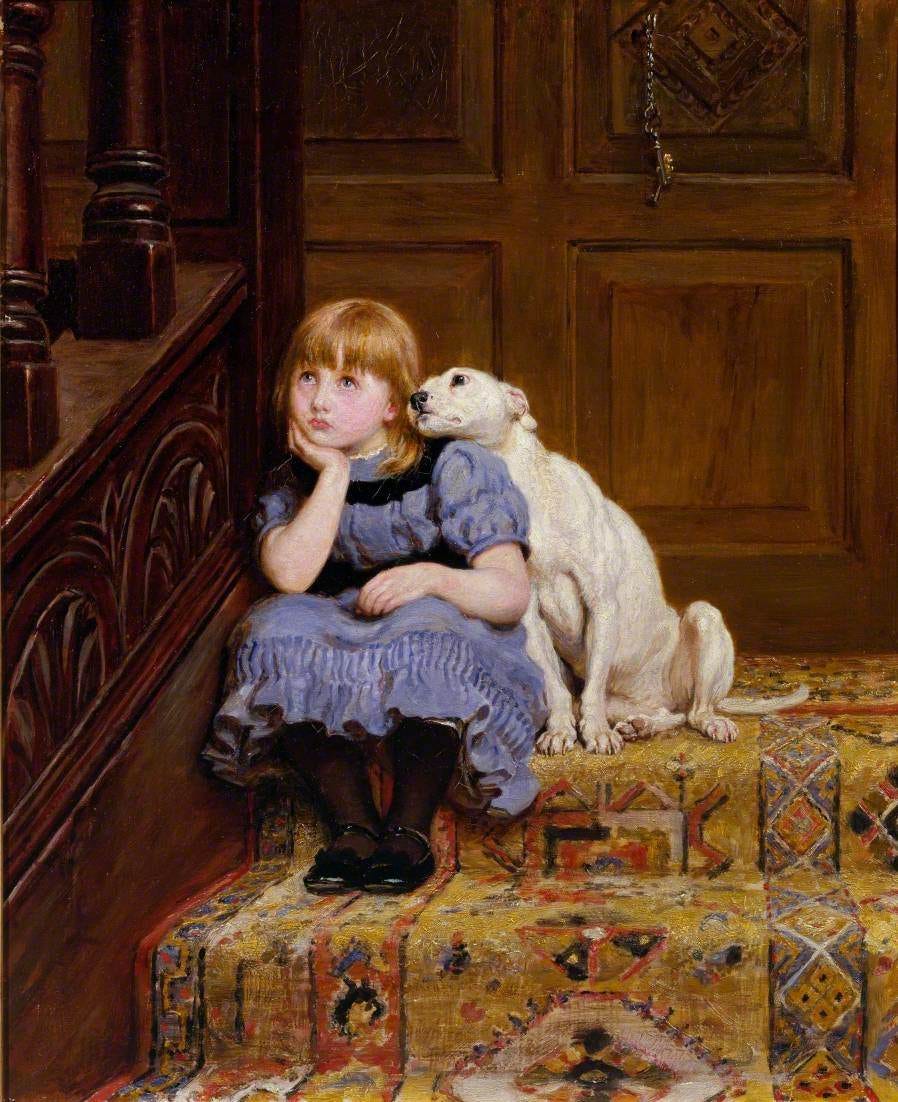
Around 1878 Riviere painted a small girl sitting on a staircase, sulking after a scolding, with a terrier pressed close against her, its chin on the step.
The dog is doing exactly what the title says. It sits with the child in her small misery, asking nothing, simply there. Riviere built a career on scenes of animals and human feeling, and this was among his most popular.
The image was reproduced so often on prints and cards that it became a fixture of Victorian parlours across Britain.
Where to see them
National Gallery, London: Jan van Eyck The Arnolfini Portrait.
Museo del Prado, Madrid: Velazquez Las Meninas and Goya The Dog.
Kunsthistorisches Museum, Vienna: Bruegel Hunters in the Snow.
Tate, London: Gainsborough Tristram and Fox and Riviere Sympathy.
Uffizi, Florence: Titian Venus of Urbino.
What a painted dog is really doing
In the old portraits, a dog signals fidelity and wealth, a pampered pet at a rich sitter feet.
In genre scenes it marks daily life, and in Goya haunting Romantic wall painting the small dog carries all the loneliness of the room.
Dogs in art, questions people ask
What do dogs symbolize in paintings? Most often loyalty and fidelity, especially in marriage portraits. They can also signal wealth, mark a hunt, or carry grief, as in Landseer mourning collie.
What is the dog in the Arnolfini Portrait? A small terrier, a sign of faithfulness between the couple and a marker of their wealth, painted by van Eyck in 1434.
What is the most famous dog painting? Coolidge Dogs Playing Poker series is the most reproduced, while Goya The Dog is the most admired by art historians.
Why is there a dog in Las Meninas? The sleeping mastiff adds a note of calm, ordinary life to Velazquez complex court scene, and dogs were common in royal households.
Did Gainsborough really paint his own dogs? Yes. Tristram and Fox were his own pets, painted for pleasure rather than for a paying patron.
The oldest promise in painting
The little terrier at the feet of the Arnolfinis was painted in 1434, and painters have kept setting dogs beside the people they love ever since. The Latin word for faithful, fidelis, is where the classic dog name Fido comes from, six centuries of loyalty folded into one small animal.