Famous Dutch Golden Age Paintings: 12 You Should Know
The Dutch Golden Age was the one century when ordinary life became the great subject of art, painted for shopkeepers and sea captains instead of kings and popes.
In the small new Dutch republic of the sixteen hundreds, a rich middle class bought pictures by the thousand, and painters gave them skaters, maids, dead pheasants and light through a window.
Here are twelve of the most famous Dutch Golden Age paintings, all now in the public domain. I have gathered the ones that turned everyday Holland into some of the most loved painting in the world.
The next stop
Three that take a single painting apart, properly:
Vermeer, Woman Holding a Balance, what is actually on those scales
The Arnolfini Portrait, detail by detail, the mirror, the dog, and the question everyone asks
Luncheon of the Boating Party, detail by detail, who everybody at that table actually was
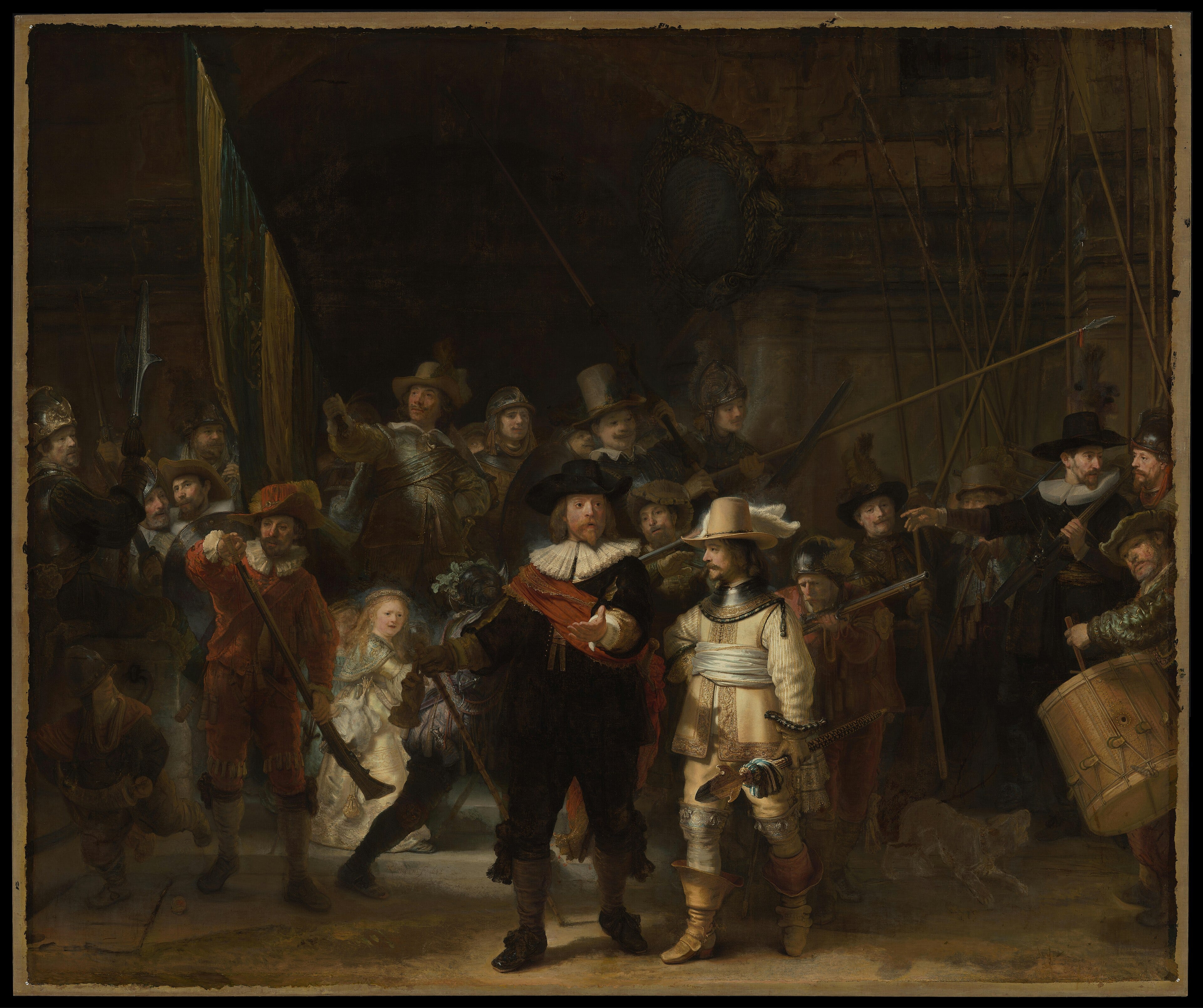
1. Rembrandt, The Night Watch (1642)
The most famous group portrait ever painted was meant to be a plain lineup of a militia company, and Rembrandt blew it apart. He caught the men mid movement, spilling out of a dark archway into a shaft of light, a drummer starting up, a dog barking, a girl glowing gold in the crowd.
Later owners cut strips off all four sides to fit a smaller wall, so the picture we see is already trimmed. Cleaning in the twentieth century proved it was a day scene, not a night one, and the nickname stuck anyway.
It fills a wall of its own in the Rijksmuseum in Amsterdam, guarded like a national treasure. In 1975 and again in 1990 it was attacked with a knife and with acid, and restored both times.
2. Johannes Vermeer, Girl with a Pearl Earring (about 1665)
Vermeer painted no background at all here, just soft darkness, so the whole picture is a face and a glance over the shoulder. It is not really a portrait but a tronie, a study of a type in exotic dress, which is why the girl has no name.
The pearl itself is two quick dabs of paint, one soft and one bright, that only turn into a jewel when you step back. Lost for centuries, the panel sold for about two guilders in 1881, and now it is the pride of the Mauritshuis in The Hague.
Vermeer left only about thirty four paintings in his whole life, and I read one of them frame by frame in my piece on his Woman Holding a Balance.
3. Frans Hals, The Laughing Cavalier (1624)
He is neither laughing nor a cavalier, yet the wrong title has stuck for four hundred years. Hals painted a wealthy young Dutchman with a curled moustache and a smile tilting at one corner of his mouth, alive in a way portraits rarely were.
Look closely at the sleeve and the embroidery is flicked on in loose, quick strokes that barely hold together up close. That speed was his signature, a freshness other painters could not copy.
He named nobody, so the sitter is a mystery, though the emblems stitched on the arm hint at the pains and joys of love. It has hung in the Wallace Collection in London since the 1860s, when a French baron and an English marquess fought a bidding war over it.
4. Carel Fabritius, The Goldfinch (1654)
A small bird sits chained to its feeder on a plain wall, painted so simply it looks almost modern, and its maker died young in a disaster.
Fabritius was Rembrandt's most gifted pupil and probably Vermeer's teacher, the link between the two giants of the age.
He painted the goldfinch the same year a gunpowder store blew up and levelled a quarter of Delft, killing him at thirty two and destroying most of his work.
Barely a dozen of his paintings survive. The little panel became famous all over again after a 2013 novel borrowed its name, and crowds now line up at the Mauritshuis to see a bird the size of a hand.
5. Jan Steen, The Feast of Saint Nicholas (about 1665)
Steen filled his canvases with cheerful chaos, and this one shows a Dutch family on the morning of the Saint Nicholas holiday, the ancestor of Christmas.
A little girl clutches her presents and refuses to share, while an older boy sobs because his shoe holds only a birch rod, the gift for children who misbehaved.
Every face tells a small story, warm and a little mocking at once. This scene of genre painting now hangs in the Rijksmuseum. Steen ran a tavern as well as a studio, and to this day a messy, happy household in Holland is called a Jan Steen house.
6. Pieter de Hooch, The Courtyard of a House in Delft (1658)
While Vermeer painted indoors, de Hooch opened a door onto a sunlit brick courtyard and made ordinary Dutch life look like quiet paradise.
A woman leads a child down worn steps past a broom and a bucket, every brick and crack set down with patient care.
A stone plaque over the passage is a real one, once on a Delft convent, reading that to reach patience you must first pass through suffering.
De Hooch and Vermeer worked in the same small city at the same moment, pushing each other toward the same still light.
The picture now hangs in the National Gallery in London, and after de Hooch later left Delft for Amsterdam his work never again reached this calm.
7. Judith Leyster, Self Portrait (about 1630)
A young woman turns from her easel to smile at us, brush in hand, as relaxed as if we had just walked in, and for centuries nobody knew she painted it.
Leyster was one of the very few women admitted to a Dutch painters' guild, running her own workshop with pupils. After she died her work was quietly credited to Frans Hals or to her husband, and her name vanished for two hundred years.
Only in 1893 did a scholar spot her star shaped monogram on another of her paintings, a pun on her surname, which means lodestar, and her lost work slowly came back to her name.
The self portrait now hangs in the National Gallery of Art in Washington, and the fiddler on her easel is lifted straight from one of her own scenes.
8. Jacob van Ruisdael, The Windmill at Wijk bij Duurstede (about 1670)
A single windmill towers over a low river town under a huge sky piled with cloud, and the sky takes up two thirds of the canvas. Ruisdael made the weather the real subject, the way light breaks and moves across flat, wet land.
He painted around seven hundred landscapes and taught a whole generation to find drama in a country with no mountains. The tiny figures below the mill remind you how small people are under that sky.
It is one of the best loved works in the Rijksmuseum, and it shaped how later painters from Constable to the Impressionists looked at the open air.
9. Willem Claesz Heda, Still Life with a Gilt Cup (1635)
A meal sits half eaten, a glass tipped over, a lemon peeled in one curling ribbon, and nothing living is anywhere in sight. Heda painted these banquet tables in a narrow range of silver and warm brown, showing off pewter, glass and crumpled linen.
The disorder is the point, a rich table abandoned mid feast, a quiet reminder that pleasure does not last. This kind of still life let a painter prove his skill on reflections and textures while slipping in a warning about time.
Heda repeated the theme for decades, and this version in the Rijksmuseum still catches the light on its tipped glass after four centuries.
10. Hendrick Avercamp, Winter Landscape with Ice Skaters (about 1608)
The whole of Dutch society crowds onto the frozen ice in this wide winter scene, from grand ladies to a couple who have fallen flat on their backs.
Avercamp was deaf and mute, known in his town as the mute of Kampen, and he watched the world with a sharp, patient eye.
He painted the little dramas most artists skipped, a tavern spilling onto the ice, lovers, even a dead horse. These freezes came during the Little Ice Age, when Dutch winters were hard enough to hold a fair on a river.
The panel now in the Rijksmuseum holds hundreds of tiny figures, each one doing something different.
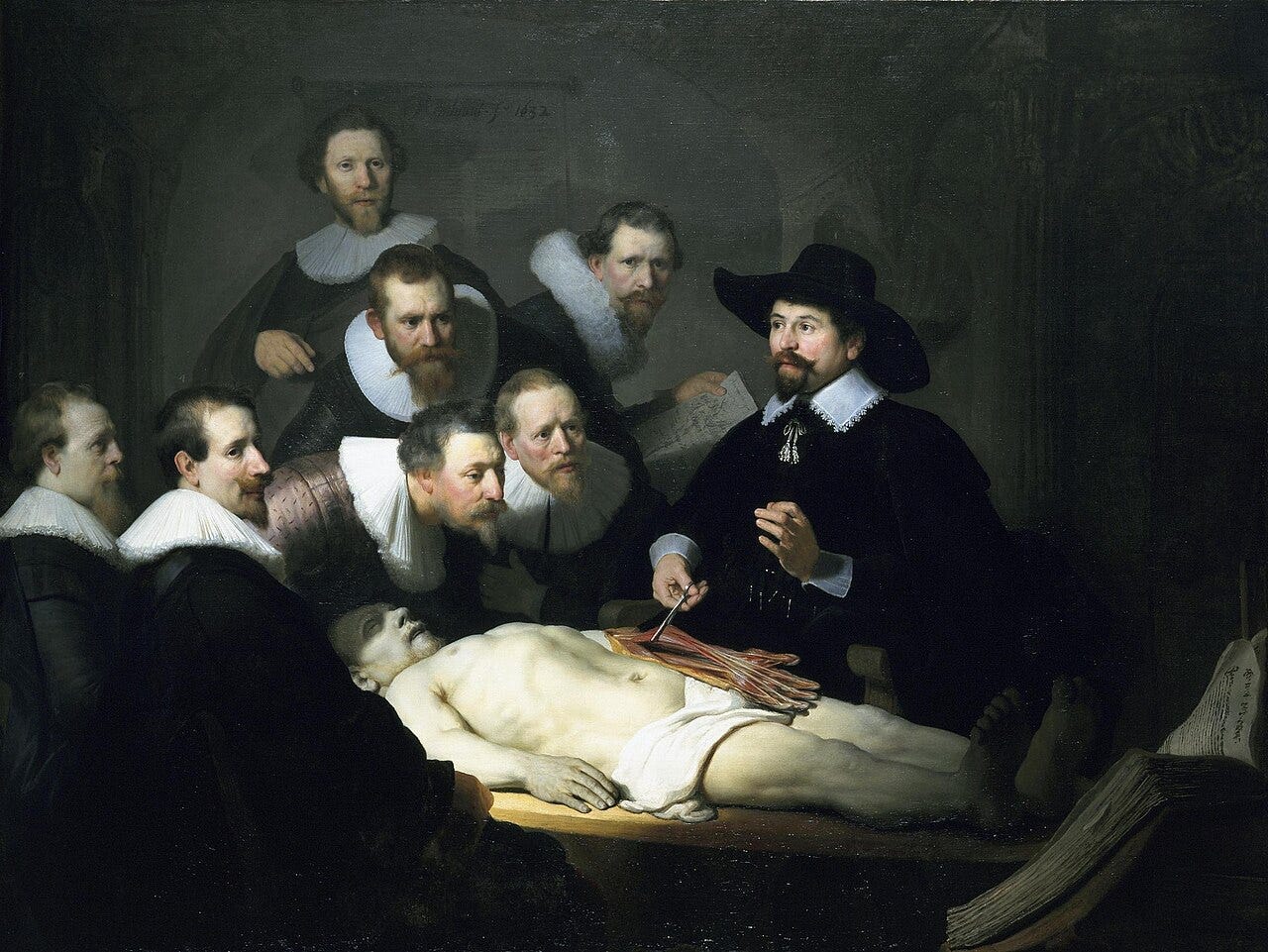
11. Rembrandt, The Anatomy Lesson of Dr Nicolaes Tulp (1632)
Rembrandt was only twenty six when this group portrait made his name in Amsterdam overnight. A famous surgeon peels back the muscles of a dead man's arm while seven colleagues lean in, each face turned a different way, each caught listening or thinking.
Public dissections like this were ticketed events that people paid to attend. Instead of a stiff row of heads, Rembrandt built a pyramid of attention around the corpse, using light and shadow to pull your eye exactly where he wanted.
Now in the Mauritshuis, it told the city a great new portraitist had arrived, and the dead man was a real thief named Aris Kindt, hanged for robbery only weeks before.
12. Willem van de Velde the Younger, The Cannon Shot (about 1680)
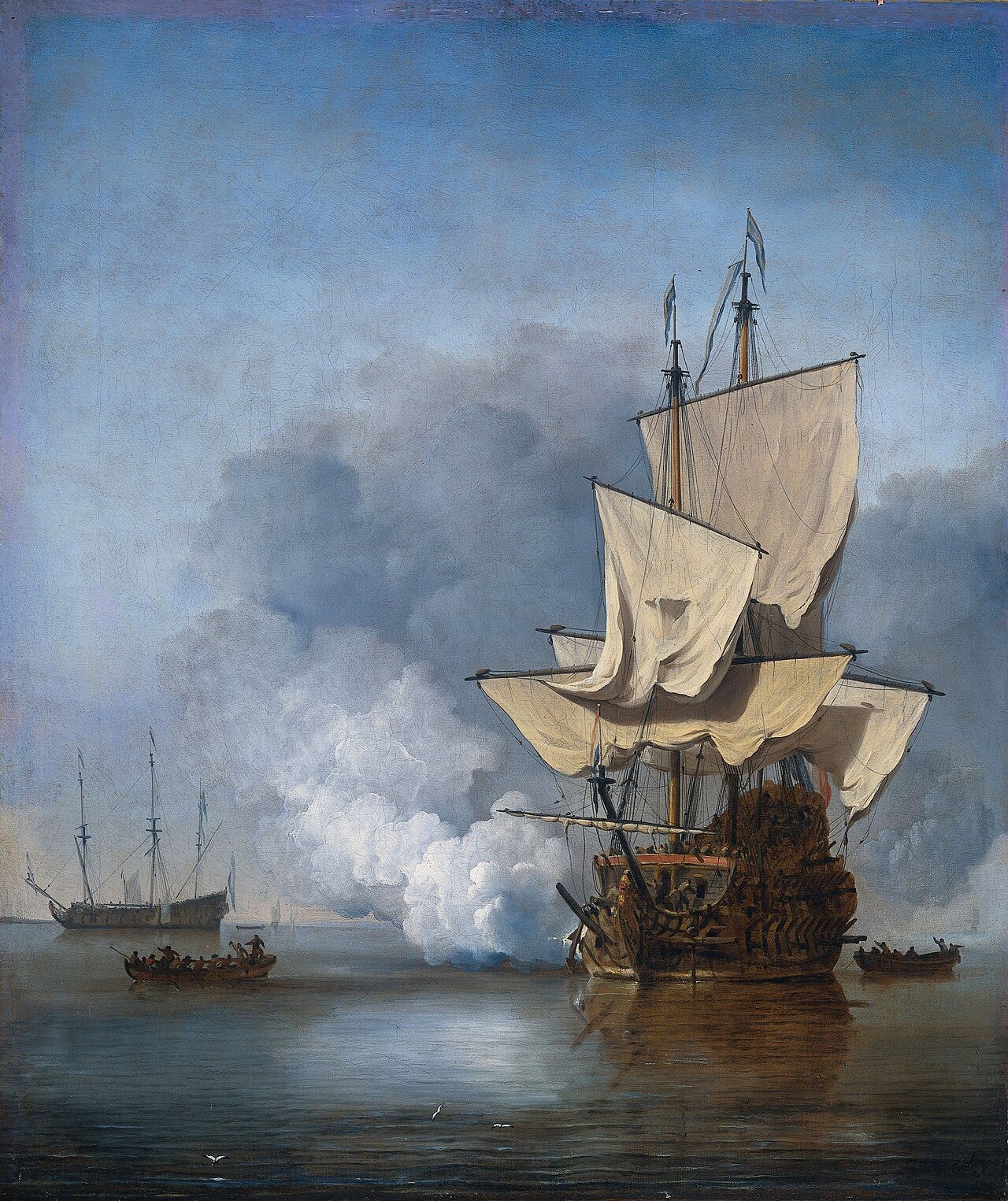
A Dutch warship fires a salute in a light haze, sails half filled, the smoke drifting flat across still water, and it is as much a portrait of weather as of a ship.
Van de Velde came from a family of sea painters who sailed out in a small boat to sketch real battles in the thick of the guns. The Dutch, a nation built on ships, made a whole art of the sea, and he was its finest hand.
The Cannon Shot now hangs in the Rijksmuseum. He and his father had crossed to England in 1672 to paint for King Charles the Second, who gave them a studio and a yearly salary, and their work went on to shape British marine art for a century.
Dutch Golden Age painting, questions people ask
What was the Dutch Golden Age? The seventeenth century, when a small new republic grew rich on trade and its middle class bought art by the thousand.
Who are the big three Dutch Golden Age painters? Rembrandt, Vermeer and Frans Hals.
Why so many still lifes and everyday scenes? Protestant Holland had no church commissions and few kings, so painters sold small pictures of ordinary life to ordinary buyers.
What is the most famous Dutch Golden Age painting? Rembrandt's Night Watch and Vermeer's Girl with a Pearl Earring are the two usual answers.
Where can I see these paintings? Mostly in the Netherlands, above all the Rijksmuseum in Amsterdam and the Mauritshuis in The Hague.
If these Dutch pictures pulled you in, you will love these too:
Twelve famous portraits and the real people, the faces behind the paintings
The Ambassadors, detail by detail, the object at the bottom that only works from one side
Was Monet really the first Impressionist, the painting that may have got there first
A whole world in a small frame
No kings, no gods, no saints, just skaters, maids, dead pheasants and the light coming through a window. For one century a tiny country turned its own daily life into some of the most loved painting in the world, sold cheap to shopkeepers and captains who wanted a slice of it on the wall.
Then, almost as fast as it began, the money dried up and the Golden Age closed. What hangs in the Rijksmuseum today is the record of a people who thought their ordinary afternoons were worth keeping forever.