
For years, Edward Hopper earned his living with magazine illustrations and made etchings on the side, and he was past forty before his paintings sold with any regularity. The deserted streets and lighted storefronts he painted next made his name. Two of his quietest canvases were later lent to President Barack Obama, to hang where he worked.
Cool Stories About Art is a newsletter to learn art the fun way.
Join 200,000+ readers and get:
10 new art stories / month
The entire archive of content (140+ articles)
Comment, ask questions, and chat with other readers
What Hopper Painted, and How He Got There
Hopper lived from 1882 to 1967, and he is usually called a realist. The label fits his subjects. He painted the places Americans passed every day without looking twice: shopfronts, workplaces, cheap restaurants, a stretch of roadside, an apartment seen after dark. He worked in oil and in watercolor and, as a younger man, in etching.
The label fits his method less well. Most of his scenes began in real places, which he then rebuilt, stretching a building or merging two restaurants into one. From the real scene he usually kept the light and the hour.
These twelve works follow the whole career, from an etching made in his late thirties to a canvas painted past eighty, by way of Paris, New York and Cape Cod. Eleven are oil paintings, and one is a print.
12. Cobb's Barns, South Truro (1930 to 1933)
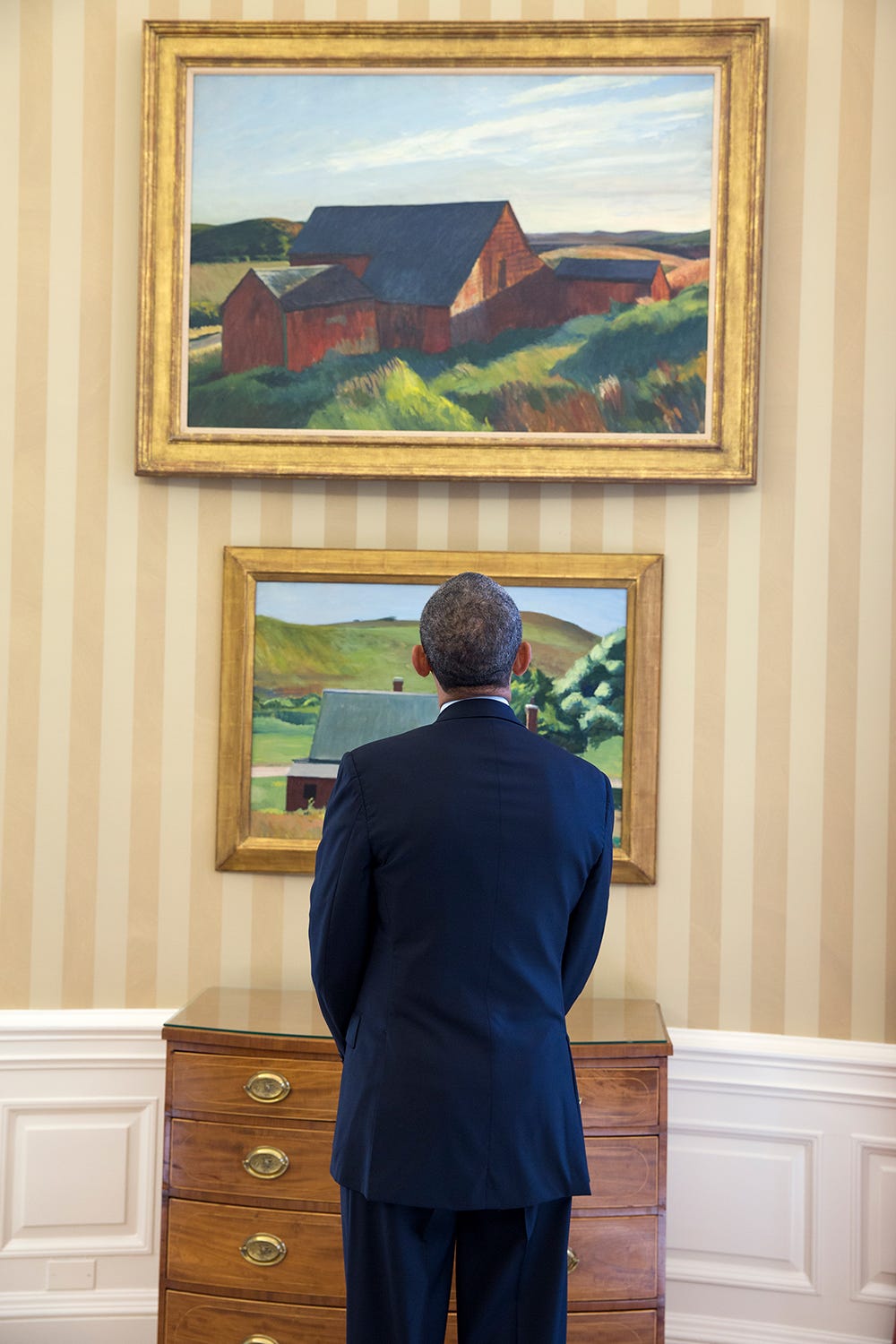
In a photograph from 2014, Barack Obama stands in the Oval Office before two paintings hung one above the other. Both show farm buildings on Cape Cod. One is Cobb's Barns, South Truro, the other Burly Cobb's House, South Truro. Hopper painted both between 1930 and 1933.
The farm stood near the tip of Cape Cod, the long arm of sand that curls into the Atlantic off Massachusetts. In 1930, Hopper and his wife picked South Truro for the summer over Gloucester and Cape Elizabeth, on the coasts of Massachusetts and Maine. He described the place as "fine big hills of sand, a very open almost treeless country."
The barns stood in that open country. The couple rented a house on a hill, and down the slope stood their landlord's farm buildings, which Hopper painted and drew again and again. In New York he had painted streets and shopfronts. Here each building stood alone, with sand all around it and the low light of late afternoon.
The two canvases came to Washington on loan from New York's Whitney Museum of American Art. In 2014 the museum learned that "President Obama is fond of Hopper's work." Its curator Dana Miller had to choose what to lend. Works on paper could not stay long under the light of that office, so she considered only paintings.
The White House set a second limit. "They did not want us taking anything off our walls and away from our public," Miller said. So she left aside Hopper's views of Paris and looked for American landscapes and ordinary buildings. I like that the choice fell on two barns rather than on one of his famous city scenes.
The paintings went up on February 7, 2014, on the southeast wall of the room. That morning, Miller noticed that the light coming into the office looked like the light in Cobb's Barns.
At a Glance
Artist: Edward Hopper (1882 to 1967)
Painted: 1930 to 1933
Medium: Oil on canvas
Size: 87.2 × 127.2 cm (34 5/16 × 50 1/16 in)
Where to see it: Whitney Museum of American Art, New York
About This Painting
Did Edward Hopper live on Cape Cod?
Yes, for part of every year from 1930 on. The Hoppers built their own house in South Truro in 1934 and kept spending about half of each year on the Cape.
11. Night Shadows (1921)
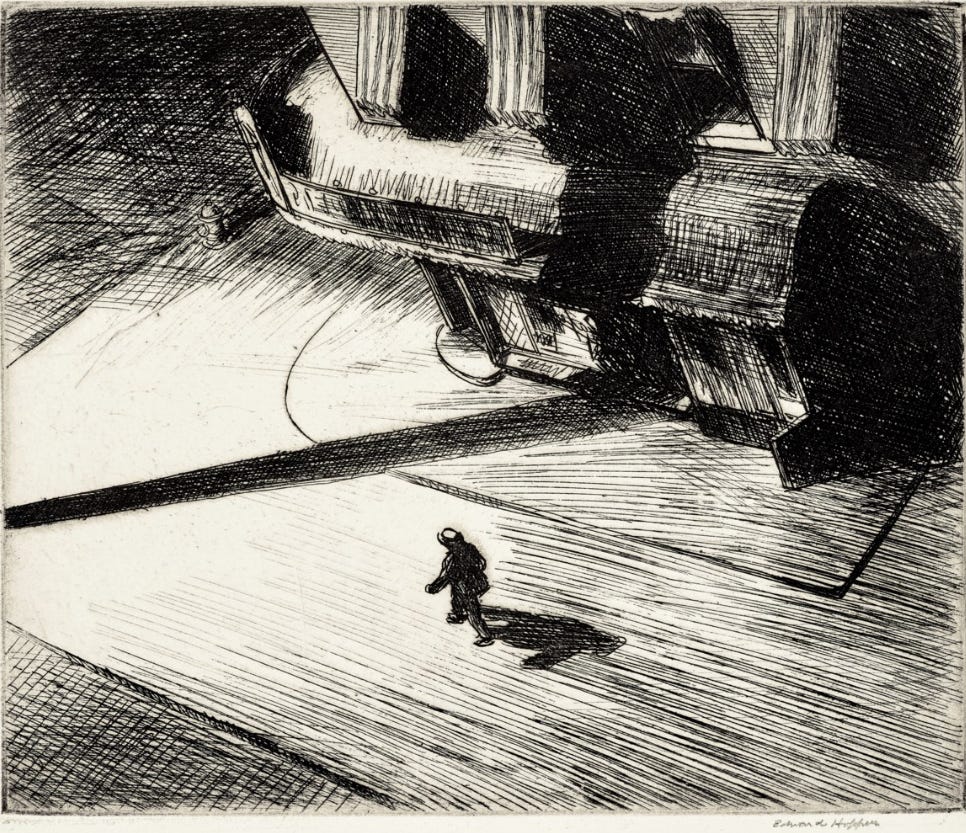
Seen from far overhead, a man walks alone down a city sidewalk at night. A streetlamp outside the frame throws a long black shadow across his path, and he is heading straight into it. In 1924, this small black and white image went out to the subscribers of a political weekly.