
Domenikos Theotokopoulos is known to history by a nickname, El Greco, the Greek, and he spent his last thirty-seven years in a Spanish city. Those years produced a canvas that a king paid for in full and then turned down, and a portrait whose cleaning was argued over in Spain's parliament four centuries later.
Cool Stories About Art is a newsletter to learn art the fun way.
Join 200,000+ readers and get:
10 new art stories / month
The entire archive of content (140+ articles)
Comment, ask questions, and chat with other readers
From Icon Painter to Altarpiece Maker
El Greco learned to paint twice. On Crete he trained as an icon painter, in egg tempera on panels with gold backgrounds, where the place of each saint had been fixed for centuries. In Venice and then Rome, painters worked in oil on canvas and were judged on the human body.
Spain, from 1577, asked for something else again. Churches, convents and chapels ordered altarpieces several meters tall, under contracts that set the subject and the price, and the clergy could refuse a picture or haggle over its value.
These twelve works follow that whole road: one from his years as an icon painter, one from Rome, and ten from Spain.
12. Christ Driving the Money Changers from the Temple (about 1570)
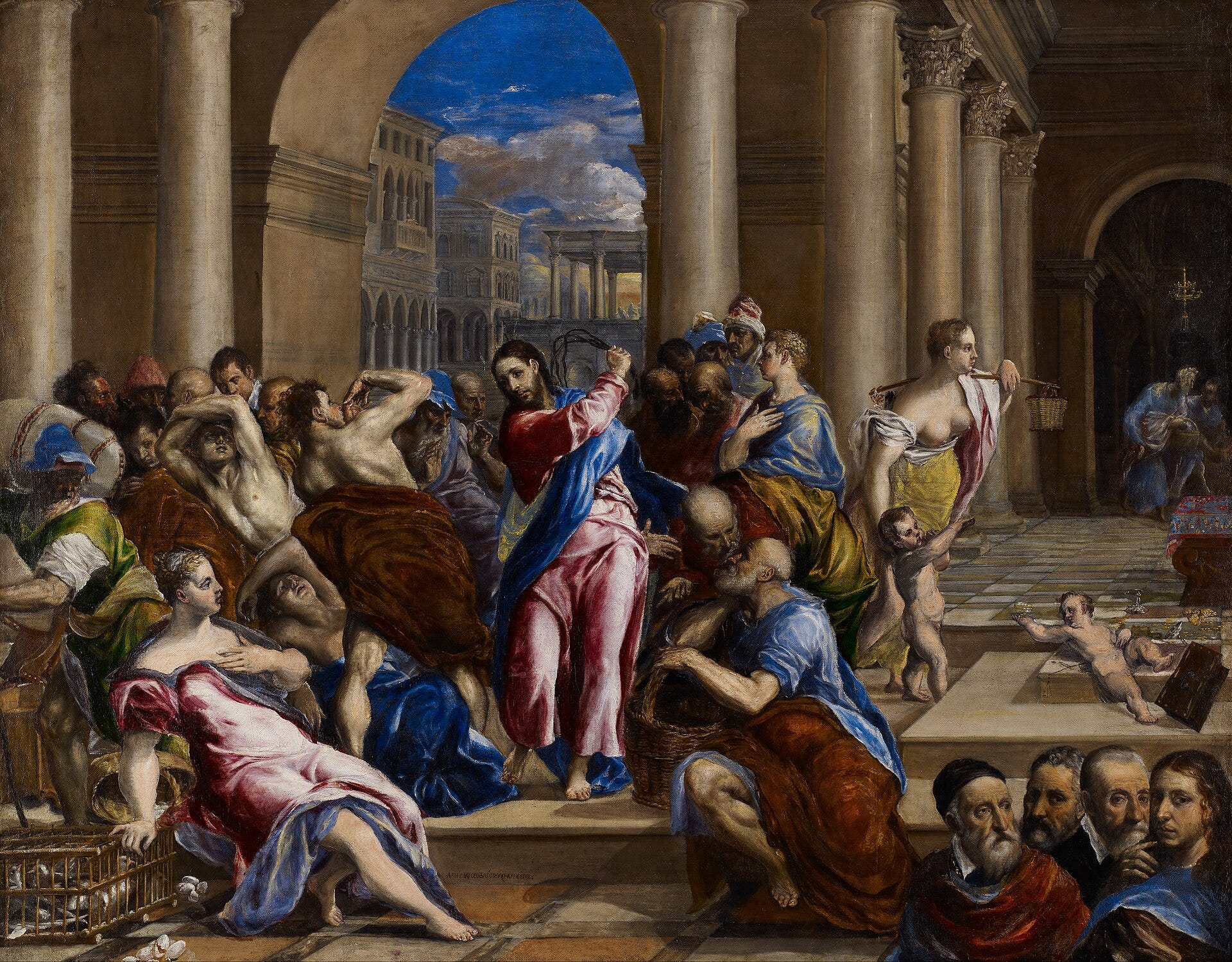
Four men who play no part in the story stand together at the bottom right of Christ Driving the Money Changers from the Temple, cut off at the chest. Behind them, Christ raises a whip, and the traders in the temple court fall back around him. The four are portraits of painters, usually identified as Titian, Michelangelo, Giulio Clovio and Raphael, the last being the least certain.
The man who painted them was about twenty-nine and new in Rome, where he arrived around 1570 after a few years in Venice. The Italians called him Il Greco, and on the step below Christ he signed his name in Greek letters.
One way to read the corner is as a set of credentials. Titian stands for Venice, where he had learned oil painting, and Michelangelo and Raphael for the Rome he had come to win over.
Clovio is the surprise. He was a miniaturist, a painter of tiny pictures in manuscripts, and the one who could actually help. In November 1570 he wrote to the powerful Cardinal Alessandro Farnese to recommend "a young man from Candia, a disciple of Titian." Candia was the Venetian name for Crete.
His respect for one of the four did not last. Years later, in the margins of his copy of the Lives of the Artists, the painters' biographies written by Giorgio Vasari, El Greco noted that Michelangelo knew little about color.
At a Glance
Artist: El Greco (1541 to 1614)
Painted: About 1570
Medium: Oil on canvas
Size: 116.8 × 149.9 cm (46 × 59 in)
Where to see it: Minneapolis Institute of Art, Minneapolis
11. The Dormition of the Virgin (before 1567)
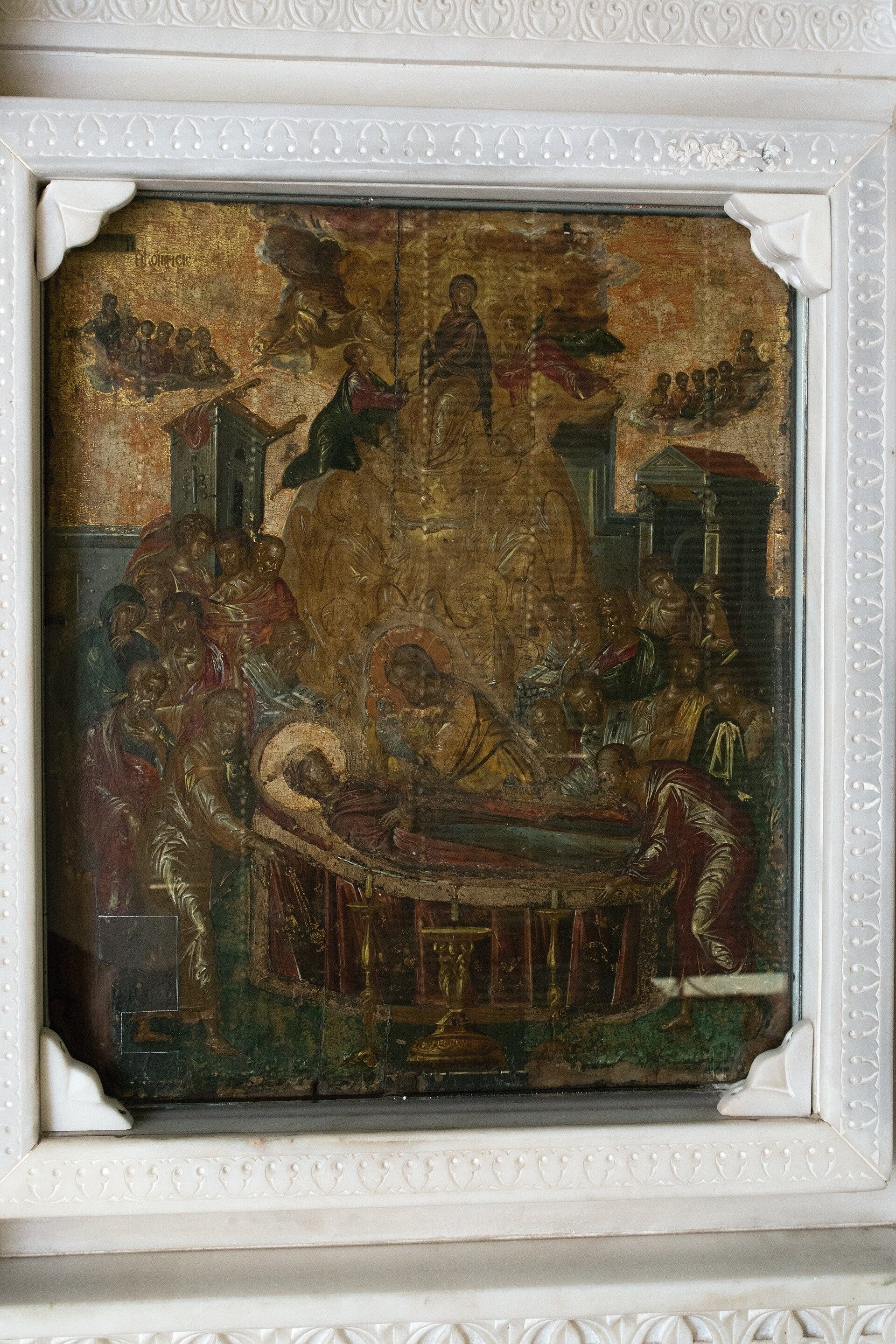
Gold fills the background of a small wooden panel. On a bed lies the Virgin Mary, dead, with the apostles crowded around her, and above them Christ holds her soul, shown as a tiny child. A tall candlestick rises in front of the bed. For about 150 years, worshippers in a church on the Greek island of Syros prayed before this panel, and none of them knew who had painted it.