Execution Paintings: 12 Famous Works in Art History
From beheadings to firing squads, painters have staged executions for four hundred years. These twelve famous execution paintings, by Caravaggio, Goya, Manet and others, turn the worst public moments in history into some of the most powerful pictures in Western art.
An execution is built to be watched. That is what made it such a subject for painters. A scaffold, a blindfold, a raised sword, a line of rifles: each one is already a piece of theatre. Some of these works honor the dead. Some accuse the killers.
Every method: the block, the sword, the guillotine and the firing squad.
History and myth: real events like Lady Jane Grey and Marshal Ney, painted with liberties.
The accusation: Goya and Manet used a killing to point at the men who ordered it.
Treated with restraint: each date, title and museum checked, the horror shown with sobriety.
If these draw you in, you will also love the beheading Caravaggio painted, 7 secrets hidden in famous paintings, and the untold story behind the Raft of the Medusa.
1. Caravaggio, The Beheading of Saint John the Baptist
In 1608, Caravaggio painted the execution of John the Baptist in a bare prison yard. The executioner leans down to finish the cut by hand while a servant holds out the platter.
It is the largest canvas Caravaggio ever made, and the only work he ever signed. He wrote his name in the blood pouring from the Baptist neck. He was a wanted man, on the run for killing someone in Rome.
He painted it for the Knights of Malta, who soon expelled him anyway. It still hangs where he left it, in Saint John Co Cathedral in Valletta.
2. Artemisia Gentileschi, Judith Slaying Holofernes
Around 1620, Artemisia Gentileschi painted Judith sawing through the neck of the enemy general Holofernes, her maid pinning him down as blood arcs across the sheets.
Gentileschi had been assaulted as a young woman and testified under torture at the trial of her attacker. Many read this killing, all effort and grip, as a woman taking back control on canvas.
An earlier version hangs in Naples. This one, at the Uffizi in Florence, is the bloodier of the two.
3. William Hamilton, Marie Antoinette Being Taken to Her Execution

In 1794, only months after the event, the British painter William Hamilton showed Marie Antoinette led out to the guillotine on 16 October 1793. She stands in white as the executioner binds her hands.
Hamilton was English, painting a French queen for a British audience that saw her as a martyr. He dressed her in white for innocence and set a jeering crowd around her.
The queen was guillotined that afternoon in what is now the Place de la Concorde. The painting hangs at the Musee de la Revolution francaise in Vizille.
4. Francisco Goya, The Third of May 1808
In 1814, Goya painted a French firing squad shooting Spanish civilians on a hill outside Madrid at night. A man in a white shirt throws his arms wide, lit by a single lantern.
Goya painted it six years after the killings, once the French were gone. The soldiers are faceless, a machine. The victim open hands carry a wound in the palm, an echo of the crucifixion.
It changed how war was painted. Both Manet and Picasso later borrowed from it. It hangs in the Prado in Madrid.
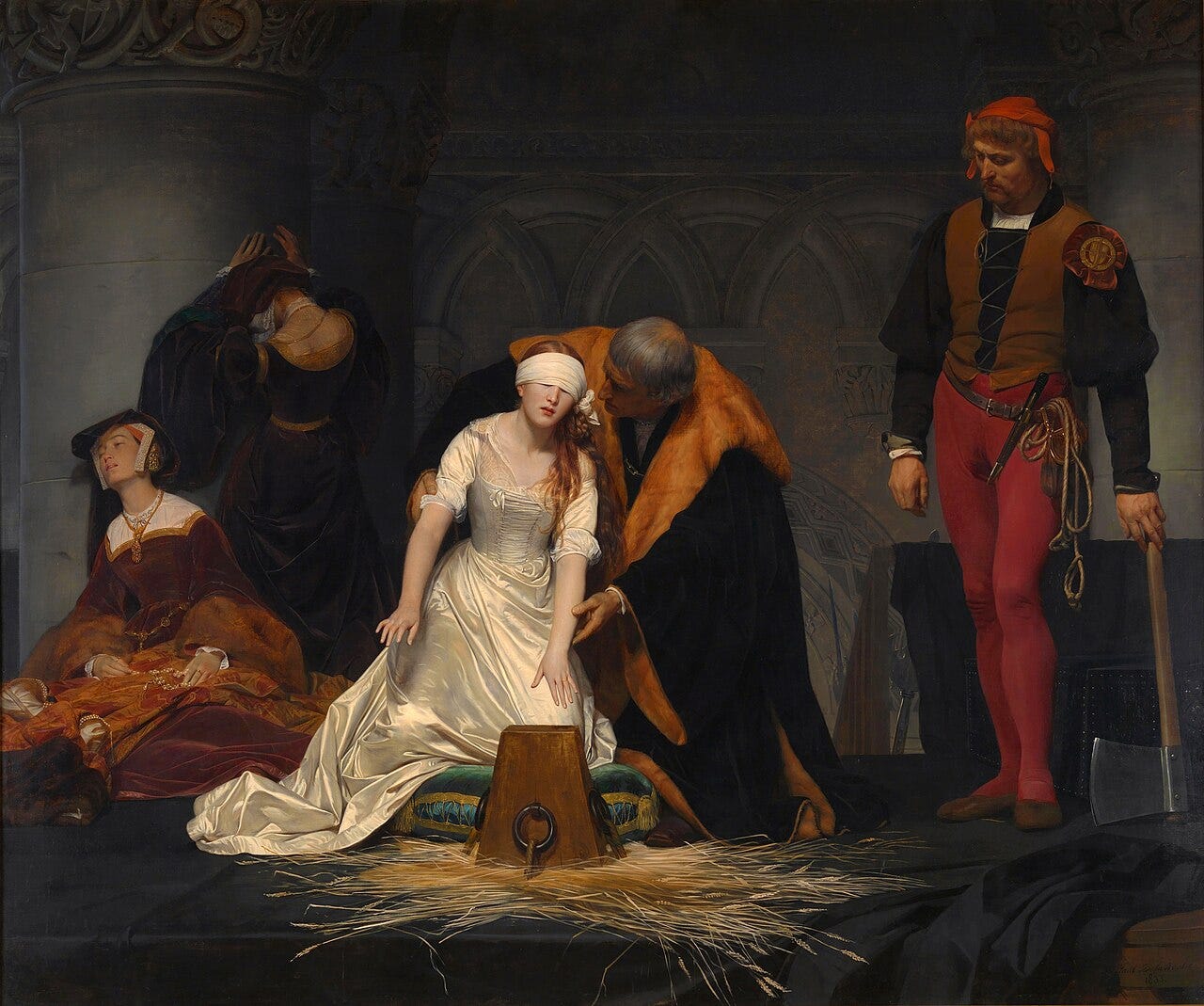
5. Paul Delaroche, The Execution of Lady Jane Grey
In 1833, Paul Delaroche painted the blindfolded teenage queen Lady Jane Grey groping for the block, guided by a helper, in the moments before her beheading at the Tower in 1554.
The scene is invented. Jane was executed outdoors on Tower Hill, not in this dim vaulted room. Delaroche staged it for the greatest pity, her white dress glowing against the dark.
The picture was long thought destroyed in a flood at the Tate in 1928. It was found in storage in 1973 and is now one of the most visited works at the National Gallery in London.
6. Edouard Manet, The Execution of Emperor Maximilian
Between 1868 and 1869, Edouard Manet painted the firing squad that shot the Habsburg emperor Maximilian of Mexico in 1867, the soldiers standing close, calm and businesslike.
Manet dressed the Mexican firing squad in uniforms that look French. It was an accusation. France had put Maximilian on the throne, then abandoned him. The French government blocked the picture from being shown.
Manet painted several versions. One was later cut into fragments, which Degas collected and reassembled. The complete version hangs at the Kunsthalle Mannheim.
7. Jean Leon Gerome, The Execution of Marshal Ney
In 1868, Jean Leon Gerome painted the aftermath of a firing squad. Marshal Ney, one of Napoleon commanders, lies face down in the mud on 7 December 1815. The soldiers are already walking away.
Gerome shows no drama, only a body, a wall and a top hat in the dirt. On the wall someone has scrawled Vive l Empereur, half crossed out, a jab at Ney shifting loyalties.
The painting has belonged to Sheffield since 1931. It hangs at the Graves Art Gallery there.
8. Pierre Puvis de Chavannes, The Beheading of Saint John the Baptist

Around 1869, Pierre Puvis de Chavannes painted the second before John the Baptist death. The saint kneels, calm. The executioner raises the blade. Salome waits to one side.
Puvis strips the scene bare, with flat pale color and no crowd. He returned to the subject for years and left a later version unfinished at his death.
The stillness is the point, the quiet before the blow. The painting is at the National Gallery in London.
9. Henri Regnault, Summary Execution under the Moorish Kings of Granada
In 1870, Henri Regnault painted an executioner in a pink robe wiping his sword at the top of a marble staircase in the Alhambra. A headless body sprawls down the steps below him.
There is no trial, no crowd, no mercy, only the calm of the killer against golden tilework. Regnault was just 26, painting after winning the Prix de Rome.
Months later Regnault himself was killed in battle in the Franco Prussian War, in January 1871. The painting hangs at the Musee d Orsay in Paris.
10. Vasily Surikov, The Morning of the Streltsy Execution
In 1881, Vasily Surikov painted the dawn before a mass hanging in Red Square. Peter the Great, on horseback, faces the condemned streltsy soldiers who had risen against him in 1698.
Surikov never shows the deaths. He paints the wait, the candles, the wives clinging to the doomed men. One prisoner locks eyes with the young tsar across the square.
It was Surikov first history painting, and Tretyakov bought it at once. It hangs at his gallery in Moscow.
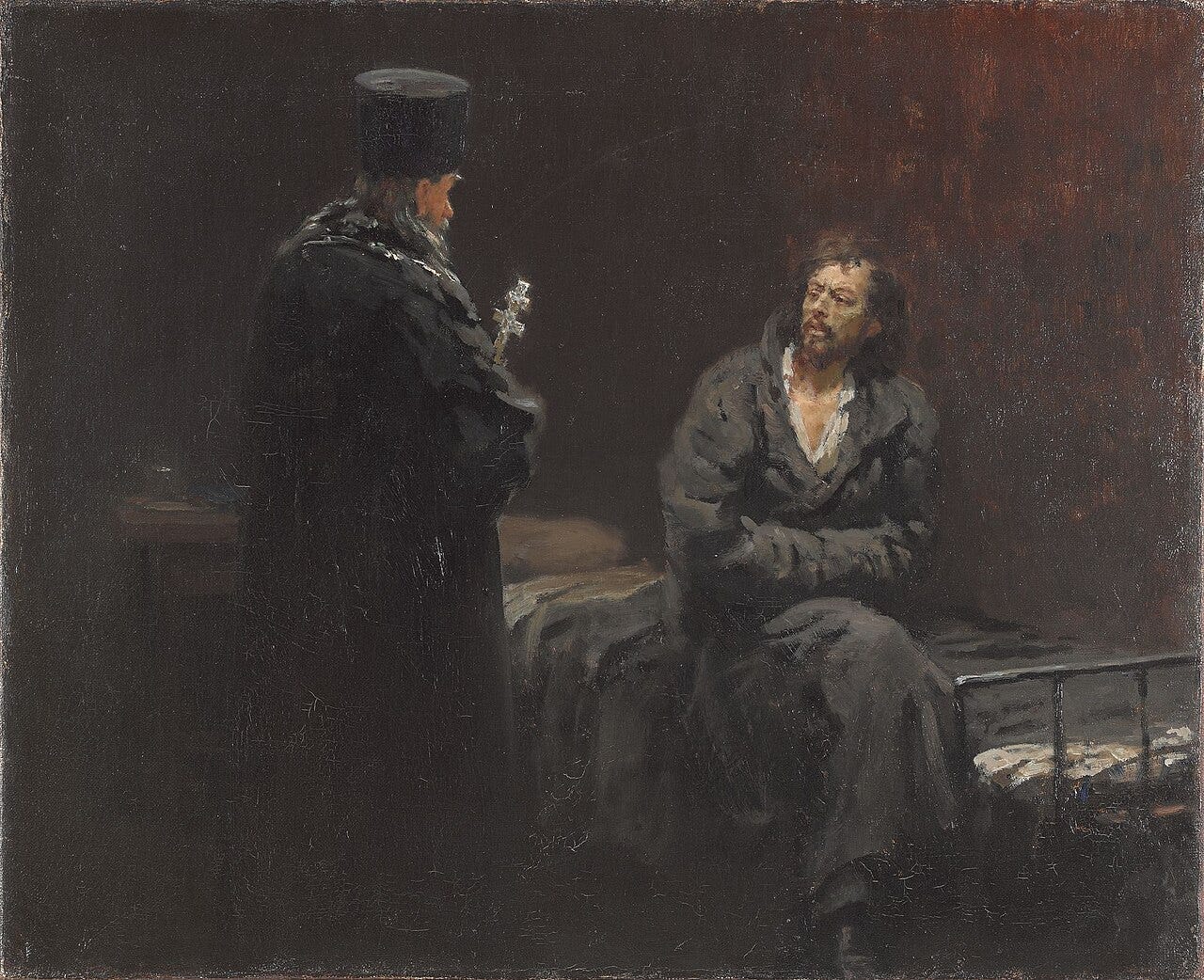
11. Ilya Repin, Refusal of Confession
Between 1879 and 1885, Ilya Repin painted a condemned prisoner in a cell, sitting up as a priest offers him the cross before execution. The prisoner will not take it.
The man is a young radical facing death for opposing the tsar. Repin based him on a banned poem. The refusal is silent, no argument, only a turned face in the gloom.
It belongs to a wave of Repin works about Russian resistance in these years. It hangs at the Tretyakov Gallery in Moscow.
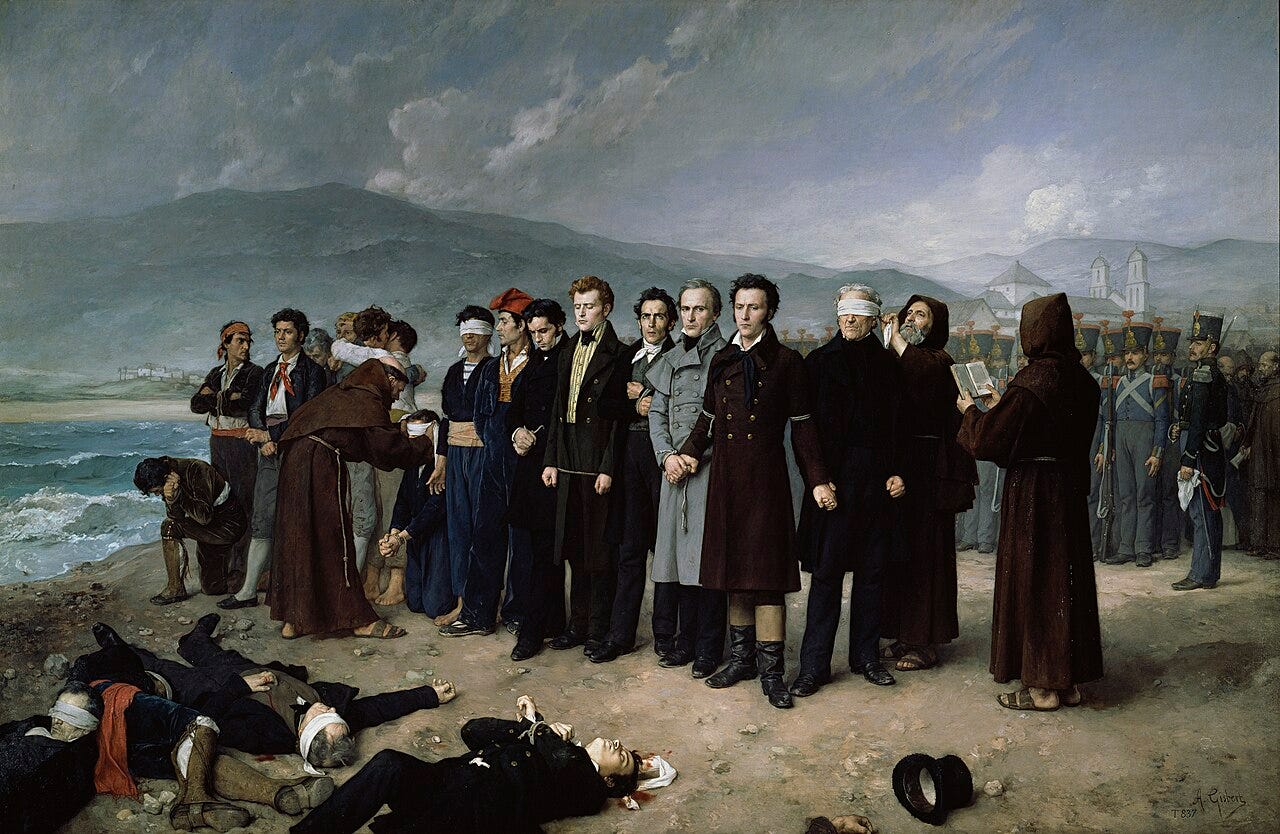
12. Antonio Gisbert, The Execution of Torrijos and His Companions

In 1888, Antonio Gisbert painted a line of men waiting to be shot on a Malaga beach. Some are already dead. General Torrijos stands at the center, holding the hand of a friend.
Torrijos and about 48 companions were shot without trial in December 1831 for opposing the absolute rule of Ferdinand VII. A liberal government commissioned the picture 55 years later as a monument to their sacrifice.
The canvas is six meters wide. On completion in 1888 it went straight into the Prado in Madrid, where it still hangs.
Where to see them
Museo del Prado, Madrid: The Third of May 1808 (Goya) and The Execution of Torrijos (Gisbert).
National Gallery, London: The Execution of Lady Jane Grey (Delaroche) and The Beheading of Saint John the Baptist (Puvis de Chavannes).
Musee d Orsay, Paris: Summary Execution under the Moorish Kings of Granada (Regnault).
Tretyakov Gallery, Moscow: The Morning of the Streltsy Execution (Surikov) and Refusal of Confession (Repin).
Uffizi, Florence: Judith Slaying Holofernes (Gentileschi).
How painters turned a killing into history
Most of these are history paintings, built to make a public death feel like a moral event that a whole nation should remember.
The oldest lean on tenebrism, the deep shadow of Caravaggio, while the modern ones use plain Realism to accuse the men who gave the order.
Executions in art, questions people ask
What is the most famous execution painting? Goya The Third of May 1808, painted in 1814, is the most influential, showing a firing squad at night. Manet and Picasso both learned from it.
Are these paintings historically accurate? Often not. Delaroche moved Lady Jane Grey beheading indoors, and Hamilton dressed Marie Antoinette in symbolic white. Painters staged history for emotion, not documentary truth.
Why did artists paint executions? Executions were public spectacles built to be seen. Painters used them to mourn the dead, accuse the powerful, or turn a political killing into lasting memory.
What is happening in Manet Execution of Emperor Maximilian? A firing squad shoots the Habsburg emperor Maximilian, installed in Mexico by France and then abandoned. Manet dressed the squad in French style uniforms as an accusation.
Where can I see execution paintings? The Prado in Madrid holds Goya and Gisbert, the National Gallery in London holds Delaroche and Puvis, and the Tretyakov in Moscow holds Surikov and Repin.
The night that never stopped echoing
Goya firing squad still stands behind almost every execution painted since. Manet reused its poses in 1868 for the death of Maximilian. Picasso reached back to it again in 1951 for Massacre in Korea. One man in a white shirt, arms flung wide on a hill outside Madrid, became the pose every later painter would return to when they needed to show the moment a state decides to kill.