Famous Expressionist Paintings: 12 Iconic Works

Expressionism threw out the calm, correct picture and painted feeling straight onto the canvas, in screaming color and jagged line.

Edvard Munch, The Scream, 1893

Born in Germany and Austria just before the First World War, Expressionism twisted the world to match the storm inside the artist, all anxiety, desire and dread.

Here are twelve of the most famous Expressionist paintings, all now in the public domain. I have gathered the works that stopped trying to show how things look and started showing how they feel.


Learn art the fun way. Free stories every week, no boring lectures.


The reading list

If you want the detail rather than the summary:


1. Edvard Munch, The Scream (1893)

The painting that lit the fuse shows a figure on a bridge, hands clamped to its skull, screaming under a blood red sky. Munch said the idea struck on an evening walk when he felt a great scream tear through nature, and the sky really did burn red, perhaps from a distant volcano.

He was still a Symbolist when he made it, yet the raw feeling, the melted face and the sick color became the seed of everything Expressionism would do.

One of the several versions sold in 2012 for nearly 120 million dollars. Munch scratched a line into another reading, only a madman could have painted this.

2. Ernst Ludwig Kirchner, Berlin Street Scene (1913)

Ernst Ludwig Kirchner, Berlin Street Scene, 1913

Tall, angular women in feathered hats crowd a Berlin corner, painted in acid pink and green, cold and glamorous and slightly menacing.

Kirchner led a group of young German painters who called themselves Die Brucke, the bridge, out to smash the polite old art.

The women are prostitutes, the men behind them customers, the whole scene sharp with the loneliness of the modern city. He painted a series of these street scenes in 1913, jagged and airless, just before the war swallowed his world.

The Nazis later branded his work degenerate, and a broken Kirchner shot himself in 1938.

3. Wassily Kandinsky, Composition VII (1913)

Wassily Kandinsky, Composition VII, 1913

To many this is the first truly abstract painting, a storm of color and line with no clear subject at all. Kandinsky believed color could sound like music and touch the soul directly, without needing to show a single real thing.

He built Composition VII from more than thirty studies, then painted the huge final canvas in only four days. Hidden inside the chaos are faint traces of a flood, a resurrection and the end of the world.

He founded the Blue Rider group with Franz Marc, and together they cut color loose from the visible world for good.

4. Franz Marc, The Fate of the Animals (1913)

Franz Marc, The Fate of the Animals, 1913

A forest shatters into shards of blue, red and green as terrified animals brace for a coming catastrophe, a blue deer arching its neck in the middle.

Marc believed animals were purer and more spiritual than people, and painted them in colors he had coded with meaning, blue for the male and the divine.

He made this the year before the First World War, and later called it a strange premonition of the horror to come. On the back he wrote, and all being is flaming suffering.

Marc was killed at Verdun in 1916, one of the many artists the war destroyed.


Join 130,000 readers who get the secrets behind the paintings. Free.


5. Egon Schiele, Death and the Maiden (1915)

Egon Schiele, Death and the Maiden, 1915

A man and a woman cling to each other on a crumpled sheet, gaunt and desperate, while death seems to hover in the man's hollow face.

Schiele, the young Austrian who drew bodies like raw nerves, based the woman on the mistress he was leaving to marry someone respectable.

He painted their farewell as a death embrace, all bone and grief and twisted limbs. His figures are never comfortable, always clenched, alive with anxiety and desire at once.

Schiele died in 1918 at twenty eight, three days after his pregnant wife, both taken by the same flu.

6. August Macke, Lady in a Green Jacket (1913)

August Macke, Lady in a Green Jacket, 1913

Not all Expressionism screamed; some of it glowed. Macke painted elegant people strolling in parks and gardens in soft, luminous blocks of color, calm and happy where his friends were anguished.

Here a woman in a green jacket stands in a dreamlike garden, the whole scene built from gentle overlapping shapes. He shared the color theories of the Blue Rider and turned them toward calm and joy.

Macke was killed in the very first months of the war, in 1914, only twenty seven years old. In his last year he had painted some of the happiest pictures Expressionism ever produced.


Learn art the fun way. Free stories every week, no boring lectures.


7. Paula Modersohn Becker, Self Portrait (1906)

Paula Modersohn Becker, Self Portrait, 1906

Years before the men of Die Brucke made their name, a young German woman was already painting the way they would become famous for.

Working in Paris in 1906, Modersohn Becker stripped her self portraits down to flat, earthy, unsparing simplicity, and around this time painted what is often called the first nude self portrait ever made by a woman.

She had left a stifling marriage to paint freely, chasing a plainness that struck her contemporaries as crude. Her heavy forms and blunt honesty were decades ahead of their time.

A year later she was dead at thirty one, about three weeks after finally giving birth, and only later was she seen as one of the true pioneers of modern art.

8. Ernst Ludwig Kirchner, Self Portrait as a Soldier (1915)

Ernst Ludwig Kirchner, Self Portrait as a Soldier, 1915

Kirchner painted himself in uniform with a bloodied stump where his painting hand should be, though in truth he had lost no hand at all.

He had volunteered for the army, broken down completely, and been discharged, terrified he would never paint again.

The missing hand is the fear made visible, the artist destroyed by the war even without a wound. A pale naked model stands ghostlike behind him, everything he was afraid to lose.

He spent the rest of the war in and out of sanatoriums, and never fully steadied his nerves again.

9. Franz Marc, Blue Horse I (1911)

Franz Marc, Blue Horse I, 1911

A single blue horse stands against rolling hills of red and yellow, calm, heavy and glowing like a living jewel. For Marc the color was everything, blue standing for the spirit and the male, so a blue horse became a kind of prayer to the innocence of animals.

He painted it in 1911, the year he and Kandinsky launched the Blue Rider, the group named for exactly this love of blue and of riders. The animal seems lost in its own gentle thought, sealed off from all human trouble.

Marc painted a whole small herd of these blue horses in 1911, and this is the first and calmest of them all.

10. Egon Schiele, Self Portrait with Chinese Lantern Plant (1912)

Egon Schiele, Self Portrait with Chinese Lantern Plant, 1912

Schiele stares out with his head tilted and enlarged, his shoulders cropped hard by the frame, a sprig of orange lantern flowers beside him. He painted more than a hundred self portraits, twisting and starving his own body into knots of raw feeling.

This one is quieter than most, almost tender, made the same year he was briefly jailed on a morals charge. The blank background throws all the weight onto the strange, watchful face.

It is now one of the most reproduced self portraits of the twentieth century.


Two new stories a week, 130+ secrets unlocked. Start free.


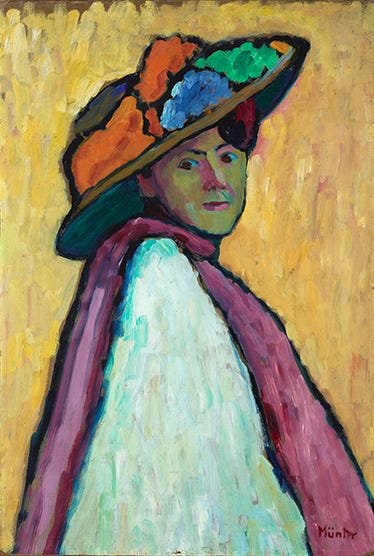
11. Marianne von Werefkin, Self Portrait (1910)

Marianne von Werefkin, Self Portrait, 1910

Behind several famous men of the Blue Rider stood Marianne von Werefkin, a Russian painter who gave up her own career for years to fund and promote the men around her.

In this self portrait her eyes glare out an unnatural red, the whole face a mask of dark color and hard line. She had been a brilliant realist in Russia, then stopped painting for a decade to support her partner Jawlensky, and returned with this raw new style.

Her Munich salon was where German Expressionism was argued into being. Only late in life, poor and alone in Switzerland, did she win any real fame of her own.

12. Vincent van Gogh, Wheatfield with Crows (1890)

Vincent van Gogh, Wheatfield with Crows, 1890

Long before the word Expressionism existed, Van Gogh was already doing it, loading paint into a stormy sky while a black flock of crows scatters over a golden field.

He painted this in the last weeks of his life in 1890, the sky a churning wall of blue, three roads leading nowhere. For a century people called it his suicide note in paint, though that story is far from certain.

The thick, violent brushwork made him the father every Expressionist would later claim, and I follow his final days in the full piece on his last day He was dead within weeks of finishing it, at thirty seven.


Expressionist art, quick questions

  • What is Expressionism? An art movement of the early twentieth century that painted raw emotion through distorted shapes and intense color instead of realistic scenes.

  • Who started Expressionism? It grew mainly in Germany and Austria around 1905, with roots in Van Gogh and Munch, through groups like Die Brucke and Der Blaue Reiter.

  • What is the most famous Expressionist painting? Edvard Munch's The Scream, though he is often counted as a forerunner rather than a full Expressionist.

  • How is it different from Impressionism? Impressionists painted the fleeting look of the real world; Expressionists painted their inner feelings, twisting the world to match.

  • Why did the Nazis hate Expressionism? They branded it degenerate art, seized thousands of works, and drove or destroyed many of the artists.


If these raw paintings pulled you in, you will love these too:


Feeling on the surface

Expressionism did not last long. The First World War killed many of its painters outright, and the Nazis later tore the rest from the walls as degenerate.

Yet the idea behind it never died, that a painting should show what the artist feels and not only what the eye sees. Every raw, distorted, deeply personal image made since owes something to these anxious years.

The scream is still echoing.