Fog in Art: 12 Famous Misty Paintings and Their Stories

Fog softens everything it touches, and painters have used it to hide, to dream and to unsettle. These 12 famous fog and mist paintings run from the London Thames to Russian forests and a lone fisherman at sea, each turning haze into mood and meaning.

Friedrich set a man on a peak above a sea of fog and never once showed his face. Monet chased London fog until it named a whole movement, while Winslow Homer used a wall of mist as a quiet threat to a fisherman life.

  • Erasing detail: fog lets a painter drop everything but a few shapes, pushing art toward abstraction.

  • Distance and depth: haze makes far objects pale and blue, a tool for showing space on a flat surface.

  • Atmosphere over subject: in fog paintings the weather itself is often the true subject.

  • North and coast: rivers, ports and cold forests gave these artists the damp air they needed.

If these draw you in, you will also love the secret behind Monet Magpie, the story of who painted the first Impressionist, and 7 secrets hidden in famous paintings.


Learn art the fun way. Free stories every week, no boring lectures.


1. Caspar David Friedrich, Wanderer above the Sea of Fog

A man on a peak gazing over a sea of fog
Caspar David Friedrich, Wanderer above the Sea of Fog, about 1818. Hamburger Kunsthalle, Hamburg.

Around 1818 Friedrich painted a man on a rocky peak, his back to us, gazing over a sea of fog that swallows the mountains below.

We never see his face. Friedrich uses the figure from behind so we look with him, not at him, out into the unknown white.

The rocks are real peaks in the Elbe Sandstone Mountains. Two centuries later this remains the single most recognized image of fog in art.

2. Claude Monet, The Houses of Parliament, Sunlight Opening in the Fog

Parliament as a mauve silhouette in London fog
Claude Monet, The Houses of Parliament, Sunlight Opening in the Fog, 1904. Musee d Orsay, Paris.

In 1904 Monet showed Parliament looming through thick London fog, its towers reduced to a mauve silhouette while the sun forces a gap in the haze.

He worked from a terrace at Saint Thomas Hospital, but he did not finish there. He carried the canvases back to Giverny and reworked them from memory and photographs.

Monet said plainly that without its fog, London would not be beautiful. He painted the series more than ninety times.

3. Claude Monet, Impression, Sunrise

An orange sun and boats in blue morning mist
Claude Monet, Impression, Sunrise, 1872. Musee Marmottan Monet, Paris.

In 1872 Monet painted the harbor of Le Havre at dawn, an orange sun and a few boats floating in blue morning mist.

A critic seized on the loose, misty look and mocked it as a mere impression. The insult became the name of a whole movement.

This one small foggy harbor gave Impressionism its title. It now hangs at the Musee Marmottan Monet in Paris.

4. James McNeill Whistler, Nocturne: Blue and Gold, Old Battersea Bridge

A wooden bridge pier rising through blue river fog
James McNeill Whistler, Nocturne: Blue and Gold, Old Battersea Bridge, about 1872 to 1875. Tate, London.

In the early 1870s Whistler painted the old wooden Battersea Bridge at night, its tall pier rising through a blue Thames fog.

The high, cropped bridge borrows directly from Japanese prints by Hiroshige. Whistler cared about mood and arrangement far more than a correct view.

The picture ended up in court as evidence in his 1878 libel trial with Ruskin. A foggy bridge became a legal exhibit.

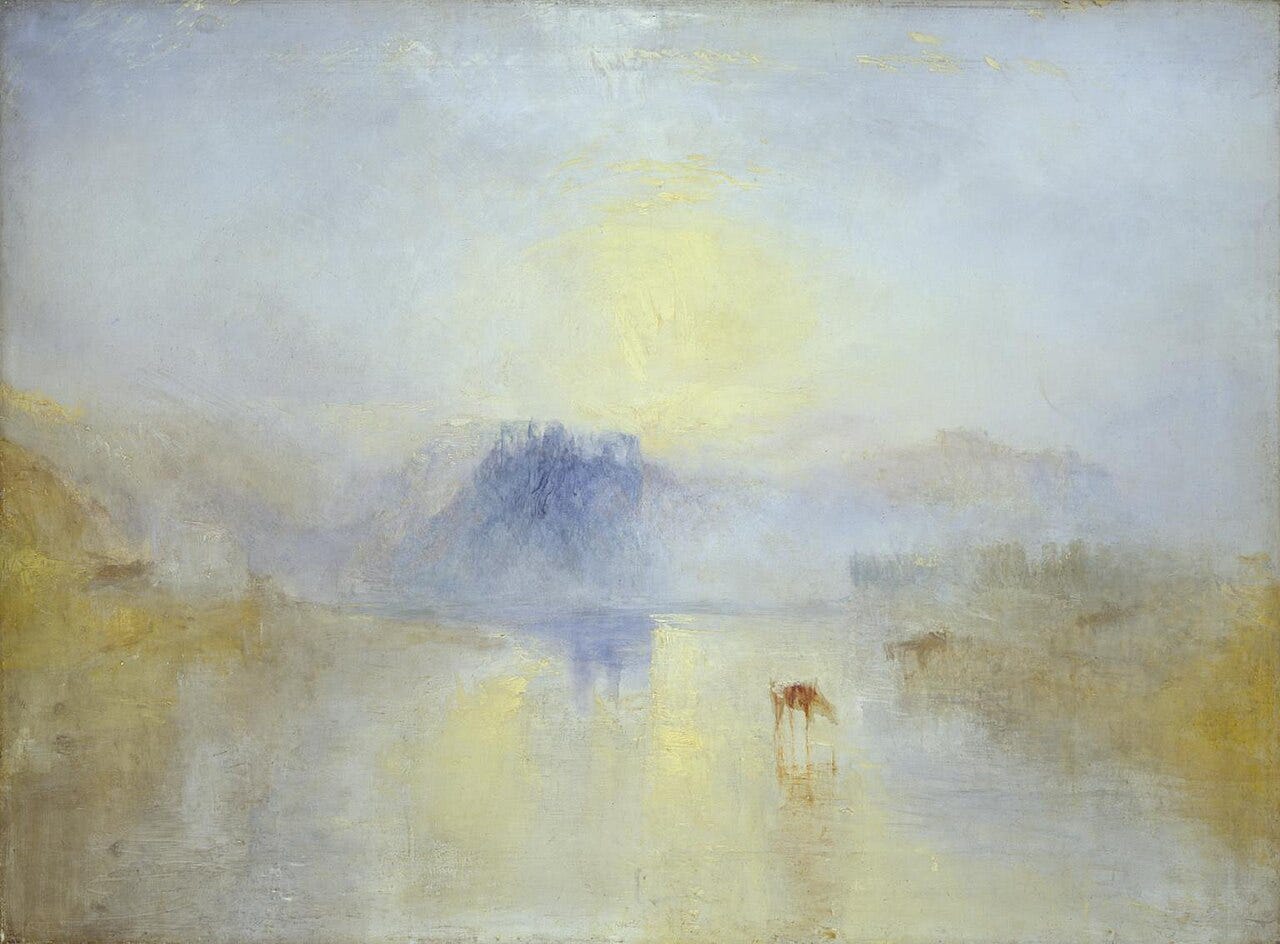
5. J.M.W. Turner, Norham Castle, Sunrise

A castle melting into blue morning mist
J.M.W. Turner, Norham Castle, Sunrise, about 1845. Tate, London.

Late in his life, around 1845, Turner painted Norham Castle melting into a blue morning mist above the River Tweed, a cow standing in the shallows.

The castle almost disappears. Turner thinned his paint like watercolor so the stone dissolves into light and air.

He never exhibited it. The picture sat in his studio until his death and is now seen as one of his furthest steps toward abstraction.

6. Caspar David Friedrich, The Abbey in the Oakwood

A ruined abbey and bare oaks in winter fog
Caspar David Friedrich, The Abbey in the Oakwood, 1809 to 1810. Alte Nationalgalerie, Berlin.

Painted from 1809 to 1810, this shows a ruined Gothic abbey and bare oaks in winter fog, with monks carrying a coffin toward a broken doorway.

Everything points to death, leafless trees, gravestones, a funeral in the mist. Friedrich made it as a pair with his sea picture The Monk by the Sea.

When both were shown in Berlin in 1810, the Prussian king Friedrich Wilhelm III bought them at once, sealing Friedrich fame.

7. Ivan Shishkin, Morning in a Pine Forest

Bear cubs in a foggy Russian pine forest at dawn
Ivan Shishkin, Morning in a Pine Forest, 1889. Tretyakov Gallery, Moscow.

In 1889 Shishkin painted dawn in a Russian pine forest, damp fog still hanging in a ravine while bear cubs clamber over a fallen trunk.

Shishkin painted the trees, but another artist, Konstantin Savitsky, painted the bears. The collector Tretyakov had Savitsky signature wiped off with turpentine so it would read as a Shishkin alone.

In Russia the image is everywhere, even on chocolate wrappers. Few people know two hands made it.

8. Camille Corot, Souvenir de Mortefontaine

A hazy lakeside with silvery trees at a misty hour
Camille Corot, Souvenir de Mortefontaine, 1864. Louvre, Paris.

Corot showed this at the Salon of 1864, a hazy lakeside at Mortefontaine with a woman and children under silvery trees at a misty hour.

The word souvenir means memory. Corot did not paint the place directly. He rebuilt it in the studio from old studies, softening it into a dream.

The Emperor Napoleon III bought it. Corot veil of mist turned a simple park into one of the most loved landscapes in France.


Join 130,000 readers who get the secrets behind the paintings. Free.


9. Vilhelm Hammershoi, Amalienborg Square, Copenhagen

A great empty square under a pale grey haze
Vilhelm Hammershoi, Amalienborg Square, Copenhagen, 1896. Statens Museum for Kunst, Copenhagen.

In 1896 Hammershoi painted the great square of Amalienborg in Copenhagen under a pale haze, almost empty, grey on grey.

He refused strong color. His world is built from greys and soft light, and the mist drains the busy square of noise and life.

Ignored for decades as too quiet, Hammershoi was rediscovered late in the twentieth century. His silence now feels ahead of its time.

10. Pieter Bruegel the Elder, The Hunters in the Snow

Hunters and dogs descending toward a frozen valley in haze
Pieter Bruegel the Elder, The Hunters in the Snow, 1565. Kunsthistorisches Museum, Vienna.

Painted in 1565, this winter scene sends three tired hunters and their dogs down a hill toward a frozen valley wrapped in cold grey haze.

It is one of a series of the seasons, made for a rich Antwerp merchant. Five of the panels survive, and this snowy one is the most famous.

The film director Andrei Tarkovsky loved it so much he lingered on it in his movies. The haze over that valley has drawn artists for centuries.

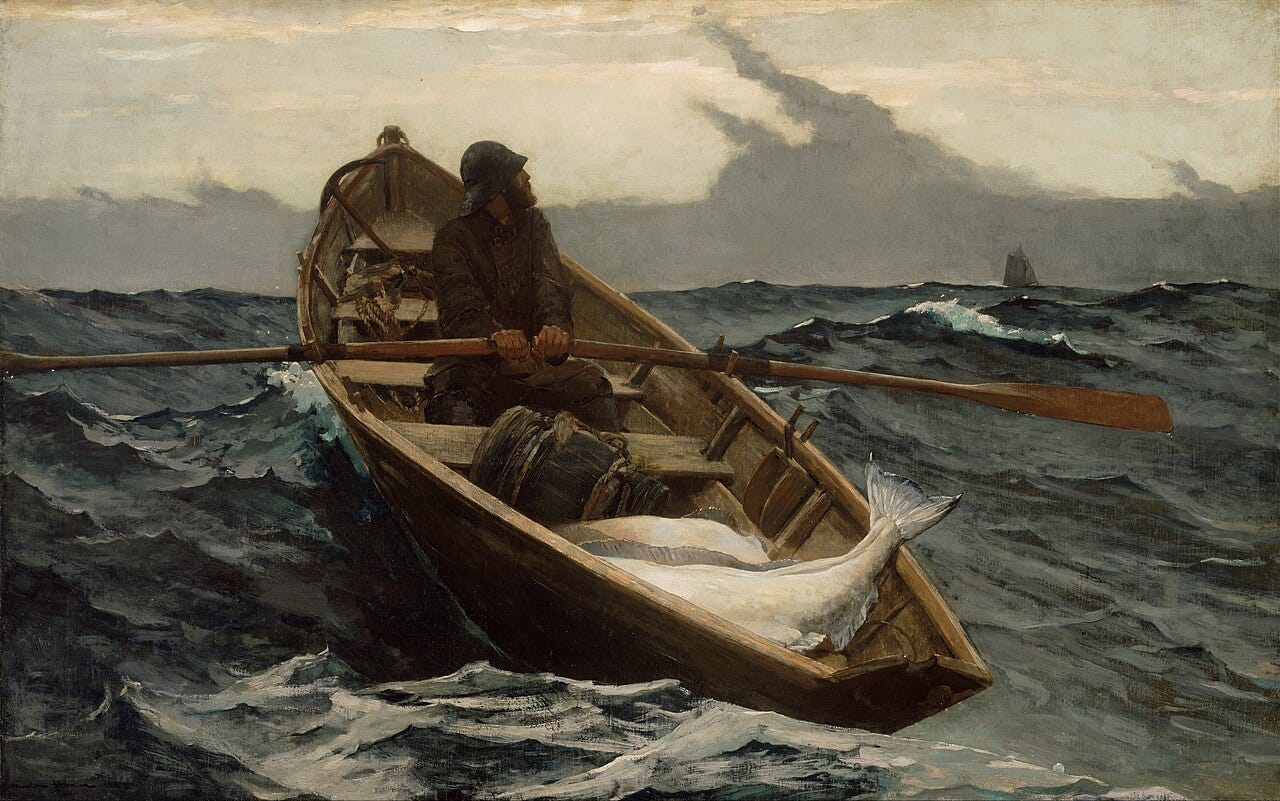
11. Winslow Homer, The Fog Warning

A lone fisherman glancing back at a wall of fog
Winslow Homer, The Fog Warning, 1885. Museum of Fine Arts, Boston.

In 1885 Homer painted a lone fisherman off the coast of Maine, two big halibut in his boat, glancing back at a wall of fog rolling in.

The title is the whole story. If that fog reaches him before he rows back, he may lose sight of his ship and be lost at sea.

Homer painted it soon after moving to Prouts Neck, Maine. The fog is not scenery here. It is a threat to a man life.

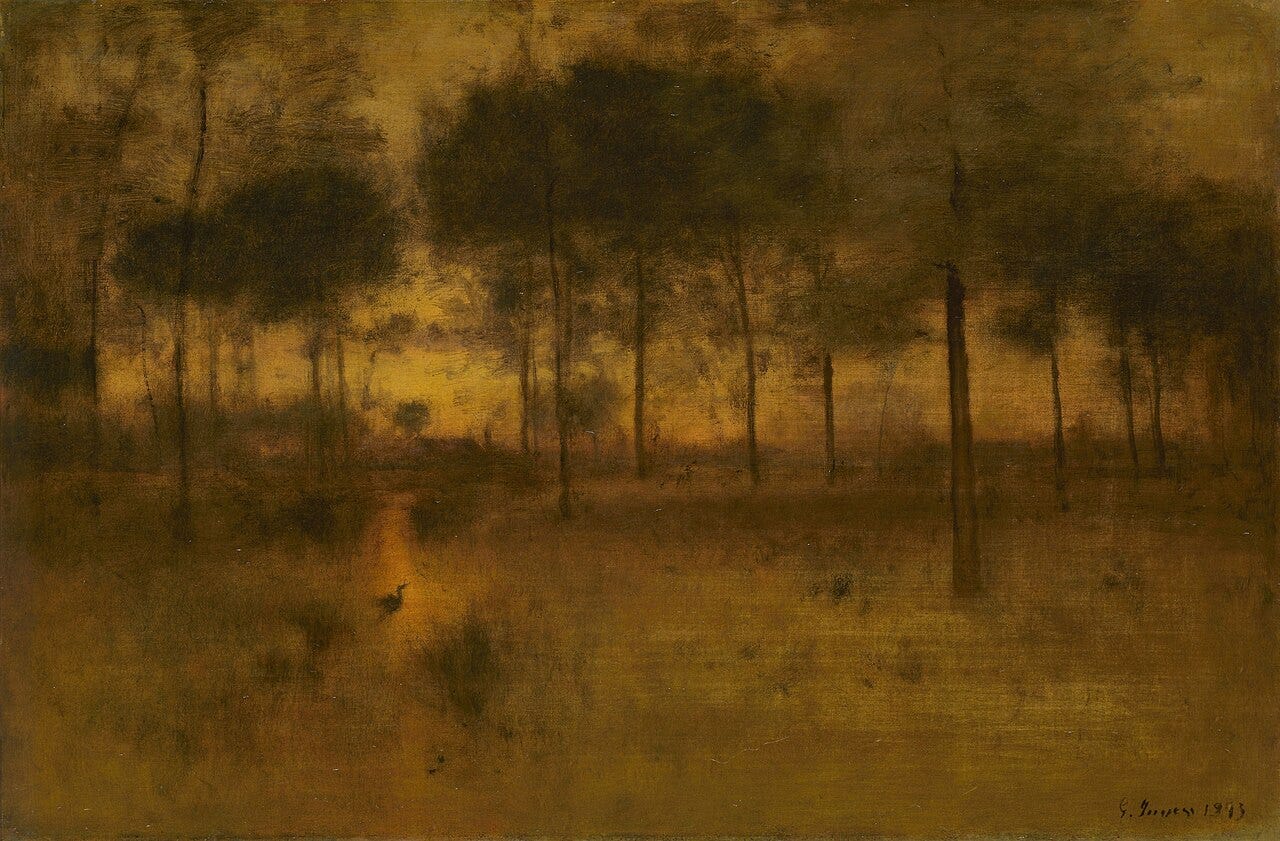
12. George Inness, The Home of the Heron

A Florida marsh melting into warm haze
George Inness, The Home of the Heron, 1893. Art Institute of Chicago.

In 1893 Inness painted a Florida marsh at a soft hour, trees and water melting into a warm haze, a heron barely visible in the gloom.

Inness followed the mystic writer Emanuel Swedenborg and used haze to hint at something spiritual behind the visible world. Detail dissolves on purpose.

He painted it in Tarpon Springs a year before he died. The bird in the title is so faint you have to hunt for it.

Where to see them

  • Tate, London: Whistler Old Battersea Bridge and Turner Norham Castle, Sunrise.

  • Musee d Orsay, Paris: Monet The Houses of Parliament, Sunlight Opening in the Fog.

  • Tretyakov Gallery, Moscow: Shishkin Morning in a Pine Forest.

  • Kunsthistorisches Museum, Vienna: Bruegel The Hunters in the Snow.

  • Museum of Fine Arts, Boston: Winslow Homer The Fog Warning.

Why painters keep reaching for the haze

Many of these are Impressionist works, where fog gave Monet a reason to paint the same view over and over as the light shifted.

Others are quiet landscape paintings and Romantic scenes, where a veil of mist stood for memory, death or the unknown.

Fog in art, questions people ask

  • What is the most famous fog painting? Caspar David Friedrich Wanderer above the Sea of Fog, from around 1818, is the best known image of fog in art.

  • Why did Monet paint fog? Monet loved London fog and said the city would not be beautiful without it. He painted the Houses of Parliament through the haze many times.

  • How does fog help a painting? Fog hides detail and pales distant shapes, which lets artists suggest depth, mood and mystery.

  • Which painting named Impressionism? Monet Impression, Sunrise, a misty harbor scene from 1872, gave the movement its name in 1874.

  • Where can I see fog paintings? The Tate in London, the Musee d Orsay in Paris and the Museum of Fine Arts in Boston hold famous examples.

The word born in a harbor haze

One foggy painting did more than set a mood. When Monet showed Impression, Sunrise in Paris in 1874, the critic Louis Leroy mocked the loose misty harbor in the paper Le Charivari and sneered that it was mere impression. The insult stuck, and a whole movement took the name Impressionism from a picture of fog over Le Havre. It hangs today at the Musee Marmottan Monet.


Two new stories a week, 130 secrets unlocked. Start free.