Forest Paintings: 12 Famous Woodland Works to Know
The most famous forest paintings turn trees into feeling. Ruisdael made the woods brood, the Barbizon painters walked into Fontainebleau to paint on the spot, Shishkin counted every pine needle, and Klimt turned a birch grove into gold. Here are twelve to know, and where to see them.
The forest is one of the oldest subjects in Western art, and one of the trickiest. A single tree is a portrait. A whole wood is a crowd. The painters below each found a different way in, from the damp Dutch beech stands of the 1600s to the pine walls of the Russian north.
Use this as a quick tour:
The mood makers: Ruisdael and Corot, who painted the forest as a state of mind.
The realists: Shishkin and Durand, who painted every trunk you could name.
The dreamers: Klimt and Henri Rousseau, who left the real woods behind.
Where to see them: a museum list at the end, grouped by city.
Jacob van Ruisdael, The Great Forest
Jacob van Ruisdael painted this Dutch wood around 1655, and it set the tone for every brooding forest that followed. A rutted path curves in from the corner, a dead beech lies across the foreground, and the sky presses down between the trees.
Ruisdael was the first to treat a forest as weather and feeling rather than decoration. Nothing dramatic happens. A traveller and a dog move along the track, small under the canopy, and that quiet scale is the whole point.
It hangs today in the Kunsthistorisches Museum in Vienna. Constable studied Ruisdael closely, and you can feel this painting two centuries later in every English landscape with a big damp sky.
Camille Corot, Forest of Fontainebleau
Corot painted the Forest of Fontainebleau in 1834, working from studies made outdoors in the woods south of Paris. The light filters down through a tall screen of oaks onto a still pool.
Fontainebleau was the training ground for a whole generation. Corot came here to work from nature, part of the shift toward en plein air painting that the Barbizon group turned into a movement.
It belongs to the National Gallery of Art in Washington. Look at the figure by the water and you see Corot the classicist still there, arranging a forest into a calm, ordered stage.
Theodore Rousseau, The Forest in Winter at Sunset
Theodore Rousseau, the leader of the Barbizon painters, worked on this huge winter forest on and off for about twenty years, from 1846 into the 1860s. Bare oaks stand black against a cold red sun.
Rousseau loved Fontainebleau so much he campaigned to have part of it protected, one of the first conservation efforts of its kind. He wanted the old trees left alone, not cleared for timber.
The unfinished canvas is at the Metropolitan Museum in New York. Its raw, scratched surface makes it feel oddly modern, a forest painted as bare bones rather than foliage.
Asher Brown Durand, In the Woods
Asher Brown Durand painted this American forest interior in 1855, a green cathedral of arching trunks, moss and a small stream. It is one of the founding images of the Hudson River School.
Durand believed you should paint trees so accurately a botanist could name them. He treated the wood as a sacred space, an idea he absorbed partly as a tribute to his late friend Thomas Cole.
It hangs at the Metropolitan Museum. Stand close and the detail keeps opening up, every fern and wet rock rendered with the patience of an engraver, which is exactly what Durand had trained as.
Ivan Shishkin, Morning in a Pine Forest
Ivan Shishkin painted this misty Russian pine forest in 1889, with bear cubs climbing over a fallen trunk at dawn. It is the most famous forest painting in Russia.
Shishkin painted the trees and the mist. The bears were added by his friend Konstantin Savitsky, who originally signed it too. The collector Pavel Tretyakov had Savitsky name wiped off so it would read as a pure Shishkin.
It lives in the Tretyakov Gallery in Moscow, and it is so loved that it appears on a famous brand of Russian chocolate. Most Russians know the bears from the candy wrapper before they know the painting.
Arkhip Kuindzhi, Birch Grove
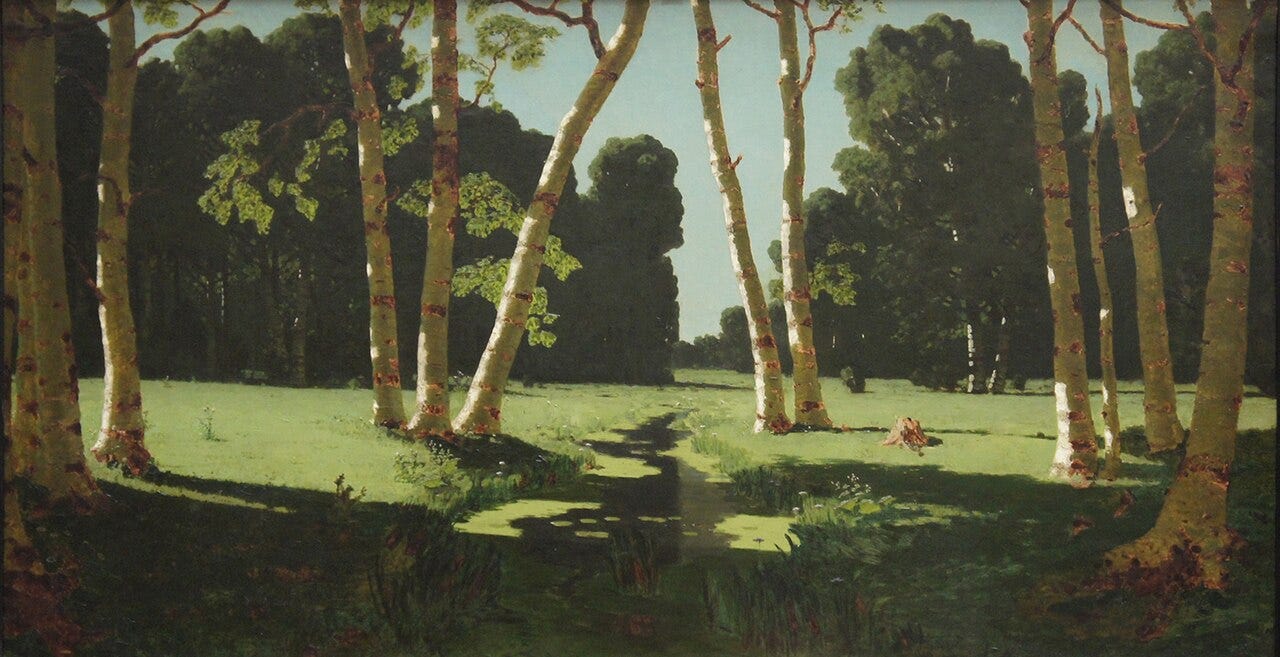
Arkhip Kuindzhi showed Birch Grove in 1879, and crowds queued to see it. White trunks blaze against deep shadow, with a strip of vivid green meadow catching the sun.
Kuindzhi was obsessed with the effect of light, and he exhibited some works alone in a darkened room with a single lamp on the canvas, so the glow looked almost lit from within. People suspected a trick.
It is held at the Tretyakov Gallery. The simplification here, flat bands of light and dark, feels closer to a modern poster than to the fussy realism of his rivals.
Gustav Klimt, Birch Forest
Gustav Klimt painted this birch forest in 1903 during a summer at the Attersee lake in Austria. The canvas is square, filled edge to edge with slender trunks and a carpet of golden fallen leaves. There is no sky.
Klimt cropped the world down to a patterned wall of trees, closer to his gilded portraits than to a normal landscape. The forest becomes a surface, a mosaic of dots and verticals.
Klimt landscapes were his private pleasure, painted on holiday away from commissions. This one has passed through private and museum collections, and its calm, decorative hush is unmistakably his.
Ivan Shishkin, Rye
Shishkin painted Rye in 1878, a golden field with a path running into it and a row of huge pines standing guard along the edge. One of the pines is dead and bare.
The dead tree was deliberate. Shishkin lost his wife, his father and two sons in the years around this painting, and critics have long read the lone withered pine as grief planted among the summer wheat.
It hangs in the Tretyakov Gallery. Shishkin scribbled a note on the back, roughly space, expanse, land, rye, a hymn to the Russian earth.
Paul Cezanne, Rocks in the Forest
Paul Cezanne painted these forest boulders around 1893, probably near Fontainebleau. Grey rocks and thin trunks are built from blocky patches of colour rather than smooth detail.
Cezanne was not after atmosphere. He wanted the underlying structure, the way the rocks and trees lock together like masonry. This is the forest treated as architecture.
It is at the Metropolitan Museum. Younger painters studied exactly this, and the way Cezanne broke the woods into faceted planes fed directly into Cubism a decade later.
Henri Rousseau, The Repast of the Lion
Henri Rousseau painted this jungle around 1907, a lion half hidden in a wall of giant leaves and glowing flowers. It is a forest that never existed.
Rousseau was a self taught Paris customs clerk who never left France. He built his jungles from the plants in the city botanical gardens, illustrated magazines and pure imagination, then painted them with dead serious care.
It hangs at the Metropolitan Museum. Critics mocked him in his lifetime, but Picasso and the avant garde saw the strangeness for what it was, and his imaginary forests now feel like dreams caught on canvas.
Ivan Shishkin, Oaks
Shishkin returns here with a stand of massive old oaks, painted with his near scientific attention to bark, branch and leaf. He drew trees the way a naturalist draws specimens.
He was trained partly through etching, and that engraver eye shows in how each layer of foliage is separated and described. Nobody in Russia painted a tree with more authority.
Works like this made Shishkin the definitive painter of the Russian forest, held across the Tretyakov Gallery and the Russian Museum. His woods feel like places you could walk into and get lost.
Ivan Shishkin, Wood Distances
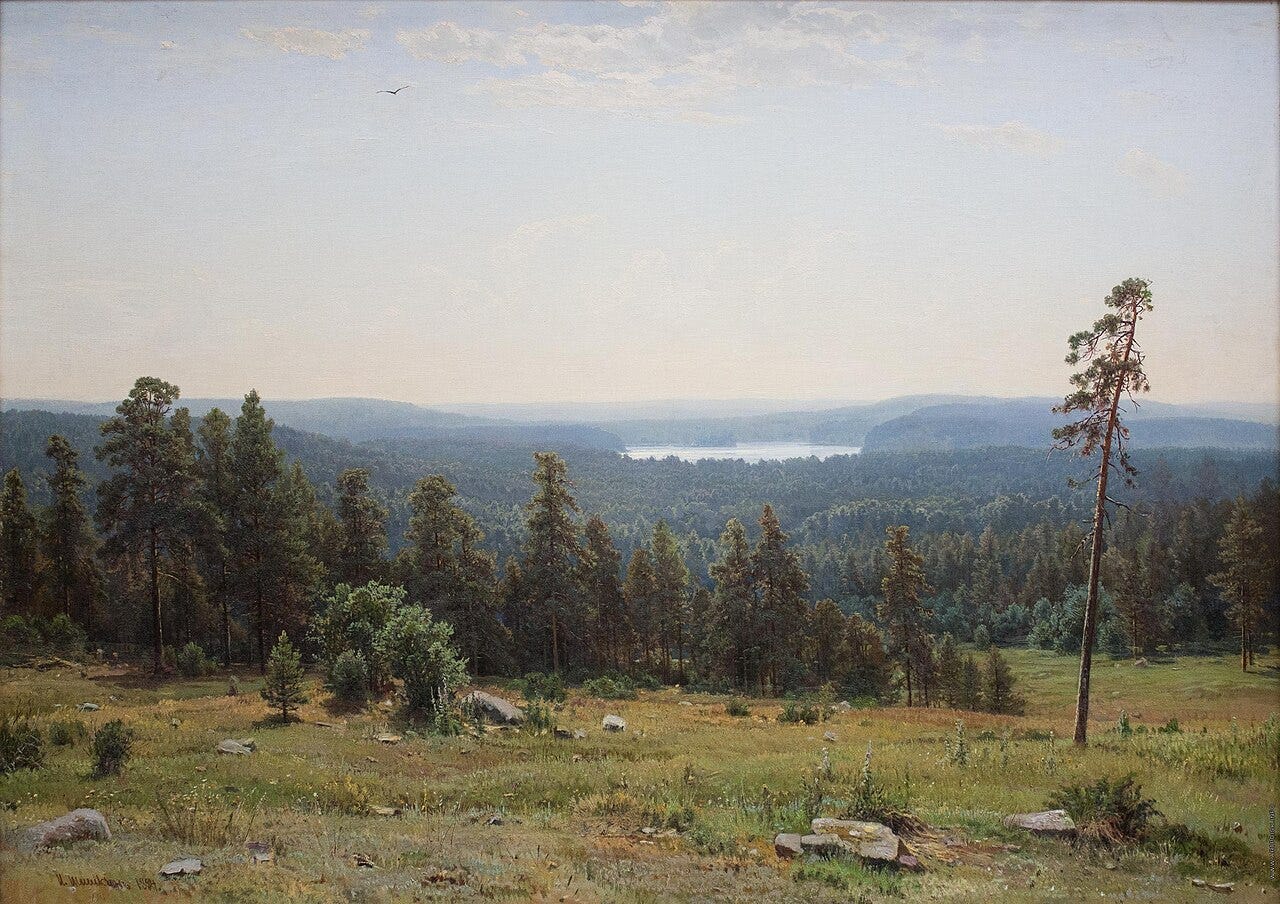
In this late panorama Shishkin pulls back from the single tree to the whole horizon, forest rolling into blue distance under an enormous sky. It is the forest as a country.
By now Shishkin could paint depth as well as detail. The near pines are sharp, the far woods dissolve into haze, and a small river threads through to lead your eye out to the edge of the land.
It belongs to the Russian collections that hold most of his major work. After a lifetime among the trees, Shishkin ended by painting the forest as something almost endless.
Questions people ask about forest paintings
What is the most famous forest painting? In Russia, Shishkin Morning in a Pine Forest of 1889, with its bear cubs, is the best known. In Western art, Ruisdael brooding Dutch woods and Klimt golden Birch Forest are among the most recognised.
Who painted the bears in Morning in a Pine Forest? Shishkin painted the forest and mist. The bears were added by his friend Konstantin Savitsky, whose signature was later removed.
Where did the Barbizon painters work? In the Forest of Fontainebleau, south of Paris, where Corot and Theodore Rousseau painted directly from nature.
Why did Klimt paint forests with no sky? He cropped the view into a flat pattern of trunks and leaves, treating the forest as a decorative surface rather than a scene.
Which artist is the painter of the Russian forest? Ivan Shishkin, whose near botanical realism made him the defining forest painter of nineteenth century Russia.
Where to see them
Metropolitan Museum, New York: Theodore Rousseau, Asher Durand, Cezanne and Henri Rousseau.
Tretyakov Gallery, Moscow: Shishkin Morning in a Pine Forest and Rye, and Kuindzhi Birch Grove.
National Gallery of Art, Washington: Corot Forest of Fontainebleau.
Kunsthistorisches Museum, Vienna: Ruisdael The Great Forest.
Keep exploring
If these woods pulled you in, three more paths from here. See how the Barbizon forest shaped a young Dutchman in how the Barbizon painters shaped Van Gogh, learn to read the hidden clues in famous canvases in seven secrets hidden in famous paintings, or start with the basics of landscape painting.
One last thing. The forest was never just scenery. For Ruisdael it was a mood, for Shishkin a homeland, for Klimt a pattern of gold. Walk into any of these twelve and you are really walking into how the painter saw the world.