
Jean-Honoré Fragonard is remembered for pink silk, gardens and lovers' games, yet his pictures often had a rougher life than the people in them. A royal mistress sent four of his canvases back without giving a reason, and one of his finest hung in a Florida dining room while its owner took it for a copy.
Cool Stories About Art is a newsletter to learn art the fun way.
Join 200,000+ readers and get:
10 new art stories / month
The entire archive of content (140+ articles)
Comment, ask questions, and chat with other readers
From the Academy to Private Rooms
Fragonard was trained for the top of the French art world. In the eighteenth century that meant history painting, the large biblical and mythological scenes that the Royal Academy ranked highest of all, and he won its prizes. Then he spent most of his career working for private collectors instead.
Those collectors wanted something lighter for their own rooms: courtship, gardens and games, in the Rococo style of eighteenth century France. That is the work he is famous for, along with a brush so fast that every stroke stays visible.
The twelve paintings chosen here follow both sides of that career, from the canvases he made for the Academy in the 1750s to the darker pictures of the 1780s.
12. Mademoiselle Guimard, Now Called the Comtesse de Grave (about 1769)
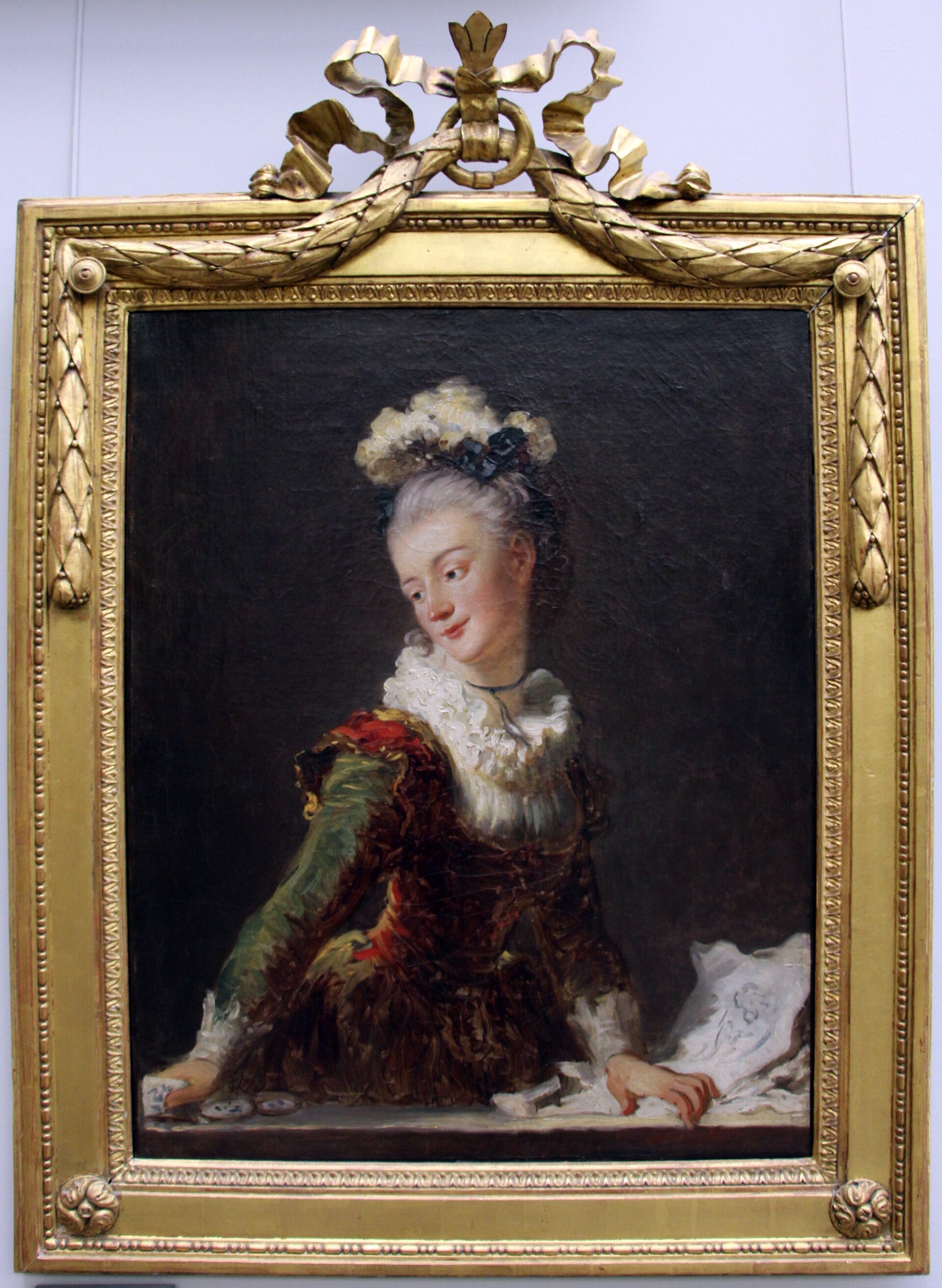
Dressed in pink and white, with a stiff ruff at the throat, a young woman turns toward us out of a dark background. The brush barely pauses anywhere, and the strokes on her sleeves and collar are long, fast and left in plain view. For generations this canvas was known as the portrait of Mademoiselle Guimard, the most celebrated dancer in Paris.
That name was not chosen at random. Around 1770, Marie-Madeleine Guimard was the leading dancer of the Paris Opera, and she was rich enough to build a townhouse in the Chaussée d'Antin, a new district of the city. Her architect, Claude-Nicolas Ledoux, gave the house its own theater with five hundred seats, and Fragonard was hired to decorate it.
He began with the large panels of her salon, where he painted her as Terpsichore, the Muse of dance. Before the work was done, the two quarreled, and the dancer found another painter to finish it.
What followed is known from a single report. In March 1773, the Correspondance littéraire, a handwritten newsletter that Baron Grimm sent from Paris to princes across Europe, told how Fragonard slipped back into the house, picked up a palette and, with a few touches, turned Terpsichore's smile into a look of fury without losing the likeness.
The dancer arrived with her friends, saw the panel and lost her temper, and the angrier she grew, the more she looked like it. Perhaps it never happened, but it went around Paris while both of them were alive.
The portrait in the Louvre, though, belongs to another part of Fragonard's work, the fantasy figures. Around 1769 he painted a series of quick portraits, cut at the waist, of sitters in theatrical costume. Several were long thought to show famous people, and the art historian Richard Rand cites two of those guesses, the dancer La Guimard and the philosopher Denis Diderot.
The guess about the dancer did not hold. The Louvre now gives the portrait the name of another sitter, Marie-Anne-Éléonore, comtesse de Grave, and in the museum's title for it, Guimard's name comes only after the word "formerly."
At a Glance
Artist: Jean-Honoré Fragonard (1732 to 1806)
Painted: About 1769
Medium: Oil on canvas
Size: 82 × 65 cm (32.3 × 25.6 in)
Where to see it: Musée du Louvre, Paris
11. The Fête at Saint-Cloud (about 1775 to 1780)
Huge trees rise over a park and take up most of the canvas, painted in greens and golds with a few touches of red. At their feet, very small, a crowd has gathered around wooden stages and stalls. Nobody knows who Fragonard painted it for, and for more than eighty years after he finished it, no surviving text so much as names it.