Most lists of famous French paintings stop at Impressionism. The paintings below run from Georges de La Tour's candlelit card tables in the 1630s to Henri Rousseau's dream jungles at the end of the 1800s, past the Impressionists into the centuries most guides skip.
If you want the Impressionists specifically, I cover Monet, Renoir, and the rest across dozens of pieces on this site. This list goes earlier, later, and around the edges of that movement, with different painters and different pictures throughout.
In 30 seconds:
Georges de La Tour worked in Lorraine in the 1630s and was largely forgotten for nearly three centuries before being rediscovered in the early 1900s.
French painting runs from La Tour's Baroque candlelight through Neoclassicism, Romanticism, Realism, and Impressionism, all the way to Rousseau's self taught dream scenes at the end of the 1800s.
The July Revolution of 1830 gave Delacroix the subject for Liberty Leading the People, one of the most reproduced images in French art.
Impressionism takes its name from a single painting on this list, Monet's Impression, Sunrise.
Ten of these twelve paintings hang in Paris, split between the Louvre, the Musée d'Orsay, and the Musée Marmottan Monet.
One story a week, no jargon, always free.
1. Georges de La Tour, The Cheat with the Ace of Diamonds (c. 1636 to 1638)
A card player leans toward a hidden ace tucked into his belt while two others plan how to fleece the naive young man across the table. Every gesture in the scene is a signal, and every viewer is meant to catch the cheat before the victim does.
La Tour worked in the Duchy of Lorraine, far from the Paris academies, and painted mostly by candlelight in the style Caravaggio had made famous in Italy. He fell into total obscurity after his death in 1652, and it took until 1915 for a German art historian to piece his career back together from scattered, misattributed canvases.
2. Jean Antoine Watteau, The Embarkation for Cythera (1717)
Couples drift toward a golden ship on a mythical island sacred to Venus, caught somewhere between arriving and leaving. Watteau submitted the painting to the Académie Royale in 1717 as his official reception piece, and the jury had to invent a new category just to classify it.
That category, fête galante, described an outdoor party of elegantly dressed figures with no clear story or moral, a genre Watteau essentially created on the spot. He died of tuberculosis four years later, in 1721. The fête galante he invented went on to shape the whole Rococo decades later, from Fragonard's The Swing to the twelve paintings that best capture that era.
3. Jacques Louis David, The Oath of the Horatii (1784)
Three brothers swear on their father's raised swords to fight Rome's enemies to the death, while their sister collapses in grief for the man she loves on the other side. David painted it in Rome in 1784 and showed it at the Paris Salon of 1785, where it became the picture everyone in the city was talking about.
I go through this painting, and eleven other Neoclassical icons, in my famous Neoclassical paintings guide.
4. Jean Auguste Dominique Ingres, La Grande Odalisque (1814)
Ingres stretched his reclining nude by several vertebrae to make the curve of her back work as pure design rather than correct anatomy. Critics accused him of not knowing how to draw a body, when he had drawn this one on purpose.
The rest of her story, and how it split Ingres from the Neoclassical rules he trained under, is in my famous Neoclassical paintings guide.
5. Théodore Géricault, The Raft of the Medusa (1818 to 1819)
A French navy frigate ran aground off the coast of Mauritania in 1816, and roughly 150 people were set adrift on a hastily built raft. Only 15 survived thirteen days at sea, and Géricault turned their ordeal into an over life size painting before he had a single major commission to his name.
I tell the full story of the wreck, the raft, and the scandal it caused in Paris in The hidden secrets of the Raft of Horror.
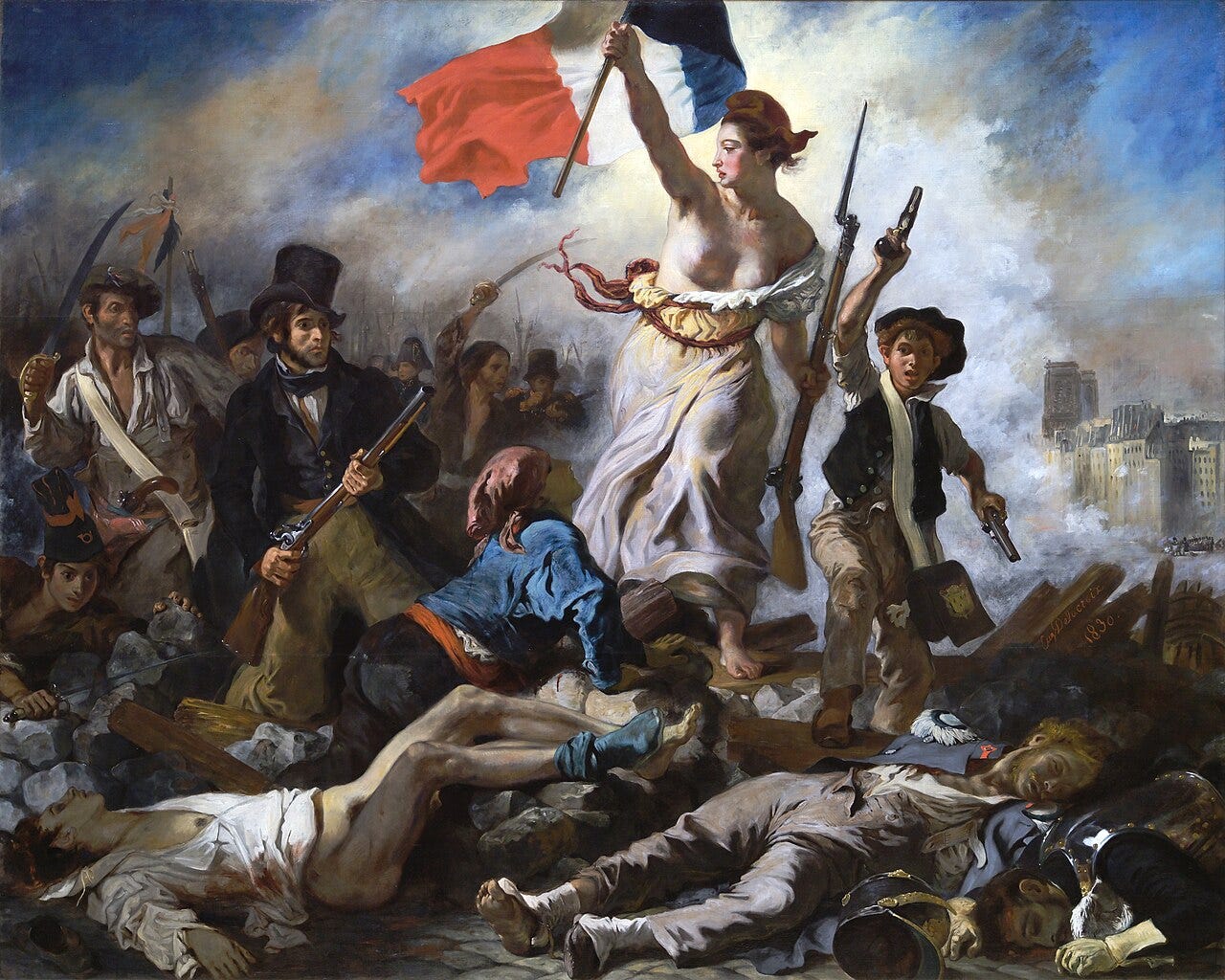
6. Eugène Delacroix, Liberty Leading the People (1830)
A bare chested woman in a Phrygian cap climbs over a barricade of paving stones and bodies, a musket in one hand and the tricolor flag in the other. Delacroix painted her to commemorate the July Revolution of 1830, the three days that toppled King Charles X, and finished the canvas within months of the events themselves.
The government judged the image too dangerous to keep on public view. It spent most of the decades between 1832 and 1874 rolled up in storage or in the safekeeping of Delacroix's family, and only entered the Louvre's permanent collection in 1874, more than forty years after it was painted.
I tell Delacroix's full career in Eugène Delacroix: The Complete Story.
7. Gustave Courbet, A Burial at Ornans (1849 to 1850)
Courbet painted his own neighbors and family from Ornans, his birthplace in eastern France, gathered at an ordinary graveside on a gray day. He painted them at more than 6 by 3 meters, a scale French painting had reserved for kings, saints, and battles.
The Paris Salon of 1850 found the choice offensive on its own terms: peasants and small town notables did not, by the old rules, deserve a canvas that size. The uproar made Courbet's name and helped set Realism on its course for the rest of the century.
I cover Courbet's full career in Gustave Courbet: The Complete Story.
8. Édouard Manet, Le Déjeuner sur l'herbe (1863)
A nude woman sits on the grass with two fully dressed men, staring straight at the viewer as if daring them to object. The jury of the 1863 Salon rejected the painting outright, and it ended up in the Salon des Refusés, the exhibition Napoleon III created that year for all the works the official jury had turned down.
Manet borrowed the pose of his three central figures from a Renaissance engraving after Raphael, which made the painting less an act of rebellion against tradition than an argument about what tradition was allowed to show. Salon nudes were common that year. A nude staring back at a fully dressed picnic was not.
I tell Manet's full career in Édouard Manet: The Complete Story.
9. Claude Monet, Impression, Sunrise (1872)
Monet painted the harbor at Le Havre in a single sitting, more sketch than finished picture by the standards of the time. A critic mocked the title at the group's first show in 1874, and the word impression stuck to the entire movement rather than staying attached to one painting.
I dig into the full naming story, and why the claim to being first Impressionist is more contested than it looks, in Was Monet really the first Impressionist?
10. Pierre Auguste Renoir, Bal du Moulin de la Galette (1876)
Renoir painted a Sunday afternoon dance at an actual open air venue in Montmartre, using his own friends as models rather than hired professionals. He carried the large canvas back and forth from his studio nearby so he could work on parts of it on site.
Sunlight falls through the trees in dappled patches across the dancers' clothes and faces, and Renoir worked hard to catch that shifting light without turning the crowd into a blur. Gustave Caillebotte, a painter and one of Renoir's most important patrons, bought the painting in 1879 and left it to the French state on his death in 1894. It hung in the Musée du Luxembourg, then the Louvre, before moving to the Musée d'Orsay in 1986.
I tell Renoir's full career in Pierre Auguste Renoir: The Complete Story.
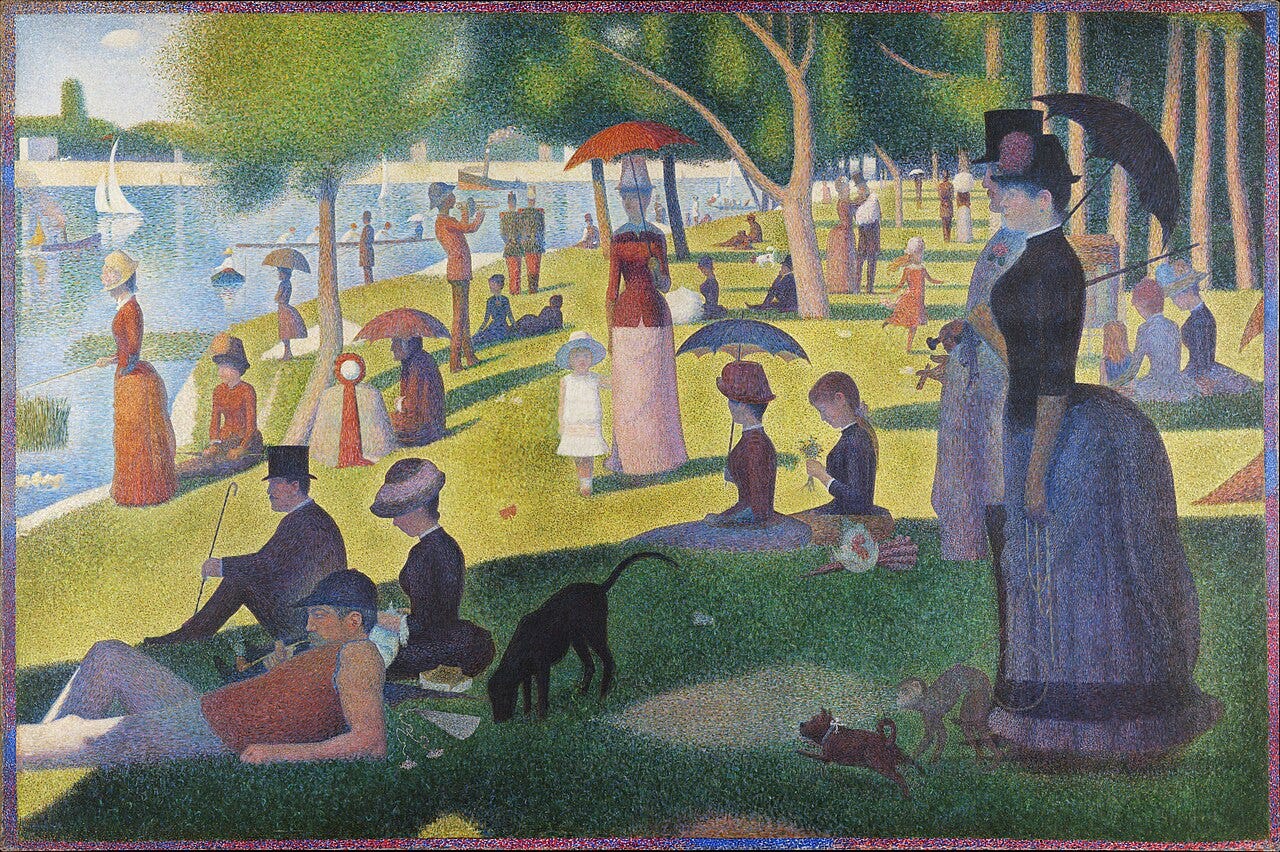
11. Georges Seurat, A Sunday Afternoon on the Island of La Grande Jatte (1884 to 1886)

Seurat spent two years building this canvas entirely out of small dots of pure color, a technique he called chromoluminarism and critics shortened to pointillism. Up close it dissolves into a field of dots. From across the room it resolves into a woman with a monkey on a leash and a crowd relaxing on a Paris island.
I cover this painting, and eleven other Post Impressionist works, in my famous Post Impressionist paintings guide.
12. Henri Rousseau, The Sleeping Gypsy (1897)
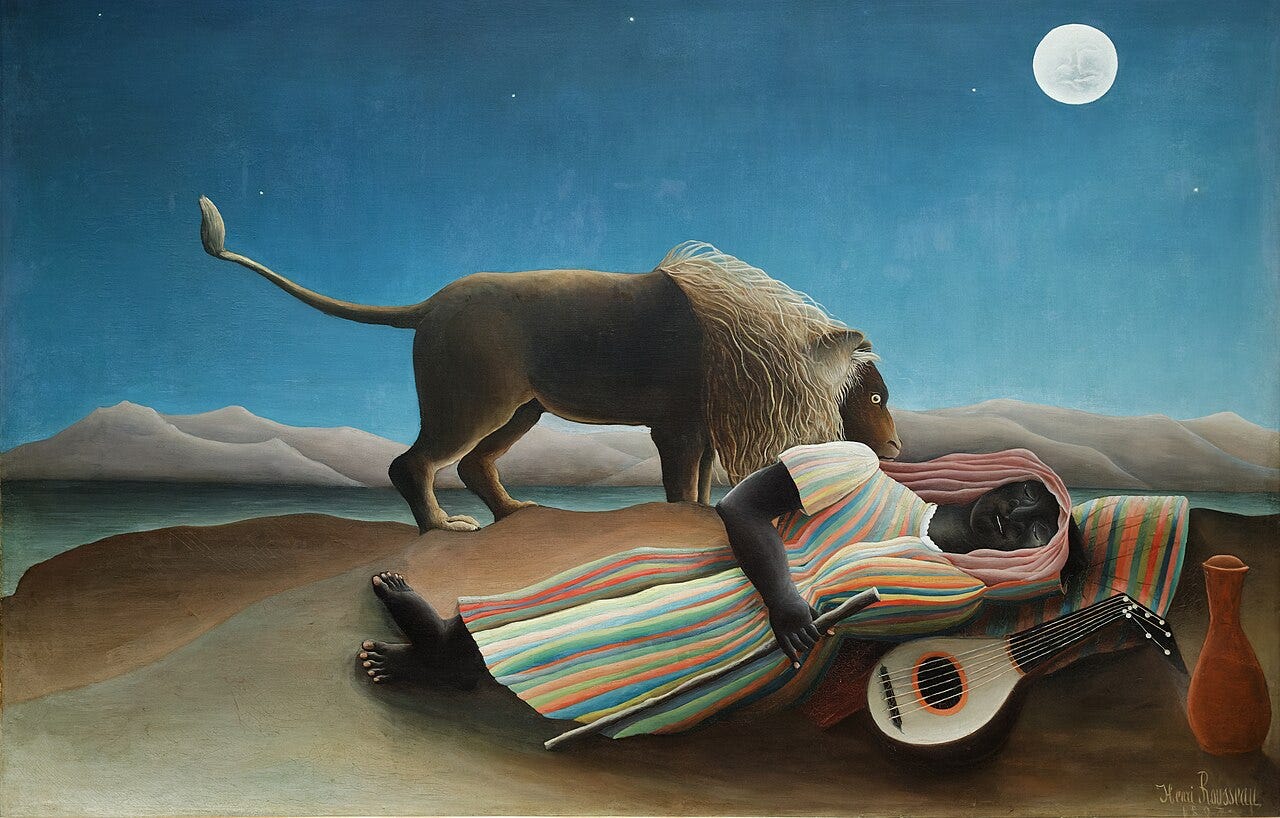
A lion stands over a sleeping woman on a moonlit desert, and neither one reacts to the other. Rousseau worked as a Paris toll collector for more than twenty years, painting on Sundays and holidays, and never left France or saw a real desert in his life.
He offered the painting to the mayor of his hometown, Laval, for 2,000 francs. The mayor thought it looked childish and never replied. It later crossed the Atlantic and entered the Museum of Modern Art's collection in 1939, where it now hangs beside Van Gogh's The Starry Night.
I tell Rousseau's full career in Henri Rousseau: The Complete Story.
Where to see them
The Cheat with the Ace of Diamonds: Musée du Louvre, Paris.
The Embarkation for Cythera: Musée du Louvre, Paris.
The Oath of the Horatii: Musée du Louvre, Paris.
La Grande Odalisque: Musée du Louvre, Paris.
The Raft of the Medusa: Musée du Louvre, Paris.
Liberty Leading the People: Musée du Louvre, Paris.
A Burial at Ornans: Musée d'Orsay, Paris.
Le Déjeuner sur l'herbe: Musée d'Orsay, Paris.
Impression, Sunrise: Musée Marmottan Monet, Paris.
Bal du Moulin de la Galette: Musée d'Orsay, Paris.
A Sunday Afternoon on the Island of La Grande Jatte: Art Institute of Chicago.
The Sleeping Gypsy: Museum of Modern Art, New York.
170,000 readers get a story like this every week. Free.
Straight answers about French painting
What is the most famous French painting? By many measures it's Liberty Leading the People by Delacroix, though the Mona Lisa often gets counted as French since it hangs in the Louvre. It's Italian, painted by Leonardo da Vinci.
What is a fête galante? An outdoor party scene of elegantly dressed figures with no fixed story, a genre Watteau invented for his 1717 reception piece at the French Academy.
Why is the Impressionist movement named after a single painting? A critic mocked the title of Monet's Impression, Sunrise at the group's first show in 1874, and the word stuck to the whole movement instead of just the one picture.
Was Le Déjeuner sur l'herbe considered scandalous in its own time? Yes. The 1863 Salon jury rejected it outright, and it was shown instead at the Salon des Refusés, where it drew mockery for pairing a nude woman with two clothed men.
Who was Henri Rousseau? A self taught painter who worked as a Paris toll collector for most of his career and never traveled outside France, despite painting jungles and deserts he had only seen in books and botanical gardens.
Why one of these spent forty years in hiding
Most paintings this famous move fast: sold, seized, or shipped straight into a museum. Liberty Leading the People is the exception on this list. The French government judged it too dangerous to display and kept it rolled up in storage for most of the decades between 1832 and 1874, before it finally entered the Louvre's permanent collection.
For the Post Impressionist and Neoclassical paintings this list points to rather than repeats, see my famous Post Impressionist paintings guide and my famous Neoclassical paintings guide, or start with what Cool Stories About Art is. For the full ranking, see the greatest painters of all time.