Famous French Paintings: 12 That Shook the Art World

The most famous French paintings run from Fragonard's flirting swing and David's murdered martyr to Manet's scandalous picnic and Seurat's dotted Sunday. For three centuries Paris was the center of Western art, and these twelve show exactly why.

Poussin shepherds Arcadian tomb
Nicolas Poussin, Et in Arcadia Ego, about 1638, Louvre, Paris

French painting is a story of rules and rebels: an official Salon that could make or break a career, and painters who kept breaking its rules on purpose. I have picked twelve that changed art or scandalized a city, sometimes both at once.

Why French painting ruled the world:

  • The Salon. For centuries every ambitious painter had to pass the official Paris Salon, so the whole art world watched it.

  • The scandals. From Manet onward, French painters kept breaking the rules and starting public fights.

  • The movements. Rococo, Realism, Impressionism and more were all born or crowned in France.

  • The city. Paris drew artists from everywhere, so French art became the meeting point of the world.


Learn art the fun way. Free stories every week, no boring lectures.


Three that go further

The ones I would send you to next:


1. Nicolas Poussin, Et in Arcadia Ego (about 1638)

Shepherds in an ideal countryside gather around a stone tomb, tracing an inscription with their fingers: even in Arcadia, I am here. Nicolas Poussin painted Et in Arcadia Ego around 1638, and death whispers quietly through the perfect calm.

Poussin worked mostly in Rome, yet he wrote the rule book for French classical painting, order, clear drawing and noble subjects. For two centuries the French academy held him up as the model every serious artist should follow.

2. Antoine Watteau, Pilgrimage to Cythera (1717)

Watteau Cythera lovers park
Antoine Watteau, Pilgrimage to Cythera, 1717, Louvre, Paris

Elegant couples drift through a golden park toward a boat that will carry them to the island of love. Antoine Watteau painted Pilgrimage to Cythera in 1717, and it was so hard to classify that the academy invented a brand new category for it, the fete galante.

Watteau turned flirtation and daydream into serious art, launching the light, playful Rococo style. Under all the silk runs a faint sadness, a sense that the lovely afternoon is already slipping away.

3. Jean Honore Fragonard, The Swing (1767)

Fragonard The Swing rococo
Jean Honore Fragonard, The Swing, 1767, Wallace Collection, London

The cheekiest picture of a very cheeky age started as a dirty joke of a commission. A nobleman asked Jean Honore Fragonard to paint his mistress on a swing with himself hidden in the bushes below for the view, and in 1767 Fragonard obliged, adding a statue of Cupid with a finger to its lips.

On the swing she laughs and kicks off a shoe, all froth and pink silk. It is the pure spirit of Rococo France, painted right before the Revolution swept every trace of it away.

4. Jacques Louis David, The Death of Marat (1793)

David Death of Marat bath
Jacques Louis David, The Death of Marat, 1793

A murdered hero of the Revolution lies dead in his bath, pen still in hand, as calm and holy as a saint. Jacques Louis David painted The Death of Marat in 1793, days after his friend was stabbed, turning a bloody killing into pure propaganda.

David was the artist of the French Revolution, and here he stripped everything away to make Marat a martyr. The bare dark background and the simple, brutal light make it one of the coldest and most powerful political paintings ever made.

5. Theodore Gericault, The Raft of the Medusa (1819)

Gericault Raft of the Medusa
Theodore Gericault, The Raft of the Medusa, 1819, Louvre, Paris

In 1816 a French navy frigate ran aground because its captaincy had been handed to an unqualified noble, and about one hundred and fifty people were left on a makeshift raft, of whom only a handful came back alive.

Theodore Gericault turned that national shame into a vast canvas in 1819.

He painted the survivors heaped together, some already dead, one waving a rag at a ship too far away to see. Gericault interviewed the men who lived, built a model of the raft, and even studied corpses to get the flesh right, turning a news story into a towering accusation.

6. Eugene Delacroix, Liberty Leading the People (1830)

Delacroix Liberty flag barricade
Eugene Delacroix, Liberty Leading the People, 1830, Louvre, Paris

A bare breasted woman with a flag strides over the dead and the rubble, leading a ragged crowd through gunsmoke. Eugene Delacroix painted Liberty Leading the People in 1830 to mark a Paris uprising, and Liberty herself is half goddess, half street fighter.

It became the great image of French revolt, so charged that the government kept it hidden for years. Today she stares out from posters, banknotes and album covers, still the face of the barricade, and the movement behind her is Romanticism.

7. Gustave Courbet, A Burial at Ornans (1850)

Courbet Burial at Ornans
Gustave Courbet, A Burial at Ornans, 1850, Musee d'Orsay

A whole country village gathers around an open grave, painted life size, as grand as any coronation. Gustave Courbet made A Burial at Ornans in 1850, and Paris was outraged that he gave ordinary peasants the scale of kings.

Courbet insisted on painting only what he could see, plain people and real life, and gave the approach a name, Realism. This huge, honest funeral helped end the old rule that only gods and heroes deserved a great canvas.


Two new stories a week, 130 secrets unlocked. Start free.


8. Jean Francois Millet, The Gleaners (1857)

Millet Gleaners peasant women
Jean Francois Millet, The Gleaners, 1857, Musee d'Orsay

In 1857 three peasant women bending in a field caused a small panic among rich Parisians. Jean Francois Millet had painted The Gleaners, showing them stooped low over a stubble field, gathering the few grains the harvest had left behind.

To some it looked like a warning of revolt, three poor women given the weight of a sacred scene. Millet meant it as respect, showing the endless, back breaking labor that fed the nation.

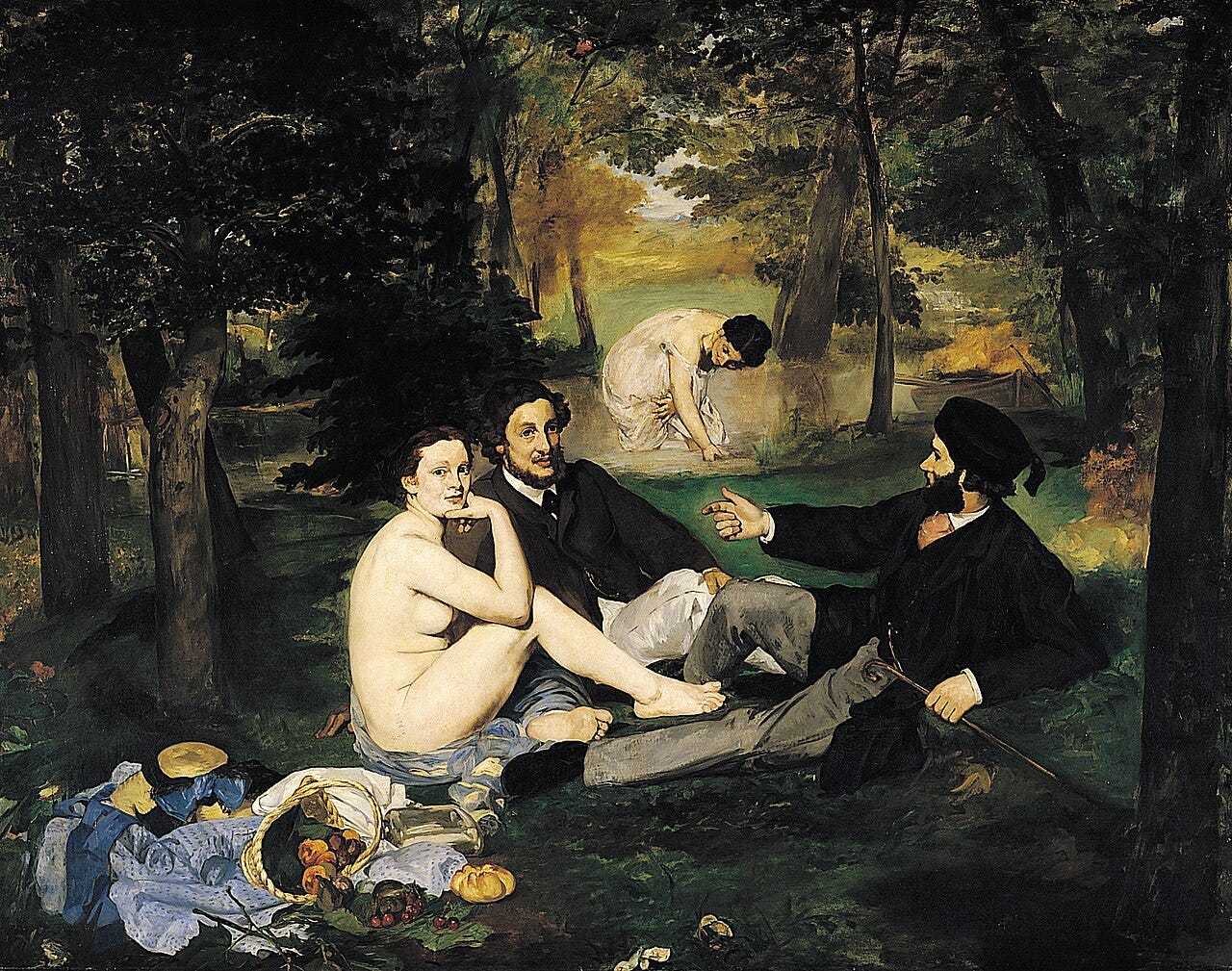
9. Edouard Manet, Le Dejeuner sur l'herbe (1863)

Manet Luncheon on the Grass
Edouard Manet, Le Dejeuner sur l'herbe, 1863, Musee d'Orsay

A naked woman sits calmly at a picnic between two fully dressed men, staring straight out at you. Edouard Manet showed Le Dejeuner sur l'herbe in 1863, and it caused one of the greatest scandals in the history of art.

It was not the nudity that shocked Paris but the honesty, a real modern woman rather than a shy goddess. Rejected by the official Salon, it became a rallying point for the young painters who would soon be called the Impressionists.

10. Georges Seurat, A Sunday on La Grande Jatte (1884)

Seurat Grande Jatte dots
Georges Seurat, A Sunday on La Grande Jatte, 1884, Art Institute of Chicago

Parisians stroll and lounge on a sunny island in the Seine, frozen as still as toy soldiers. Georges Seurat painted A Sunday on La Grande Jatte between 1884 and 1886, building the entire scene from millions of tiny dots of pure color.

Stand back and the dots blend in your eye into glowing light. He called the method pointillism, and it took him two years of patient, almost scientific work. The result is one of the calmest and strangest pictures in all of French art.

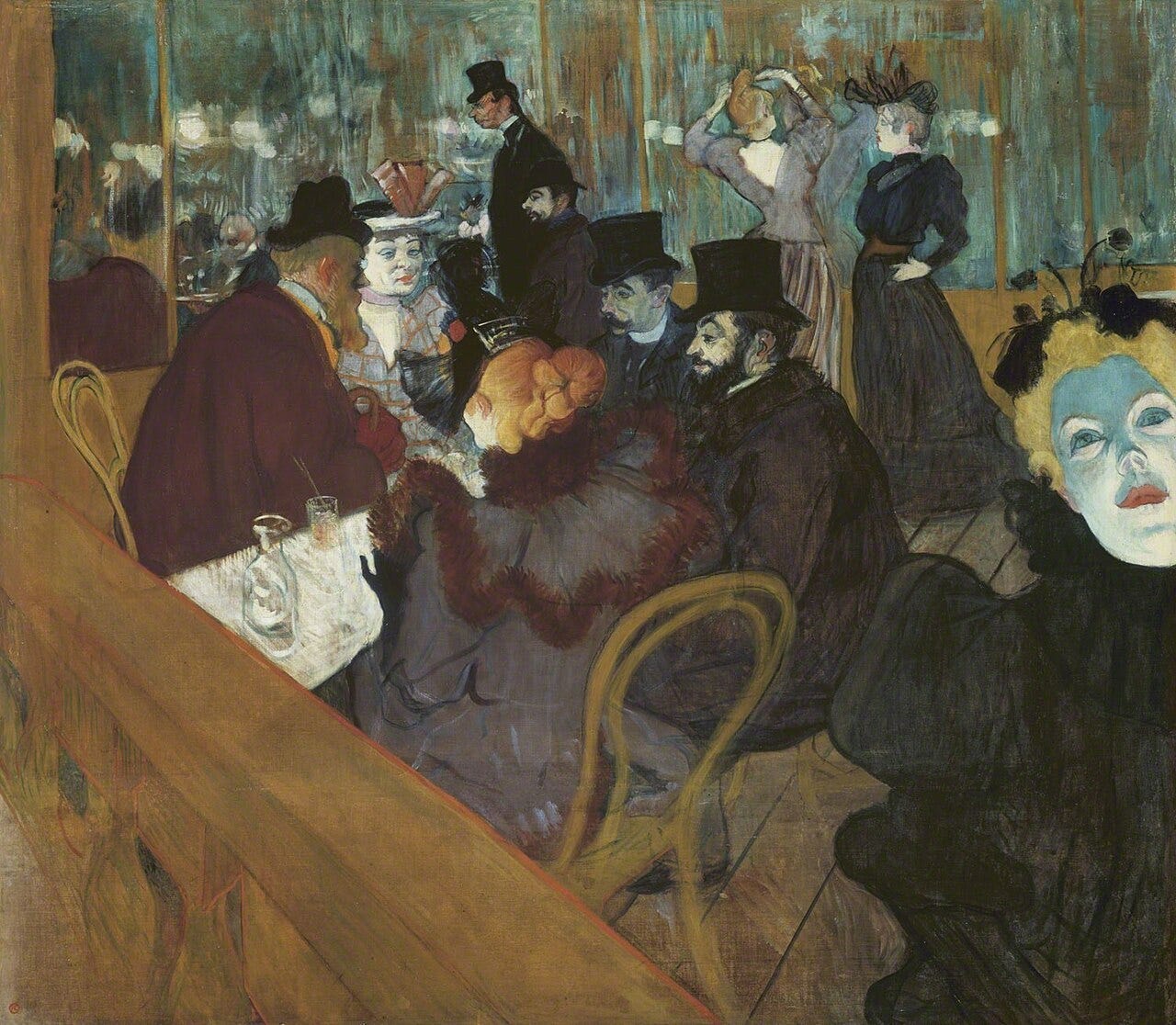
11. Henri de Toulouse Lautrec, At the Moulin Rouge (1892)

Toulouse Lautrec Moulin Rouge
Henri de Toulouse Lautrec, At the Moulin Rouge, about 1892, Art Institute of Chicago

Under harsh electric light, dancers, drinkers and a ghostly green faced woman fill a Montmartre nightclub. Henri de Toulouse Lautrec painted At the Moulin Rouge around 1892, living among the very people he put on the canvas.

Crippled by illness and mocked for his height, he found his true home in the cabarets of Paris and made their nightlife immortal. His flat colors and sharp, cropped angles came straight from Japanese prints and pointed toward modern design.

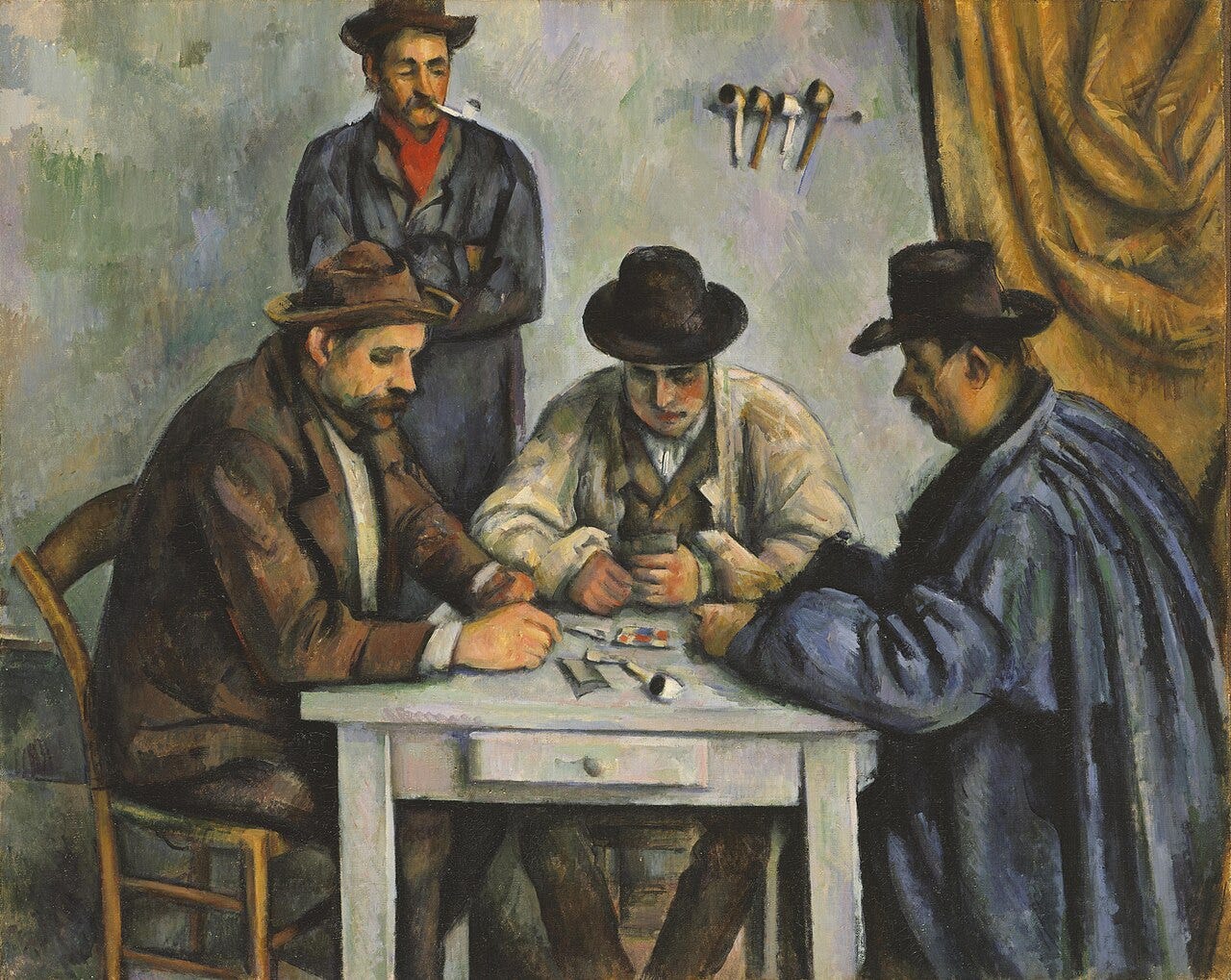
12. Paul Cezanne, The Card Players (about 1892)

Cezanne Card Players
Paul Cezanne, The Card Players, about 1892, Metropolitan Museum

A picture of two farm workers playing cards in silence became, a century later, one of the most expensive paintings on earth. Paul Cezanne painted The Card Players in the early 1890s, setting them solid and still as a cathedral, and there is nothing grand about the scene, which is exactly the point.

Cezanne broke objects into simple planes of color and rebuilt them like an architect, opening the door to Cubism and modern art. I make the case for him in is Cezanne the greatest painter, and one version of this quiet card game later sold for around two hundred and fifty million dollars.


Join 130,000 readers who get the secrets behind the paintings. Free.


Paris, and a few detours

  • Poussin, Et in Arcadia Ego, Gericault, The Raft of the Medusa, and Delacroix, Liberty Leading the People: the Louvre, Paris.

  • Fragonard, The Swing: the Wallace Collection, London.

  • Courbet, A Burial at Ornans, Millet, The Gleaners, and Manet, Le Dejeuner sur l'herbe: the Musee d'Orsay, Paris.

  • Seurat, A Sunday on La Grande Jatte: the Art Institute of Chicago.


If Paris pulled you in, keep going:


Two new stories a week, 130+ secrets unlocked. Start free.


French painting, a few quick questions

  • What is the most famous French painting? Delacroix's Liberty Leading the People and Manet's Le Dejeuner sur l'herbe are among the most famous, along with David's Death of Marat.

  • Why was Paris the center of art? For centuries the official Salon and the great academies were in Paris, so ambitious painters from all over the world came there.

  • Which French painting caused the biggest scandal? Manet's Le Dejeuner sur l'herbe of 1863, whose calm naked woman among dressed men shocked the Salon.

  • What movements began in France? Rococo, Realism, Impressionism, Pointillism and much of early modern art were all born or crowned in France.

  • What is the most expensive French painting? A version of Cezanne's The Card Players sold privately for around two hundred and fifty million dollars.

The city that kept changing the rules

Line them up and you can watch a country argue with itself for three hundred years. A duke wants a cheeky swing, a revolution wants a martyr, a village demands to be painted as grand as kings, and a naked woman at a picnic breaks the Salon in half.

What ties them together is the fight, since French painters kept refusing to leave art the way they found it. The proof is in the prices: a single quiet French card game, by a man Paris once laughed at, is now worth a quarter of a billion dollars.