Famous Fresco Paintings: 12 Painted Into Wet Plaster

A fresco is a painting made by brushing pigment straight into wet plaster, so the color dries into the wall itself and can last a thousand years.

Christ judging the world on the Sistine Chapel wall
Michelangelo, The Last Judgment, 1541

It is one of the oldest and most demanding ways to paint, done fast, in a race against the drying wall, with no room for mistakes. Here are twelve of the most famous fresco paintings, all now in the public domain.

I have picked the walls and ceilings that people still cross the world to stand beneath.


Learn art the fun way. Free stories every week, no boring lectures.


Three worth opening

Three that take a single painting apart, properly:


1. Michelangelo, The Last Judgment (1541)

On the towering back wall of the Sistine Chapel, Christ raises his arm to judge the world while the damned are dragged screaming down to hell.

Michelangelo painted it decades after the ceiling above, an older, angrier man, and filled it with more than three hundred writhing bodies.

He painted his own face onto a piece of flayed human skin held by a saint, a grim kind of signature. The nudes so scandalized the Church that a later painter was hired to add loincloths, earning him the nickname the breeches maker.

You can still see where those cover ups were painted straight into the fresco.

2. Giotto, The Lamentation (about 1305)

The dead Christ mourned by figures and angels
Giotto, The Lamentation, about 1305, Scrovegni Chapel

In a small chapel in Padua, Giotto painted the dead Christ laid across his mother's knees while angels wheel overhead, twisting in real grief.

This was something new around 1305, figures with weight and feeling instead of flat golden icons, and it began the whole march toward the Renaissance.

He covered the entire Scrovegni Chapel in scenes from the Bible, painted for a rich banker trying to buy his way out of the sin of lending money at interest.

Look at the sky and it is one unbroken sweep of deep blue, made from crushed lapis. Giotto was so admired that Dante wrote him into the Divine Comedy while both men were still alive.

3. Masaccio, The Tribute Money (about 1425)

Saint Peter shown three times paying a tax collector
Masaccio, The Tribute Money, about 1425

Saint Peter appears three times on one wall, pulling a coin from the mouth of a fish to pay a tax collector, all set in a real landscape with real light.

Masaccio painted it in a Florence chapel in his early twenties, before dying at about twenty seven, and every great painter of the age came to study it.

He was among the first to light a whole fresco as if from a single window, casting consistent shadows across solid, believable people. Leonardo, Michelangelo and Raphael all sketched these figures as students.

A fire in 1771 darkened the chapel for two centuries, until a cleaning in the 1980s brought the daylight back into the scene.

4. Raphael, The Triumph of Galatea (about 1512)

The sea nymph Galatea on a shell chariot pulled by dolphins
Raphael, The Triumph of Galatea, about 1512

Raphael covered a wall of a Roman banker's pleasure villa with the sea nymph Galatea skimming the waves on a shell chariot pulled by dolphins, ringed with tritons and cupids.

He painted it not for a church but for Agostino Chigi, the richest man in Rome, to decorate a riverside party house. Asked why his Galatea was so beautiful when no such woman existed, Raphael said he painted from an idea in his own head.

The whole scene spins around her in a perfect wheel of movement. It was one of the last things he painted entirely with his own hand before his busy workshop took over.


Join 130,000 readers who get the secrets behind the paintings. Free.


5. Fra Angelico, The Annunciation (about 1440)

The angel Gabriel bowing to the Virgin Mary in a plain room
Fra Angelico, The Annunciation, about 1440, San Marco

At the top of a staircase in a Florence monastery, the angel Gabriel bows to the Virgin Mary in a plain, quiet room, the whole scene washed in pale morning light.

Fra Angelico, a Dominican friar, painted it directly onto the wall of the monks' own living quarters, a picture meant only for the monks' own prayer.

He was said to weep every time he painted the crucifixion, and never picked up a brush without a prayer first. There is no gold and no crowd, just two figures and an empty garden, stripped to pure stillness.

The Church beatified him in 1982 and later named him the patron of artists.

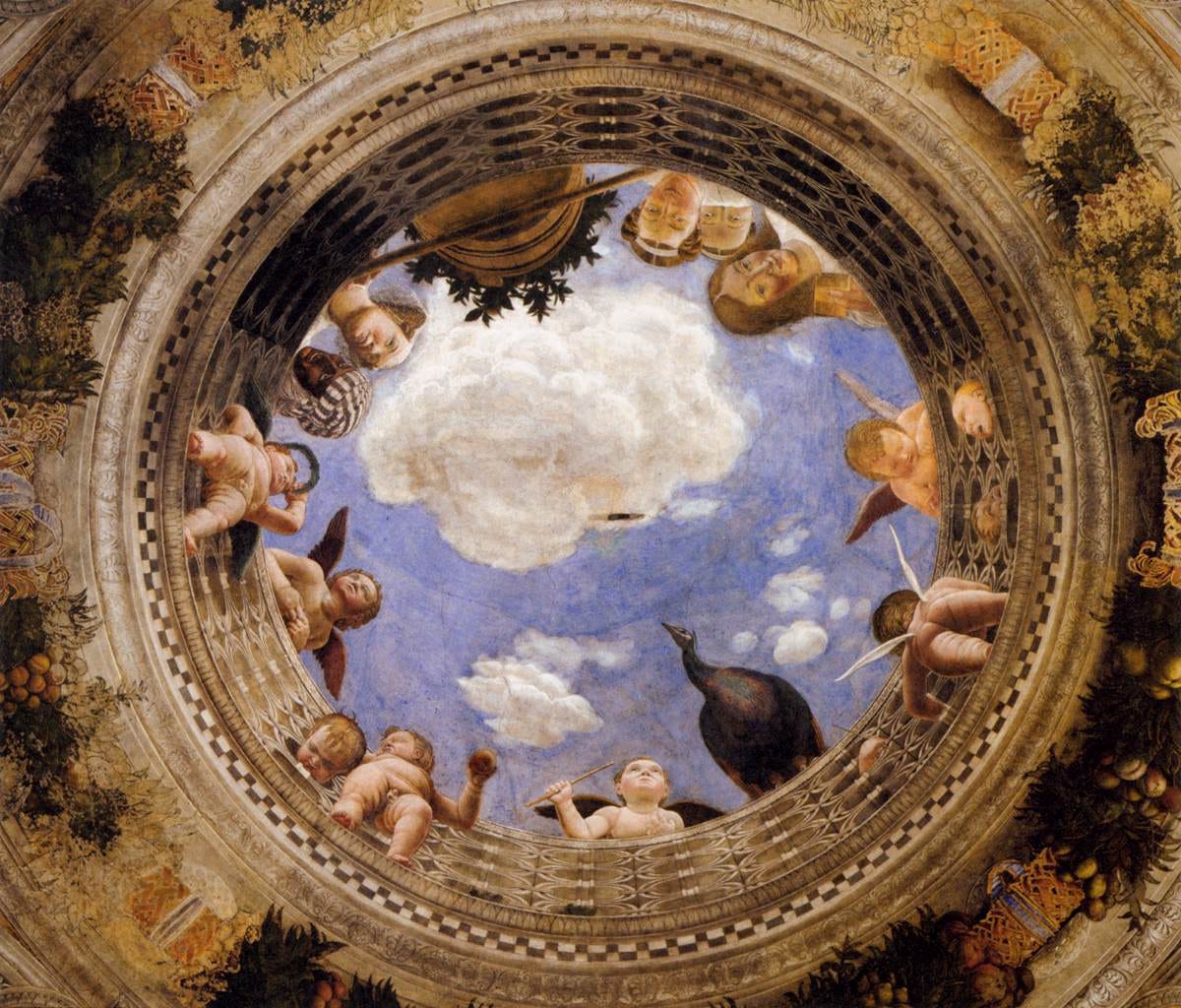
6. Andrea Mantegna, The Camera degli Sposi (about 1465 to 1474)

A painted ceiling opening to the sky with figures peering down
Andrea Mantegna, the ceiling oculus of the Camera degli Sposi, about 1474

Mantegna spent nine years turning a square room in a Mantua castle into a painted world, the ruling family lounging on the walls as if you had walked in on them.

Then he did something nobody had tried, painting the flat ceiling as an open hole to the sky, ringed with cherubs and grinning servants peering down at you.

It is the first painted ceiling to fool the eye into looking straight up into blue air. A potted plant balances on the painted rim, forever about to fall on your head.

Rulers across Italy sent artists to copy the trick for the next two hundred years.


130,000 people read this every week. Joining them costs nothing.


7. The Villa of the Mysteries, Pompeii (about 60 BC)

Roman figures in a ritual against a deep red wall
The frieze of the Villa of the Mysteries, Pompeii, about 60 BC

Long before the Renaissance, a Roman villa outside Pompeii was decorated with a frieze of near life size figures acting out a strange, secret ritual against a wall of deep red.

Nobody fully knows what the ceremony is, perhaps the initiation of a bride into the cult of the wine god Bacchus, complete with a flogging and a dance.

The villa was buried under ash when Vesuvius erupted in 79 AD, which is exactly why it survived. It was dug out in 1909 with the reds and the faces still fresh, and it is the most complete Roman wall painting anyone has ever found.

8. Piero della Francesca, The Legend of the True Cross (about 1460)

Still soldiers and figures in cool morning light
Piero della Francesca, from The Legend of the True Cross, about 1460

Across the walls of a church in Arezzo, Piero della Francesca painted the whole tangled legend of the wood of Christ's cross, from a branch on Adam's grave to a great victorious battle.

He filled it with silent, still soldiers and cool morning light, using the same geometry and perspective he wrote about in his math books.

One panel, the Dream of Constantine, is one of the first true night scenes in Western art, lit by a single descending angel.

The iconography is so dense that scholars still argue over who is who. Aldous Huxley once called the cycle the greatest painting in the world.

9. Correggio, Assumption of the Virgin (about 1526 to 1530)

A dome dissolving into open sky full of spiraling figures
Correggio, Assumption of the Virgin, about 1526 to 1530, Parma Cathedral dome

Look up into the dome of Parma Cathedral and the ceiling seems to dissolve into open sky, the Virgin spiraling upward through a tornado of tumbling saints and angels.

Correggio painted this dizzying swirl of foreshortened legs and clouds decades before anyone else dared. A local canon reportedly sneered that it looked like a hash of frogs' legs.

Later painters realized he had turned the ceiling into an infinite opening, and the whole Baroque age followed him upward. He was paid partly in a sack of small coins, and legend says the long walk home carrying it gave him the fever that killed him.


Two new stories a week, 130+ secrets unlocked. Start free.


10. The Bull Leaping Fresco, Knossos (about 1450 BC)

Three slim figures vaulting over a charging bull
The Bull Leaping Fresco, Knossos, about 1450 BC

The oldest painting on this list shows three slim figures vaulting clean over the back of a charging bull, painted on a palace wall on the island of Crete more than three thousand years ago.

The Minoans, a lost Bronze Age people, loved bright, flowing scenes of nature and sport, nothing like the stiff art of Egypt next door.

Whether the bull leaping was a real sport, a ritual, or a myth, nobody can say, since we still cannot read their writing.

The fresco was pieced back together from scattered fragments dug up around 1900, and its restorers guessed at the missing parts, so some of what you see is a modern painter's best guess.

11. Tiepolo, Apollo and the Four Continents (1752 to 1753)

A vast ceiling fresco of Apollo above the four continents
Tiepolo, Apollo and the Four Continents, 1752 to 1753, Wurzburg

Tiepolo painted the largest ceiling fresco in the world above the grand staircase of a German prince bishop's palace, the sun god Apollo surrounded by the four known continents shown as glamorous women riding animals.

As you climb the stairs the whole sky opens overhead, using the illusion painters call quadratura to make a flat ceiling soar into infinite air. He tucked an elephant, a crocodile and a portrait of himself into the crowd.

He painted the whole vast thing in about a year with his two sons at his side. When the palace was bombed in 1945, the ceiling somehow survived the fire raging below it.

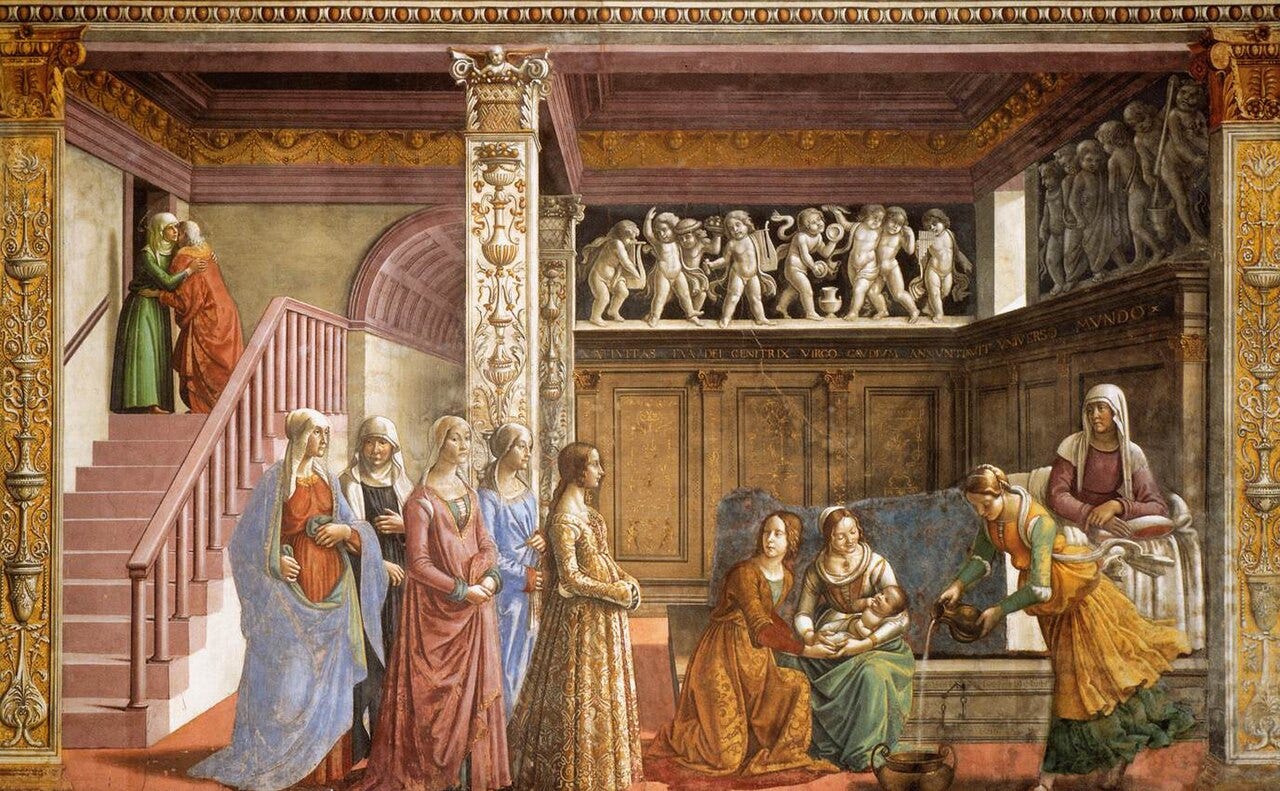
12. Ghirlandaio, The Birth of the Virgin (about 1490)

Florentine women visiting a newborn in a grand painted room
Ghirlandaio, The Birth of the Virgin, about 1490

Ghirlandaio filled a chapel in a Florence church with Bible scenes staged inside the grand homes of his own wealthy patrons, dressing holy stories in the latest Florentine fashion.

In the Birth of the Virgin, elegant young Florentine women in gold trimmed gowns arrive to visit the newborn, as if it were a society call. Ghirlandaio ran the busiest workshop in the city, turning out frescoes and painted panels alike.

A teenage apprentice named Michelangelo learned to paint on these very walls, and everything he knew about plaster he carried straight up to the Sistine ceiling.


The wet plaster questions people ask

  • What is a fresco? A painting made by brushing water based pigment into wet lime plaster, so the color becomes part of the wall as it dries.

  • Why are frescoes so hard to paint? The plaster dries in a few hours, so the artist must work fast, in sections, with no way to correct a mistake once it sets.

  • What is the most famous fresco? Michelangelo's Sistine Chapel ceiling, with The Creation of Adam, followed by Raphael's Vatican walls.

  • How long do frescoes last? A true fresco can survive for thousands of years, as the Minoan and Roman examples show, as long as the wall itself is protected.

  • Who revived fresco in modern times? Mexican muralists like Diego Rivera brought the wet plaster technique roaring back in the twentieth century.


If these walls pulled you in, you will love these too:


Paint that becomes the wall

A fresco cannot be moved, rolled up or sold at auction. It is stuck to the building it was made for, which is why seeing one means going to it, climbing the stairs, tipping your head back.

These artists gambled everything on a wall that had to be finished before it dried. A thousand years later, the gamble is still holding.