Famous Frida Kahlo Paintings: Her 12 Greatest Works

Frida Kahlo turned her own broken body and battered heart into some of the most unforgettable paintings of the twentieth century.

Calavera of Frida Kahlo

Confined to bed for months by a terrible accident, she painted mostly herself, her miscarriages, her love for Diego Rivera and her pride in Mexico, with a raw honesty no one had dared before.

These are twelve of her most famous paintings, each one a page torn from her own life. For the whole story of the woman, see the complete Frida guide; here, the paintings themselves.

I have chosen the twelve that made her a legend.


Learn art the fun way. Free stories every week, no boring lectures.


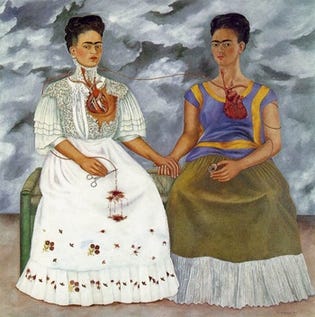
1. The Two Fridas (1939)

Two Fridas sit side by side holding hands, one in a white European wedding dress, the other in Mexican costume, their two hearts joined by a thin vein that drips blood onto the white lace.

She painted it just after her divorce from Diego Rivera, the two selves standing for the woman he loved and the one he left. One heart is whole and one is cut open, its artery clamped with a surgeon's tool to stop her bleeding to death.

It is her largest painting and one of the most piercing images of heartbreak ever made, a huge part of why she became so famous In 1947 the Mexican government bought it, the highest price her work had ever earned in her lifetime.

2. Self Portrait with Thorn Necklace and Hummingbird (1940)

Frida stares out dead level, a necklace of thorns cutting into her neck until it bleeds, a dead black hummingbird hanging from it like a grim pendant.

A black monkey and a cat sit on her shoulders, and huge leaves frame her like a saint in an altarpiece. Every object carries meaning, the thorns her suffering, the dead hummingbird a Mexican charm for luck in love turned bitter.

She painted it the year of her remarriage to Diego, pain and love knotted together as always. This self portrait she gave to her lover, the photographer Nickolas Muray, and it now hangs in his collection at a university in Texas.

3. The Broken Column (1944)

Toni Frissell Frida Kahlo, seated next to an agave

Frida stands alone in a cracked desert, her body split open to show a shattered stone column where her spine should be, her skin studded with nails and tears rolling down her calm face.

She painted it after yet another spinal operation, strapped for months into a punishing steel and leather brace like the one she wears in the picture.

As a teenager she had been broken apart in a horrific bus accident that left her in pain for the rest of her life. The single tears and the nails turn her private agony into something almost holy, a modern saint of suffering.

It hangs in Mexico City, painted the same year doctors first locked her into the steel corset she would wear until she died.

4. Self Portrait with Cropped Hair (1940)

Frida sits in a man's oversized dark suit, her long hair shorn off and scattered across the floor around her chair, the scissors still in her hand.

She painted it right after divorcing Diego, cutting off the long hair he had loved as an act of furious independence. Across the top she wrote the words of a Mexican song, look, if I loved you it was for your hair, now that you are bald I don't love you any more.

She had traded her bright Mexican dresses for a man's clothes, refusing for once to be anyone's beautiful wife. It hangs at the Museum of Modern Art in New York, and within the year she and Diego, the man she would marry all over again, had reconciled.


Join 130,000 readers who get the secrets behind the paintings. Free.


5. Henry Ford Hospital (1932)

Lille rue louis niquet frida kahlo

Frida lies naked and bleeding on a hospital bed floating in an empty industrial wasteland, six objects tied to her by red veins like balloon strings, chief among them a lost baby.

She painted it in Detroit after a miscarriage that devastated her, one of the first painters ever to show such an experience without shame.

The bed drifts alone against the smoking factories of a foreign city where she felt trapped and homesick. It was small, painted on metal, and unlike anything else hanging in a gallery of its day, and I tell the story of her whole heartbreaking life in the piece on the tragic life of Frida Kahlo She kept the little painting for herself, too raw to sell.

6. The Wounded Deer (1946)

Frida gives her own face to a young deer pierced by nine arrows, bleeding as it runs through a broken forest toward a stormy sea it will never reach.

She painted it after a spinal surgery in New York failed to end her pain, the arrows standing for a body and a hope shot full of holes.

The little deer is her pet fawn from the garden of her Blue House, given her own crowned head. This picture, one of her many strange and telling works, turns her body into a hunted animal.

She sent it to friends as a wedding gift with a bitter poem, a present of pain for a happy day.

7. Diego and I (1949)

Frida paints her own tear streaked face with the head of her husband Diego Rivera fixed on her forehead like a third eye, her hair wrapping around her throat as if to strangle her.

She made it while Diego was openly chasing the film star Maria Felix, and all of Mexico gossiped about it. Her love for Diego, she once said, was the second great accident of her life, after the bus.

The tiny portrait pours all that helpless jealousy into one small, shattering image. In 2021 it sold for nearly thirty five million dollars, a record for any Latin American artist.


Two new stories a week, 130 secrets unlocked. Start free.


8. Frida and Diego Rivera (1931)

Frida stands tiny beside the huge figure of Diego Rivera, holding his hand, a ribbon overhead naming them as newlyweds, painted in the plain style of an old Mexican wedding portrait.

She made it two years into a marriage that friends called the union of an elephant and a dove, so mismatched in size and temper. She casts herself as the dutiful wife at his side, though she was already a serious painter in her own right.

It was one of the first pictures the wider world saw of her, shown in San Francisco where the couple were then living. It hangs in San Francisco still, its stiff pose copied from a photograph taken at their 1929 wedding.

9. My Grandparents, My Parents, and I (1936)

A small Frida stands naked in the courtyard of her childhood home, holding a red ribbon that branches up into a family tree of floating portraits of her parents and grandparents.

She painted her own bloodline like a diagram, her Mexican mother on one side, her German father on the other, the two lines that made her.

A tiny unborn Frida floats inside her mother, and a seed sprouts in the earth, life beginning again. It hangs at the Museum of Modern Art, a portrait of the two bloodlines that met in the Blue House where she was born and later died, the home now kept exactly as she left it.

10. Self Portrait as a Tehuana (1943)

Frida wears the huge white lace headdress of a Tehuana woman from southern Mexico, its petals spreading like a flower, with a small portrait of Diego painted on her forehead.

The Tehuana costume, worn by proud women from a place where mothers rule, became her armor and her flag of Mexican pride. Even here, thinking always of Diego, his face is stamped on her mind like a brand she cannot remove.

The threads of the headdress spread out like roots, tying her to the earth and to him. It is one of the most reproduced of all her images, printed on everything from posters to shopping bags.


Two new stories a week, 130+ secrets unlocked. Start free.


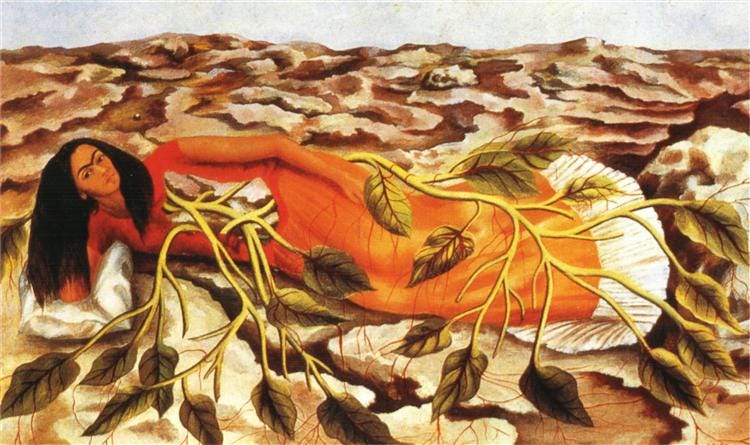
11. Roots (1943)

Frida lies on her side in a barren, cracked landscape, her chest opening to let a green vine grow out of her body, its leaves feeding blood back into the dry earth.

She painted this strange dream of herself as the source of life at a time when she could not have the child she longed for. Her body becomes a plant, rooted to the Mexican soil she loved, giving life even as her own drained away.

It is one of her most beautiful and mysterious pictures, at once about death and endless growth. In 2006 it sold for over five million dollars, then a record for the artist.

12. Marxism Will Give Health to the Sick (1954)
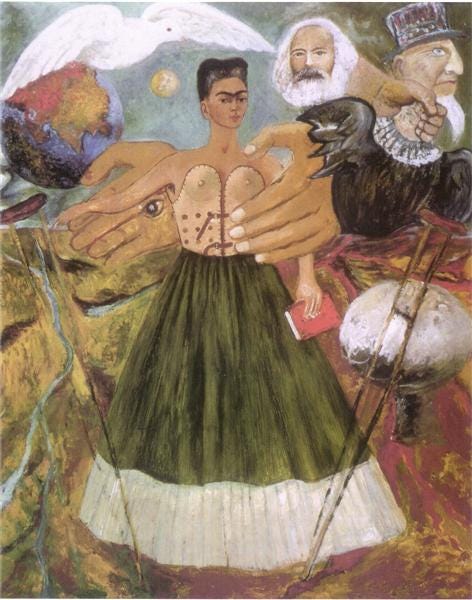
In one of her last paintings, Frida throws away her crutches and stands upheld by giant hands, a portrait of Karl Marx behind her while a huge hand chokes an American eagle.

Sick, in constant pain and near the end of her life, she poured her lifelong communism into this raw, unfinished picture of a political cure.

She had been a devoted communist since her youth, and believed the cause could heal both her country and her broken body. Her politics were as central to her as her pain, a red thread through her whole life.

She died within months of finishing it, and it hangs in her Blue House in Mexico City.


The wounds behind the pictures

  • What is Frida Kahlo's most famous painting? The Two Fridas from 1939 and her many searing self portraits are her best known works.

  • Why did Frida paint so many self portraits? Bedridden and often alone after her accident, she said she painted herself because she was the subject she knew best.

  • Was Frida Kahlo in a lot of pain? Yes, a teenage bus crash shattered her spine and pelvis, leaving her in pain and in and out of hospital her whole life.

  • Who was Frida Kahlo's husband? The muralist Diego Rivera, whom she married, divorced and married again, a stormy love at the heart of her art.

  • Are Frida Kahlo's paintings valuable? Yes, her Diego and I sold in 2021 for nearly thirty five million dollars, a record for any Latin American artist.


If these paintings pulled you in, you will love these too:


She painted her own truth

Frida Kahlo made her broken body and her broken heart the whole subject of her art, long before anyone called that brave. She hid nothing, not the blood, not the miscarriages, not the jealousy or the pain.

That total honesty is why, seventy years after her death, she speaks to more people than almost any other painter, alive or dead.

She turned her own suffering into something the whole world could recognize as its own.