Garden Paintings: 12 Famous Painted Gardens in Art

A garden painting is never just flowers. From Bosch nightmare paradise to Monet water lilies, artists used the garden as a stage for pleasure, temptation, private grief, and the pure problem of painting light on leaves.

The garden is one of the oldest ideas in art. It is Eden, it is escape, it is the one bit of nature a person can control. Some painters filled it with sin, some with sunlight, some with their own back yard.

  • The garden as paradise: from Eden onward, a walled garden stands for innocence, pleasure, and the world before the fall.

  • A private world made public: many of these gardens are the artist own back yard, painted as an intimate diary.

  • A laboratory for light: the Impressionists used gardens to chase sunlight through leaves, the hardest thing in paint to catch.

  • Flowers that carry a message: sunflowers, lilies and roses are rarely just decoration. They often stand for love, death, or faith.

If these draw you in, you will also love the secret behind Monet Magpie, inside Monet house, room by room, and 7 secrets hidden in famous paintings.


Learn art the fun way. Free stories every week, no boring lectures.


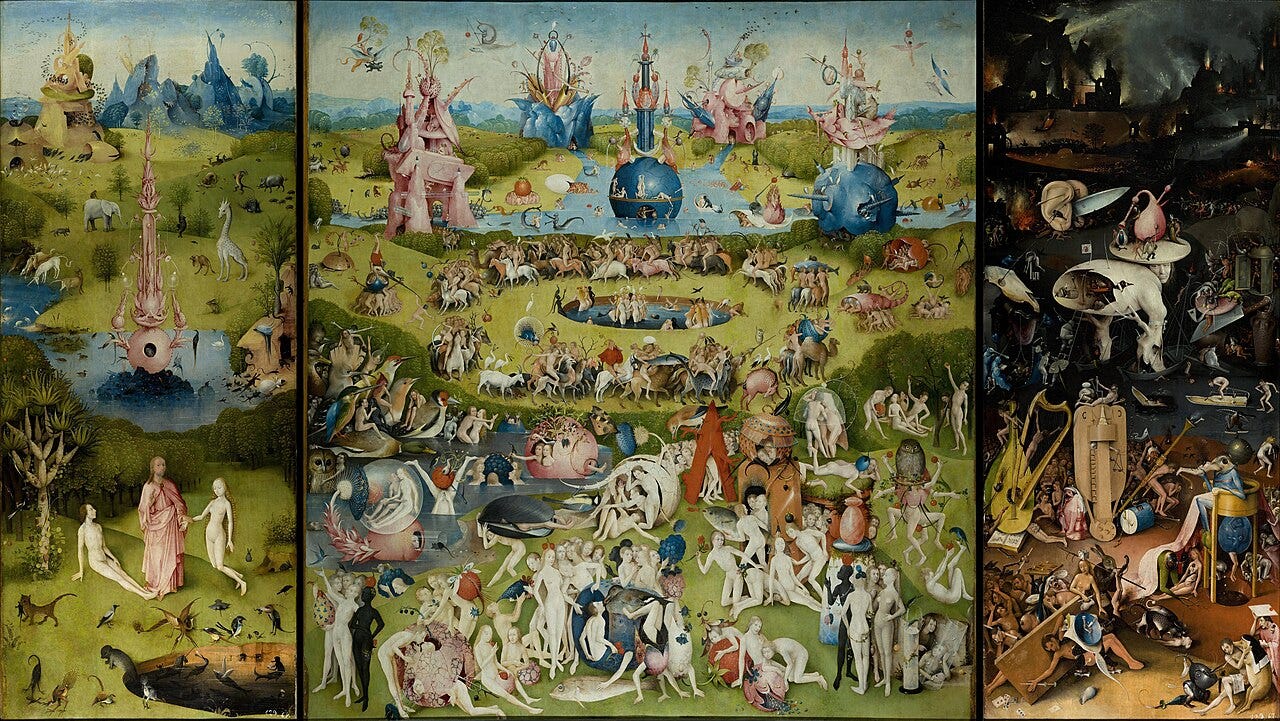
1. Bosch, The Garden of Earthly Delights

A three panel garden running from Eden to a swarming paradise to hell
Hieronymus Bosch, The Garden of Earthly Delights, about 1495 to 1505. Museo del Prado, Madrid.

Painted around 1495 to 1505, this three panel work runs from Eden on the left, through a garden swarming with nude figures and giant fruit, to hell on the right.

It is not really a garden of joy. The central panel is a warning, a swollen fantasy of lust and folly that pours straight into the burning panel beside it.

One tiny figure has music notes written across his backside. Someone transcribed and recorded that butt song from hell, and it went viral centuries after Bosch died.

2. Fragonard, The Swing

A woman on a swing in a lush garden as a young man watches from the bushes
Jean Honore Fragonard, The Swing, about 1767 to 1768. Wallace Collection, London.

Painted around 1767 to 1768, a young woman swings high in a lush garden while a young man hidden in the bushes below looks straight up her billowing skirts.

The setup was requested by a patron who wanted himself painted gazing up at his mistress. An older churchman pushes the swing behind, oblivious, part of the joke.

Her pink slipper flies off her foot in midair. That flung shoe, a wink at lost virtue, has become the most quoted detail in all of Rococo painting.

3. Monet, The Garden at Sainte Adresse

A seaside terrace of red and white flowers with sailboats beyond
Claude Monet, The Garden at Sainte Adresse, 1867. Metropolitan Museum of Art, New York.

Painted in 1867 at his family seaside terrace in Normandy, figures sit among beds of red and white flowers as sailboats pass on a flat blue sea.

Monet packed the terrace with brilliant color and cut the composition into flat bands, a debt to the Japanese prints he collected obsessively.

He was broke and dependent on family that summer, painting relatives who disapproved of his career. The Met bought this bright, happy scene in 1967.

4. Monet, The Water Lily Pond

A green Japanese footbridge over a pond thick with lilies
Claude Monet, The Water Lily Pond, 1899. National Gallery, London.

Painted in 1899 at Giverny, a green Japanese footbridge arches over a pond thick with lilies, everything dissolving into reflection.

Monet built this pond and bridge himself, diverting a river and fighting local officials who feared his strange plants would poison the water.

He painted the bridge dozens of times. By the end of his life the lilies had swallowed his art entirely, filling canvases meters wide with almost nothing else.

5. Manet, The Monet Family in Their Garden at Argenteuil

Monet wife and son on the grass while Monet tends flowers nearby
Edouard Manet, The Monet Family in Their Garden at Argenteuil, 1874. Metropolitan Museum of Art, New York.

Painted in 1874, Monet wife Camille and their son sit on the grass while Monet himself tends flowers just out of frame, a rooster and hen nearby.

This was a friendly duel. Renoir showed up the same afternoon and painted the exact same scene, so two versions of this garden exist by two different hands.

Monet later teased that Manet, watching him work, muttered that Monet had no talent and should give up. They stayed close friends anyway.

6. Pissarro, Kitchen Garden at the Hermitage, Pontoise

Workers gathering crops in a plain vegetable garden in autumn light
Camille Pissarro, Kitchen Garden at the Hermitage, Pontoise, 1874. Scottish National Gallery, Edinburgh.

Painted in 1874, the year of the first Impressionist show, workers gather crops in a working vegetable garden under soft autumn light.

This is no pleasure garden. Pissarro chose a plain kitchen plot, cabbages and rows and labor, and treated ordinary rural work as worth a serious canvas.

He had fled to London in 1870 during the war, and returned to find many early paintings destroyed. Works like this one rebuilt his career from the ground up.

7. Sargent, Carnation, Lily, Lily, Rose

Two girls lighting paper lanterns at dusk in a garden of lilies and roses
John Singer Sargent, Carnation, Lily, Lily, Rose, 1885 to 1886. Tate Britain, London.

Painted in 1885 to 1886, two girls in white light paper lanterns at dusk in an English garden thick with lilies, roses and carnations.

Sargent could only work a few minutes each evening, in the exact fading light he wanted. He painted the same twilight moment night after night for months.

The odd title comes from the chorus of a popular song of the day. The finished picture made Sargent name in England after Paris had turned on him.

8. Childe Hassam, Celia Thaxter Garden

A wild seaside garden of red poppies spilling toward the ocean
Childe Hassam, Celia Thaxter's Garden, Isles of Shoals, Maine, 1890. Metropolitan Museum of Art, New York.

Painted in 1890 on Appledore Island off the Maine coast, a wild seaside garden of red poppies and larkspur spills toward the ocean.

The garden belonged to the poet Celia Thaxter, who ran a salon for artists and writers. Hassam spent summers there and painted her flowers for years.

Thaxter died in 1894 and the island hotel later burned. The garden was eventually replanted from her own book about it, so visitors can walk the scene Hassam painted.


Join 130,000 readers who get the secrets behind the paintings. Free.


9. Klimt, Farm Garden with Sunflowers

A dense square wall of flowers and sunflowers edge to edge
Gustav Klimt, Farm Garden with Sunflowers, 1907. Belvedere, Vienna.

Painted around 1907 during a summer on Lake Attersee, a dense wall of flowers and sunflowers fills the entire square canvas edge to edge.

This is Klimt without the gold. On his lake holidays he dropped the glowing portraits and painted flowers as a flat, crowded tapestry, closer to Impressionism.

The tall sunflowers stand almost like figures. Critics have long noted they echo the poses of the women in his famous gold portraits.

10. Caillebotte, The Orange Trees

A man reading in the shade among potted orange trees
Gustave Caillebotte, The Orange Trees, 1878. Museum of Fine Arts, Houston.

Painted in 1878 at the family estate at Yerres, the artist brother reads in the shade while a cousin stands among potted orange trees and gravel paths.

Caillebotte painted this one outdoors, on the spot, which was unusual for him. Most of his famous city scenes were built carefully in the studio.

He was rich, and mostly known in his lifetime as the man who bought and rescued his friends Impressionist paintings. Only decades later was he taken seriously as a painter.

11. Sorolla, The Garden of the Sorolla House

Sunlight flooding tiled fountains and flowerbeds
Joaquin Sorolla, The Garden of the Sorolla House, about 1916 to 1920. Museo Sorolla, Madrid.

Painted between roughly 1916 and 1920, sunlight floods the tiled fountains and flowerbeds of the garden Sorolla designed at his own Madrid home.

He built the garden before he painted it, modeling it on the Alcazar of Seville and the Alhambra of Granada, two Andalusian gardens he loved and studied.

A cataloguer counted 28 views of this single garden. Sorolla painted his own back yard in every season and hour until a stroke ended his work.

12. Sorolla, Louis Comfort Tiffany

The designer in white in his own lush Long Island garden
Joaquin Sorolla, Louis Comfort Tiffany, 1911. Hispanic Society of America, New York.

Painted in 1911, the American designer Louis Comfort Tiffany sits in a white suit in his own lush Long Island garden, surrounded by banks of flowers and a small dog.

Two garden lovers met here. Tiffany, famous for his colored glass, sits inside a garden he grew himself, painted by an artist obsessed with the same riot of color and light.

The picture stayed in the United States and hangs at the Hispanic Society in New York, a rare Sorolla garden portrait outside Spain.

Where to see them

  • Metropolitan Museum of Art, New York: Monet The Garden at Sainte Adresse, Manet The Monet Family in Their Garden, and Hassam Celia Thaxter Garden.

  • London: Fragonard The Swing (Wallace Collection), Monet The Water Lily Pond (National Gallery), and Sargent Carnation, Lily, Lily, Rose (Tate Britain).

  • Museo del Prado, Madrid: Bosch The Garden of Earthly Delights.

  • Edinburgh and Vienna: Pissarro Kitchen Garden (Scottish National Gallery) and Klimt Farm Garden with Sunflowers (Belvedere).

  • Farther afield: Caillebotte The Orange Trees (Houston) and Sorolla The Garden of the Sorolla House (Madrid).

What a painted garden is really about

Many are Impressionist works, where the garden was a laboratory for chasing sunlight through leaves in loose, quick paint.

Others reach back to iconography of Eden and paradise, and Fragonard turns his garden into a Rococo stage for flirtation.

Gardens in art, questions people ask

  • What does a garden usually mean in a painting? Often paradise or Eden, sometimes temptation, and very often the artist own private world, painted as a personal diary.

  • Which is the most famous garden painting? Monet water lily and Japanese bridge scenes from Giverny are the best known, alongside Bosch Garden of Earthly Delights.

  • Is Bosch Garden of Earthly Delights a happy garden? No. The central garden of pleasure is a warning about lust and folly, and it flows directly into a panel of hell.

  • Did Monet really build his own garden? Yes. He designed the pond, bridge and plantings at Giverny himself, then painted them for the rest of his life.

  • Where can I see the most garden paintings together? The Metropolitan Museum of Art in New York holds Monet Garden at Sainte Adresse, Manet Monet Family in Their Garden and Hassam Celia Thaxter Garden.

The garden that was planted twice

Most gardens on this list are long gone, torn up or built over. Celia Thaxter is the exception. Her wild flower plot on Appledore Island, the one Hassam painted through the summers of the 1890s, vanished after she died in 1894 and the island hotel burned. Then someone found her book, An Island Garden, where she had written down every seed and row. Volunteers used it to replant the whole thing. Today you can stand on that same rock in Maine, in the same poppies Hassam painted, because a poet wrote her garden down before it disappeared.


Two new stories a week, 130 secrets unlocked. Start free.