
Gauguin is remembered as the Paris stockbroker who left for the South Seas. His paintings hold smaller and stranger stories than that legend. In a Breton village, a hotel keeper saw her own portrait and asked him to take it away. Far off in the Marquesas, a friend who had died years earlier turns up again, now with claws.
Cool Stories About Art is a newsletter to learn art the fun way.
Join 200,000+ readers and get:
10 new art stories / month
The entire archive of content (140+ articles)
Comment, ask questions, and chat with other readers
From the Stock Exchange to the Marquesas
Gauguin started out as a stockbroker in Paris who painted on Sundays. Painting full time meant giving up that income, and then it meant moving again and again: to Brittany, to Arles, back to Brittany, then to Tahiti and at last to the Marquesas Islands.
The change of place brought a change of method. He stopped copying the view in front of him. By 1888, in Brittany, he was laying flat areas of strong color inside dark outlines, and later, back in Paris, he could paint Tahiti without having it before his eyes.
The twelve canvases chosen here follow that whole road. The earliest belongs to his stockbroker years, the latest to the Marquesas, in 1902, and the Brittany and Tahiti pictures he is best known for fall in between.
12. La Belle Angèle (1889)
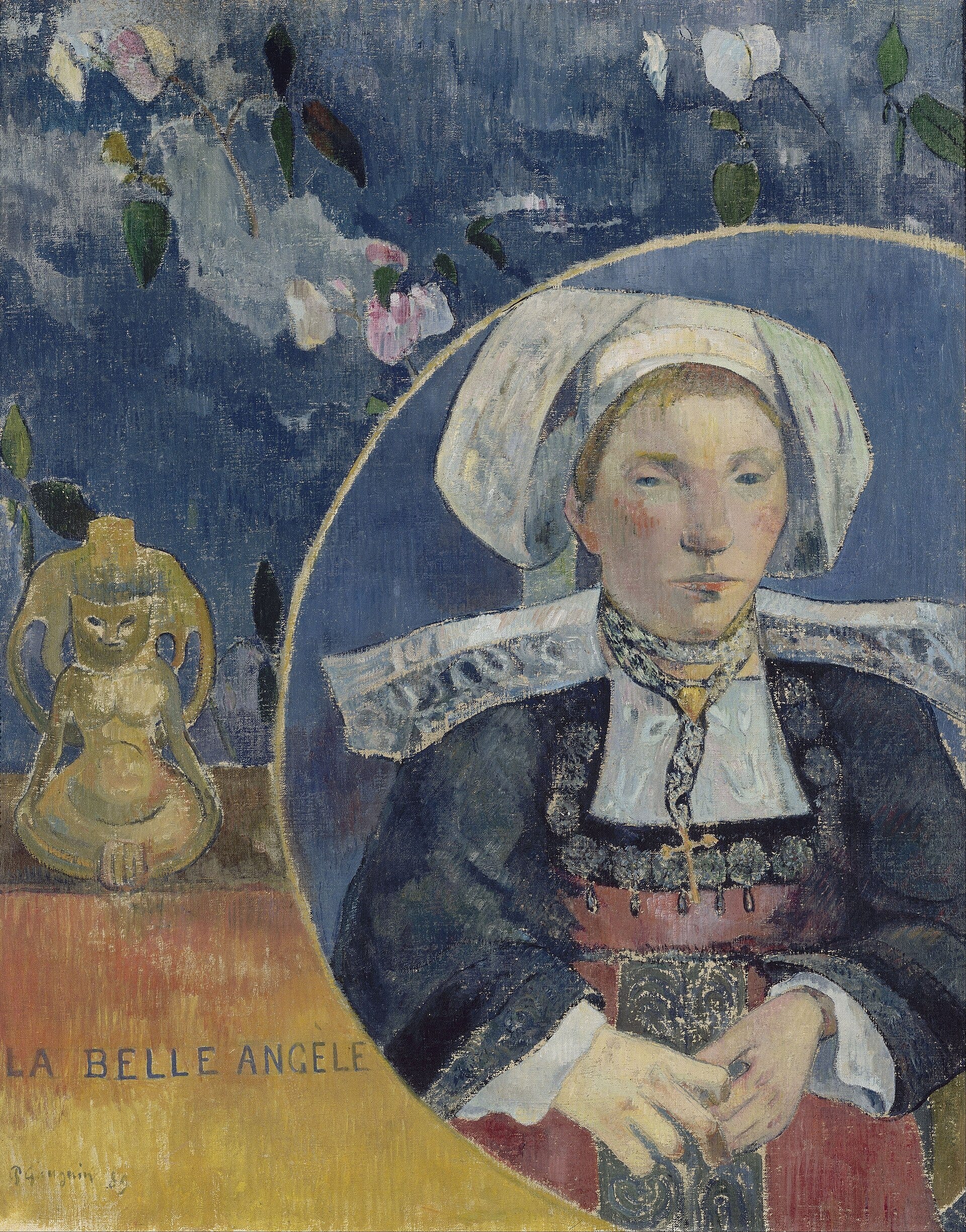
A woman dressed in black sits inside a circle laid over a flat blue ground scattered with flowers. Her hands are folded, a white lace headdress frames her face, and below the circle the canvas spells out her name in capitals: La Belle Angèle, the beautiful Angèle.
Gauguin painted her in 1889 at Pont-Aven, the Breton village he kept returning to from 1886. He had learned his trade under the Impressionist painter Camille Pissarro, in small strokes with soft edges. In this portrait he drops them. Dark lines ring the figure, the color lies flat, and the background is pure decoration, as in a Japanese print.
The sitter, Marie Angélique Satre, ran a hotel in the village and was said to be one of the most beautiful women in the area. Around 1920 she described the sittings, and she remembered Gauguin as "very sweet and very miserable."
Then he showed her the finished canvas. She cried out "How horrible!" and asked him to take it away. Gauguin, saddened, told her he had never painted a better portrait.
Part of the shock may have come from what sat beside her. To the left of the circle, Gauguin had placed a squat pottery figure in a Peruvian style, a foreign idol next to a woman in Breton dress. He had spent part of his childhood in Lima.
At a Glance
Artist: Paul Gauguin (1848 to 1903)
Painted: 1889, Pont-Aven
Medium: Oil on canvas
Size: 92 × 73.2 cm (36 1/4 × 28 7/8 in)
Where to see it: Musée d'Orsay, Paris
11. Study of a Nude, or Suzanne Sewing (1880)
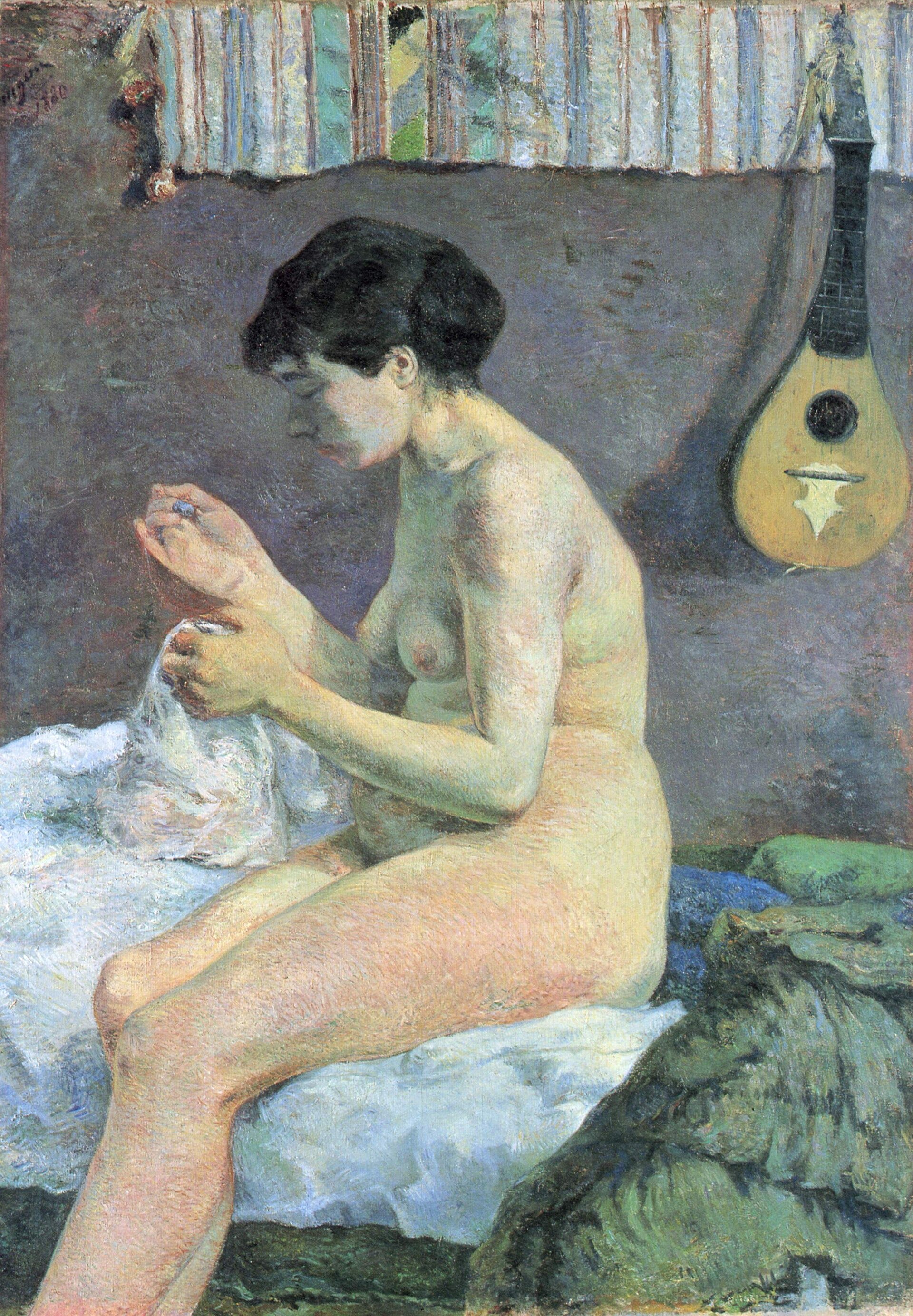
Bent over the linen she is mending, a young woman sits naked on a rumpled bed, against a mauve wall where a mandolin hangs. In 1881, at an exhibition in Paris, one of the toughest critics in the city singled this canvas out for praise. Its painter spent his weekdays at the stock exchange.