
Famous German paintings run from Albrecht Dürer's self portrait in 1500 to Caspar David Friedrich's fog covered cliffs three centuries later, and together they trace how German painting moved from religious devotion to the birth of a national feeling.
In 30 seconds:
10 paintings, from Dürer's Self Portrait at 28 (1500) to Friedrich's Chalk Cliffs on Rügen (about 1818).
Dürer appears three times: his self portrait, his watercolor Young Hare, and his panel Adam and Eve.
Friedrich appears twice, both painted around the same year, after his honeymoon trip to the Baltic coast.
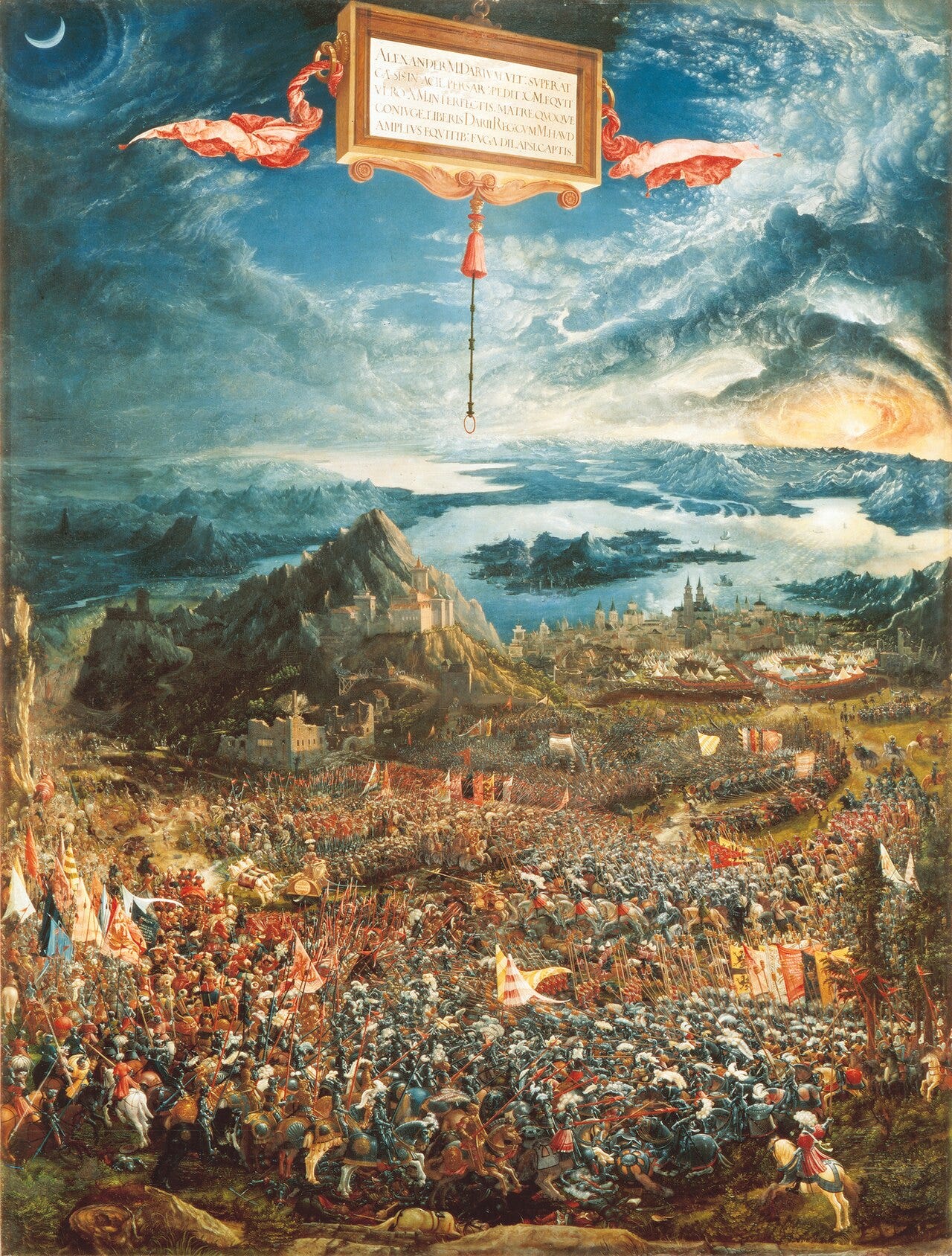
Napoleon personally had Altdorfer's Battle of Alexander at Issus taken from Munich and hung it in his own quarters.
Holbein's Ambassadors hides a skull that only appears when you view the canvas from a sharp angle to the right.
How German painting changed:
The devotion. Grünewald painted Christ's wounds to match the disease his hospital's patients suffered from.
The self. Dürer painted his own face the way earlier painters had only painted Christ.
The nation. Friedrich's wanderer wears an outfit tied to German nationalist politics of his own era.
The eye. Holbein hid a distorted skull that only resolves into shape from one exact angle.
1. Albrecht Dürer, Self Portrait at 28 (1500)
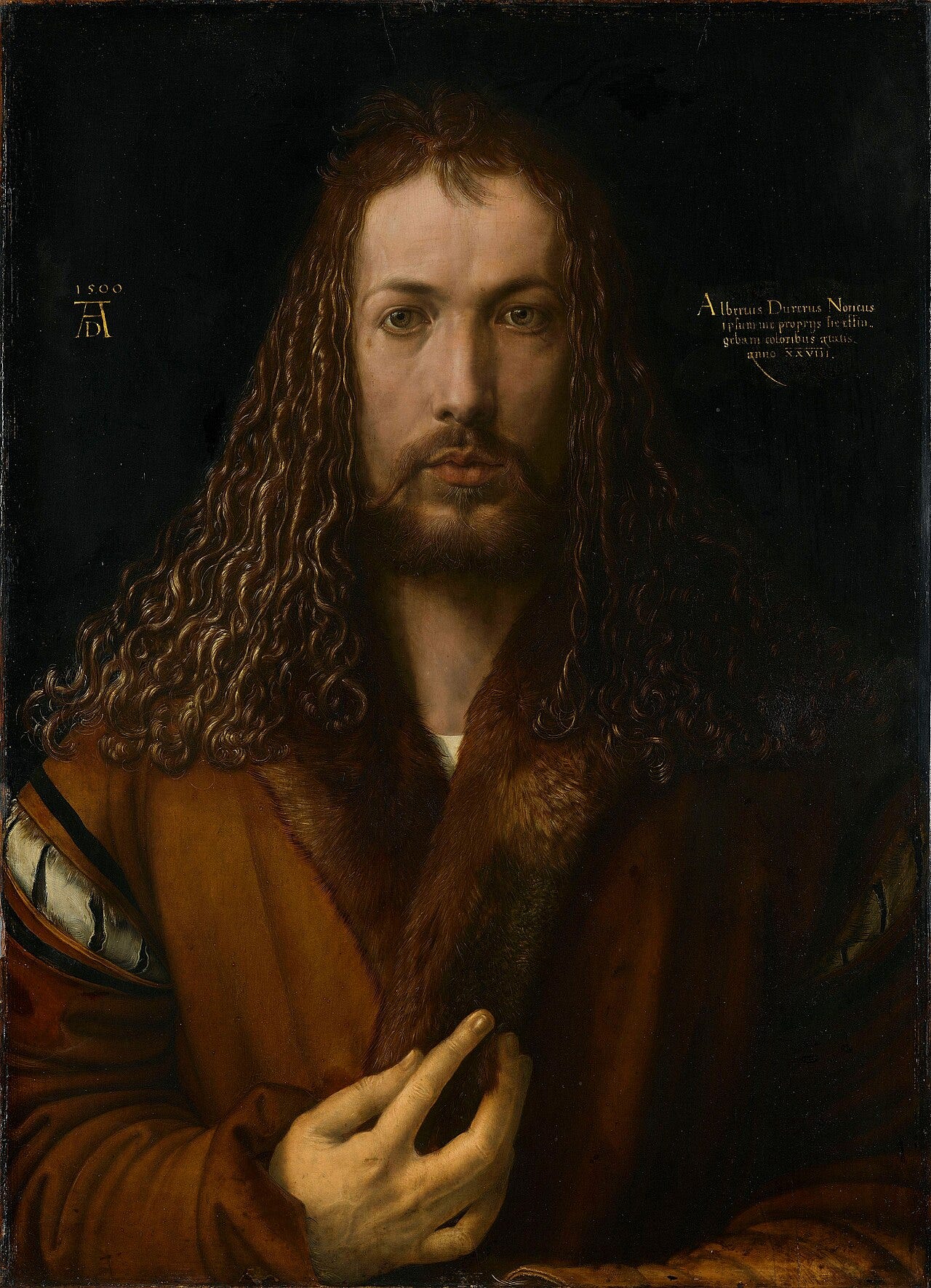
Dürer stares straight out of the panel, one hand raised near his chest in a gesture painters had reserved for depictions of Christ.
He finished it in Nuremberg early in 1500, the last of three self portraits he painted before turning thirty.
No German painter before him had shown himself this way. The panel is oil on lime wood, and it still hangs in the Alte Pinakothek in Munich, the same museum that also holds Altdorfer's Battle of Alexander.
2. Albrecht Dürer, Young Hare (1502)

A single hare sits still, its fur built hair by hair, one eye catching the reflection of a window.
Dürer painted it in watercolor and bodycolor, a technique usually kept for quick studies, and finished it like a full picture instead.
The hare still lives at the Albertina in Vienna, and the museum shows the original only a few weeks a year to keep the paper from fading in the light.
3. Albrecht Dürer, Adam and Eve (1507)
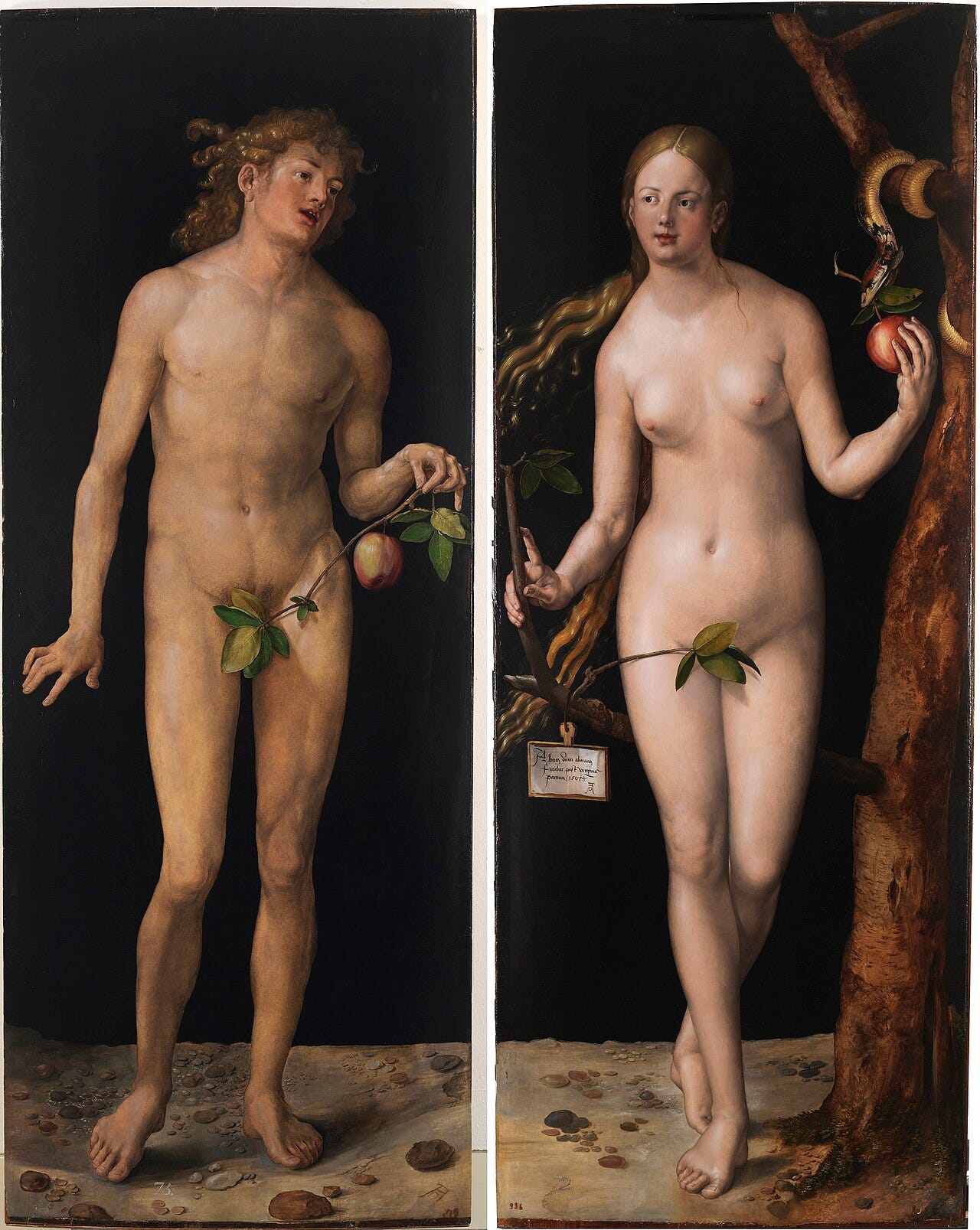
Adam and Eve stand at full human scale, the first pair of life sized nudes painted in Germany.
Dürer had just returned from a second trip to Venice, and the balance of the two bodies shows what he had studied there about proportion.
The panels traveled further than most Renaissance paintings. They hung in Prague Castle, were taken by Swedish troops during the Thirty Years War, and were given to the king of Spain in 1654, which is how they reached the Prado in Madrid.
4. Matthias Grünewald, Isenheim Altarpiece, Crucifixion panel (about 1512 to 1516)
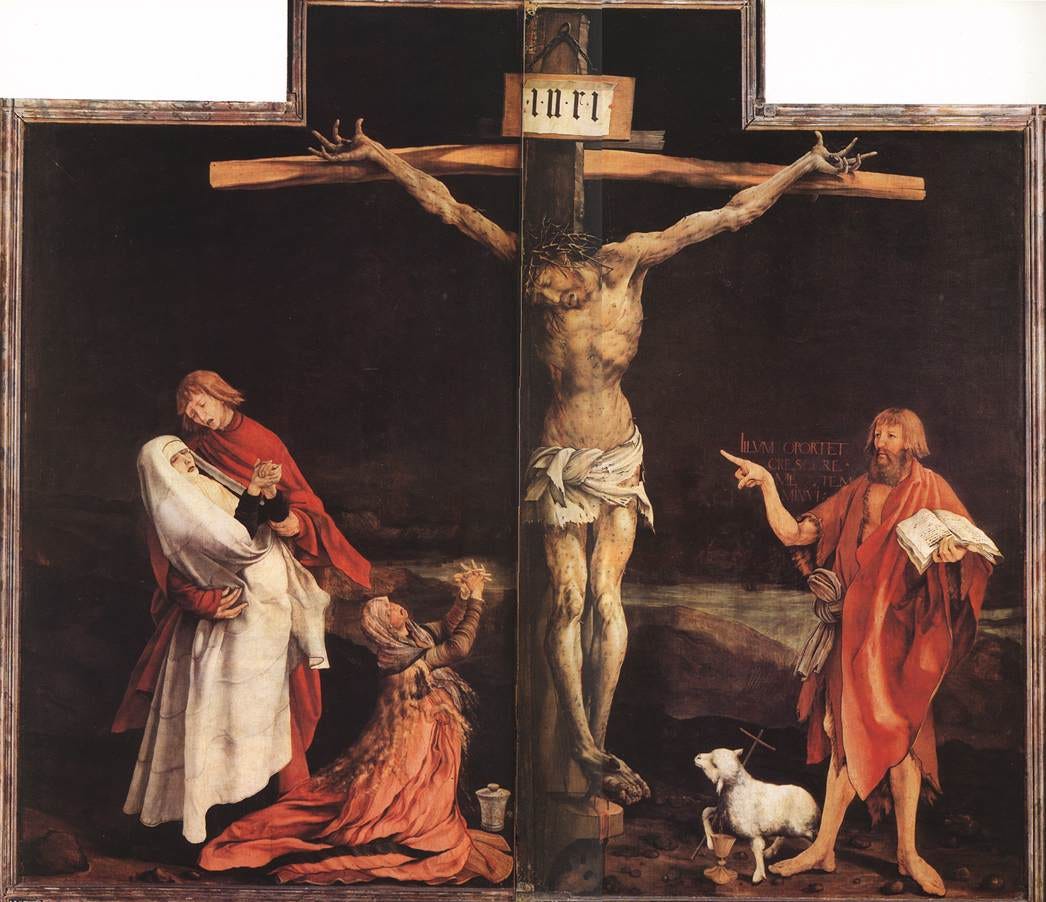
Christ's body on this cross is covered in sores and lesions, painted with a precision that has nothing to do with beauty.
Grünewald built the altarpiece for a monastery hospital that treated ergotism, a disease that caused burning skin and gangrene.
Patients praying in front of it saw a Christ who suffered exactly as they did. The altarpiece still hangs in Colmar, at the Musée Unterlinden, close to where it was painted.
5. Albrecht Altdorfer, The Battle of Alexander at Issus (1529)
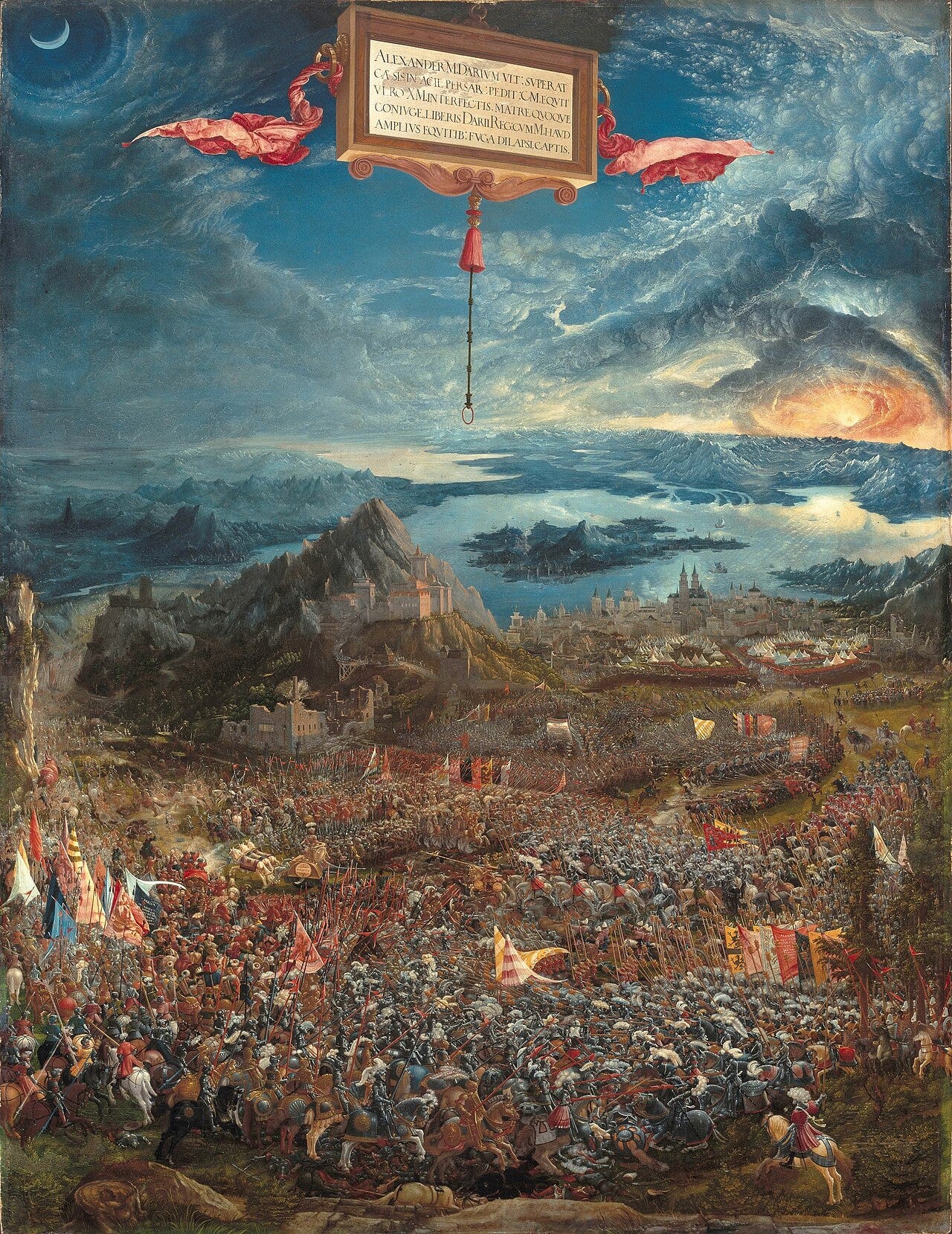
Thousands of tiny soldiers clash under a sky where the sun and moon both appear, as if the whole cosmos were taking sides.
The panel shows Alexander the Great defeating Darius III at Issus in 333 BC, a battle Altdorfer never saw, restaged in the armor of his own century.
In 1800 Napoleon had the painting taken from Munich and hung in his own quarters at Saint Cloud, reportedly his bathroom, out of his fascination with Alexander. Bavaria got it back in 1815.
6. Lucas Cranach the Elder, Portrait of Martin Luther (1529)
Cranach painted Luther more than once from a workshop that turned out portraits and altarpieces across Reformation Germany. That workshop is the subject of Lucas Cranach the Elder, The Complete Story.
Luther looks out in three quarter view, plain and direct, without any papal ornament around him.
Cranach was Luther's friend and neighbor in Wittenberg, and he stood in as the go between for Luther's own marriage negotiations.
His workshop repeated this portrait so many times that Cranach's version, more than any other, became the face people still picture when they hear Luther's name.
7. Hans Holbein the Younger, The Ambassadors (1533)
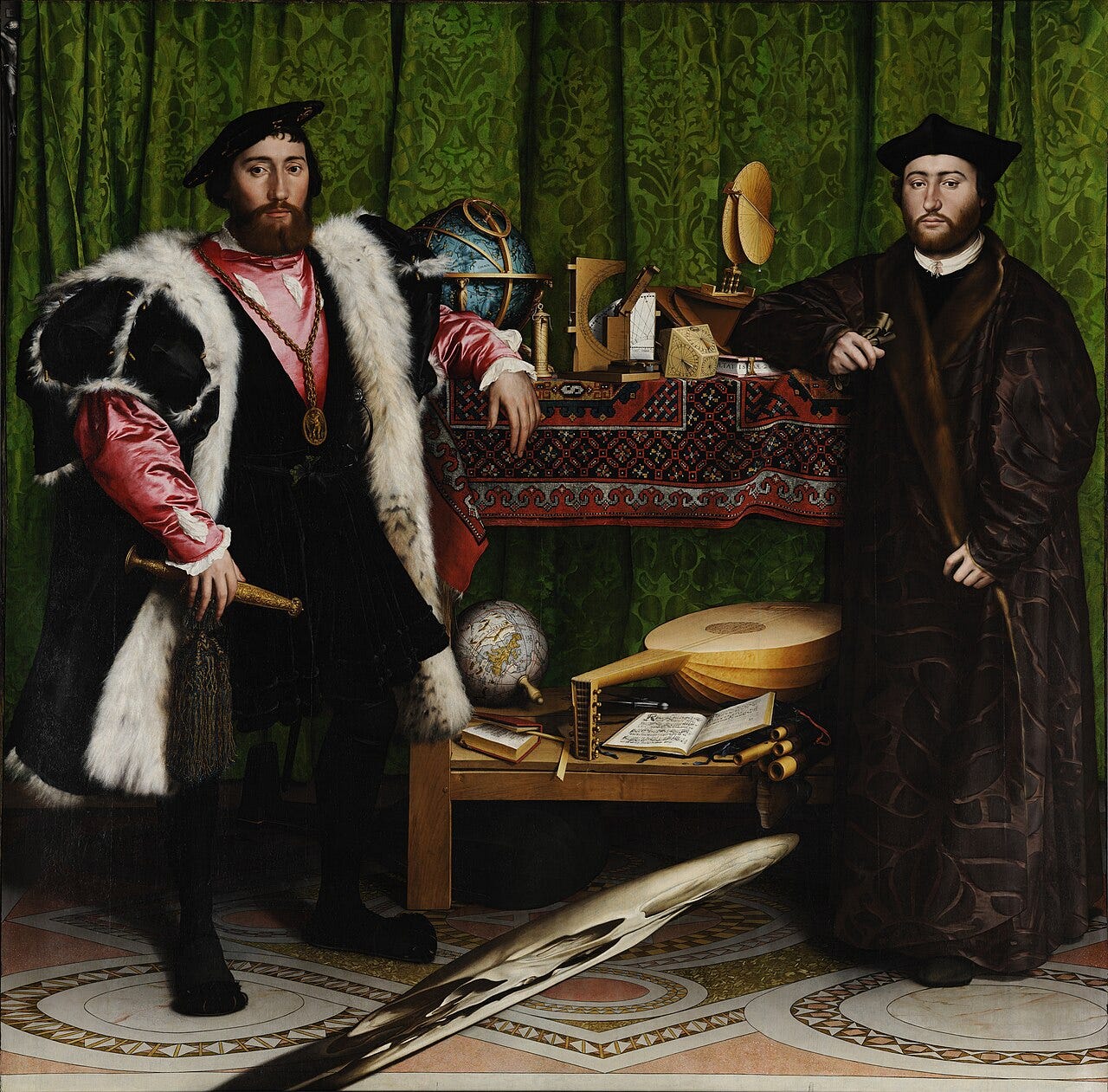
Two French diplomats stand among globes, lutes, and instruments for measuring the stars, the full toolkit of a learned man in 1533.
A gray smear stretches across the floor at their feet. Seen straight on, it reads as nothing at all.
Seen from a sharp angle to the right, the smear resolves into a human skull, a reminder of death invisible from where anyone would normally stand. It hangs today at the National Gallery in London.
I go detail by detail through this painting in The Ambassadors: Holbein’s Secret Detail-by-Detail.
8. Philipp Otto Runge, The Hülsenbeck Children (1805 to 1806)
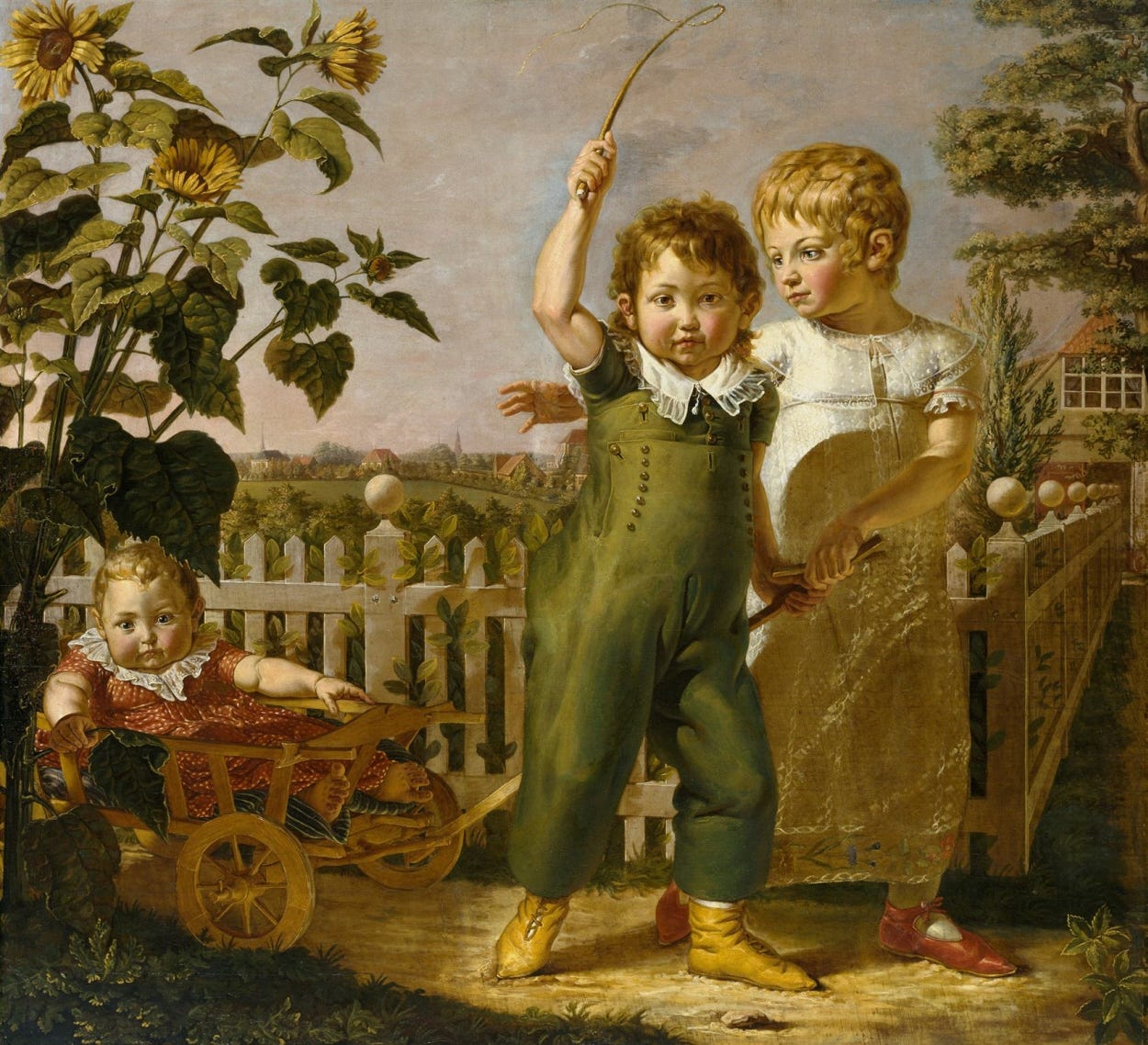
Three children play in a Hamburg garden, painted at their own eye level instead of looking up toward an adult.
A Hamburg merchant named Friedrich August Hülsenbeck commissioned the portrait of his own children, then aged five, four, and two.
German portraiture had usually shown children as small adults. Runge painted them at their own height, doing their own thing, closer to how children are actually seen today. It hangs at the Hamburger Kunsthalle.
9. Caspar David Friedrich, Wanderer above the Sea of Fog (1818)
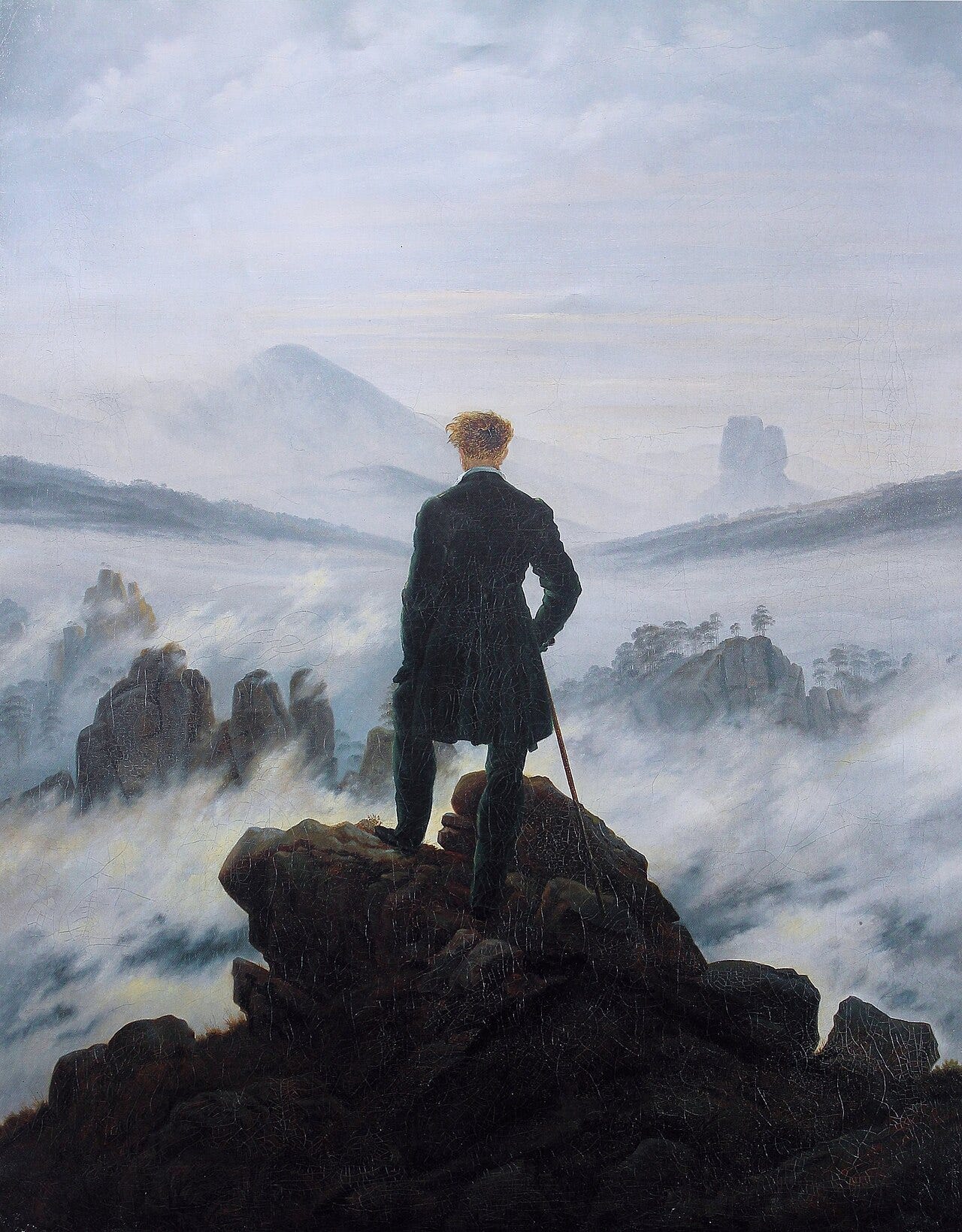
A man stands with his back to us on a rocky ledge, looking out over a sea of cloud that swallows the whole landscape below.
Friedrich built the scene from several real outcrops in the Elbe Sandstone Mountains, sketched separately on site and recomposed later in the studio.
The man's coat has been read as an outfit tied to German liberal and nationalist politics of the 1810s, worn by young men who wanted a unified Germany, a period I trace further in my guide to 10 Romantic artists worth knowing.
10. Caspar David Friedrich, Chalk Cliffs on Rügen (about 1818)
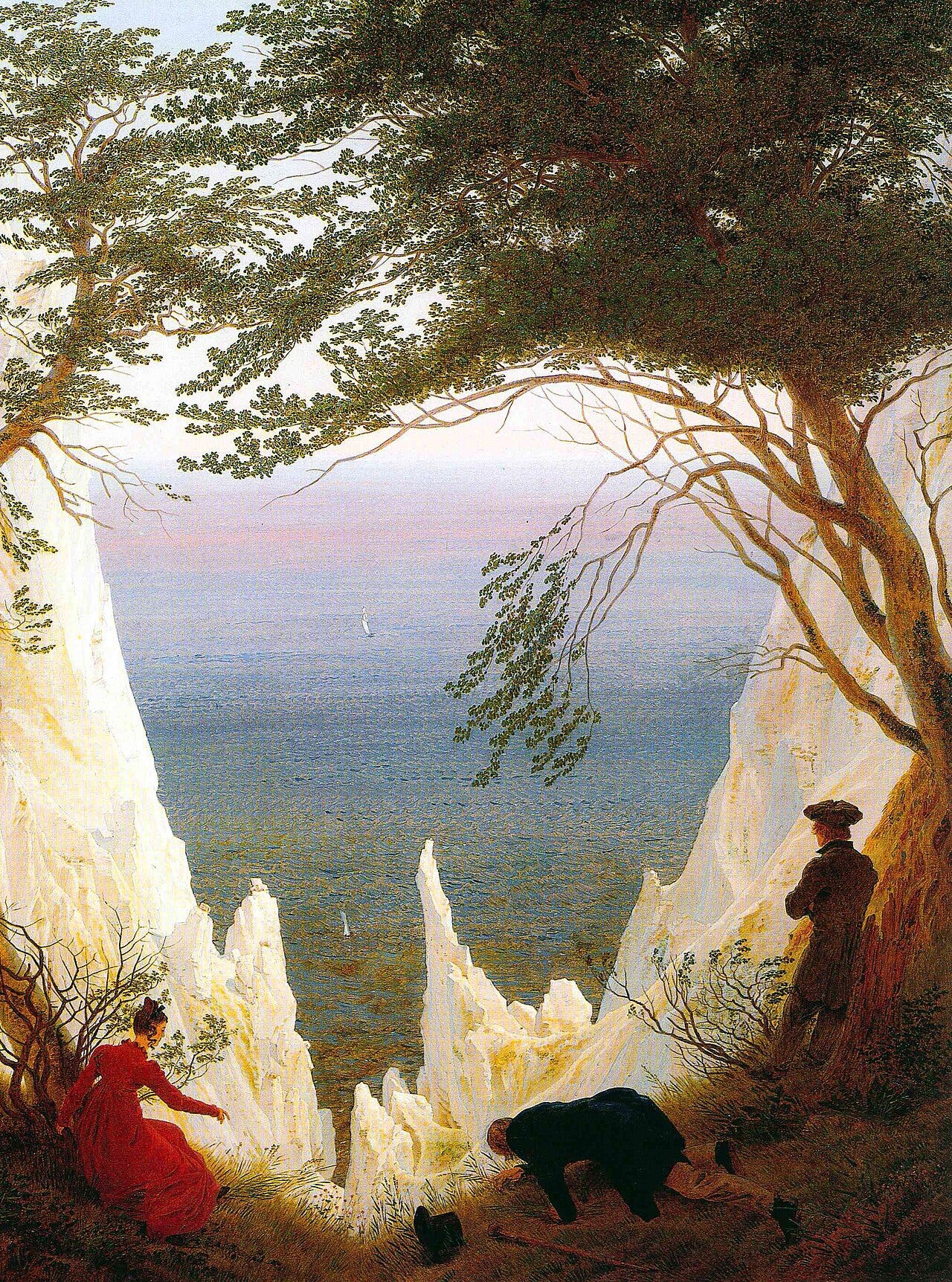
Three figures look out from a gap in white chalk cliffs toward a flat, pale sea.
Friedrich painted it after his honeymoon trip to the island of Rügen with his new wife Caroline in the summer of 1818.
The woman in red is usually identified as Caroline. The thin figure kneeling at the center is usually read as Friedrich himself, looking not at the view but down at the edge of the cliff. It hangs at the Museum Oskar Reinhart in Winterthur.
Where to see them
Dürer's Self Portrait at 28 and Altdorfer's Battle of Alexander at Issus: the Alte Pinakothek, Munich.
Dürer's Adam and Eve: the Museo del Prado, Madrid.
Dürer's Young Hare: the Albertina, Vienna.
Grünewald's Isenheim Altarpiece: the Musée Unterlinden, Colmar.
Cranach's Portrait of Martin Luther: St Anna Church, Augsburg.
Holbein's The Ambassadors: the National Gallery, London.
Runge's The Hülsenbeck Children and Friedrich's Wanderer above the Sea of Fog: the Hamburger Kunsthalle, Hamburg.
Friedrich's Chalk Cliffs on Rügen: the Museum Oskar Reinhart, Winterthur.
Common questions about German painting
What is the most famous German painting? Friedrich's Wanderer above the Sea of Fog is usually named today, though Dürer's Self Portrait at 28 held that place for centuries before it.
Who is the greatest German painter? Dürer is usually named first, for how much he did across painting, drawing, and printmaking in one lifetime.
What is the Isenheim Altarpiece? A multi panel altarpiece painted by Matthias Grünewald for a hospital monastery in Alsace, built to comfort patients suffering from a specific skin disease.
Why does Friedrich paint people from behind? The pose, called a Rückenfigur, puts the viewer in the same position as the figure, looking out at the same unknown view.
Is German Expressionism part of this list? Not directly. I kept this list to painters who died more than a century ago, so every image here is safely in the public domain. You can read about Expressionists like Kirchner in my one minute guide to Expressionism.
The thread from Dürer to Friedrich
Line up these ten paintings and three centuries of German painting run through a handful of repeated ideas: the human face examined at close range, the suffering body shown without softening, and a landscape read as more than scenery.
Dürer treated his own face with the seriousness earlier painters reserved for Christ. Grünewald painted Christ's wounds to match the disease in front of him. Friedrich turned an empty coastline into a question about who a person is once the fog closes in. That mood runs through German Romanticism.
Cranach's portrait of Luther is the one painting on this list built for repetition rather than contemplation, copied so many times by his own workshop that it fixed how an entire reformation would be pictured.
That thread runs well past this list. In the late twentieth century, Anselm Kiefer kept German history as his subject, building vast textured works about war and memory out of lead, straw and ash.
See how these paintings compare with the greatest painters of all time.
Napoleon cared enough about Altdorfer's version of ancient history to keep it in his own quarters for fifteen years before Bavaria got it back in 1815.
Otto Dix returned from the trenches of the First World War to paint some of the most unsparing images of Weimar Germany. His full story runs in Otto Dix, The Complete Story.