Ghost Paintings: 12 Haunting Works in Art History

For four hundred years, painters have tried to give a body to the dead. They painted returning lovers, doubles in the woods, spirits raised from the grave, and figures crossing dark water. These twelve famous ghost paintings show how the returning dead were imagined across Western art.

A ghost is impossible to paint. It has no body, no weight, no fixed shape. That is exactly why the best painters could not resist it. Some are stories from the Bible or Shakespeare, some are private grief, a dead wife painted back into the room.

  • Every kind of haunting: the raised prophet, the doppelganger, the returning love, the island of the dead.

  • The demon on the chest: Fuseli turned a bad dream into a body you can see.

  • The double as omen: meeting your own ghost in the woods was a folk sign of death.

  • One secret each: a hidden portrait, an omen, or a title the artist never chose.

If these draw you in, you will also love 7 secrets hidden in famous paintings, Leonora Carrington, the woman they could not tame, and what a memento mori really means.


Learn art the fun way. Free stories every week, no boring lectures.


1. Henry Fuseli, The Nightmare

A sleeping woman with a demon on her chest and a pale horse
Henry Fuseli, The Nightmare, 1781. Detroit Institute of Arts.

In 1781, Henry Fuseli painted a sleeping woman flung back across a bed, an ape like incubus squatting on her chest while a pale eyed horse pushes through the curtain. It went on show at the Royal Academy in 1782.

The horse is a pun on the word nightmare, which never had anything to do with horses. On the back of the canvas Fuseli left a portrait of a young woman who had refused to marry him.

The image spread everywhere as a print and has been copied ever since. It hangs today at the Detroit Institute of Arts, and remains the picture people reach for when they describe a bad dream.

2. William Blake, The Ghost of a Flea

A muscular flea spirit carrying a cup for blood
William Blake, The Ghost of a Flea, about 1819 to 1820. Tate, London.

Around 1819 to 1820, William Blake told the astrologer John Varley that a ghost had visited him. It was the spirit of a flea. Blake drew what he claimed to see, then worked it up as this small panel in tempera and gold.

Blake said the flea spirit told him that fleas were inhabited by the souls of bloodthirsty men. The muscular creature carries a cup for drinking blood and steps between stage curtains, as if taking a bow.

The panel is barely 21 centimeters tall, painted on a tropical hardwood. It belongs to the Tate, one of the oddest things Blake ever made.

3. Salvator Rosa, The Shade of Samuel Appears to Saul

A dead prophet rising in white before a kneeling king
Salvator Rosa, The Shade of Samuel Appears to Saul, 1668. Louvre, Paris.

In 1668, Salvator Rosa painted the scene from the First Book of Samuel where King Saul, deserted by God, seeks out a witch at Endor. She raises the dead prophet Samuel, who rises wrapped in white.

The Bible tells the story as a warning against forbidden magic. Rosa fills the shadows with grotesque spirits and a wild haired sorceress, while the ghost tells the kneeling Saul that he will die the next day.

The canvas is nearly three meters wide. It entered the French royal collection and now hangs in the Louvre.

4. John Everett Millais, Speak! Speak!

A young man startled as a woman in bridal dress appears at dawn
John Everett Millais, Speak! Speak!, 1895. Tate, London.

In 1895, John Everett Millais showed a young Roman who has read the letters of his lost love all night. At dawn the bed curtains part and she stands before him in her bridal dress.

Is she alive or a ghost? Millais refused to say. When a friend pressed him, he answered, that is just what I want. The doubt was the whole point.

The nation bought it for two thousand pounds under the Chantrey Bequest that same year. It was among the last things Millais painted before his death in 1896.

5. Arnold Bocklin, Isle of the Dead

A white figure in a boat crossing to an island of tombs
Arnold Bocklin, Isle of the Dead, 1880. Kunstmuseum Basel.

In 1880, Arnold Bocklin painted a small boat crossing still water toward an island of dark cypress and pale tombs. A figure in white stands upright beside a coffin. He finished this first version in Basel that May.

Bocklin never explained the scene and never gave it this title. A dealer supplied the name. A widow, Marie Berna, had asked him to add the coffin and the white figure, turning it into an image of her own grief.

Bocklin painted five versions between 1880 and 1886. Rachmaninoff saw a print and wrote his symphonic poem Isle of the Dead in 1908.

6. Ary Scheffer, The Ghosts of Paolo and Francesca

Two pale entwined lovers drifting through the dark
Ary Scheffer, The Ghosts of Paolo and Francesca Appear to Dante and Virgil, 1835. Louvre, Paris.

In 1835, Ary Scheffer painted the two lovers from Dante Inferno, Paolo and Francesca, drifting through the dark as pale entwined ghosts while Dante and Virgil look on from the shadows.

The couple were killed for their affair and damned to the second circle of hell, tossed forever on an infernal wind. Scheffer returned to the subject at least six times between 1822 and 1855.

The 1835 canvas is the finest of the group. It hangs in the Louvre, where the pale bodies still seem lit from within.

7. Gustave Moreau, The Apparition

A floating haloed severed head before Salome
Gustave Moreau, The Apparition, about 1876. Musee d Orsay, Paris.

Between 1874 and 1876, Gustave Moreau painted Salome frozen in mid dance. Before her floats the severed, haloed head of John the Baptist, dripping and staring straight at her.

The head is a vision only Salome can see. Moreau turned a Bible story into a hallucination, and the writer Joris Karl Huysmans made this watercolour a cult image in his 1884 novel Against Nature.

It is a watercolour, just over a meter tall. It lives at the Musee d Orsay in Paris.

8. Dante Gabriel Rossetti, How They Met Themselves

Two lovers meeting their glowing doubles in a dark wood
Dante Gabriel Rossetti, How They Met Themselves, 1864. Fitzwilliam Museum, Cambridge.

In 1864, Dante Gabriel Rossetti finished a watercolour of two lovers walking in a dark wood who suddenly meet their own doubles. The woman faints. Her double glows.

Rossetti called it his bogie drawing. In folklore, meeting your doppelganger was an omen of death. He had been drawing the idea since 1851.

He first painted a version on his honeymoon with Elizabeth Siddal. She died two years later. This 1864 watercolour is now at the Fitzwilliam Museum in Cambridge.


Join 130,000 readers who get the secrets behind the paintings. Free.


9. Theodore Chasseriau, Macbeth and the Ghost of Banquo

Macbeth recoiling from a ghost only he can see
Theodore Chasseriau, Macbeth and the Ghost of Banquo, 1854. Musee des Beaux Arts, Reims.

In 1854, Theodore Chasseriau painted the banquet scene from Macbeth, act three. Macbeth recoils in horror from an empty chair. Only he can see the blood soaked ghost of Banquo, the friend he ordered killed.

The guests see nothing, and that is the terror of the scene. Chasseriau sent it to the Salon of 1855, where it was rejected.

The city of Reims acquired the painting in 1939. It hangs today in its Musee des Beaux Arts.

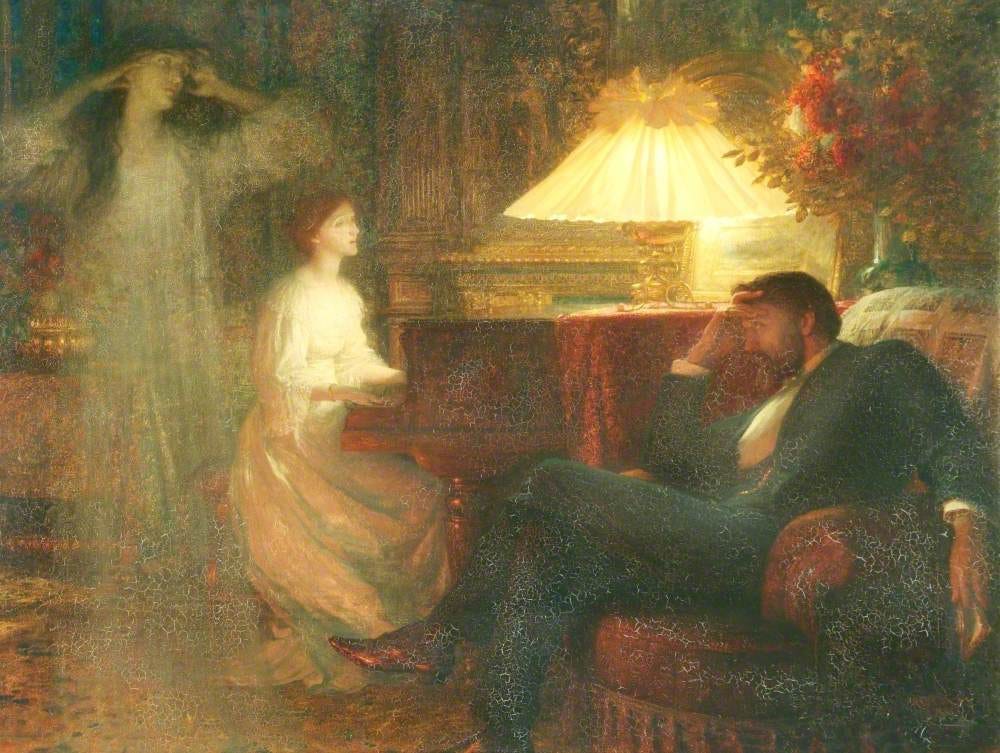
10. Frank Dicksee, A Reverie

A pale woman appearing behind a brooding husband at a piano
Frank Dicksee, A Reverie, 1895. Walker Art Gallery, Liverpool.

In 1895, Frank Dicksee painted an evening drawing room. A wife plays the piano. Her husband broods, and behind him a pale woman appears, the ghost of a love he lost years before.

The wife cannot see the apparition. Dicksee painted his own face on the husband and posed a model as the spectre. A reviewer that year called her an excellent ghost indeed.

The picture illustrates a line of verse, lips that are dead sang me that song. It hangs at the Walker Art Gallery in Liverpool.

11. Caspar David Friedrich, The Abbey in the Oakwood

Monks like shades carrying a coffin through snow to a ruin
Caspar David Friedrich, The Abbey in the Oakwood, 1809 to 1810. Alte Nationalgalerie, Berlin.

Between 1809 and 1810, Caspar David Friedrich painted a line of monks carrying a coffin through snow toward a ruined church, lit only by two candles. Bare oaks claw at a cold sky.

Friedrich based the ruin on the real Eldena Abbey. The monks move like shades, and a fresh grave gapes in the foreground, so the whole picture becomes a slow procession toward death.

King Frederick William III of Prussia bought it straight from the 1810 exhibition. It hangs in the Alte Nationalgalerie in Berlin, still paired with The Monk by the Sea.

12. Dante Gabriel Rossetti, Beata Beatrix

A woman at the moment of death with a red dove and a poppy
Dante Gabriel Rossetti, Beata Beatrix, 1864 to 1870. Tate, London.

Between 1864 and 1870, Dante Gabriel Rossetti painted Beatrice from Dante poem at the instant of her death, eyes closed, a red dove dropping a poppy into her open hands.

The face is Elizabeth Siddal, Rossetti wife, who died in 1862 from a laudanum overdose. The poppy points straight at how she died. He painted her as a spirit slipping out of the living world.

Rossetti made several versions. The first, begun as a memorial, hangs at Tate Britain in London.

Where to see them

  • Tate, London: Blake The Ghost of a Flea, Millais Speak! Speak! and Rossetti Beata Beatrix.

  • Louvre, Paris: Rosa The Shade of Samuel Appears to Saul and Scheffer The Ghosts of Paolo and Francesca.

  • Musee d Orsay, Paris: Moreau The Apparition.

  • Detroit Institute of Arts: Fuseli The Nightmare.

  • Kunstmuseum Basel: Bocklin Isle of the Dead.

Why painters kept summoning the dead

Many of these belong to Romanticism and to Symbolism, movements drawn to dreams, death, and the unseen.

Others are history paintings of ghost scenes from the Bible and Shakespeare, staged with all the drama of the theatre.

Ghosts in art, questions people ask

  • What is the most famous ghost painting? Fuseli The Nightmare from 1781 is the best known, though it shows a demon rather than a returning spirit. For an actual ghost, Millais Speak! Speak! is the clearest.

  • Why did artists paint so many ghosts in the 1800s? The nineteenth century saw a boom in spiritualism, seances and ghost stories, which painters like Rossetti and Millais turned into images of doubles and returning loves.

  • What is Bocklin Isle of the Dead about? Bocklin never said. He painted five versions from 1880 and let a dealer supply the title. A grieving widow asked him to add the coffin and the white figure.

  • Is the woman in Speak! Speak! a ghost? Millais left it deliberately unclear. She may be a living bride or a spirit at dawn. He said the doubt was exactly what he wanted.

  • Where can I see ghost paintings in person? Tate in London holds Blake, Millais and Rossetti. The Louvre has Rosa and Scheffer, and the Musee d Orsay has Moreau The Apparition.

Why a good ghost never wants to leave

Notice how often these painters could not stop. Bocklin painted five Isles of the Dead. Scheffer painted his Paolo and Francesca at least six times between 1822 and 1855. Rossetti went back to his dead wife again and again. Once a painter conjures a spirit onto canvas, it seems, the spirit is very hard to send away.


Two new stories a week, 130 secrets unlocked. Start free.