Famous Greek Mythology Paintings: 12 Myths on Canvas

The most famous Greek mythology paintings include the Birth of Venus, Bacchus and Ariadne and Goya’s Saturn. Twelve myths on canvas, a drowning boy nobody notices, and two lost Ledas by the two biggest names in art.

Venus arriving on shell
Sandro Botticelli, The Birth of Venus, about 1486, Uffizi

The myths, in brief

  • Twelve paintings, from 1486 to 1907, all built on stories older than Rome.

  • In one, the mythological hero is two tiny legs vanishing into the sea.

  • Both Leonardo and Michelangelo painted the same myth, and both paintings are lost.

  • One god here is eating his own child. His Greek name was Cronus.

  • And one sculptor falls in love with his own statue, painted by a man who knew the feeling.


Learn art the fun way. Free stories every week, no boring lectures.


1 | The Birth of Venus, Sandro Botticelli (about 1486)

The goddess of love arrives on a shell, blown to shore by wind gods. It was the first monumental pagan nude painted in Christian Europe for a thousand years.

Strictly, it shows her arrival, and almost every symbol in it has a second meaning. I decode the whole canvas in what the Birth of Venus means.

2 | Landscape with the Fall of Icarus (about 1560)

Ploughman ignoring drowning Icarus
Landscape with the Fall of Icarus, about 1560, Brussels

A farmer ploughs, a shepherd daydreams, a ship sails on. And in the corner, two small legs disappear into the sea. That splash is Icarus.

The painting in Brussels is probably an early copy of a lost original by Bruegel, whose habit of hiding the main event I unpack in my guide to Pieter Bruegel the Elder.

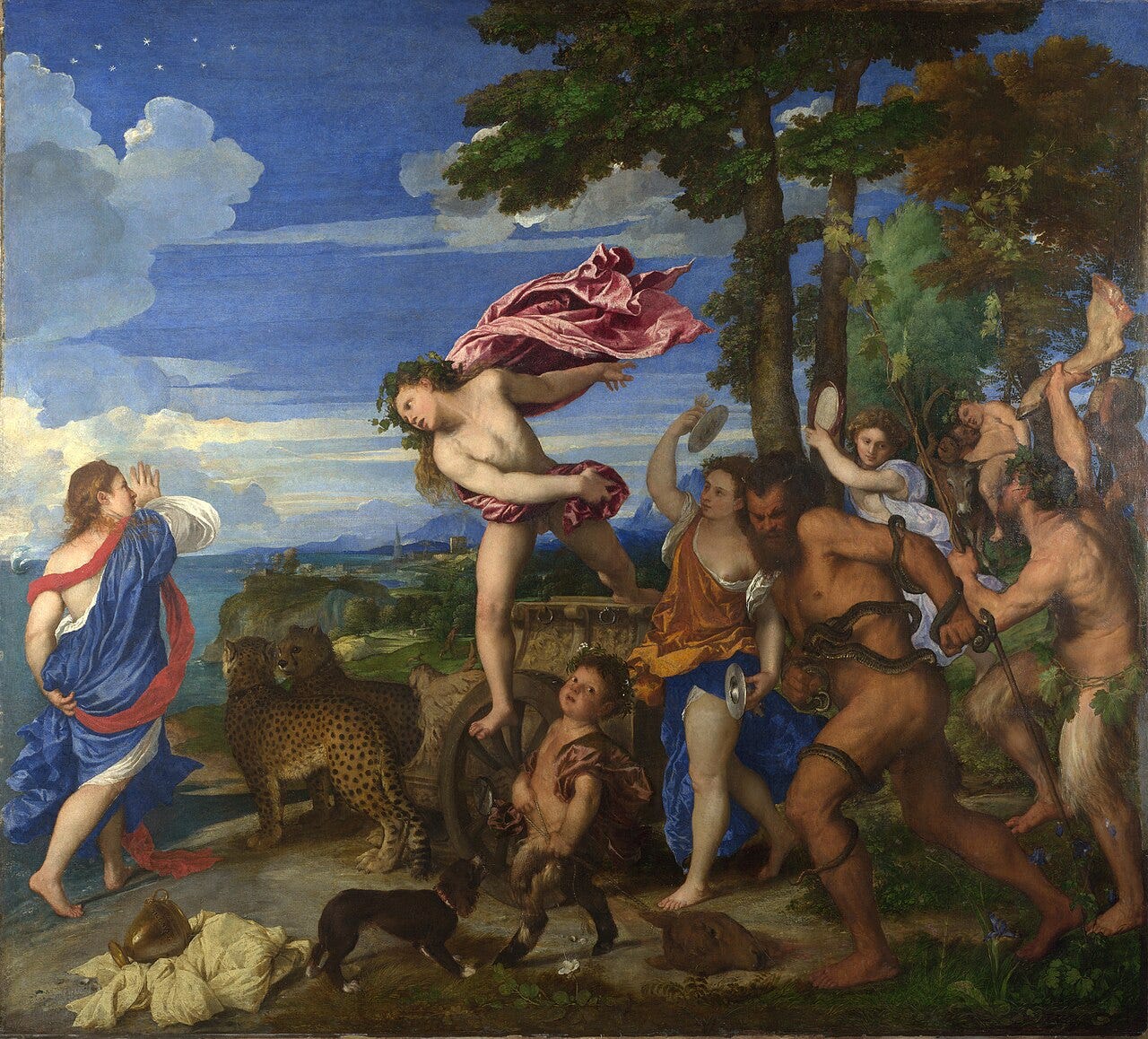
3 | Bacchus and Ariadne, Titian (1523)

Bacchus leaping from chariot
Titian, Bacchus and Ariadne, 1523, National Gallery

The god of wine leaps off his chariot at first sight of an abandoned princess. Above her, her future crown already hangs in the sky as a ring of stars.

Titian bought the most expensive blue on earth, ultramarine, for that sky. The painter who could afford it is in my guide to Titian.

4 | Saturn Devouring His Son, Francisco Goya (about 1823)

Saturn devouring a body
Francisco Goya, Saturn Devouring His Son, about 1823, Prado

The Titan the Greeks called Cronus eats his children to escape a prophecy. Goya painted him mid meal, directly on the wall of his own dining room.

He never meant anyone to see it. The house paintings were peeled off the plaster after his death. The old man behind them is in my guide to Francisco Goya.

5 | Danae, Gustav Klimt (1907)

Danae and golden shower
Gustav Klimt, Danae, 1907

Zeus visits a locked princess as a shower of gold. Painters loved the excuse for gold and skin, and Klimt, son of a gold engraver, made the definitive version.

The myth ends with the birth of Perseus. The painter of gold is in my guide to Gustav Klimt.

6 | The Judgement of Paris, Peter Paul Rubens (about 1638)

Paris judging three goddesses
Peter Paul Rubens, The Judgement of Paris, about 1638, Prado

Three goddesses, one golden apple, one shepherd asked to choose the fairest. Paris picks Venus, wins Helen, and starts the Trojan War.

Rubens painted the contest at least seven times. The Prado version was his last, with his young wife Helena as a goddess.


Join 130,000 readers who get the secrets behind the paintings. Free.


7 | Pygmalion and Galatea, Jean Leon Gerome (about 1890)

Statue kissing her sculptor
Jean Leon Gerome, Pygmalion and Galatea, about 1890, Met

A sculptor falls in love with his statue, and Venus grants the wish: the marble softens into flesh from the lips down while the feet stay stone.

Gerome, a sculptor himself, painted the kiss from several angles and even painted himself carving her. The picture hangs at the Met in New York.

8 | Echo and Narcissus, John William Waterhouse (1903)

Narcissus staring at reflection
John William Waterhouse, Echo and Narcissus, 1903

Narcissus stares at his reflection while Echo, cursed to repeat only the words of others, watches him from across the stream, unable to speak first.

Waterhouse built a late career painting doomed mythological women. His whole world is in my guide to John William Waterhouse.

9 | Leda and the Swan, the myth both giants lost

Leonardo painted Leda. Michelangelo painted Leda. Both paintings are gone, known only through copies by students and rivals.

Leonardo’s standing Leda survived into the 1600s at Fontainebleau before vanishing, possibly destroyed for indecency. The lost works are part of my guide to Leonardo da Vinci.

10 | Oedipus and the Sphinx, Ingres (1808)

Oedipus facing the Sphinx
Ingres, Oedipus and the Sphinx, 1808, Louvre

A naked traveler answers the riddle of a monster with a woman’s face, painted by a 28 year old student in Rome.

Ingres kept the canvas for decades and enlarged it late in life, the way other people revise a diary. The perfectionist is in my guide to Ingres.

11 | Prometheus Bound, Peter Paul Rubens (about 1618)

The Titan who stole fire for mankind, chained while an eagle eats his liver, which regrows every night. Punishment as subscription.

Rubens painted the body and hired the animal specialist Frans Snyders to paint the eagle. Division of labor, baroque style. It hangs in Philadelphia.

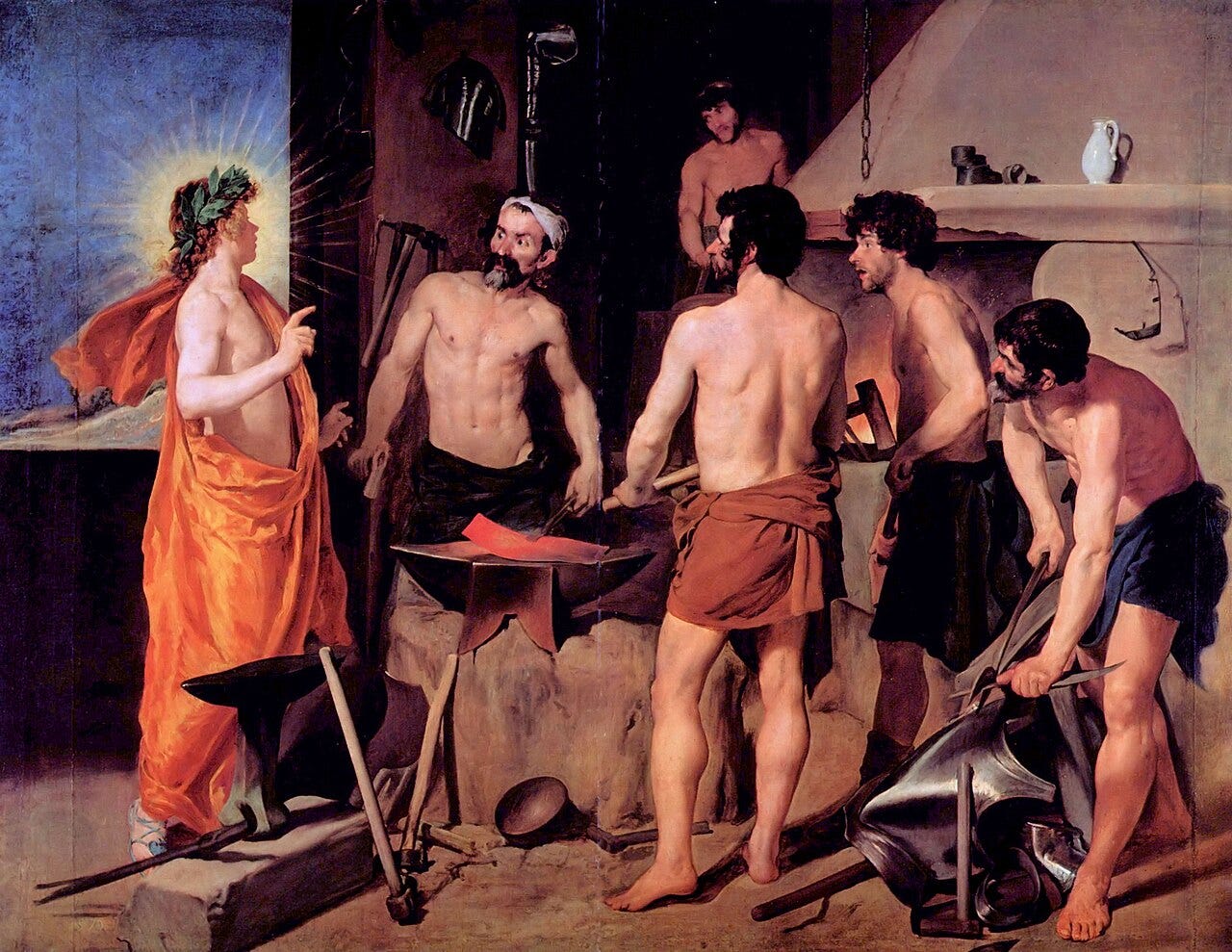
12 | The Forge of Vulcan, Diego Velazquez (1630)

Apollo visiting the forge
Diego Velazquez, The Forge of Vulcan, 1630, Prado

Apollo drops by a blacksmith’s shop to tell Vulcan that his wife Venus is cheating on him with Mars. The workers freeze mid hammer.

Velazquez painted gods as working men with sunburnt necks, gossip landing in a real workshop. The painter is in my guide to Diego Velazquez.

Where the myths hang

The Uffizi has the Birth of Venus, London’s National Gallery has Bacchus and Ariadne, the Prado has Saturn, the Judgement of Paris and the Forge of Vulcan in adjoining rooms.

The Met has Pygmalion, and Vienna keeps Klimt’s Danae in private hands, shown on loan.

Greek myths on canvas, common questions

  • What is the most famous Greek mythology painting? The Birth of Venus, by a distance. Bacchus and Ariadne and Goya’s Saturn follow.

  • Is Saturn Greek or Roman? Roman name, Greek story. The Greeks called him Cronus, the Titan who ate his children.

  • Why is Icarus so small in Bruegel’s painting? That is the point. The world does not stop for a private tragedy, and the ploughman never looks up.

  • Which museum has the most mythology paintings? The Prado in Madrid, thanks to the Spanish kings’ appetite for Titian and Rubens.

  • Did Leonardo paint Greek myths? At least once: his lost Leda and the Swan, known today only through copies.

A last detail: in Bacchus and Ariadne, Titian signed his name on the urn at the lower left, right next to the sleeping cheetahs that stand in for the god’s leopards.


Two new stories a week, 130+ secrets unlocked. Start free.