
There is no record that John Atkinson Grimshaw ever took a painting lesson. Until 1861 he was a railway clerk in Leeds, the son of strict Baptist parents, and his mother once destroyed all his paints.
By the end of the 1870s he was the painter who showed Victorian England its own industrial towns after dark, with gaslit shop windows, wet cobbles and the masts of ships in the haze.
Cool Stories About Art is a newsletter to learn art the fun way.
Join 200,000+ readers and get:
10 new art stories / month
The entire archive of content (140+ articles)
Comment, ask questions, and chat with other readers
From Feathers to Gaslight
Grimshaw's working life lasted some thirty years, and he spent its first years training his own eye. He began with small, exact studies of birds and fruit, moved on to the rocks and valleys of the Lake District, and found his true subject in the 1870s: the towns and docks of the North of England under the moon and the gas lamps.
Those night scenes keep returning to the same few places. There is Leeds, where he was born and spent most of his life, and the seaside resort of Scarborough, on the Yorkshire coast. There is London, where he went to find new buyers, and there are the docks of Liverpool on the river Mersey.
The pictures sold, and he needed them to sell. He had six surviving children, a seventeenth-century manor outside Leeds to keep up and, from 1879, debts that stayed with him to the end.
12. Iris (1886)
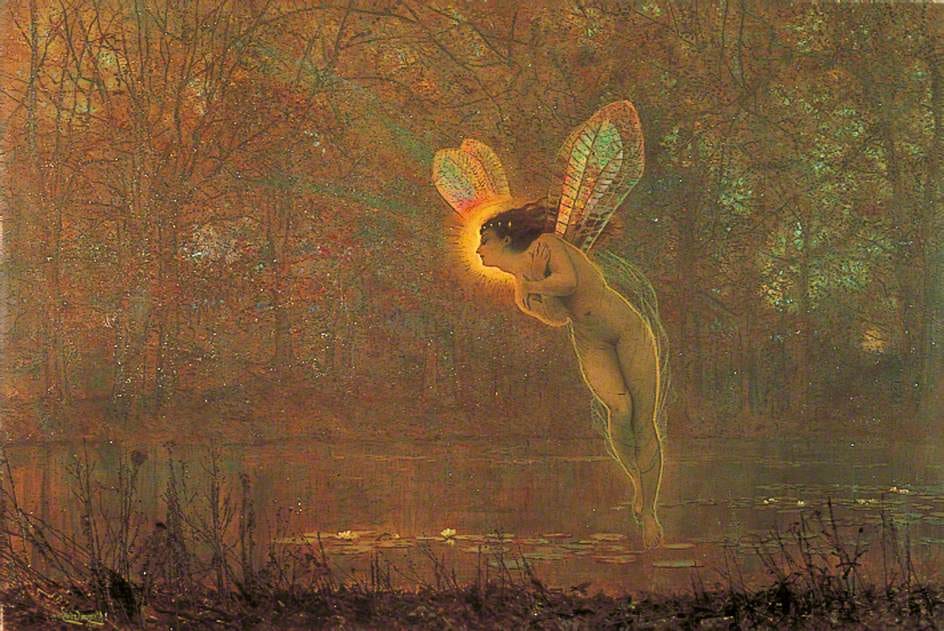
A young woman with a pale glow around her head floats in midair above an autumn pond, her body bent into a long curve between the bare trees. The picture is Iris, and her pose only makes sense on the reverse of the canvas.
There Grimshaw wrote out her story in his own hand, copied from a book he called only an "Old Book." He painted the canvas in 1886, seven years after his money ran out, when every picture had to earn its keep.
He had painted floating fairy women before. This time he made her a goddess from classical myth, a subject fit for the summer exhibition of the Royal Academy in London, the great yearly show of British painting. The canvas was shown there that year, and it was the last time the Academy hung his work.
The woman who posed for her was probably Agnes Leefe, his young assistant. She also stood for many of the small figures who walk through his town views, and she died of tuberculosis four years later.
The text on the reverse is what explains the curve. Iris, the messenger of Juno, queen of the Roman gods, is sent out in autumn to wither the flowers and the leaves. She stops in front of a water lily and cannot bring herself to touch it, and for that disobedience she is turned into a rainbow.
Grimshaw paints her at the moment just before. Bent above the water between the trees, her body already draws the arc of the rainbow she is about to become.
At a Glance
Artist: John Atkinson Grimshaw (1836 to 1893)
Painted: 1886
Medium: Oil on canvas
Size: Not published
Where to see it: Leeds Art Gallery, Leeds
11. Reflections on the Aire: On Strike (1879)
Seen from behind, a woman stands alone on a riverbank at night and looks across black water at the outline of an ironworks. No smoke rises from its chimneys, and the reason is in the title Grimshaw gave the picture, Reflections on the Aire: On Strike.
He painted it in 1879, seven years before Iris, on the river that ran past his own house in Leeds. That year, cold chimneys were a sight his neighbors across the water knew well.