
For three decades, readers in Europe and America pictured the heroes and monsters of their favorite books through the drawings of Gustave Doré, a French artist who gave faces to the characters of Dante, Cervantes, Milton and the Bible.
He was twenty-two when his first big book, a comic history of Russia, appeared in Paris. He died at fifty-one, before his last, Edgar Allan Poe's The Raven, went on sale in New York.
Cool Stories About Art is a newsletter to learn art the fun way.
Join 200,000+ readers and get:
10 new art stories / month
The entire archive of content (140+ articles)
Comment, ask questions, and chat with other readers
What Doré's Books Asked of Him
His pictures reached so many readers because of the way books were printed in his day. A book illustration took two trades. The artist drew the scene directly on a block of wood, and engravers then cut away everything around his lines.
What remained could sit beside the type and print with the text, by the thousand. That system suited Doré, who drew fast, and his books grew to match his speed, with dozens of full-page plates in volumes more than forty centimeters tall.
His ambition was to illustrate the great classics, and more than once he paid for a book with his own money. Each plate says something about its book and about the moment in his life when he drew it.
The plates run from his twenties in Paris to the drawings of his final months, through books people still look for and a few that are rarely mentioned.
12. The New Zealander (1872)
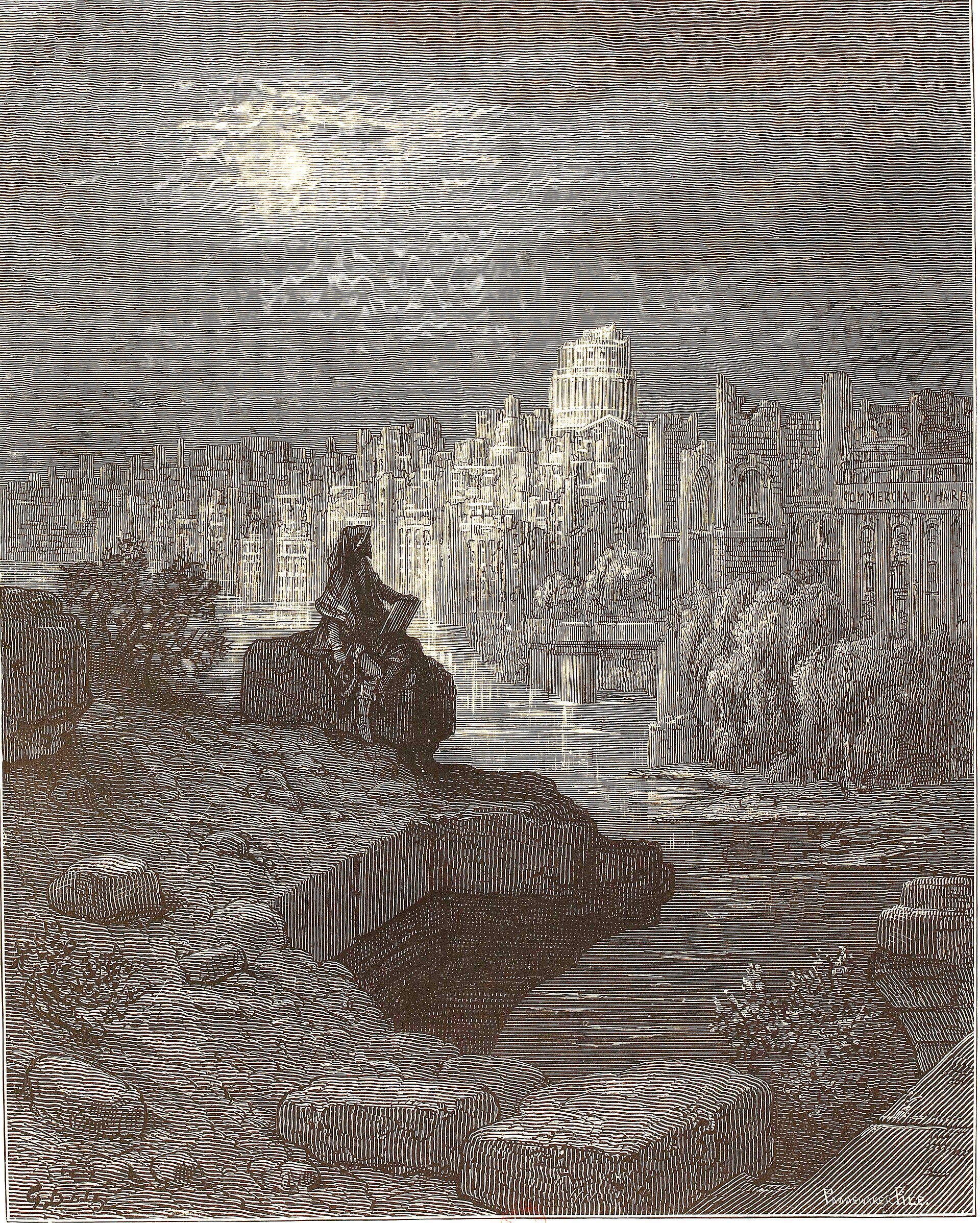
A cloaked figure sits on a fallen stone above the Thames, a sketchbook on his knees, drawing what is left of London. Under a full moon, the dome of St Paul's Cathedral stands broken against the sky, and weeds grow over an empty wharf.
The New Zealander is the last plate of London: A Pilgrimage, a portrait of the city at the height of its wealth. Between 1869 and 1872, Doré walked its streets with the English journalist Blanchard Jerrold, who wrote the text while the artist drew.
Almost every other picture in the volume records what the two men saw together, from the docks and the slums to the prisons. Only this final one leaves the present behind and shows London long after its fall.
The idea came from a sentence written in 1840 by the historian Thomas Babington Macaulay. Reviewing a history of the popes, he argued that the Catholic Church might outlast even London, the capital of the largest empire of his day.
The Church, he wrote, might still be strong "when some traveller from New Zealand shall, in the midst of a vast solitude, take his stand on a broken arch of London Bridge to sketch the ruins of St. Paul's."
New Zealand was then a young colony at the far end of the world, and its traveler sketching a dead London became shorthand for the fall of a great power. Victorian readers repeated the image until it wore thin.
By 1865 the comic magazine Punch listed "Macaulay's New Zealander" among the clichés that deserved to be retired. Doré took the tired phrase literally and drew the traveler at work among the fallen stones, studying London the way visitors had long studied the ruins of Rome.
That foreigner sketching a city that was not his own recalls Doré, a Frenchman drawing London. In 1880, the novelist William Delisle Hay borrowed the same vision for The Doom of the Great City, a novel in which London is destroyed.
At a Glance
Artist: Gustave Doré (1832 to 1883)
Made: 1872
Medium: Wood engraving after Doré's drawing
Size: Not published
Where to see it: London: A Pilgrimage (1872), last plate
11. History of Holy Russia (1854)
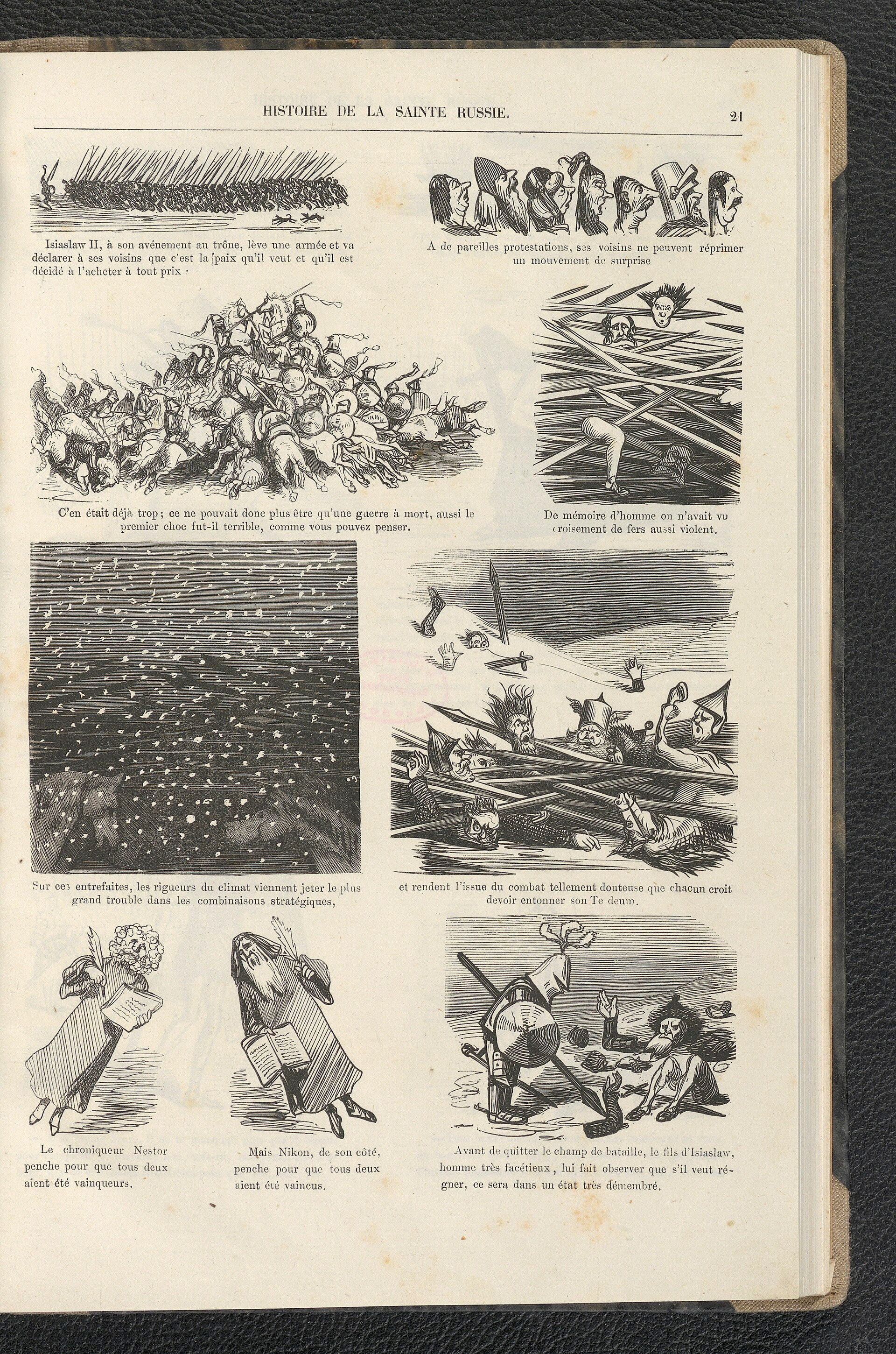
On a page crowded with battles, one square panel is almost entirely black, with a few flakes of snow falling across it. Around it, armies collide and two bearded chroniclers read aloud from their books.
History of Holy Russia appeared in Paris in 1854, as France went to war against Russia in the Crimea. In small comic panels, the young Doré told a thousand years of Russian history and mocked the enemy in a form that barely existed yet.