
Search results for Halloween paintings are mostly pumpkins and step-by-step tutorials. The older pictures are stranger. Few painters ever showed the holiday itself, but for four centuries they kept painting the guests it invites, from a skeleton slipping into a dying man's bedroom to a schoolteacher racing through a forest at night, chased by a rider who has no head.
Cool Stories About Art is a newsletter to learn art the fun way.
Join 170,000+ readers and get:
10 new art stories / month
The entire archive of content (1,000+ articles)
Comment, ask questions, and chat with other readers
What Halloween Asked of Painters
Halloween is short for All Hallows' Eve, the night before All Saints' Day on November 1. A party of games in a barn or a kitchen had little place among the histories, portraits and altarpieces that painters were expected to produce, so most of the pictures now called Halloween paintings were made for other reasons.
What painters did take up, again and again, are the figures the night has gathered around itself. The skeleton came from the Church, which used it for centuries to remind the living that death comes for everyone. Ghosts came from tales told aloud and then on stage, in Europe as in Japan. Witches, demons and monsters came from myths and sermons. Each of them let a painter show something no one has ever seen: a dead man walking, a body without a head, a face that turns people to stone.
So there is no such thing as a Halloween painter. The artists whose names come up when people look for Halloween paintings painted fear, death or the supernatural for reasons of their own, and the holiday adopted their pictures later.
This list follows that idea. Each work shows either the night itself or one of the figures that now walk through it in costume: the skeleton, the ghost, the witch, the demon, the monster, even the spider. Pictures that are only dark or sad stayed out. The best-known pictures come last.
12. Daniel Maclise, Snap-Apple Night (1833)
Halfway across a packed barn, a man opens his mouth wide and lunges at an apple dangling in the air. To the right, boys plunge their heads into a tub of water to catch apples with their teeth. All around them, by candlelight, a whole Irish parish plays cards and talks in corners.
This is Halloween as it was kept in 1832. That autumn, Daniel Maclise, a 26-year-old painter from Cork, was staying at Blarney, just outside the city, with the folklorist Thomas Crofton Croker. The parish priest, Father Mathew Horgan, invited them both to the party he gave every year on All Hallows' Eve, in a large barn.
Maclise spent the evening drawing. His biographer wrote in 1871 that he "contrived to sketch every group in the barn," where the better-off guests mixed with the poorest peasants of the parish. Back in London, the young painter worked those sketches up into a large canvas, which hung in the Royal Academy's 1833 show.
The game in the center gives the picture its title. Snap-apple was played by adults, and more than a prize was at stake: whoever caught the apple was thought to be the next to marry. The boys on the right are bobbing for apples, a game children still play at Halloween parties.
Nothing in the picture is meant to frighten. The dead are nowhere in sight, and the living spend the night trying to guess whom they will marry.
At a Glance
Artist: Daniel Maclise (1806 to 1870)
Painted: 1833
Medium: Oil on canvas
Size: Not published. James Scott's 1845 engraving after it measures 63.5 x 84.5 cm (25 x 33.3 in)
Where to see it: Location not published
11. John Quidor, The Headless Horseman Pursuing Ichabod Crane (1858)
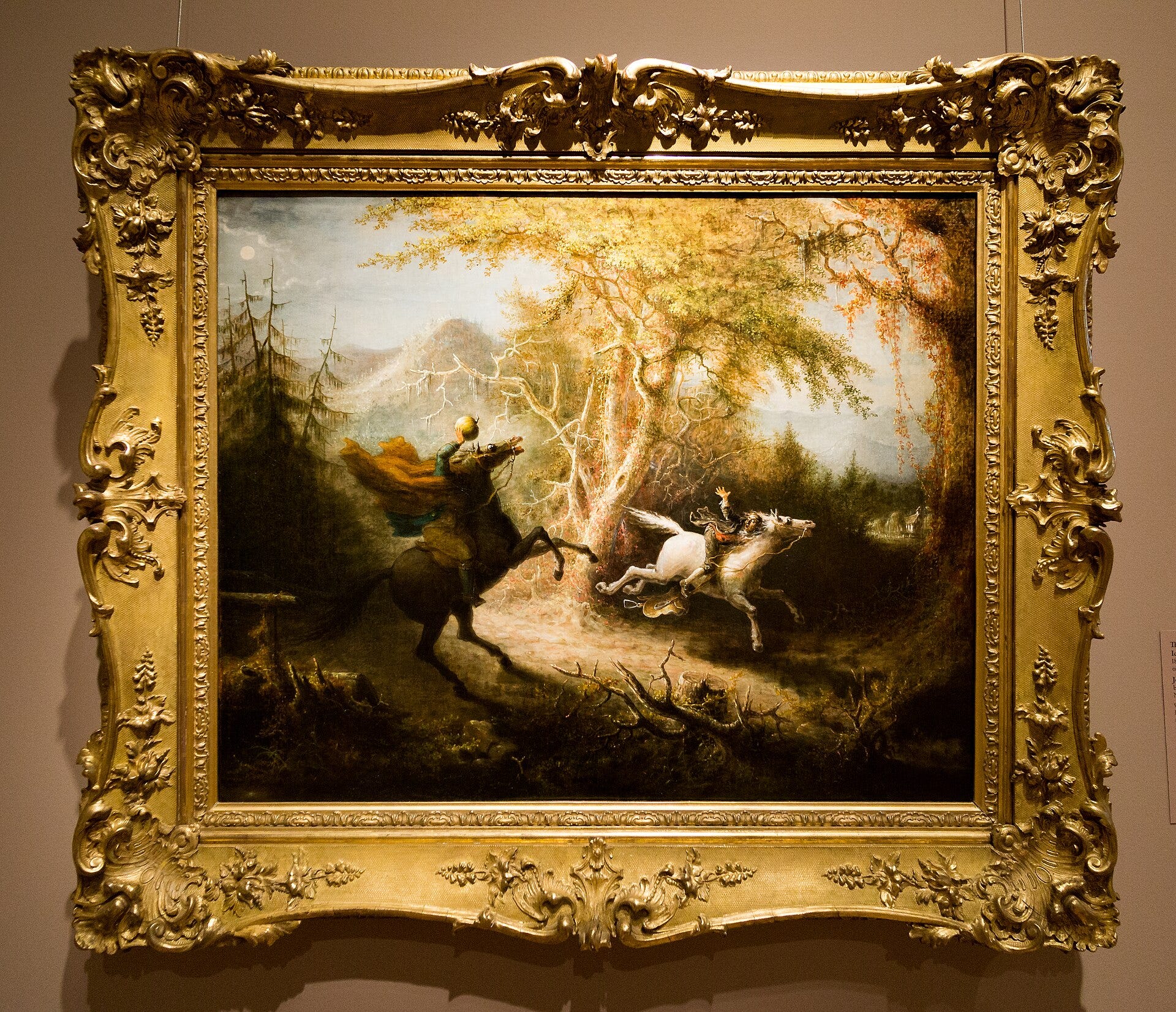
A rider with no head on his shoulders raises his arm to throw something round and pale. Ahead of him, under a stormy sky, a thin man in black bends low over a galloping horse and twists around in terror. That pale object is the key to the whole story, and the man on the horse has not understood it yet.