
A finished painting shows a hand in its final pose and hides the hours spent on it. Those hours survive on loose sheets of paper, kept in studios and never meant for the public. Among them are a boy's study dated to the day by his father, and a page of fists drawn by a painter who died on the eve of his voyage to Boston.
Cool Stories About Art is a newsletter to learn art the fun way.
Join 200,000+ readers and get:
10 new art stories / month
The entire archive of content (140+ articles)
Comment, ask questions, and chat with other readers
What the Painting Hides
A hand changes shape with every movement. It grips, points, counts and rests, and it is very hard to invent convincingly. So before risking one on a panel, a canvas or a ceiling, artists worked it out on a separate sheet, usually from a living model.
Such studies survive from every period, from the Renaissance to the 1920s, and they show what the finished work hides: a contour set down once, a shadow pushed further or abandoned, a finger left half done.
In every drawing chosen here, the hand is the subject rather than a detail. Most of them prepare a painting, a portrait or a ceiling. Each entry follows the drawing's story to its end and says what it still teaches anyone learning to draw.
12. Moses ter Borch, Study of a Hand (1657)
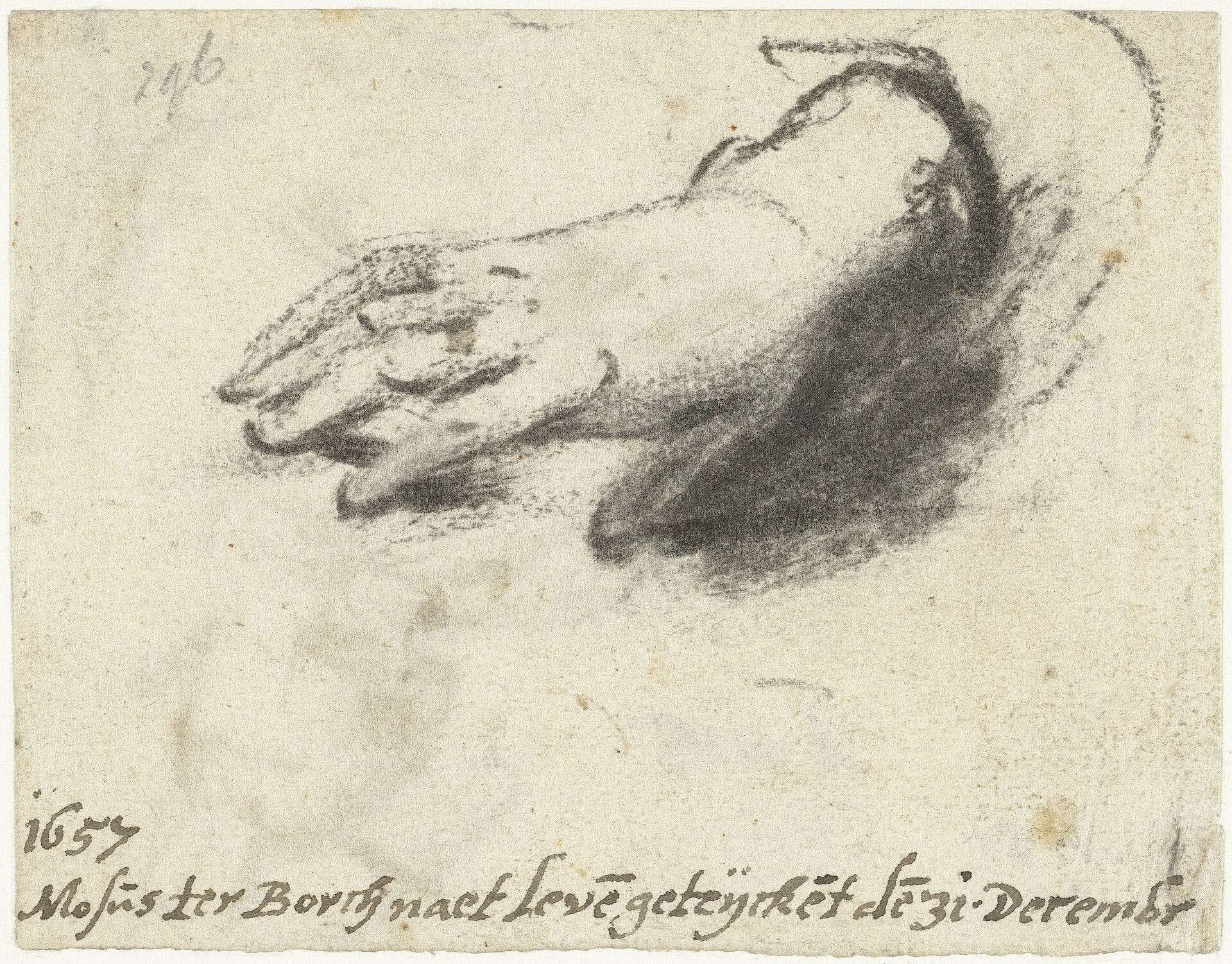
Along the bottom edge of a small sheet, a line of brown ink gives a year, 1657, and a sentence in Dutch: "Mosus ter Borch naet leven geteijckent den 31. Decembr," meaning "Moses ter Borch, drawn from life on December 31." Above the inscription, in black chalk, a hand lies palm down, its fingers bent toward the left, with a heavy shadow under the wrist.
The inscription is not in the artist's handwriting. Moses ter Borch was twelve on that New Year's Eve, and the words were written by his father, Gerard ter Borch the Elder. A former painter who had become a tax official in Zwolle, in the province of Overijssel, the father taught all his children to draw, and he dated this sheet and kept it.
The household was a gifted one. Moses's half-brother, Gerard the Younger, became one of the great Dutch painters of everyday life, and his sister Gesina painted and wrote poetry. A single hand seen from the side, with no setting, was the first exercise of any studio, and the boy took it seriously.
The seriousness shows in the line. He follows each finger with a careful outline and keeps his darkest strokes for the spot where the wrist presses down. That one shadow is what makes the hand rest on something instead of floating, and it is the first lesson the sheet holds for a beginner. Above it, sleeve and forearm stay a bare line.
The boy grew up and joined the Dutch navy. In July 1667, during a Dutch raid on the English coast, he was killed in the attack on Landguard Fort, near Harwich. Soon afterward Gerard and Gesina painted his memorial portrait together, Gerard the face and Gesina the setting, with a watch, a skull and ivy on the rocks. Gesina painted her brother once more, on the coast near Harwich where he had fallen.
At a Glance
Artist: Moses ter Borch (1645 to 1667)
Drawn: December 31, 1657
Medium: Black chalk on paper
Size: 8.8 × 11.4 cm (3.5 × 4.5 in)
Where to see it: Rijksmuseum, Amsterdam (works on paper, shown in rotation)
11. Georges Seurat, The Hand of Poussin, after Ingres (about 1875 to 1877)
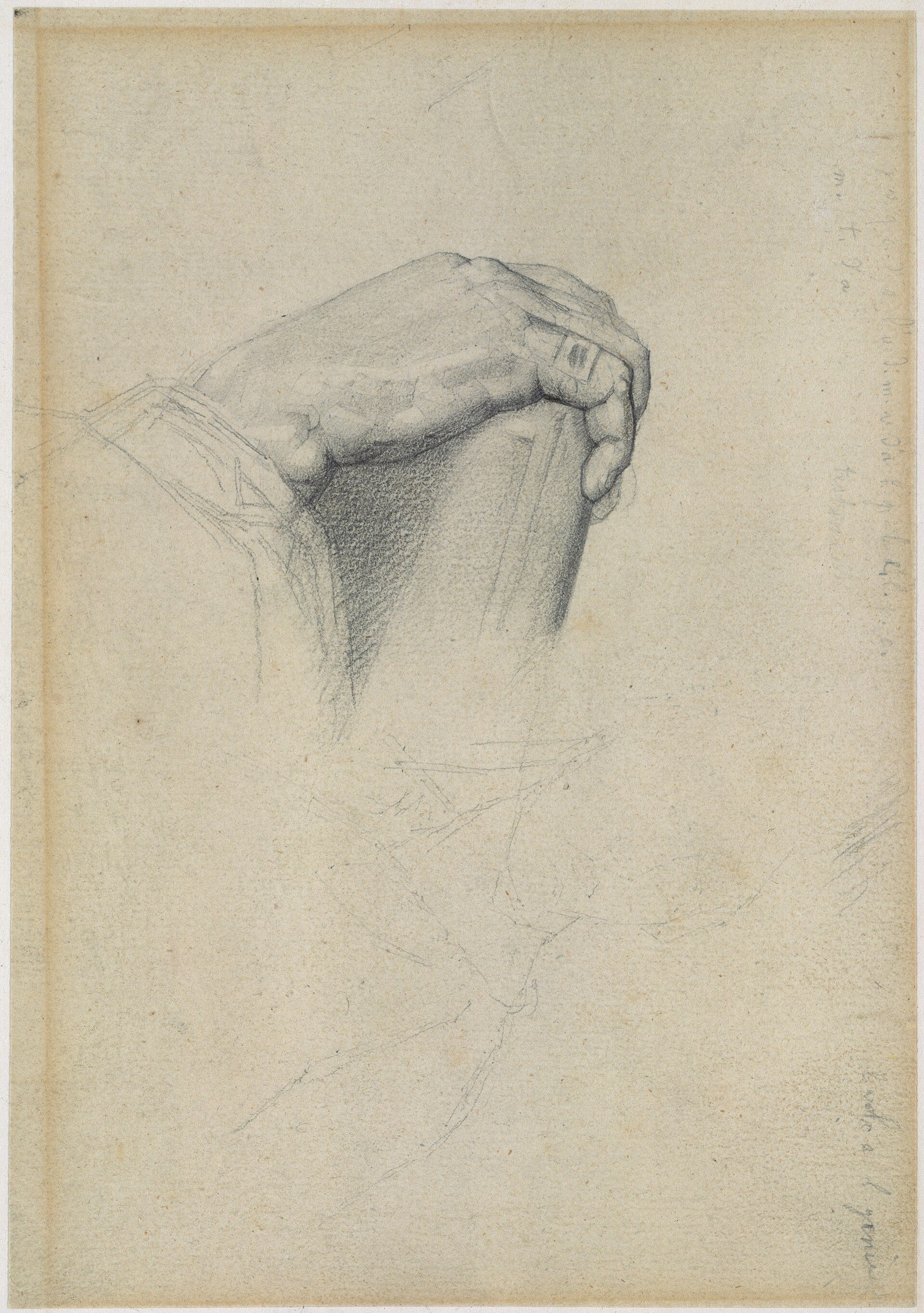
Its little finger circled by a ring, a man's hand drawn in pencil holds the edge of a thick book. At the bottom right, a teenager has written three words in French, "voila le génie," there is the genius. The hand belonged to a painter gone for over two centuries, and the boy who drew it was not even looking at that painter's own picture.