Hands in Art: 12 Famous Paintings to Know
The most famous hands in art carry the whole meaning of the picture. Michelangelo let two fingers nearly touch and invented the most quoted gesture in painting, Caravaggio pushed a finger into a wound, and Durer turned a pair of praying hands into an icon. Here are twelve to know, and where to see them.
Painters have always said that hands are the hardest thing to get right, second only to faces. A hand can pray, accuse, doubt, bless or simply rest. In the twelve paintings below, the hands are not a detail. They are the point.
Use this as a quick tour:
The gestures: Michelangelo and Caravaggio, whose hands changed art.
The studies: Durer, who drew hands with almost frightening care.
The quiet ones: Rembrandt and van Eyck, where a touch says everything.
Where to see them: a museum list at the end, grouped by city.
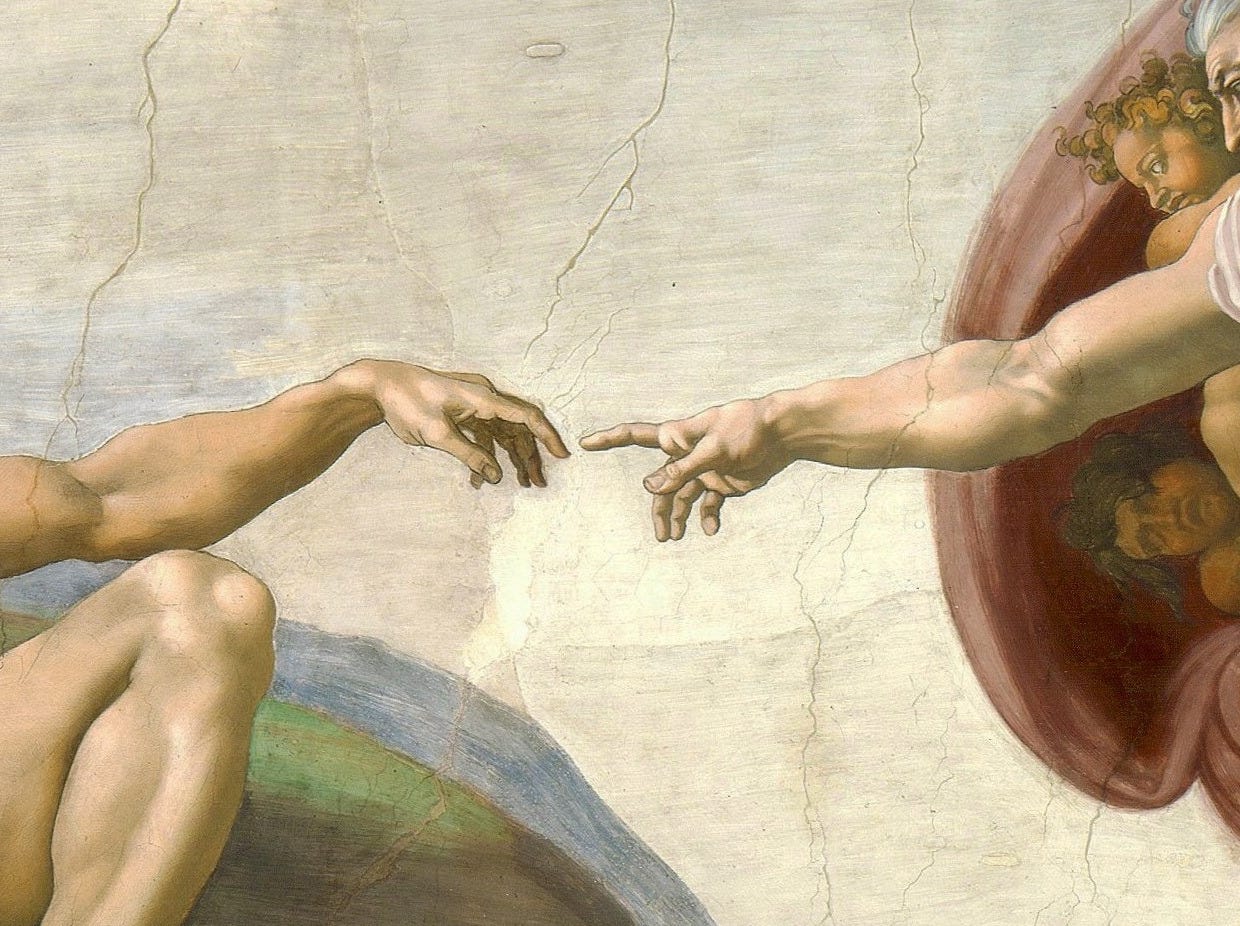
Michelangelo, The Creation of Adam
Michelangelo painted The Creation of Adam on the Sistine Chapel ceiling around 1512, and its two almost touching fingers are the most famous hands in the world. God reaches out, Adam barely lifts his.
The gap between the fingertips is the whole idea. Life has not quite passed yet. Michelangelo froze the instant before the spark, and centuries of viewers have leaned in to close it.
It is in the Sistine Chapel in the Vatican. Some scholars even see the shape around God as a cross section of the human brain, as if creation is really about the mind.
Albrecht Durer, Praying Hands
Albrecht Durer drew Praying Hands in 1508, two slender hands pressed together, rendered in fine ink on blue paper. It was only a study for a large altarpiece that later burned.
The altarpiece is long gone, but this quick preparatory drawing became one of the most reproduced images in the world, printed on countless cards, walls and gravestones.
It is held at the Albertina in Vienna. Durer, the great German master of line, put more feeling into a pair of hands than most painters manage in a whole self portrait.
Caravaggio, The Incredulity of Saint Thomas
Caravaggio painted The Incredulity of Saint Thomas around 1602, and it is almost unbearable to look at. Thomas, who would not believe Christ had risen, pushes his finger right into the wound in his side.
Caravaggio gives you the exact moment of proof through touch, three astonished men crowding in, the finger disappearing into the flesh. His harsh tenebrism makes the hands leap out of the dark.
It hangs in the Sanssouci collection near Berlin. No painting has ever made doubt so physical, faith settled not by a vision but by a hand.
Rembrandt, The Jewish Bride
Rembrandt painted the couple known as The Jewish Bride around 1667, and its power is all in the hands. The man gently lays his hand on the woman’s breast, and she rests her own hand lightly on his.
Nobody is sure who they are, but the tenderness is unmistakable. The gesture is protective, not passionate, two people simply belonging to each other.
It hangs in the Rijksmuseum in Amsterdam. Van Gogh said he would give ten years of his life just to sit in front of it for a fortnight, and the hands are why.
Leonardo da Vinci, Mona Lisa
Everyone remembers the smile, but the Mona Lisa is also a lesson in hands. Around 1503 Leonardo folded her hands calmly one over the other, and that quiet gesture anchors the whole portrait.
The pose looks simple and became the model for portraits for centuries. Leonardo used soft sfumato to blur the edges of the fingers, so the hands seem to breathe rather than sit still.
It hangs in the Louvre in Paris. The composed hands give her the calm, self possessed air that, as much as the smile, has kept the world staring for five hundred years.
Jan van Eyck, The Arnolfini Portrait
Jan van Eyck painted the Arnolfini Portrait in 1434, and at its centre a man and woman join hands. He raises his other hand as if taking an oath.
For a long time it was read as a wedding, the joined hands sealing a vow, though scholars now argue about exactly what is happening. Either way, the clasped hands are the heart of it.
It hangs in the National Gallery in London. In the mirror on the back wall you can even see two more figures entering, witnesses to whatever the hands are promising.
Grant Wood, American Gothic
Grant Wood painted American Gothic in 1930, and one hand holds the whole picture together, the farmer’s fist gripping a three pronged pitchfork straight at the viewer.
The pitchfork is a warning and a badge of hard work, its shape echoed in the seams of his overalls and the window behind. It makes the couple look rooted and unmovable.
It hangs at the Art Institute of Chicago. Wood used his sister and his dentist as models, and that clenched hand on the fork turned a small portrait into an American icon.
Egon Schiele, Self-Portrait
Egon Schiele filled his self portraits, painted in the years around 1910, with tense, splayed, twisting hands. Fingers spread like claws or press against his own thin body.
For Schiele the hand was pure emotion, awkward, nervous, almost painful. He used his own body as raw material, and the hands make his portraits vibrate with anxiety.
His work is held at the Leopold Museum in Vienna and beyond. Dead at just twenty eight, Schiele left behind some of the most expressive hands in modern art.
Georges de la Tour, The Fortune Teller
Georges de la Tour painted The Fortune Teller around 1630, and it is a comedy of hands. An old woman reads a young man’s palm while, all around him, other hands quietly rob him.
One girl slides a coin from his pocket, another slips a medal from his chain. Your eye has to hunt for the thieving fingers, exactly as the victim fails to. It is a masterclass in chiaroscuro storytelling.
It hangs at the Metropolitan Museum in New York. Every hand in the picture is busy, and every one of them is lying.
Rembrandt, The Anatomy Lesson of Dr Tulp
Rembrandt painted The Anatomy Lesson of Dr Nicolaes Tulp in 1632, and its subject is, of all things, a hand. Dr Tulp lifts the exposed tendons of a corpse’s forearm with a pair of forceps.
To show how it works, Tulp raises his own left hand, mirroring the muscles he is pulling in the dead arm. The living hand explains the dead one.
It hangs at the Mauritshuis in The Hague. Rembrandt was only in his twenties, and he turned a dissection into a gripping drama about the machinery of the human hand.
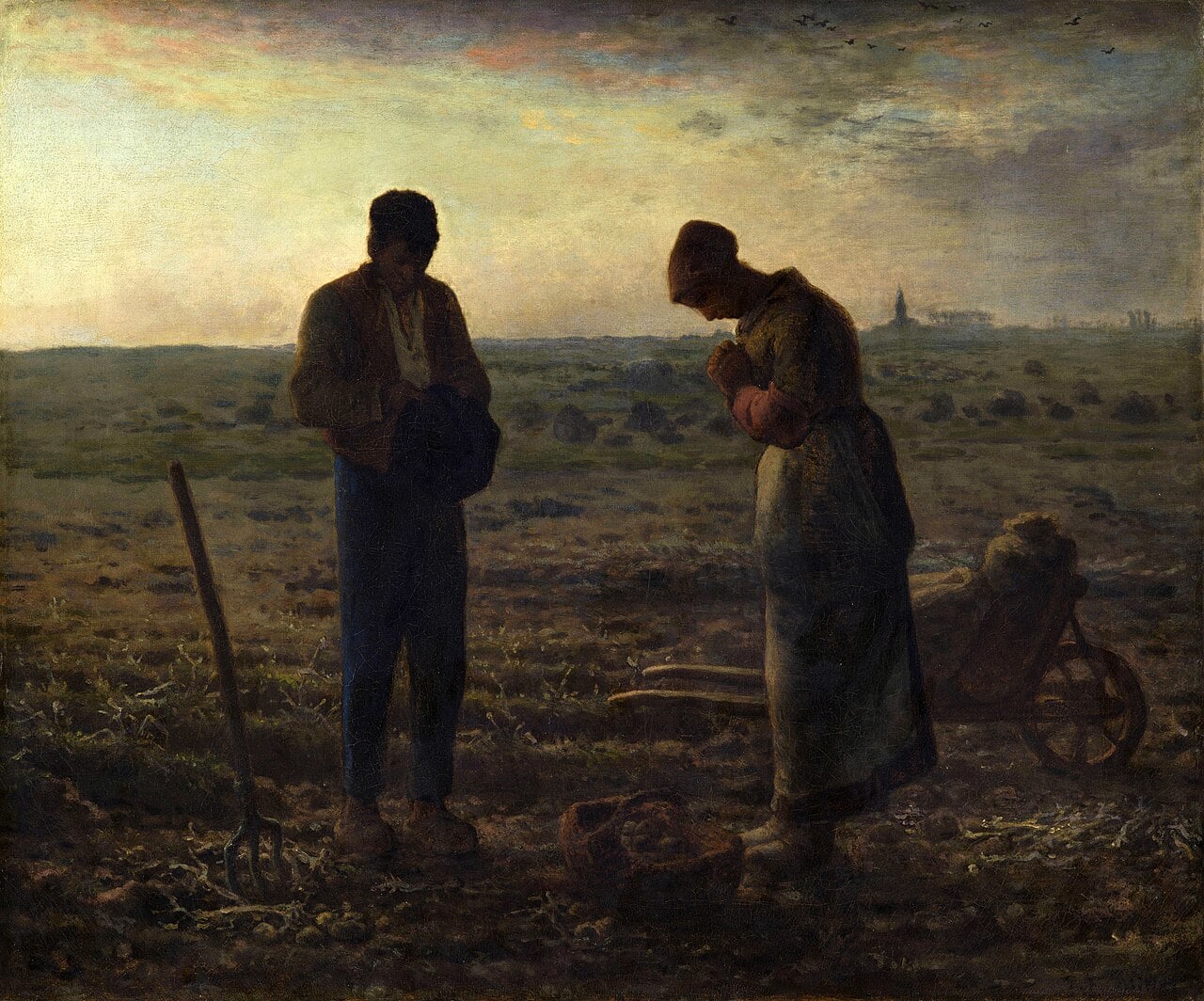
Jean-Francois Millet, The Angelus
Jean-Francois Millet painted The Angelus around 1859, two peasants pausing in a field at dusk as a distant bell calls them to prayer. Their hands are clasped, heads bowed.
The whole painting turns on those two pairs of praying hands. Millet gave simple field workers the dignity of a religious scene, labour and faith folded together.
It hangs at the Musee d’Orsay in Paris. Salvador Dali was obsessed with it, convinced the basket between them hid a small coffin, a story that says more about Dali than about Millet.
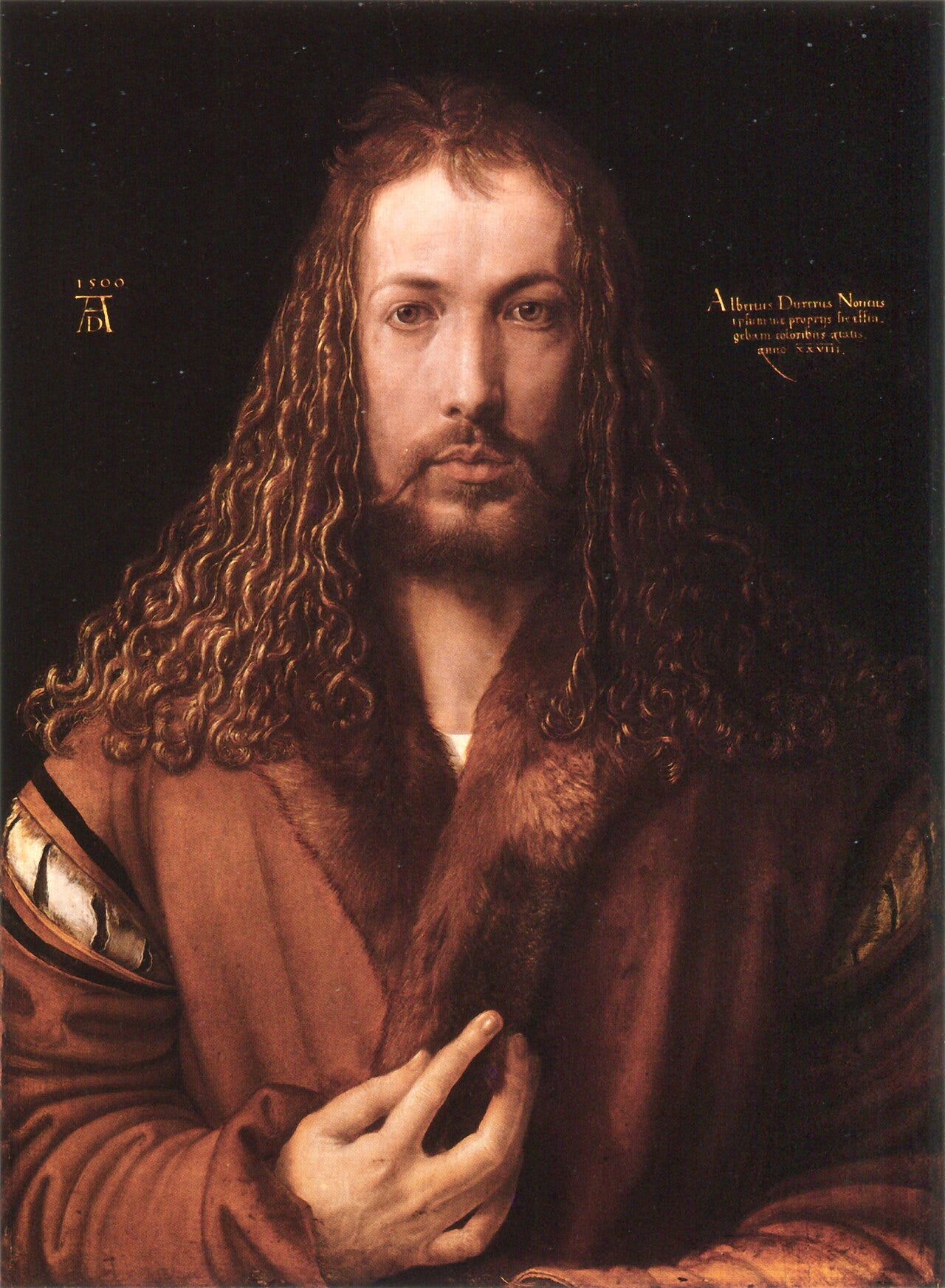
Albrecht Durer, Self-Portrait at Twenty Eight
Durer returns with his famous frontal self portrait of 1500, posed like an image of Christ, and one hand rises to his fur collar with strange delicacy.
That raised hand is the hand of the maker. Durer signed and dated the painting proudly, presenting himself as a creator, and the elegant gesture is part of the claim.
It hangs at the Alte Pinakothek in Munich. In an age when painters were treated as craftsmen, Durer used his own careful hand to argue that the artist was something higher.
Questions people ask about hands in art
What is the most famous painting of hands? Michelangelo The Creation of Adam, with its two almost touching fingers, and Durer Praying Hands are the two best known.
Why are hands so hard to paint? They have complex bones and joints, endless poses and huge expressive power, so a badly painted hand ruins a picture faster than almost anything else.
What does the gesture in The Incredulity of Saint Thomas mean? Thomas doubts that Christ has risen, so he pushes his finger into the wound. It is faith proved through touch.
Why are the hands important in The Jewish Bride? The gentle way the couple rest their hands on each other turns the painting into an image of tenderness and belonging.
What are the hands doing in The Fortune Teller? While one hand reads the young man’s palm, other hands quietly pick his pocket and steal his jewellery.
Where to see them
Louvre, Paris: Leonardo Mona Lisa.
Rijksmuseum, Amsterdam: Rembrandt The Jewish Bride.
National Gallery, London: Jan van Eyck The Arnolfini Portrait.
Art Institute of Chicago: Grant Wood American Gothic.
Sistine Chapel, Vatican: Michelangelo The Creation of Adam.
Keep exploring
If the gestures pulled you in, three more paths from here. Look at the secret Leonardo hid in the hands of the apostles in the secret of the Last Supper, learn to read the hidden clues in famous canvases in seven secrets hidden in famous paintings, or start with the basics of portrait painting.
One last thing. A face tells you who someone is, but a hand tells you what they are doing, and why. Michelangelo knew it, Caravaggio knew it, Rembrandt knew it. Watch the hands, and the whole painting opens up.