
In the 1920s Harlem had poets, jazz clubs and magazines of its own, but almost no gallery would show a Black painter. So the pictures went wherever a door opened: onto a magazine cover, into a prize exhibition, across the walls of a library or a hospital lobby. Getting them made was often a fight, and a few were nearly lost.
Cool Stories About Art is a newsletter to learn art the fun way.
Join 200,000+ readers and get:
10 new art stories / month
The entire archive of content (1,000+ articles)
Comment, ask questions, and chat with other readers
What Harlem Asked of Its Painters
The Harlem Renaissance was the flowering of Black American culture between about 1918 and 1937, centered on a single Manhattan neighborhood. Its writers asked painters to show Black Americans as modern people, at ease in the city and proud of an African past.
What the painters lacked was money. With few galleries willing to show them, they lived on prizes, fellowships and, after 1933, federal relief programs. That money often paid for a stay in Paris, where academies took Black students and modern art was already borrowing from African sculpture.
Every work here belongs to that generation, even when it was painted far from Harlem or after the movement had faded.
One name keeps coming back: the Harmon Foundation, a private New York charity whose prizes, awarded from 1926 to 1933, launched careers.
12. Aaron Douglas, Cover of Fire!! (1926)
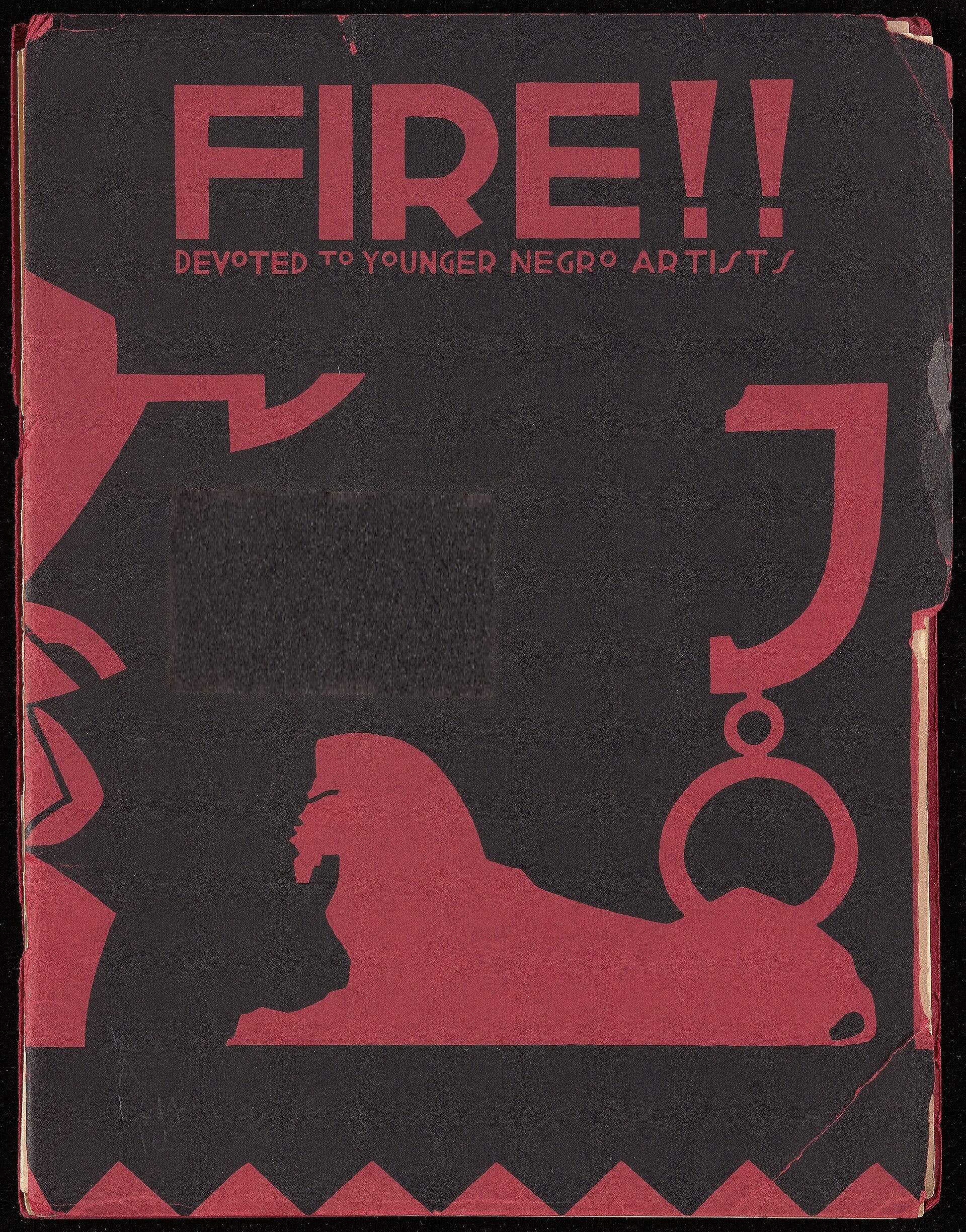
On the red cover, a face seen in profile is made of a few flat black shapes, like a paper cutout. Above it the title shouts in black capitals, FIRE!!, and underneath runs a promise: Devoted to Younger Negro Artists. Aaron Douglas drew it in 1926 for a magazine that lasted exactly one issue.
Seven young writers and artists from Harlem launched it, among them Langston Hughes, Zora Neale Hurston, the editor Wallace Thurman and Douglas himself. They wanted a magazine of their own, free of the respectability their elders expected of them.
The cover was their declaration. Douglas used no shading and no modeling, only a silhouette in which an African face shrinks to a handful of hard edges, with the clean lines of a modern poster. He would carry the same manner onto much larger surfaces in the years that followed.
The money, though, never added up. Each of the seven was supposed to put in fifty dollars, and only three paid. Printing cost almost a thousand dollars, and the reviews hurt more than the bill. The critic of the Baltimore Afro-American opened his piece with "I have just tossed the first issue of Fire into the fire."
Then a real fire finished the joke. Most of the unsold copies, stored in a basement, burned. Hughes called it "irony of ironies." Thurman, the only one of the seven with a steady job, spent three or four years handing part of his wages to the printer.
At a Glance
Artist: Aaron Douglas (1899 to 1979)
Made: 1926 (the only issue, November 1926)
Medium: Printed cover, red and black, on a 48-page magazine
Size: 28 cm high (about 11 in)
Where to see it: Beinecke Rare Book and Manuscript Library, Yale University, New Haven, and the Schomburg Center for Research in Black Culture, New York
11. Charles Alston, Magic in Medicine (1936 to 1940)
Two tall arched canvases face each other across the lobby of Harlem Hospital. On the left, healing as it was practiced in traditional Africa, and on the right, a modern operating room. In 1936, before any paint reached the wall, the hospital's white administration rejected the designs of Charles Alston, for a reason that fit in a single phrase: the murals contained "too much Negro subject matter."